
BYD(01211)

Search documents
比亚迪1月30日获融资买入2.54亿元,融资余额129.93亿元
Xin Lang Cai Jing· 2026-02-02 01:28
Group 1 - BYD's stock price decreased by 1.54% on January 30, with a trading volume of 3 billion CNY [1] - The financing buy amount for BYD on the same day was 254 million CNY, while the financing repayment was 309 million CNY, resulting in a net financing outflow of 55.02 million CNY [1] - As of January 30, the total financing and securities lending balance for BYD was 13.048 billion CNY, with the financing balance at 12.993 billion CNY, accounting for 2.63% of the circulating market value, which is below the 50th percentile level over the past year [1] Group 2 - As of September 30, BYD had 642,600 shareholders, an increase of 98.37% compared to the previous period, with an average of 5,427 circulating shares per person, up by 51.21% [2] - For the period from January to September 2025, BYD reported operating revenue of 566.266 billion CNY, a year-on-year increase of 12.75%, while the net profit attributable to shareholders decreased by 7.55% to 23.333 billion CNY [2] Group 3 - BYD has distributed a total of 27.859 billion CNY in dividends since its A-share listing, with 24.414 billion CNY distributed in the last three years [3] - As of September 30, 2025, Hong Kong Central Clearing Limited was the fourth largest circulating shareholder of BYD, holding 263 million shares, an increase of 137 million shares from the previous period [3] - Huatai-PB CSI 300 ETF ranked as the eighth largest circulating shareholder with 46.304 million shares, an increase of 30.2458 million shares from the previous period [3]

比亚迪1亿砸完,这家公司不到一周就递表IPO!
Xin Lang Cai Jing· 2026-02-02 01:05
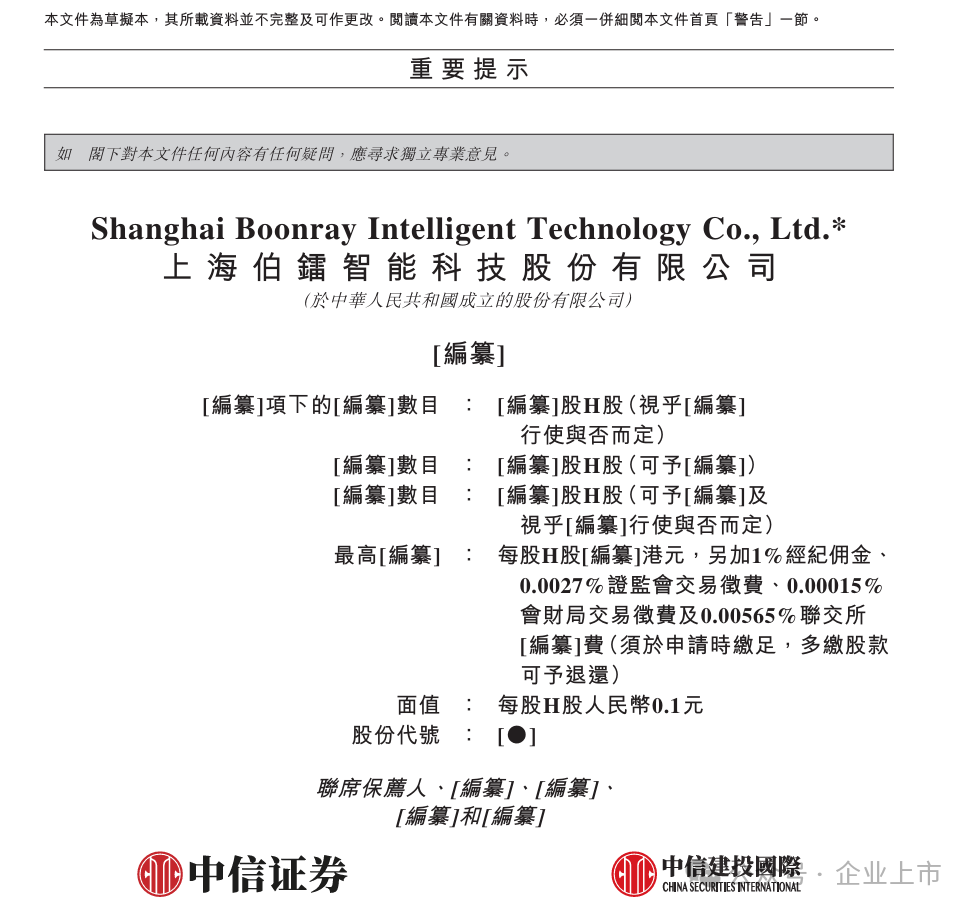
Group 1 - The core point of the article is that Shanghai Borai Intelligent Technology Co., Ltd. submitted its IPO application to the Hong Kong Stock Exchange just six days after receiving a strategic investment of 100 million RMB from BYD Company Limited, which significantly enhances its market appeal and valuation [1][5][27]. Group 2 - The investment from BYD is crucial as it serves as a strong endorsement of Borai Intelligent's technology and future prospects, boosting market confidence [8][43]. - The strategic collaboration potential between BYD and Borai Intelligent in areas such as technology research and supply chain management is significant [8][43]. - The timing of the IPO application is strategic, leveraging the heightened market attention following the investment to maximize valuation [9][62]. Group 3 - Borai Intelligent focuses on the research and sales of fully electric, autonomous mining trucks, having been established in Shanghai in 2015 [10][45]. - The company is recognized as the largest provider of fully electric autonomous mining trucks globally based on projected shipment volume and revenue for 2024 [11][46]. - It ranks second in the Chinese market for autonomous mining truck solutions [12][48]. Group 4 - The company's revenue model consists of three main segments: selling autonomous mining trucks, providing comprehensive intelligent solutions for mining operations, and offering unmanned transportation services using its own fleet [16][51][53]. - The company aims to help mining companies adopt more environmentally friendly, safer, and efficient transportation solutions [19][54]. Group 5 - The financial performance shows rapid revenue growth, with approximately 69.57 million RMB in 2023, projected to reach about 171 million RMB in 2024, and 315 million RMB in the first nine months of 2025, which is over eight times the revenue from the same period the previous year [20][21][22]. - Despite the revenue growth, the company is still operating at a loss, with losses of 32.48 million RMB in 2023, 60.99 million RMB in 2024, and 58.67 million RMB in the first nine months of 2025, primarily due to high R&D expenses and rapid business expansion [23][24][58]. - A significant risk is the concentration of revenue, with the top five customers contributing 97.7% of total revenue, indicating a strong dependency on a few major clients [25][60]. Group 6 - The urgency for the IPO is driven by the need for capital to accelerate development in a rapidly growing industry, requiring substantial investment in R&D and capacity expansion [26][62]. - The recent investment from BYD has increased market interest, making this an opportune moment to file for the IPO to maximize attention and valuation [27][62]. - The company has undergone multiple rounds of financing since its inception, and the IPO represents a critical exit opportunity for early investors [27][62].

广汽集团、比亚迪、理想汽车等多家车企发布1月产销或交付快报
Xin Lang Cai Jing· 2026-02-02 01:04
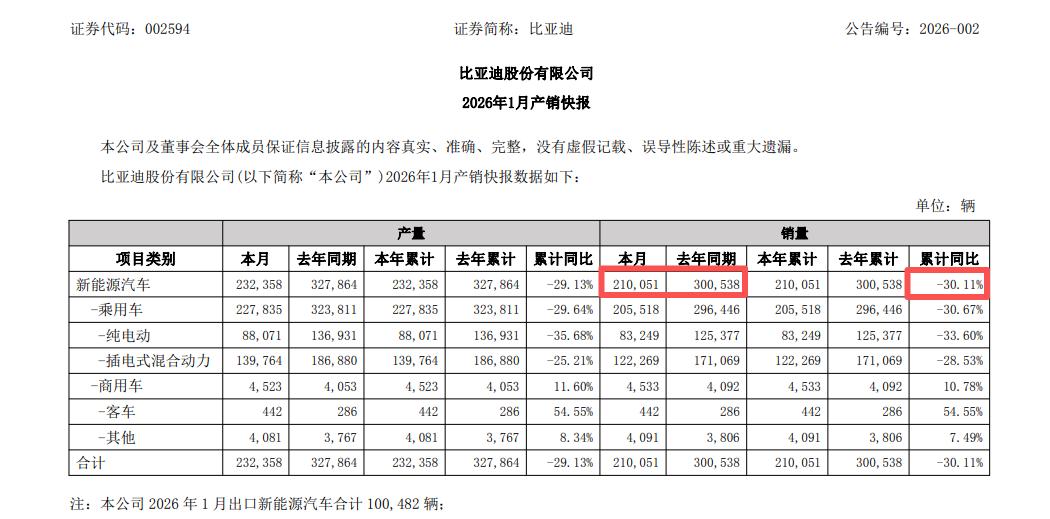
Group 1: GAC Group Performance - GAC Group reported January 2026 sales of 116,600 vehicles, an increase of 18.47% year-on-year [1][5] - The production for January was 110,800 vehicles, a decrease of 4.77% year-on-year [1][5] - New energy vehicles (NEVs) showed strong performance with a production of 23,700 units, up 42.82% year-on-year, and sales of 26,000 units, a significant increase of 162.90% [1][5] - GAC Aion's sales reached 21,600 units, a year-on-year increase of 171.63% [1][5] - GAC Honda's sales were 4,558 units, down 69.86% year-on-year, while GAC Toyota's sales increased by 9.82% to 62,600 units [1][5] - Wuyang-Honda motorcycles sold 45,200 units, up 15.00% year-on-year [1][5] Group 2: BYD Performance - BYD reported January 2026 sales of 210,100 NEVs, a decrease of 30.11% year-on-year [2][6] - The production for January was 232,400 NEVs, down 29.13% year-on-year [2][6] - Sales of pure electric passenger vehicles were 83,200 units, a decline of 33.60% year-on-year, while plug-in hybrid passenger vehicles sold 122,300 units, down 28.53% [2][6] - The commercial vehicle segment performed well with production and sales of 4,523 and 4,533 units, respectively, representing year-on-year growth of 11.60% and 10.78% [2][6] - NEV exports reached 100,500 units, and the total installed capacity of power batteries and energy storage batteries was approximately 20.187 GWh [2][6] Group 3: Li Auto Performance - Li Auto delivered 27,700 vehicles in January 2026, with a cumulative delivery of 1,567,900 vehicles as of January 31, 2026 [3][7] - The company launched OTA 8.2 system update in January, featuring 40 new functions and 25 experience optimizations [3][7] - Li Auto has 547 retail centers covering 159 cities and 547 after-sales service centers across 221 cities, with 3,966 charging stations and 21,900 charging piles in operation [3][7]


汽车早报|多家车企公布1月销量 宝马大中华区换帅
Xin Lang Cai Jing· 2026-02-02 00:40
Group 1: Automotive Industry Overview - In January 2026, the Vehicle Inventory Alert Index for Chinese automotive dealers was reported at 59.4%, a year-on-year decrease of 2.9 percentage points and a month-on-month increase of 1.7 percentage points, indicating inventory levels above the threshold [1] - Various automotive companies reported their January delivery and sales figures, showcasing a mixed performance across the industry [2][3][4][5][6][7][8][9][10][11][12][13][14][15][16][17][18][19] Group 2: Company-Specific Performance - Xiaomi delivered over 39,000 vehicles in January 2026 [2] - Hongmeng Zhixing reported a total delivery of 57,915 vehicles in January, marking a year-on-year increase of 65.6% [3] - Aion (昊铂埃安) achieved sales of 23,591 vehicles in January, reflecting a growth of 63.9% [16] - NIO delivered 27,182 vehicles in January, up 96.1% year-on-year [7] - Li Auto reported deliveries of 27,668 vehicles in January [8] - Leap Motor achieved total deliveries of 32,059 vehicles, a year-on-year increase of 27% [9] - BYD's January sales of new energy vehicles were 210,051, a decline of 30.11% year-on-year [6] - Great Wall Motors sold 90,312 vehicles in January, an increase of 11.59% [11] - GAC Group reported sales of 116,622 vehicles in January, up 18.47% year-on-year [13] - Geely's total sales for January were 270,200 units, showing a growth of approximately 1% [13] - Chery's total sales across five brands in January decreased by 10.7% year-on-year [13] - SAIC-GM delivered approximately 51,005 vehicles in January, with a year-on-year increase of 8.2% [15] - A total of 40,016 vehicles were delivered by AITO in January, representing an 83% increase year-on-year [4] - Seres reported sales of 43,034 new energy vehicles in January, a significant increase of 140.33% [5] - GAC Trumpchi's terminal sales reached 26,937 vehicles in January, up 2.06% [14] - BAIC Blue Valley's subsidiary reported sales of 8,073 vehicles, an increase of 11.83% [19] Group 3: Leadership Changes - BMW Group announced that Christian Ach will succeed Sean Green as the President and CEO of BMW Group Greater China, effective April 1 [20]




2月2日投资早报|锋龙股份核查结束股票复牌,比亚迪1月新能源汽车销量21万辆同比下降30.11%,今日一只新股申购
Xin Lang Cai Jing· 2026-02-02 00:36
Market Overview - On January 30, 2026, the A-share market showed mixed results with the Shanghai Composite Index closing at 4117.95 points, down 0.96%, while the Shenzhen Component Index fell 0.66% to 14205.89 points, and the ChiNext Index rose 1.27% to 3346.36 points. Over 2800 stocks declined, with total trading volume in the Shanghai and Shenzhen markets at 2.84 trillion yuan, a decrease of 390 billion yuan from the previous trading day [1] - The Hong Kong stock market experienced a downward trend, with all three major indices dropping over 2%. The Hang Seng Index fell by 2.08% or 580.98 points to 27387.11 points, with a total trading volume of 301.61 billion HKD. The Hang Seng China Enterprises Index decreased by 2.47% to 9317.09 points, and the Hang Seng Tech Index dropped by 2.1% to 5718.18 points. For the month, the Hang Seng Index increased by 6.85% [1] - U.S. stock markets opened lower and closed down across all three major indices on January 30, 2026. The Dow Jones Industrial Average fell by 0.36% to 48892.47 points, the S&P 500 dropped by 0.43% to 6939.03 points, marking its third consecutive day of decline, and the Nasdaq Composite Index decreased by 0.94% to 23461.82 points, with all indices experiencing intraday declines of over 1% [1] New Stock Offerings - On January 30, 2026, there was one new stock available for subscription, with no new stocks listed [2] - The new stock, Yisiwei, listed on the Sci-Tech Innovation Board under the code 688816, has an issuance price of 55.95 yuan per share and a price-to-earnings ratio of 90.39 times. The company specializes in industrial intelligent vision, integrating design, research and development, manufacturing, and application of machine vision products. It has established a comprehensive system of industrial vision equipment for the automotive manufacturing sector, successfully breaking the long-standing monopoly of foreign brands in this field [3] Important News - On February 1, 2026, the State Taxation Administration issued an announcement clarifying the standards for the value-added tax (VAT) threshold and other management matters. The announcement specifies that the threshold for individual VAT taxpayers will increase from 500 yuan to 1000 yuan per transaction. Additionally, certain specific situations will now be subject to a monthly sales threshold of 100,000 yuan instead of the per-transaction threshold [4] - The Guotou Silver LOF fund announced that it will suspend trading from 10:30 AM on February 2, 2026, with resumption of trading following the Shenzhen Stock Exchange's regulations. If the market price does not effectively decrease, the fund reserves the right to apply for temporary suspension of trading to warn the market of risks [4]
智通港股沽空统计|2月2日
智通财经网· 2026-02-02 00:23
Group 1 - The article highlights the top short-selling ratios for various companies, with JD Health-R, Anta Sports-R, and Lenovo Group-R leading the list at 100.00%, 89.98%, and 89.87% respectively [1][2] - The top three companies by short-selling amount are CSPC Pharmaceutical Group at 1.268 billion, Zijin Mining Group at 1.031 billion, and Xiaomi Group-W at 1.014 billion [1][2] - The highest deviation values in short-selling are recorded for Kuaishou-WR at 36.02%, Xiaomi Group-WR at 30.00%, and Heptagon Pharmaceuticals-B at 26.77% [1][2] Group 2 - The top ten short-selling ratios include JD Health-R at 100.00%, Anta Sports-R at 89.98%, and Lenovo Group-R at 89.87%, with Kuaishou-WR and Xiaomi Group-WR also featuring prominently [2] - The top ten short-selling amounts show CSPC Pharmaceutical Group leading with 1.268 billion, followed by Zijin Mining Group and Xiaomi Group-W [2] - The top ten deviation values indicate significant short-selling activity, particularly for Kuaishou-WR and Xiaomi Group-WR, suggesting potential volatility [2]


“新王”诞生,比亚迪大跌,雷军大动作
3 6 Ke· 2026-02-02 00:16
Core Insights - The competitive landscape in the automotive industry has shifted in January, with Xiaomi emerging as the new leader among new energy vehicle manufacturers, surpassing Leap Motor for the first time [4][15] - BYD reported a significant decline in domestic sales, with January sales reaching 210,510 units, a year-on-year decrease of 30.11% and a month-on-month decrease of 50.04% [1][10] Sales Performance - BYD's January sales figures indicate a total of 210,510 units sold, down 30.11% year-on-year and 50.04% month-on-month [1][10] - In contrast, Xiaomi's deliveries exceeded 39,000 units, marking a significant lead over Leap Motor, which delivered approximately 32,059 units [4][15] - Other companies like Seres, NIO, and Lantu reported year-on-year growth in January deliveries of 104.85%, 96.08%, and 31.29% respectively [5] Market Dynamics - The reduction of the new energy vehicle purchase tax by half starting January 1 may have impacted BYD's sales negatively [2][11] - Unlike BYD, which has fully embraced new energy vehicles and ceased production of fuel vehicles, other brands like Geely continue to balance both fuel and electric vehicle sales, achieving growth in both segments [11][12] - Geely's January sales included 124,252 units of new energy vehicles and 145,900 units of fuel vehicles, both showing year-on-year growth [12] Financial Strategies - Several automakers, including Xiaomi and NIO, have introduced long-term low-interest financing options to stimulate sales amid declining subsidies [24] - Xiaomi's financing plan offers a starting down payment of 99,900 yuan with monthly payments as low as 1,931 yuan, aiming to attract more customers [21][24] - The introduction of these financing options is seen as a strategic move to mitigate the impact of subsidy reductions and enhance sales performance [24]


金融时报:福特与小米讨论合作 建合资公司在美国生产电动汽车
Feng Huang Wang· 2026-02-02 00:10
Group 1 - Ford Motor Company is in discussions with Xiaomi to establish a partnership that could facilitate Xiaomi's entry into the U.S. market [1] - The discussions are in preliminary stages, with Ford exploring the possibility of forming a joint venture with Xiaomi to manufacture electric vehicles in the U.S. [1] - Ford is also in talks with BYD and other Chinese automakers regarding potential collaborations in the U.S. market [1] Group 2 - Ford has publicly denied the report, stating that it is "completely untrue and has no factual basis" [1] - As of the report's publication, Xiaomi has not responded to requests for comment, and BYD declined to comment [1]
两大牛股今日复牌……盘前重要信息一览
证券时报· 2026-02-02 00:10
Key Points - The core viewpoint of the article highlights significant corporate announcements and market movements, including stock resumption and performance forecasts for various companies [2][5][8]. Group 1: Corporate Announcements - Fenglong Co., Ltd. announced that Yubiqi committed not to inject assets within 36 months, and the stock resumed trading after a suspension [2][9]. - Jiamei Packaging also completed its suspension review and resumed trading [2][10]. - Zhongji Xuchuang projected a net profit increase of 89.50% to 128.17% for 2025 [2][11]. - Xinyi Technology expects a net profit increase of 231% to 249% for 2025, with Q4 performance exceeding expectations [2][12]. - Hanwujing announced an expected net profit of 1.85 billion to 2.15 billion yuan for 2025, marking a turnaround from losses [2][13]. - Wentai Technology anticipates a net loss of 9 billion to 13.5 billion yuan for 2025 [2][14]. - Jerry Holdings signed a sales contract for gas turbine generator sets worth 1.265 billion yuan for a U.S. data center [2][16]. - The actual controller of Fushi Holdings, Chen Yongliang, has been detained [2][17]. Group 2: Automotive Industry Performance - BYD reported January sales of 210,051 new energy vehicles, a year-on-year decrease of 30.11% [2][18]. - Silverson announced January sales of 43,000 new energy vehicles, a year-on-year increase of 140.33% [2][19]. - Xiaomi Auto reported over 39,000 deliveries in January [2][20]. - NIO delivered 27,182 new vehicles in January, a year-on-year increase of 96.1% [2][21]. - XPeng delivered 20,011 new vehicles in January [2][22]. - Li Auto delivered 27,668 new vehicles in January [2][23]. - Leap Motor achieved total deliveries of 32,059 vehicles in January, a year-on-year increase of 27% [2][24].


展望二〇二六驶向汽车产业提质增效新征程
Jing Ji Ri Bao· 2026-02-02 00:00
Core Insights - The Chinese automotive industry is transitioning from "scale expansion" to "quality improvement and efficiency enhancement" in 2026, driven by electrification and intelligent transformation [1] - The market competition is shifting from price wars to a "value war" focused on technological innovation, product iteration, quality enhancement, and experience optimization [1] Market Overview - In 2026, the total vehicle sales in China are projected to reach 34.75 million, a slight increase of 1%, while another estimate suggests around 28 million units, growing by 2% [2] - The industry is entering a phase characterized by high sales volume but low growth, with competition focusing on quality and efficiency rather than scale [2] - The central economic work conference emphasizes a policy direction of "stability while seeking progress" and "quality improvement and efficiency enhancement" for the automotive sector [2] New Energy Vehicles (NEVs) - NEVs are expected to achieve significant growth, with sales projected to exceed 20 million units in 2026, solidifying their market dominance [3] - Domestic automakers are leveraging technological innovation and supply chain advantages to produce competitively priced NEVs, shifting from policy-driven sales to market-driven sales as penetration rates exceed 50% [3] Competitive Landscape - Leading domestic automakers like Geely, BYD, and Chery are expected to benefit from product structure upgrades and global expansion, with Geely targeting over 4.5 million units in sales for 2026 [3] - New entrants in the automotive market are experiencing accelerated differentiation, with companies like Leap Motor and Xpeng doubling their sales, while others like NIO are focusing on operational efficiency [4] Internationalization and Global Expansion - The Chinese automotive industry is increasingly focusing on international markets, with exports projected to exceed 8 million units in 2026, primarily driven by NEVs [12] - Major automakers are establishing overseas production facilities to mitigate tariffs and trade barriers, enhancing local integration and responsiveness [13] Technological Innovation - Key areas of technological advancement include power batteries, chips, and software, with significant breakthroughs expected in 2026 [6] - The development of next-generation battery technologies, such as solid-state batteries, is progressing, with initial production expected to begin in 2026-2027 [6] - Intelligent driving technologies are advancing, with L2-level driving assistance features expected to penetrate over 70% of new passenger vehicles by 2026 [7] Emerging Trends - The automotive industry is evolving into a "super platform," integrating various technologies and services beyond traditional transportation [11] - Companies are exploring new growth avenues, including humanoid robots and low-altitude economy sectors, with significant developments anticipated in 2026 [9][10]


