NCI(01336)

Search documents
近16年寿险公司增资与分红盘点:有11家公司分红金额超过股东投入,有62家公司股东累计投入金额高达3423亿元,但从未分过红!
13个精算师· 2025-07-23 00:33
Core Viewpoint - The life insurance industry has experienced significant disparities in performance over the past 16 years, with only a small number of companies successfully distributing dividends while many others have struggled with capital increases and losses [1][2][3]. Summary by Sections Life Insurance Industry Dividend Situation - From 2009 to 2024, the life insurance industry has distributed a total of 850.6 billion yuan in dividends, with 180 instances of dividend distribution [7]. - The cumulative capital increase in the life insurance industry during the same period reached 587.7 billion yuan, with 366 instances of capital increase [9]. - The total profit accumulated by the industry over 16 years is 1,989.9 billion yuan, with a peak profit of 320.1 billion yuan in 2024 [10][13]. Company Performance Analysis - Out of 87 companies that have increased capital, only 27 have distributed dividends, indicating a significant divide in performance [14][15]. - The 27 companies that have distributed dividends have a cumulative profit of 2,046.4 billion yuan, while the remaining 62 companies have accumulated losses of 56.6 billion yuan [17]. - The 62 companies that have never distributed dividends accounted for 72% of the total capital increases, totaling 342.3 billion yuan [2][16]. Dividend Distribution Rankings - The top 10 companies in terms of cumulative dividends from 2009 to 2024 include Ping An Life, China Life, and Taiping Life, all of which have distributed dividends exceeding their cumulative shareholder investments [20]. - Notably, 11 companies, including the top three, have also surpassed their cumulative shareholder investments in terms of dividend payouts [20]. - In 2024, three companies made their first dividend distributions: Ping An Health, PICC Health, and Agricultural Bank Life [20].




解码险资“囤楼”经济学:收租型物业成抗周期利器
Zhong Guo Zheng Quan Bao· 2025-07-22 21:05
Core Viewpoint - The recent acquisition of the Yumi Community in Shanghai by AIA Insurance highlights the growing interest of insurance capital in real estate investments, driven by declining interest rates and a scarcity of quality assets [1][2]. Investment Trends - As of July 22, 2023, four insurance companies have announced 13 real estate investments totaling approximately 4.747 billion yuan, showing a significant increase compared to the same period last year [2]. - Insurance companies are increasingly focusing on rental-type properties such as shopping centers, office buildings, and long-term rental apartments to secure stable rental income [1][2]. Market Environment - The current low interest rate environment has made traditional fixed-income assets less appealing, prompting insurance capital to seek alternative investment channels [2][3]. - The yield on 10-year government bonds was reported at 1.69% as of July 22, 2023, while the maximum guaranteed interest rate for most ordinary life insurance products is around 2.5% [3]. Investment Strategies - Insurance capital is diversifying its investment methods, moving away from heavy investments in real estate stocks to include direct equity investments, private equity funds, and public REITs [3][4]. - The focus is on high-quality real estate in core urban areas, with expected net operating income rates around 4%, which can cover liability costs [4]. Research and Development Needs - The current allocation of insurance capital to real estate is relatively low, indicating potential for growth as the policy environment improves [6]. - There is a need for enhanced research and investment capabilities within insurance companies to effectively manage real estate investments, which involve complex market, financial, operational, and legal considerations [5][6]. Exit Strategies - The ability to exit real estate investments is a significant consideration for insurance capital, with public REITs and bulk transactions being the primary exit channels [7]. - Recommendations include easing the entry barriers for public REITs and promoting the development of asset securitization products to facilitate smoother exits [7].




银行股变奏,普涨格局下减持暗涌
2 1 Shi Ji Jing Ji Bao Dao· 2025-07-22 11:39
Core Viewpoint - The banking sector has shown strong performance in 2023, with the China Securities Banking Index rising by up to 25%, and many bank stocks reaching historical highs, prompting some shareholders to consider profit-taking through share reductions [1][2][3] Summary by Sections Bank Stock Performance - The banking sector's stocks have experienced significant gains, with 42 stocks achieving positive growth and 18 reaching new historical highs this year [1] - Qingdao Bank has seen the largest increase, with intraday gains exceeding 40% [1] Shareholder Reduction Announcements - Six banks have announced share reduction plans since May, coinciding with the peak prices of bank stocks [2][3] - China Life intends to reduce its stake in Hangzhou Bank by up to 50.79 million shares, representing 0.7% of the total shares, marking the end of its 16-year investment in the bank [2] - Other banks, such as Qilu Bank and Changsha Bank, have also announced share reductions, with Qilu Bank's major shareholder planning to sell up to 60.44 million shares [3][5] Reasons for Share Reductions - Market analysts suggest that the reductions are primarily due to shareholders seeking to lock in profits after substantial price increases [8][9] - Factors influencing these decisions include the need for asset reallocation, the high valuation of bank stocks, and potential concerns about future growth prospects [9] Ongoing Investment Interest - Despite the reductions, there is still strong interest in bank stocks, with eight banks receiving shareholder increases this year, indicating a net positive sentiment towards the sector [9][10] - Insurance companies have also been actively acquiring bank shares, further demonstrating ongoing confidence in the banking sector [10]


A股保险板块短线拉升,*ST天茂涨停,新华保险、中国人保、中国人寿、中国太保跟涨。
news flash· 2025-07-22 01:45
Group 1 - The A-share insurance sector experienced a short-term surge, with *ST Tianmao hitting the daily limit up [1] - Other major insurance companies such as Xinhua Insurance, China Pacific Insurance, China Life Insurance, and China Reinsurance also saw increases in their stock prices [1]


十家险企赔付700亿 重疾保障缺口大
Sou Hu Cai Jing· 2025-07-21 23:10
Core Insights - The insurance industry is experiencing a significant increase in claim payouts, driven by rising demand for critical illness and medical insurance, with a notable protection gap for consumers [2][9] - Technological advancements are enhancing efficiency in claims processing, with companies implementing digital solutions to streamline services [5] - The focus on improving service quality and inclusivity is evident, as companies are reaching out to underserved populations and enhancing their service offerings [7][8] Claims Payout Overview - As of July 15, 2025, ten major insurance companies reported a total claims payout exceeding 700 billion yuan, with China Life leading at 302 billion yuan and a payout rate of 99.6% [3] - Other notable companies include Ping An Life with 206.2 billion yuan, Taibao Life with 99.2 billion yuan, and Xinhua Insurance with 73 billion yuan [3] Industry Growth and Efficiency - The insurance sector's total claims expenditure grew to 1.17 trillion yuan in the first five months of 2025, marking a year-on-year increase of 9.91%, with life insurance claims at 801.9 billion yuan [4] - Companies like Zhongyou Insurance and ICBC-AXA Life reported significant year-on-year increases in claims payouts, with Zhongyou's claims exceeding 11 billion yuan, up over 50% [4] Technological Advancements - Companies are leveraging technology to improve claims processing efficiency, with China Life's integration of medical insurance data leading to a 25% reduction in manual processing for certain claims [5] - Xinhua Insurance has reduced claims processing time to an average of 0.72 days, while Fude Life has achieved a claims payment cycle of 1.16 days [5] Service Quality and Inclusivity - Insurance companies are enhancing their service offerings to better serve vulnerable populations, with China Life providing services to nearly 2.24 million rural residents and over 190,000 elderly clients [7] - The introduction of initiatives like "one-day critical illness claims" by China Life aims to expedite the claims process for eligible cases [7] Regulatory Developments - Recent regulatory frameworks aim to strengthen the inclusive insurance system over the next five years, focusing on affordable products and improved claims services [8] - The synchronization of basic medical insurance and commercial health insurance drug lists is expected to enhance coverage and accessibility for high-cost treatments [10] Key Risk Areas - The analysis indicates a significant gap in critical illness insurance coverage, with average treatment costs for severe diseases far exceeding current payout levels [9] - The need for improved product design and service integration is emphasized as the industry transitions towards comprehensive health management solutions [10]



中证港股通非银行金融主题指数上涨1.19%,前十大权重包含中国平安等
Jin Rong Jie· 2025-07-21 12:02
Group 1 - The core index, the CSI Hong Kong Stock Connect Non-Bank Financial Theme Index, rose by 1.19% to 3984.14 points, with a trading volume of 22.457 billion yuan [1] - Over the past month, the index has increased by 11.28%, by 36.78% over the last three months, and by 35.47% year-to-date [1] - The index consists of up to 50 listed companies that meet the non-bank financial theme criteria from the Hong Kong Stock Connect securities, reflecting the overall performance of these companies [1] Group 2 - The top ten weighted companies in the index include China Ping An (15.24%), Hong Kong Exchanges (13.97%), AIA Group (13.55%), China Life (8.76%), China Pacific Insurance (6.94%), China Property & Casualty Insurance (6.21%), New China Life (3.96%), People's Insurance Group of China (3.73%), CITIC Securities (2.9%), and Shandong Hi-Speed (2.46%) [1] - The index is composed entirely of financial sector companies, with a 100% allocation to this industry [1]

中欧红利优享灵活配置混合A:2025年第二季度利润3.59亿元 净值增长率8.22%
Sou Hu Cai Jing· 2025-07-21 02:14
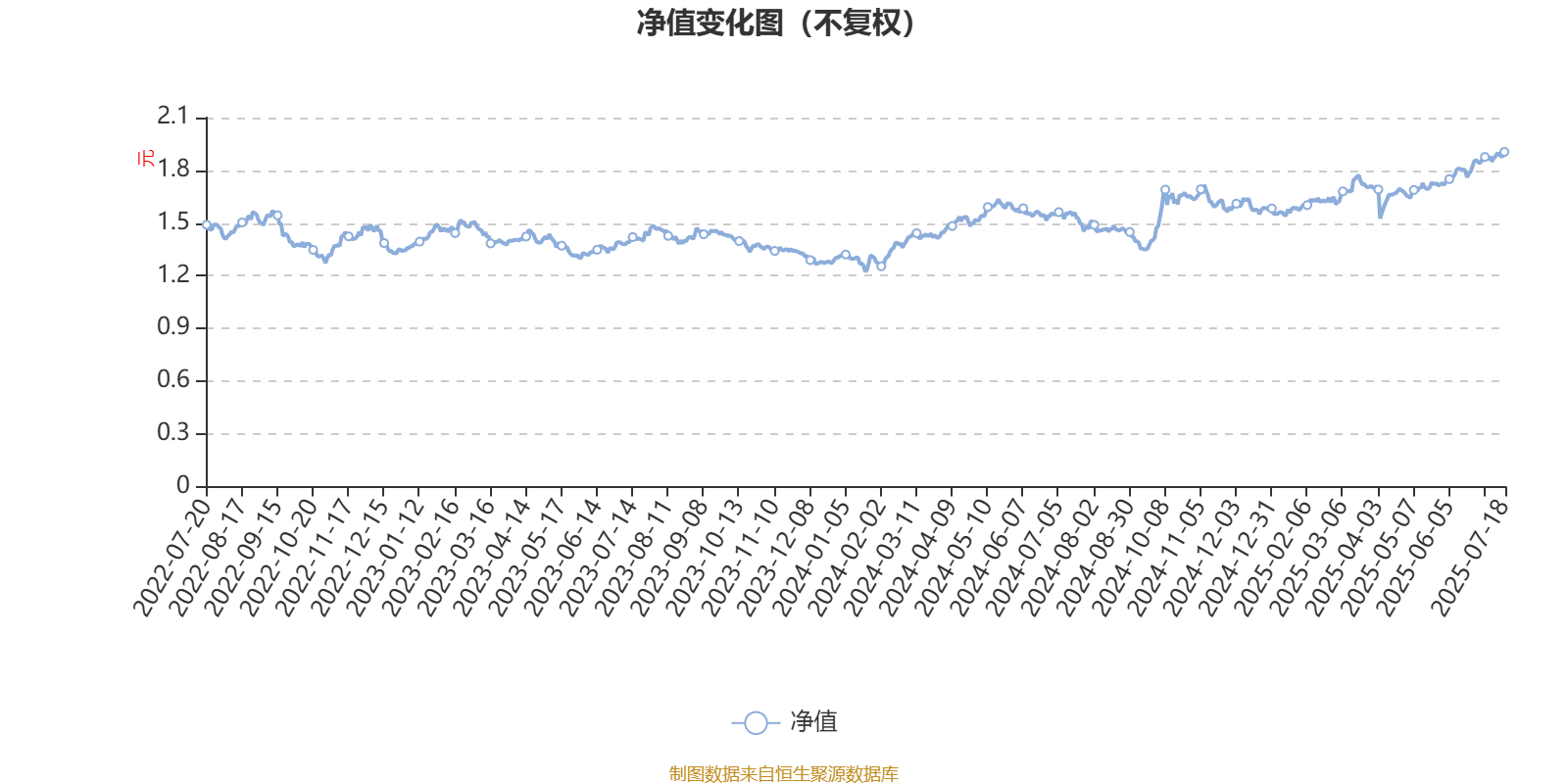
Core Viewpoint - The AI Fund, China Europe Dividend Enjoyment Flexible Allocation Mixed A (004814), reported a profit of 359 million yuan in Q2 2025, with a weighted average profit per fund share of 0.1336 yuan, and a net asset value growth rate of 8.22% for the period [2] Fund Performance - As of July 18, the fund's unit net value was 1.905 yuan, with a three-month net value growth rate of 14.13%, ranking 16 out of 82 in its category [3] - The fund's six-month net value growth rate was 20.09%, ranking 6 out of 82, and the one-year growth rate was 22.31%, also ranking 6 out of 77 [3] - Over the past three years, the fund achieved a net value growth rate of 41.31%, ranking 2 out of 57 [3] - The fund's Sharpe ratio over the past three years was 0.7644, ranking 4 out of 57 [8] - The maximum drawdown over the past three years was 19.38%, with the largest single-quarter drawdown occurring in Q1 2020 at 19.96% [10] Fund Holdings and Strategy - As of June 30, the fund maintained an average stock position of 91.42% over the past three years, compared to the category average of 84.99% [13] - The fund's top ten holdings as of Q2 2025 included Zijin Mining, New China Life Insurance, China Life Insurance, China Ping An, Construction Bank, Zhongjin Gold, Ningbo Bank, China National Heavy Duty Truck Group, China Gold International, and SANY Heavy Industry [17] - The fund manager expressed optimism about the stability and certainty of the Chinese economy, focusing on undervalued assets in both Hong Kong and A-shares, while also highlighting risks from Western debt and geopolitical conflicts [2]


新华保险保费增速1年2跃进 曾单月将前7月6%降幅拉正
Zhong Guo Jing Ji Wang· 2025-07-20 23:19
Core Viewpoint - Xinhua Insurance reported a significant increase in premium income for the first half of 2025, achieving a total of RMB 12,126,217 million, representing a year-on-year growth of 23% [1] Group 1: Premium Income Performance - For the first half of 2025, Xinhua Insurance's premium income showed a consistent high growth trend, with monthly figures as follows: January at RMB 39.449 billion, February at RMB 51.124 billion, March at RMB 73.218 billion, April at RMB 85.379 billion, May at RMB 99.090 billion, and June at RMB 121.262 billion, with year-on-year growth rates of 32%, 29%, 28%, 27%, 26%, and 23% respectively [1] - In 2024, Xinhua Insurance experienced a turnaround in premium income after a period of decline, reporting RMB 1,302.82 billion for the first eight months, which was a year-on-year increase of 1.9% [2] - In August 2024, Xinhua Insurance achieved a remarkable premium income of RMB 184.07 billion, reflecting a year-on-year growth of 122.0% [3] Group 2: Strategic Initiatives - The company emphasized a customer-centric strategy, enhancing top-level design, and strengthening branch operations to improve its product system and service ecosystem [1] - Xinhua Insurance is focused on upgrading its business and income structure, aiming for high-quality development through improved service and value creation [1]
中报预计延续高增,配置价值持续提升
Changjiang Securities· 2025-07-20 10:13
Investment Rating - The report maintains a "Positive" investment rating for the investment banking and brokerage industry [7] Core Insights - The report indicates that several brokerage firms have disclosed performance increases, with mid-year results expected to continue high growth, enhancing their investment value. Additionally, the insurance sector is anticipated to see an increase in value ratios, driving significant growth in new business value. The equity market is expected to continue its upward trend, with positive investment returns and profit growth. Current valuations reflect a pessimistic assumption about long-term investments, but considering the medium to long-term interest rate spreads, current valuations remain safe. The report is optimistic about improvements in concentration and liability costs [2][4] - From the perspective of profitability and dividend stability, the report recommends Jiangsu Jinzhong, China Ping An, and China Pacific Insurance for their stable profit growth and high dividend yields. Furthermore, it recommends Xinhua Insurance, China Life, Hong Kong Stock Exchange, CITIC Securities, Dongfang Fortune, Tonghuashun, and Jiufang Zhitu Holdings based on their performance elasticity and valuation levels [4] Summary by Sections Industry Overview - The non-bank financial index decreased by 1.2% this week, underperforming the CSI 300 by 2.3%, ranking 28th out of 31 sectors. Year-to-date, the non-bank financial index has increased by 3.0%, also underperforming the CSI 300 by 0.2%, ranking 22nd out of 31 sectors. Overall, the non-bank sector has shown weak performance this week [5] Market Performance - Market activity has seen a rebound, with an average daily trading volume of 15,462.47 billion yuan, up 3.35% week-on-week. The average turnover rate is 1.83%, an increase of 4.07 basis points. The leverage capital scale has also risen, with a margin balance of 1.90 trillion yuan, up 1.64% [5][34] Brokerage Data Tracking - The report highlights a recovery in trading activity, with the CSI 300 index rising by 1.09% and the ChiNext index increasing by 3.17%. The average daily trading volume has surpassed the 2024 average, indicating a gradual recovery in brokerage business profitability [33][39] Investment Business - The equity market is showing signs of recovery, with the CSI 300 index up by 1.09% and the ChiNext index up by 3.17%. The report notes that brokerage firms have a significant portion of their investment assets in equities (10%-30%) and bonds (70%-90%), necessitating close monitoring of market changes [39] Credit Business - The margin trading balance has increased to 1.90 trillion yuan, reflecting a 1.64% week-on-week rise. The report notes that while the stock pledge business is expected to remain cautious due to past credit risks, income from this business is anticipated to perform better than its scale [42] Investment Banking Business - In June, the equity financing scale rose significantly to 544.19 billion yuan, a 3140.2% increase, while bond financing reached 88.3 trillion yuan, up 21.3%. The report suggests that the stock underwriting scale is expected to increase due to new refinancing regulations [44][46] Asset Management Business - The report indicates a rebound in the issuance of collective asset management products, with June seeing a total issuance of 9.301 billion units, up 116.8% from the previous month. However, the new fund issuance decreased by 22.0% in June compared to the previous month [48]

非银行业周报20250720:中国香港《稳定币条例》生效在即,重视头部券商及跨境支付-20250720
Minsheng Securities· 2025-07-20 09:35
Investment Rating - The report maintains a "Recommended" rating for the industry, indicating a positive outlook for investment opportunities [7]. Core Insights - The Hong Kong "Stablecoin Regulation" will take effect on August 1, 2025, which is expected to enhance the development of the stablecoin industry in Hong Kong. The U.S. Congress has also passed the "Genius Act" to establish a regulatory framework for cryptocurrencies, signed into law by President Trump [1][2]. - Short-term, cross-border payment scenarios are anticipated to be significant applications for stablecoins, improving efficiency and reducing costs. Financial technology companies related to cross-border payments are expected to benefit, with a focus on companies like Lianlian Digital [1]. - Long-term, stablecoins are expected to facilitate virtual asset trading and the tokenization of real-world assets (RWA) and security token offerings (STO). Major Chinese brokerages are accelerating their involvement, with firms like Guotai Junan International upgrading their virtual asset trading licenses [2]. Summary by Sections Market Review - Major indices saw increases, with the Shanghai Composite Index up by 0.69% and the ChiNext Index up by 3.17% during the week [9]. - The non-bank sector experienced an overall decline, with the non-bank financial index down by 1.24% [9]. Securities Sector - The report highlights a significant increase in trading activity, with a total trading volume of 0.73 trillion shares and a turnover of 9.34 trillion yuan, marking a 6.05% increase week-on-week [17]. - The report notes that the margin trading balance reached 1.90 trillion yuan, a 1.52% increase from the previous week [17]. Investment Recommendations - The report suggests focusing on insurance companies such as China Pacific Insurance, New China Life, China Ping An, China Life, and China Property & Casualty Insurance. In the securities sector, it recommends attention to leading firms like CITIC Securities, Huatai Securities, Guotai Junan, and China Galaxy Securities [44][45]. - Non-bank institutions to watch include ZhongAn Online, Lianlian Digital, Hong Kong Exchanges and Clearing, and Lianyi Technology [45].