HUA HONG SEMI(01347)

Search documents
电子掘金 - 出口管制叠加关税升级,科技板块投资怎么看?
2025-10-13 01:00
Summary of Conference Call Notes Industry Overview - The conference call primarily discusses the **consumer electronics** and **semiconductor** sectors, focusing on the impact of tariffs and geopolitical tensions on these industries [1][2][12]. Key Points on Consumer Electronics - The **valuation of the consumer electronics sector** has increased more than the EPS growth, despite weak overall demand in the smartphone market [3][5]. - **Apple's new product performance** is strong, but the overall smartphone market remains weak [3]. - **End-side AI hardware**, such as AI glasses, and companies within the Apple supply chain are highlighted as key areas of focus, with expectations for performance realization in the coming years [1][3][5]. - Short-term tariff disruptions are expected to have limited impact, with the second half of the year projected to perform better than the first half due to the traditional peak season and new Apple products [1][5]. Semiconductor Sector Insights - There is an increased focus on **upstream semiconductor equipment and materials**, particularly in **wafer manufacturing** [1][6]. - The **utilization rates** for wafer manufacturing companies like **SMIC** and **Huahong Semiconductor** are reported to be high, with a positive outlook for the packaging and testing segment [4][9]. - Domestic **NAND** production has a high localization rate, while **DRAM** still has room for improvement, with ongoing expansion plans [7]. - The **semiconductor equipment market** is seeing progress in new process chip development and yield improvement, with companies adjusting order revenues upward, providing a basis for valuation increases [8]. Long-term Outlook - Long-term recommendations include focusing on: 1. Leading companies in the Apple supply chain 2. Emerging products in end-side AI hardware 3. Platform-based leading companies with favorable competitive landscapes [5]. - The **capital expenditure** in the semiconductor sector is expected to continue increasing, alleviating concerns about reaching a peak in capital spending [7]. Geopolitical and Market Dynamics - The **U.S.-China tensions** are noted to have a limited long-term impact on the consumer electronics sector, with tariffs being a primary concern in the short term [2][12]. - The semiconductor industry is characterized as being in a **structural bull market**, with a focus on domestic production and core replacement sectors [12]. Additional Insights - The **silicon wafer market** is experiencing changes due to increased consumption driven by storage and various analog-digital chips, with rising prices for overseas silicon wafers boosting domestic valuations [10]. - The **AI chip market** is optimistic, with domestic AI chips gaining recognition at the 12nm and N+1 nodes, leading to expectations for future advancements [15]. - The **storage chip sector** is expected to benefit from rising prices and increased demand from both end-side and cloud-side applications [17]. Investment Recommendations - Investors are advised to look for **opportunities in core stocks** that have reasonable valuations and high earnings certainty in the upcoming quarters [21].
计算机行业周报:手握中国芯,改写半导体格局-20251012
HUAXI Securities· 2025-10-12 06:41
Investment Rating - Industry Rating: Recommended [4] Core Insights - China strengthens its rare earth export controls, limiting exports to military users and entities on a control list, which significantly impacts the U.S. semiconductor industry as China accounts for nearly 70% of global rare earth production [15][20][21] - The world's first two-dimensional-silicon hybrid flash memory chip has been developed, outperforming current flash technologies and providing faster, lower-energy data support for AI and big data applications [16][22][26] - Upcoming semiconductor industry conferences aim to explore new development paths for China's semiconductor sector, focusing on advanced packaging and wafer manufacturing, which are crucial for enhancing global competitiveness [17][42][60] Summary by Sections Section 1: Rare Earth Security - China has implemented stricter export controls on rare earth materials, particularly for military applications, which could hinder U.S. semiconductor capabilities [15][20][21] - Rare earths are essential for semiconductor manufacturing, impacting various components and processes across the industry [21] Section 2: Hybrid Flash Memory Chip - The new hybrid chip integrates two-dimensional ultra-fast memory with mature silicon-based CMOS technology, marking a significant technological breakthrough [16][22][26] - This innovation positions China at the forefront of next-generation storage technology, crucial for AI and big data [22][41] Section 3: Semiconductor Industry Conferences - The 2025 Bay Area Semiconductor Industry Expo will gather industry leaders to discuss future directions and innovations [17][42] - The Third Generation Semiconductor Industry Cooperation Conference will focus on collaborative development and technological advancements in the semiconductor field [55][56] - The 2025 China Semiconductor Advanced Packaging Conference will address the integration of wafer manufacturing and advanced packaging technologies [60][61] Section 4: Investment Recommendations - Beneficial stocks in the semiconductor sector include North China Huachuang, Zhongwei Company, SMIC, and Huahong Semiconductor [18] - In the chip sector, recommended companies are Cambrian, Haiguang Information, and Longxin Zhongke [18]




智通港股通活跃成交|10月10日
智通财经网· 2025-10-10 11:03
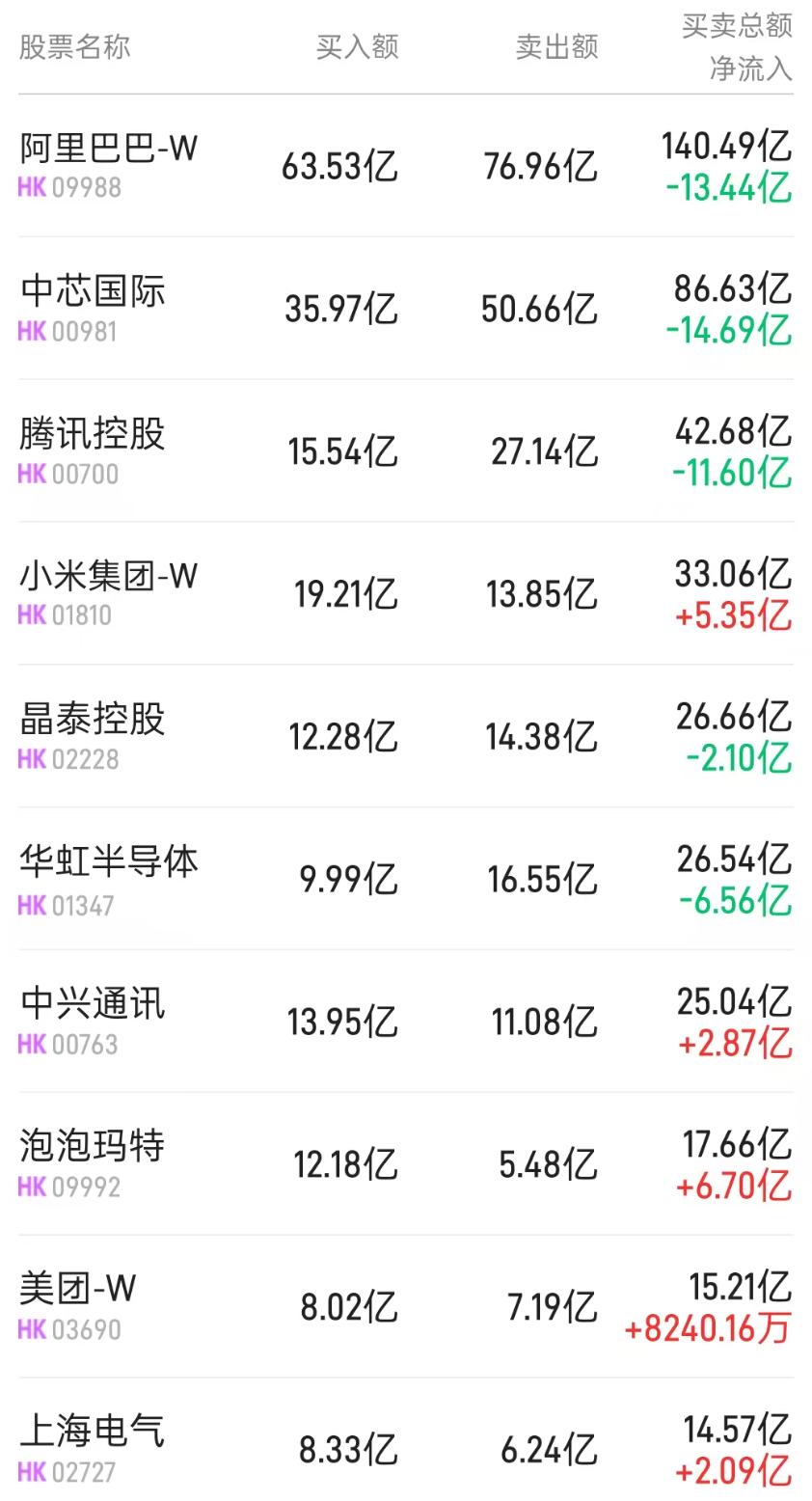
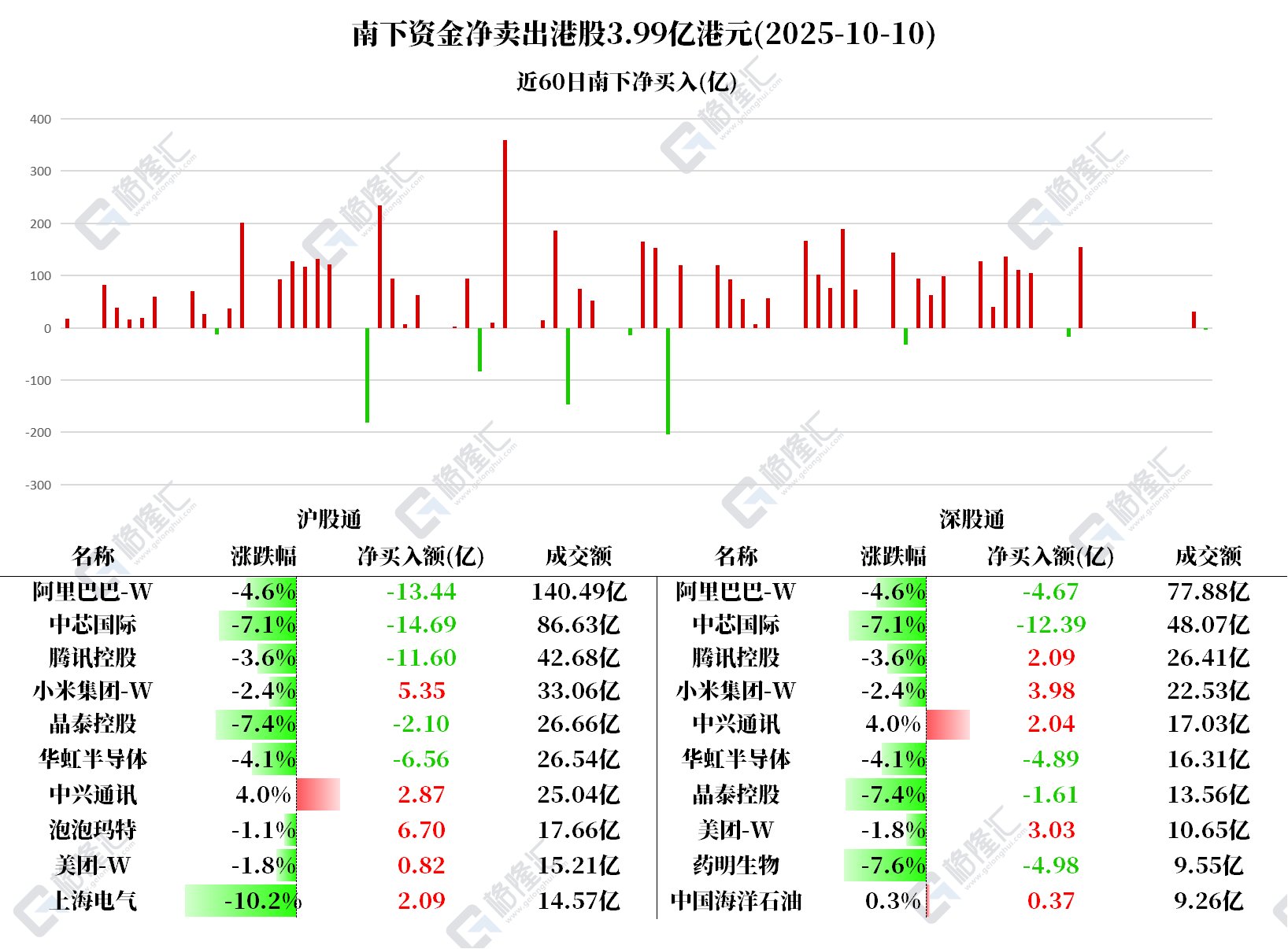
Core Insights - On October 10, 2025, Alibaba-W (09988), SMIC (00981), and Tencent Holdings (00700) were the top three companies by trading volume in the southbound trading of the Stock Connect, with trading amounts of 140.49 billion, 86.63 billion, and 42.68 billion respectively [1][2] - In the southbound trading of the Shenzhen-Hong Kong Stock Connect, Alibaba-W (09988), SMIC (00981), and Tencent Holdings (00700) also ranked as the top three, with trading amounts of 77.88 billion, 48.07 billion, and 26.41 billion respectively [1][2] Southbound Trading Highlights - The top three active companies in the southbound trading of the Shanghai-Hong Kong Stock Connect were: - Alibaba-W (09988): 140.49 billion with a net buy of -13.44 billion - SMIC (00981): 86.63 billion with a net buy of -14.69 billion - Tencent Holdings (00700): 42.68 billion with a net buy of -11.60 billion [2] - The top three active companies in the southbound trading of the Shenzhen-Hong Kong Stock Connect were: - Alibaba-W (09988): 77.88 billion with a net buy of -4.67 billion - SMIC (00981): 48.07 billion with a net buy of -12.39 billion - Tencent Holdings (00700): 26.41 billion with a net buy of +2.09 billion [2]


北水动向|北水成交净卖出3.99亿 北水节后两日累计抛售中芯国际超50亿港元
智通财经网· 2025-10-10 10:03
Summary of Key Points Core Viewpoint - The Hong Kong stock market experienced a net sell-off of 3.99 billion HKD from northbound trading, with significant movements in various stocks, indicating a shift in investor sentiment and trading strategies. Group 1: Northbound Trading Activity - Northbound trading saw a net sell of 12.2 billion HKD in the Shanghai-Hong Kong Stock Connect and a net buy of 8.21 billion HKD in the Shenzhen-Hong Kong Stock Connect [1] - The most bought stocks included Xiaomi Group-W (01810), Pop Mart (09992), and ZTE Corporation (00763) [1] - The most sold stocks were SMIC (00981), Alibaba-W (09988), and Hua Hong Semiconductor (01347) [1] Group 2: Stock-Specific Insights - Xiaomi Group-W (01810) had a net buy of 9.33 billion HKD, with a reported increase in electric vehicle deliveries to over 40,000 units in September, up from 36,000 in August [4] - Pop Mart (09992) received a net buy of 6.69 billion HKD, with new product launches selling out quickly and expectations for strong sales during upcoming festive seasons [5] - ZTE Corporation (00763) saw a net buy of 4.9 billion HKD, with analysts highlighting its unique position in providing end-to-end communication solutions and potential benefits from AI development [5] Group 3: Notable Sell-offs - Alibaba-W (09988) faced a net sell of 18.1 billion HKD, while Tencent (00700) experienced a net sell of 9.51 billion HKD, reflecting concerns over market valuations and potential corrections [6] - SMIC (00981) and Hua Hong Semiconductor (01347) were sold off significantly, with net sells of 27.08 billion HKD and 11.44 billion HKD respectively, attributed to high static P/E ratios leading to adjustments in margin financing [6]


图解丨南下资金连续第二日大幅减持中芯国际和华虹半导体
Ge Long Hui A P P· 2025-10-10 09:56
Group 1 - Southbound funds recorded a net sell of HKD 399 million in Hong Kong stocks today [1] - Notable net purchases included Xiaomi Group-W at HKD 933 million, Pop Mart at HKD 669 million, and ZTE Corporation at HKD 490 million [1] - Significant net sells were observed in SMIC at HKD 2.709 billion, Alibaba-W at HKD 1.81 billion, and Tencent Holdings at HKD 951 million [1] Group 2 - Southbound funds have continuously net bought Xiaomi for 5 days, totaling HKD 3.82084 billion [1] - There has been a consecutive 2-day reduction in holdings for SMIC, amounting to HKD 5.105 billion [1] - A similar trend of reduction was noted for Hua Hong Semiconductor, with a total decrease of HKD 2.286 billion over 2 days [1]
南向资金今日净卖出3.99亿港元 中芯、阿里、华虹净卖额居前



Mei Ri Jing Ji Xin Wen· 2025-10-10 09:50
Group 1 - The net selling of southbound funds amounted to 399 million HKD on October 10 [1] - Xiaomi Group, Pop Mart, and ZTE Corporation were the top three net buyers, with net purchases of 933 million HKD, 670 million HKD, and 491 million HKD respectively [1] - Semiconductor companies such as SMIC, Alibaba, and Hua Hong Semiconductor faced significant net selling, with amounts of 2.709 billion HKD, 1.81 billion HKD, and 1.145 billion HKD respectively [1]
南向资金|小米集团-W获净买入9.33亿港元
Di Yi Cai Jing· 2025-10-10 09:49
Group 1 - Southbound funds recorded a net sell of 399 million HKD [1] - The top three net purchases were from Xiaomi Group-W, Pop Mart, and ZTE Corporation, with net purchases of 933 million HKD, 670 million HKD, and 491 million HKD respectively [1] - The companies with the highest net sells were SMIC, Alibaba-W, and Hua Hong Semiconductor, facing net sells of 2.709 billion HKD, 1.81 billion HKD, and 1.145 billion HKD respectively [1]
港股午后加速回调,科技股领跌,恒生科技指数跌超3%,恒指跌1.8%!中芯国际跌近7%,华虹半导体、百度、快手跌超5%



Ge Long Hui· 2025-10-10 06:46
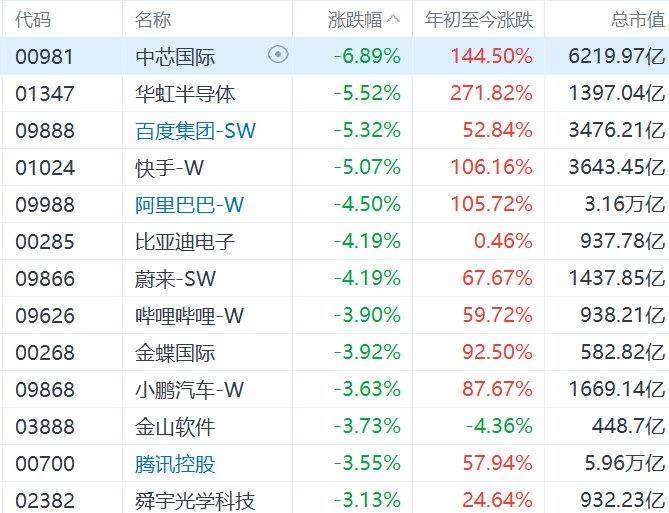
Core Viewpoint - The Hong Kong stock market experienced a significant decline in the afternoon session, with technology stocks leading the drop, as the Hang Seng Technology Index fell over 3% and the Hang Seng Index dropped by 1.8% [1] Group 1: Market Performance - The Hang Seng Technology Index decreased by more than 3% [1] - The Hang Seng Index fell by 1.8% [1] Group 2: Individual Stock Movements - Semiconductor stocks were notably affected, with SMIC (中芯国际) dropping nearly 7% and Hua Hong Semiconductor (华虹半导体) falling by 5.52% [1][2] - Other major declines included Baidu (百度) down 5.32%, Kuaishou (快手) down 5.07%, and Alibaba (阿里巴巴) down 4.50% [1][2] - NIO (蔚来) and Bilibili (哔哩哔哩) both saw declines of 4.19% and 3.90% respectively [2] - Tencent (腾讯) and Sunny Optical Technology (舜宇光学科技) also experienced drops of 3.55% and 3.13% respectively [2] Group 3: Year-to-Date Performance - Despite the recent declines, SMIC has seen a year-to-date increase of 144.50% [2] - Hua Hong Semiconductor has increased by 271.82% year-to-date [2] - Baidu and Kuaishou have also shown positive year-to-date performance, with increases of 52.84% and 106.16% respectively [2] - Alibaba's year-to-date increase stands at 105.72% [2]
锂电芯片集体杀跌,先导智能、华虹公司跌超10%,金价失守4000美元
2 1 Shi Ji Jing Ji Bao Dao· 2025-10-10 04:25
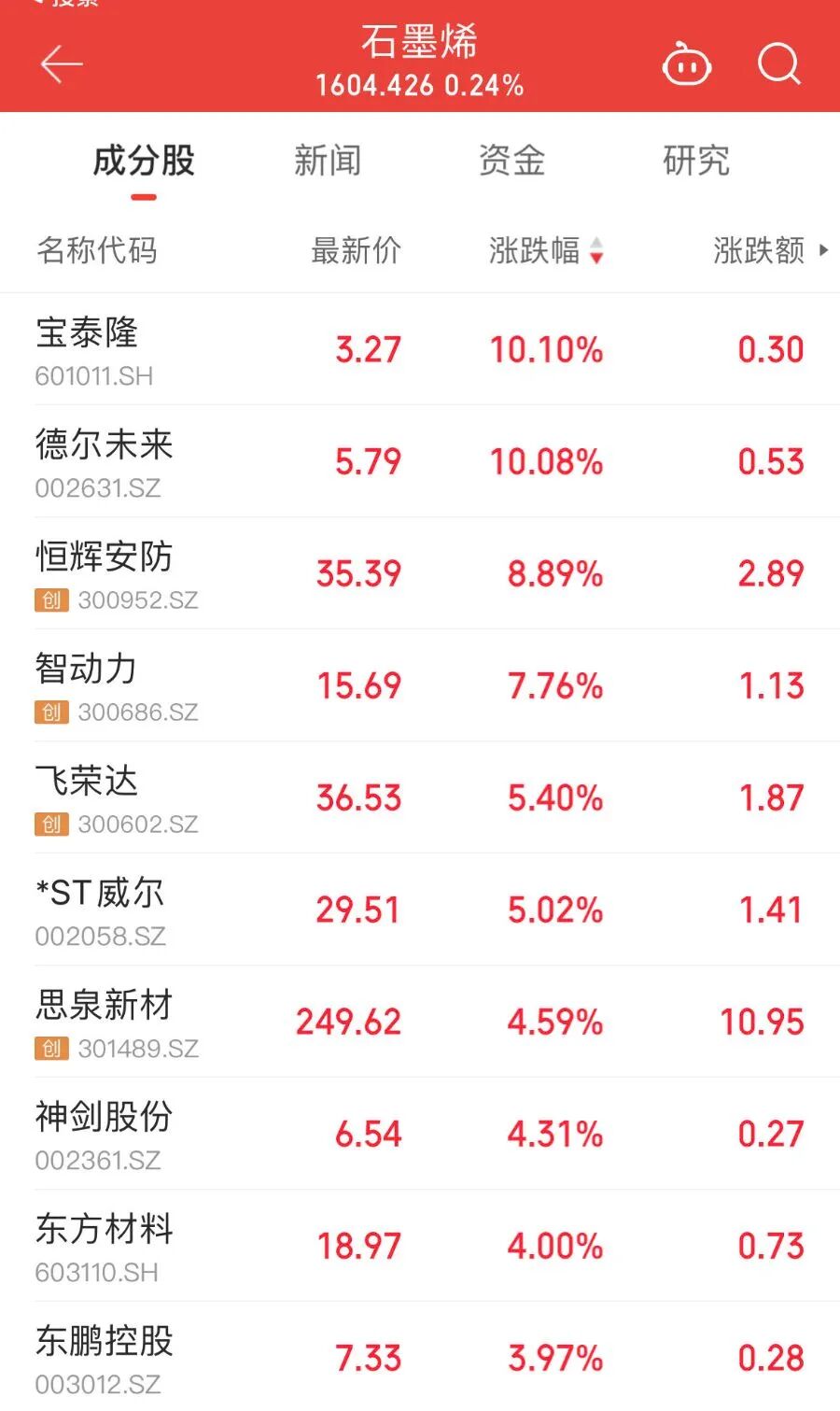
Market Overview - On October 10, the three major indices opened lower, with the Shanghai Composite Index down 0.51%, the Shenzhen Component Index down 1.85%, and the ChiNext Index down 3.4%. Over 2,300 stocks declined, with a trading volume of 1.66 trillion yuan, a decrease of 63.4 billion yuan compared to the same period of the previous trading day [1]. Sector Performance - The graphene concept and coal mining sectors saw gains, while precious metals, semiconductor chips, and new energy batteries experienced significant declines [2]. Graphene Sector - The graphene sector was notably active, with stocks such as Baotailong (601011) and Del Future (002631) hitting the daily limit up. Other stocks like Henghui Security (300952) and Feirongda (300602) also saw increases. This activity was driven by the announcement from the Ministry of Commerce and the General Administration of Customs regarding export controls on lithium batteries and artificial graphite negative electrode materials [3]. Graphene Stock Performance - Baotailong (601011.SH): Latest price 3.27, up 10.10% - Del Future (002631.SZ): Latest price 5.79, up 10.08% - Henghui Security (300952.SZ): Latest price 35.39, up 8.89% [4]. Coal Mining Sector - The coal mining sector showed a strong upward trend, with Dayou Energy (600403) hitting the daily limit up. Other companies like Jinkong Coal Industry (601001) and Shanxi Coking Coal (000983) also reported gains. Analysts from Guosheng Securities noted that domestic coal production has been constrained since July due to regulatory checks, leading to a likely decrease in coal production in the second half of the year. This situation, combined with lower inventory levels compared to last year, could result in upward pressure on coal prices [5]. Coal Mining Stock Performance - Dayou Energy (600403.SH): Latest price 4.31, up 9.95% - Jinkong Coal Industry (601001.SH): Latest price 14.91, up 3.61% - Shanxi Coking Coal (000983.SZ): Latest price 7.35, up 2.23% [6]. Lithium Battery and Semiconductor Sectors - The lithium battery supply chain faced significant declines, with stocks like Tianji Co. (002759) hitting the limit down, falling 9.08%. Other companies such as Xiandao Intelligent (300450) and Yinghe Technology (300457) dropped over 10%. The semiconductor sector also saw declines, with companies like Huahong Semiconductor and Dongxin Co. falling over 10% [7]. Precious Metals Sector - On October 10, spot gold prices fell below $4,000 per ounce, trading at $3,972.44. The A-share precious metals sector dropped over 3%, with stocks like Xiaocheng Technology (300139) and Western Gold (601069) declining over 8% [9][10]. Market Sentiment on Precious Metals - The recent decline in precious metals may be attributed to a combination of easing geopolitical tensions and profit-taking by investors. Reports indicated that a ceasefire agreement between Israel and Hamas has led to reduced demand for gold as a safe-haven asset. However, overall confidence in gold's long-term prospects remains optimistic, with forecasts suggesting that gold prices could exceed $4,500 per ounce in the first quarter of next year [11].



恒生指数午盘跌1.14%,恒生科技指数跌2.45%,半导体概念股走弱
Mei Ri Jing Ji Xin Wen· 2025-10-10 04:23
Core Viewpoint - The Hong Kong stock market experienced a decline, with the Hang Seng Index falling by 1.14% and the Hang Seng Tech Index dropping by 2.45% on October 10th [1] Group 1: Semiconductor Sector - The semiconductor sector in Hong Kong showed weakness, with notable declines in key stocks: SMIC fell over 5%, Fudan Microelectronics and Hua Hong Semiconductor dropped more than 4%, and InnoCare and ChipMOS fell over 3% [1] Group 2: Beverage Sector - In contrast, the beverage sector performed well, with Gu Ming rising over 13%, Mixue Group increasing nearly 6%, and other companies like Hou Shang Ayi, Cha Ba Dao, Uni-President China, and Nongfu Spring also seeing gains [1]