
PSBC(01658)

Search documents
“流水不够?亲友间转转账就能达标”记者调查经营贷利率已跌破2.5%
Zhong Guo Zheng Quan Bao· 2025-11-20 20:08
Core Insights - The article highlights the ongoing decline in business loan interest rates, with many banks offering rates below 2.5% as they seek to attract small and micro enterprises amid weak mortgage demand and retail pressures [1][2][4] Group 1: Business Loan Market Dynamics - Business loan interest rates are dropping significantly, with some banks like Ping An Bank and Zhuhai Huaren Bank offering rates as low as 2.3% [1][2] - The competitive landscape among banks is intensifying, leading to a price war where banks are lowering rates to capture market share [1][4] - Banks are also innovating in loan repayment methods and customer referral programs to attract new clients [3] Group 2: Loan Approval Practices - Banks are showing flexibility in loan approval criteria, allowing personal bank statements to supplement business income statements if the latter do not meet requirements [2][3] - Some banks are encouraging practices that may violate prudent lending principles, such as using personal transactions to inflate business income [4][6] Group 3: Regulatory and Risk Considerations - The decline in interest rates is attributed to multiple factors, including a shrinking mortgage market and regulatory pressures to support small businesses [4] - There are concerns that the aggressive pricing strategies could undermine banks' long-term sustainability and lead to lax risk management practices [4][6] - Legal experts warn that using personal income to misrepresent business financial health could lead to regulatory penalties for banks and potential criminal charges for borrowers [6][7] Group 4: Consumer Protection Issues - The article discusses the emergence of fraudulent intermediaries who exploit the low-interest environment to charge fees for facilitating loans, posing risks to consumer rights and financial safety [5][7] - Banks are issuing warnings to consumers about the misuse of loan funds and the consequences of not adhering to loan agreements [7]




124家A股公司股息率超5%,历年高股息“牛股”含金量如何?
Di Yi Cai Jing· 2025-11-20 11:20
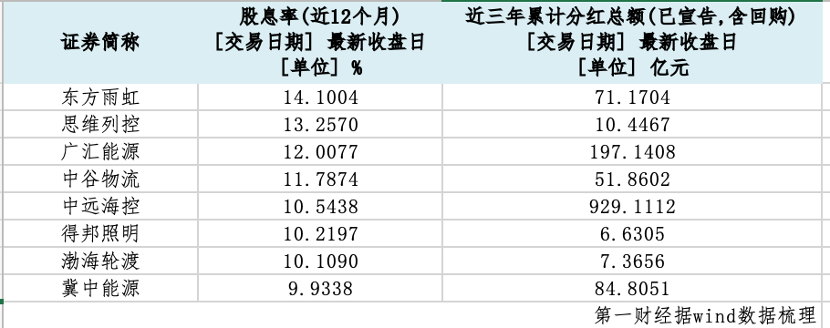
Group 1: Bank Sector Performance - The bank sector is becoming a market focus, with A-share banks showing strong performance, particularly China Bank, which rose 4% to reach a historical high [1] - As of November 20, the total market capitalization of the four major banks in A-shares has exceeded 2 trillion yuan [1] - In the Hong Kong market, Minsheng Bank led gains with over 3% increase, while other banks also saw significant rises [1] Group 2: High Dividend Stocks - There are currently 124 companies in A-shares with a dividend yield exceeding 5%, with 7 companies yielding over 10% [2][3] - The top three companies with the highest dividend yields are Dongfang Yuhong (14.1%), Siwei Liekong (13.25%), and Guanghui Energy (12%) [3][4] - High dividend stocks are not limited to the banking sector but are also found in utilities, energy, and telecommunications, providing a buffer against market volatility [2][3] Group 3: Dividend Distribution Trends - As of November 20, 24 out of 42 A-share listed banks have announced mid-term dividends totaling approximately 263.8 billion yuan, marking an increase from the previous year [1] - Regulatory bodies are encouraging companies to enhance shareholder returns through measures like "cancellation-style buybacks" and multiple annual dividends [5] Group 4: Long-term Dividend Trends - For the 2024 reporting period, the companies with the highest projected dividend yields are Haoxiangni (16.91%), Meiyingsen (15.95%), and Jinshi Technology (14.97%) [6] - In 2023, the top dividend yielders included Libai Co. (15.34%), Rong'an Real Estate (13.06%), and Yutong Bus (11.32%) [7][8] Group 5: Characteristics of High Dividend Companies - High dividend companies are typically found in stable sectors like utilities, energy, telecommunications, and consumer staples, which are less affected by economic cycles [8] - These companies often have clear and stable dividend policies, viewing consistent dividends as a means to maintain credibility and attract long-term investors [8] Group 6: Risks Associated with High Dividend Strategies - High dividend strategies may carry risks, as some companies with high yields may face declining performance or debt issues [10][12] - The phenomenon of "high dividend traps" can occur when a company's stock price falls, artificially inflating the dividend yield without a corresponding increase in earnings [12]






机构称银行板块价值空间依旧显著,关注银行ETF易方达(516310)等配置价值
Sou Hu Cai Jing· 2025-11-20 10:42
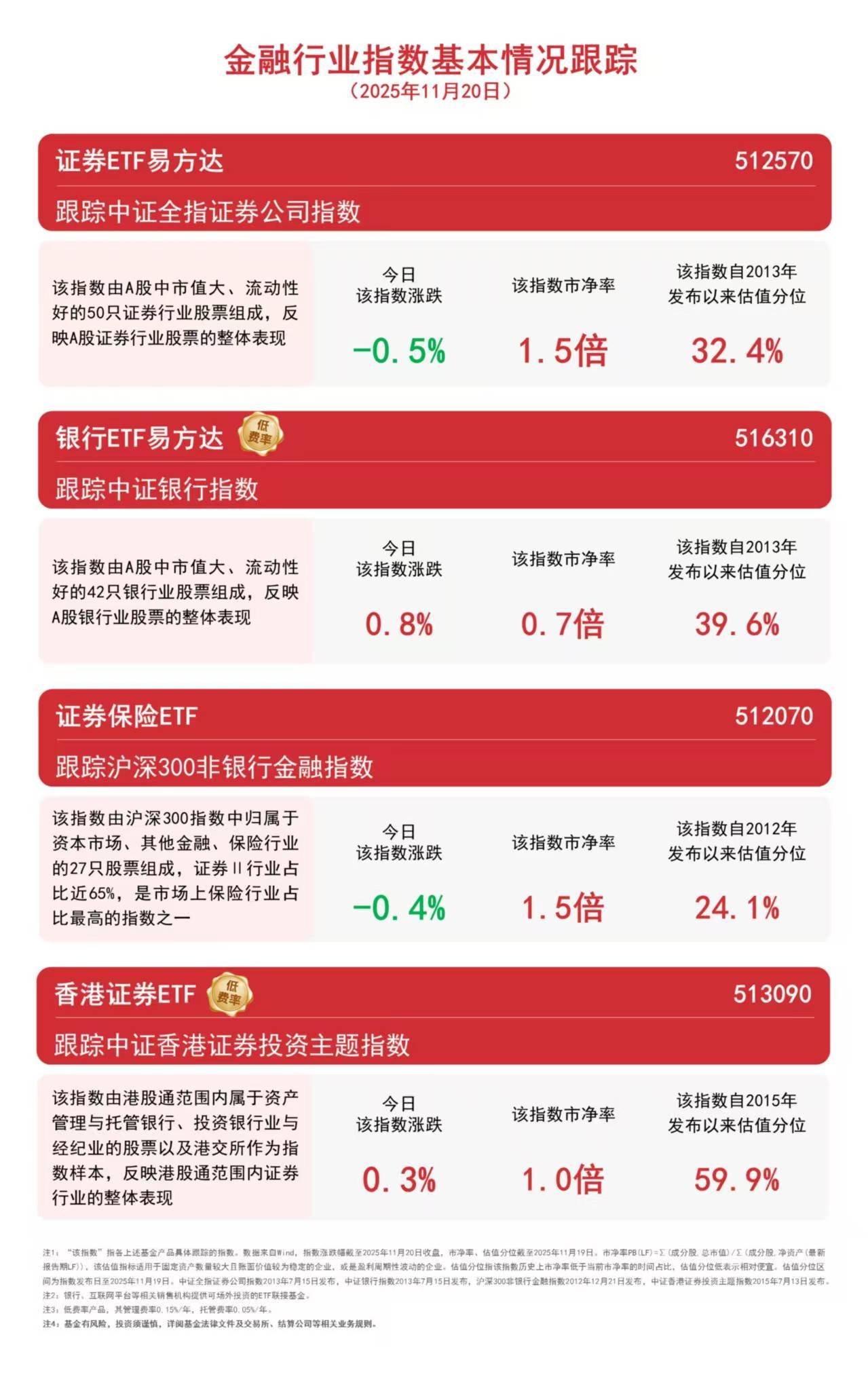
Group 1 - The core viewpoint of the news highlights the strong performance of bank stocks amidst market fluctuations, with China Bank reaching a historical high, and other banks like Construction Bank and Postal Savings Bank also showing significant gains [1] - The China Securities Bank Index rose by 0.8%, while the Hong Kong Securities Index increased by 0.3%. In contrast, the non-bank financial index of the CSI 300 fell by 0.4%, and the CSI All Securities Company Index decreased by 0.5% [1] - According to CITIC Securities, financial statistics indicate active transfers of resident deposits and non-bank deposits, leading banks to focus more on liquidity management as the year-end approaches [1] Group 2 - The preliminary stabilization of bank interest margins in the third quarter has contributed to stable profit levels for banks [1] - The banking sector is perceived to have significant value space due to low valuations, which may attract long-term capital allocation as the year-end approaches, potentially enhancing the market performance of bank stocks [1]
邮储银行天津分行“十四五”时期高质量发展纪实
Xin Lang Cai Jing· 2025-11-20 09:30
Core Viewpoint - The China Postal Savings Bank Tianjin Branch has undergone significant transformation and achieved high-quality development over the past five years, navigating complex economic challenges and enhancing its strategic framework [1][2][3]. Strategic Evolution - The bank initiated a self-revolution in response to unprecedented challenges during the "14th Five-Year Plan" period, focusing on "customer management" and "capability enhancement" as key strategies for high-quality development [2][3]. - In 2024, the bank introduced the "Exceeding Plan," aiming for continuous improvement and fostering a proactive work atmosphere among employees [2]. Performance Breakthrough - The bank has transitioned from being a "follower" to a "competitor" in the market, achieving steady revenue growth and maintaining high profit generation despite economic downturns [4]. - The business structure has been optimized, with significant growth in corporate finance, retail finance, and inclusive finance, particularly in small business loans [4]. Risk Management - The bank has strengthened its risk compliance system, enhancing its ability to manage risks during economic downturns through comprehensive lifecycle management of loans and proactive asset recovery efforts [5][6]. Social Responsibility - The bank has actively supported regional economic development, financing nearly 270 billion yuan for various projects, including 50% of the city's subway lines and 60% of urban renewal projects [7]. - It has established strategic partnerships with local governments and enterprises, enhancing its brand influence and social responsibility recognition [4][7]. Financial Innovations - The bank has developed a comprehensive financial service ecosystem, including the "U Benefit Creation" brand for technology finance and a robust inclusive finance system, achieving significant growth in small micro-loans [8][9]. - Green finance initiatives have seen exponential growth, with green credit balances exceeding 18 billion yuan, reflecting the bank's commitment to sustainable development [8]. Internal Reforms - The "Customer Management" project has led to a substantial increase in client numbers and a transformation in operational models, enhancing the bank's service capabilities [11]. - The "Capability Enhancement" project has resulted in significant improvements in branch transformation, technology empowerment, and talent development, ensuring long-term growth [12]. Party Leadership - The bank has integrated party leadership into its operational framework, ensuring that business and party work are planned and executed in tandem, which has strengthened its organizational structure and operational effectiveness [13][14].
邮储银行大兴安岭地区分行:北地秋收守护者
Zhong Guo Jin Rong Xin Xi Wang· 2025-11-20 07:39
Core Insights - The article highlights the proactive measures taken by Postal Savings Bank in the Daxing'anling region to support local agriculture, particularly in ensuring stable autumn grain production and enhancing food security [1][6]. Group 1: Financial Support for Agriculture - Postal Savings Bank has provided 406 million yuan in loans to local farmers this year, focusing on the unique agricultural challenges of the Daxing'anling region, such as short growing seasons and susceptibility to natural disasters [1]. - The bank has introduced specialized financial products to meet the funding needs of farmers during the autumn harvest, utilizing a "10-minute rapid approval" model that allows farmers to apply for loans via mobile banking without needing to visit bank branches [2][5]. Group 2: Support for Grain Purchase and Processing - The bank has launched "grain purchase loans" to assist local grain processing and storage enterprises in expanding their capacity and improving purchasing capabilities, particularly for soybean processing [3]. - By enhancing credit support for soybean deep processing enterprises, the bank aims to shift the local agricultural focus from raw grain sales to value-added processing, thereby increasing farmers' income through scale planting [3]. Group 3: Technological Innovations in Agricultural Financing - Postal Savings Bank is leveraging technology and big data to overcome traditional agricultural financing challenges, moving away from collateral-based lending to a credit-based model that incorporates various agricultural data [4]. - The bank has developed a three-dimensional credit model that evaluates farmers' creditworthiness based on land rights, planting scale, and agricultural insurance, allowing farmers to access loans up to 3 million yuan without traditional collateral [4]. Group 4: Collaborative Efforts for Financial Accessibility - The bank has established a collaborative mechanism with local government agencies to implement a "whole village credit" initiative, ensuring precise matching of farmers' needs with available credit [6]. - To enhance financial service accessibility, the bank has set up four "rural revitalization financial service stations" in key towns and villages, providing one-stop services for loan consultations, contract signing, and fund disbursement [6][7].
A股收评 | 沪指收跌0.40% 银行护盘!中国银行大涨4%创新高
智通财经网· 2025-11-20 07:20
Market Overview - The market opened high but closed lower, with sectors like Hainan, lithium battery concepts, and banks showing strong gains. The total market turnover was approximately 1.7 trillion, slightly lower than the previous trading day, with over 3,800 stocks declining [1] - The banking sector continued its strong performance, with China Bank rising 4% to reach a historical high, and other banks like Industrial and Commercial Bank of China also hitting new highs. The increase in stock prices is attributed to the overall upward trend in the banking sector and stable operational data disclosed in the Q3 report [1] Key Stocks - Hezhong China resumed trading and hit the limit up again, achieving 13 limit-ups in 15 trading days, with a cumulative increase of over 290%. The company stated there are no additional favorable information or undisclosed news regarding the stock price surge [2][5] - The LPR (Loan Prime Rate) for November remained unchanged at 3.5% for 5-year and above loans and 3% for 1-year loans, indicating a stable monetary policy environment [6] Sector Performance - The Hainan sector became active again, with Hainan Haiyao achieving three limit-ups in five days. The lithium mining concept continued to strengthen, with stocks like Beijiete and Shengxin Lithium Energy hitting limit-ups [1] - The real estate sector saw significant gains in the afternoon, with stocks like I Love My Home hitting limit-up, while consumer sectors like tourism, pre-made dishes, and dairy continued to weaken [1] Fund Flow - Main funds focused on sectors such as components, banks, and communication equipment, with notable net inflows into stocks like Fangzheng Technology and Dazhong Public [3] Market Sentiment and Future Outlook - Analysts from Huatai Securities suggest that the market's breakthrough momentum may still need to accumulate, with a focus on low-position sectors for short-term rebound opportunities [10] - The overall market is expected to maintain a positive long-term trend, with attention on the rotation of sectors and potential opportunities in anti-involution and dividend themes [8][9]
多股创历史新高!大金融崛起,高股息再发力,价值ETF(510030)盘中涨超1%!机构高呼配置价值凸显
Xin Lang Ji Jin· 2025-11-20 05:35
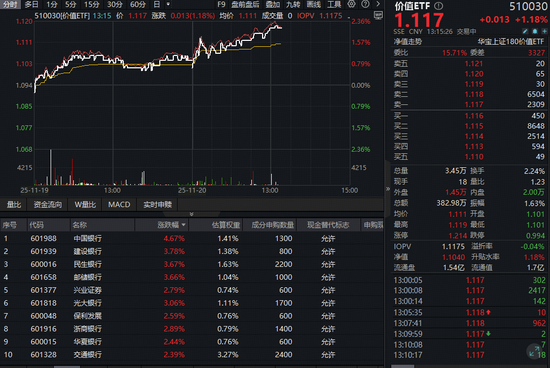
Core Viewpoint - High dividend stocks are experiencing a strong rise, particularly focusing on "high dividend + low valuation" large-cap blue-chip stocks, with the value ETF (510030) showing a 1.18% increase as of the latest report [1] Group 1: Market Performance - The banking sector is seeing significant gains, with major banks like Bank of China rising over 4%, and other banks such as China Construction Bank and Minsheng Bank increasing by over 3% [1] - Both Bank of China and Industrial and Commercial Bank of China reached historical highs during trading [1] Group 2: Institutional Investment Trends - Insurance capital is increasing its holdings in the banking sector, with a reported 27.95% holding position as of Q3 2025, which is a slight decrease in market value but an increase in share quantity by 8.36 billion shares [3] - As of the end of September, insurance capital has invested in 23 banks, with 10 banks receiving increased investments and several new entries from both large and regional banks [3] - Factors such as new premium inflows, increased equity investment ratios, and the implementation of IFRS9 are expected to provide further growth opportunities for insurance capital in the banking sector [3] Group 3: Valuation Insights - The value ETF (510030) is tracking the 180 Value Index, which has a price-to-book ratio of 0.86, indicating a relatively reasonable valuation level, positioned at the 46.38 percentile over the past decade [4] - The index is characterized by a high dividend yield, making it attractive for defensive positioning in volatile markets [5] Group 4: Future Market Outlook - The market is expected to maintain a volatile structure towards the end of the year, with a focus on themes like "anti-involution" and dividends [5] - The A-share market is in a consolidation phase, with rapid rotations between sectors, particularly as technology stocks are currently stabilizing [5] - The value ETF (510030) closely follows the 180 Value Index, which includes 60 stocks with high value factor scores, covering 20 banking stocks [5]

港股午评|恒生指数早盘涨0.14% 内房板块强势反弹
Zhi Tong Cai Jing· 2025-11-20 04:13
Group 1 - The Hang Seng Index rose by 0.14%, gaining 36 points to close at 25,867 points, while the Hang Seng Tech Index fell by 1.01% with a trading volume of HKD 143.6 billion in the morning session [1] - Real estate stocks surged amid market expectations for new supportive policies, with Sunac China rising over 10%, Country Garden up over 5%, and Vanke Enterprises increasing by 5.67% [2] - Beike-W saw a rise of 5.15%, driven by substantial profits from its home decoration rental business, with the buyback amount reaching a near two-year high in a single quarter [3] Group 2 - China’s banking sector showed signs of recovery in the morning, with major banks advancing in their mid-term dividend distributions, including Minsheng Bank up by 3.56%, Postal Savings Bank up by 2.7%, and Bank of China up by 1.93% [3] - Kingsoft Cloud rose over 4% post-earnings, with Q3 industry cloud revenue showing both year-on-year and quarter-on-quarter growth, and a solid foundation in government cloud services [4] - Maoyan Entertainment fell over 2% due to reports of a significant increase in the ticket refund rate for the movie "Demon Slayer" [5] Group 3 - Trip.com Group fell over 3% despite exceeding expectations in its Q3 financial report, with institutions predicting resilience in domestic business revenue for Q4 [6] - XPeng Motors declined over 4%, denying rumors regarding the production of thousands of autonomous driving taxis [7] - Contemporary Amperex Technology Co., Ltd. (CATL) dropped over 8% as cornerstone investors' lock-up period expired today [8]


银行板块再度走强,中国银行续创新高,建设银行等拉升
Zheng Quan Shi Bao Wang· 2025-11-20 03:36
Core Viewpoint - The recent rally in the banking sector is primarily driven by a shift in market investment style, with mid-term dividends acting as a catalyst, and the trend is expected to continue until the end of December [1] Group 1: Market Performance - As of the latest report, major banks such as Bank of China saw a nearly 5% increase, while China Construction Bank and Postal Savings Bank rose nearly 4%, and other banks like Everbright Bank and Minsheng Bank increased by over 2% [1] - The banking sector is experiencing a strong upward trend, indicating positive investor sentiment and market dynamics [1] Group 2: Investment Opportunities - According to Guosen Securities, there are likely to be good investment opportunities in the banking sector before the main theme of spring volatility becomes clear, suggesting that investors should overlook short-term fluctuations [1] - The demand for insurance capital allocation is significant due to the low interest rate environment, making stable bank stocks attractive to insurance funds [1] - The banking sector is expected to be an important allocation direction as the basic bottom-line expectations have become clear, which can help reduce asset yield volatility [1] Group 3: Recommendations - The institution recommends focusing on high-dividend, fundamentally stable stocks in the short term, while also considering quality stocks for potential upside [1] - It is suggested to pay attention to major banks like Industrial and Commercial Bank of China and China Merchants Bank as they represent stable investment opportunities [1]
内银股早盘回暖 上市银行中期分红持续推进 今年中期分红时点整体提前
Zhi Tong Cai Jing· 2025-11-20 03:15
兴业证券指出,上市银行中期分红方案陆续落地。从分红节奏来看,今年中期分红时点整体提前。四大 行公告中期分红时点,其中A股派息时间均提前到2025年12月中旬,H股派息时间在2026年1月下旬。伴 随着上市银行中期分红工作的逐步展开,持等对股息较为重视的资金或加大对银行股的财置投资力度, 推动板块估值的修复。 内银股早盘回暖,截至发稿,民生银行(600016)(01988)涨3.56%,报4.36港元;邮储银行(601658) (01658)涨2.88%,报5.71港元;中国银行(601988)(03988)涨2.36%,报4.77港元;建设银行(601939) (00939)涨1.85%,报8.28港元。 消息面上,据数据统计,截至11月19日,42家上市银行中已有13家完成中期分红实施或进入实施阶段, 另有13家银行公布了分红方案,合计分红金额达到2637.90亿元。与此同时,还有6家上市银行的中期分 红事项已通过年度股东大会审议,等待董事会公布具体方案。 ...
