PING AN OF CHINA(02318)

Search documents
中国平安再度大涨创四年新高,驱动因素有哪些?
Zheng Quan Shi Bao· 2025-12-15 07:31
Core Viewpoint - China Ping An has led the rise in insurance stocks, with significant increases in both A and H shares, reaching new highs since June 2021, driven by favorable market conditions and regulatory support [1][5]. Company Level - China Ping An, as a leading insurance stock, benefits from the popularity of dividend insurance in a low-interest-rate environment, substantial gains from equity investments, and stable dividends, currently offering a yield above 4% [4][9]. - The company has increased its equity investment scale to over 800 billion yuan, enhancing its net asset value and dividend capacity, despite stock investment gains not being included in net profit calculations [8][9]. Industry Level - The National Financial Regulatory Administration has lowered risk factors for insurance companies, allowing for more long-term investment funds, which supports the expansion of the insurance industry's balance sheets [5][8]. - The insurance sector is entering an expansion phase, with strong sales of dividend insurance products and increased equity positions benefiting from a slow bull market [8]. Market Sentiment - Major investment banks, including Morgan Stanley and CITIC Securities, have issued reports recommending China Ping An, predicting it will lead the next valuation recovery in the insurance industry [5][10]. - Analysts highlight that the insurance sector is poised for a new growth cycle, with trends indicating rapid growth in new business and a shift towards high-quality development in the industry [10].


沪深两市今日成交额合计1.77万亿元,中际旭创成交额居首
Xin Lang Cai Jing· 2025-12-15 07:21
12月15日,沪深两市成交额合计1.77万亿元,较上一交易日缩量约3187.67亿元。其中,沪市成交额 7646.05亿元,深市成交额1.01万亿元。中际旭创成交额居首,为173.31亿元。其后是新易盛、胜宏科 技、航天发展、中国平安,成交额分别为165.31亿元、133.7亿元、105.55亿元、102.58亿元。 ...


创业板指、深成指均跌超1% 大消费板块逆势走强
Mei Ri Jing Ji Xin Wen· 2025-12-15 07:19
Market Overview - The market experienced fluctuations with the Shanghai Composite Index briefly turning positive before declining again, while the ChiNext Index opened lower and continued to fall [1] - By the end of trading, the Shanghai Composite Index fell by 0.55%, the Shenzhen Component Index decreased by 1.1%, and the ChiNext Index dropped by 1.77% [1] Sector Performance - The consumer sector saw significant gains, particularly in the liquor segment, with Zhongrui Co. achieving two consecutive trading limit increases [1] - The dairy industry experienced a rapid rise, with Huangshi Group and Sunshine Dairy both hitting the trading limit [1] - The retail sector performed strongly, with Baida Group and Guangbai Co. also reaching the trading limit [1] - The insurance sector strengthened, with China Ping An rising nearly 5%, reaching a four-year high [1] - The commercial aerospace sector remained active, with Hualing Cable and Zhongchao Holdings achieving three consecutive trading limit increases [1] - The precious metals sector saw a quick rise in the afternoon, with Guiyan Platinum reaching the trading limit [1] Declining Sectors - The film and cinema sector faced declines, with Bona Film Group hitting the trading limit down [1] - The computing hardware sector weakened, with Changfei Optical Fiber also hitting the trading limit down [1] Summary of Leading and Lagging Sectors - Leading sectors included dairy, insurance, retail, and precious metals, while lagging sectors included CPO and film and cinema [1]



A股收评:沪指跌0.55%、创业板指跌1.77%,白酒、乳业及零售股集体走高,钢铁及商业航天概念股活跃
Jin Rong Jie· 2025-12-15 07:15
Market Overview - The A-share market experienced a "V"-shaped trend on December 15, with the Shanghai Composite Index closing down 0.55% at 3867.92 points, the Shenzhen Component Index down 1.1% at 13112.09 points, and the ChiNext Index down 1.77% at 3137.8 points. The total market turnover was 1.79 trillion yuan, a decrease of 324.6 billion yuan from the previous trading day, with over 2900 stocks declining [1]. Sector Highlights - **Consumer Sector Surge**: The consumer sector saw significant gains, particularly in the liquor and dairy segments. Notable stocks included Zhongrui Co., which achieved two consecutive trading limits, and dairy companies like Huangshi Group and Sunshine Dairy, which hit trading limits [1]. - **Insurance Sector Strength**: The insurance sector showed resilience, with China Ping An rising nearly 5%, reaching a four-year high. Other major insurers also saw substantial gains following a regulatory adjustment that lowered risk factors for investments in certain indices [3]. - **Retail Sector Activity**: The retail sector remained active, with Baida Group achieving three consecutive trading limits. The Ministry of Commerce announced measures to enhance consumer spending, contributing to the sector's positive performance [4]. Institutional Insights - **CITIC Securities**: The firm noted that while external demand may face challenges, there are increasing factors to expect growth in domestic demand. The focus remains on expanding the internal circulation of the economy [5]. - **CITIC Construction Investment**: The firm believes the underlying logic of a bull market persists, driven by structural trends and capital market reforms. A new wave of market activity is anticipated as the year-end approaches [6]. - **Industrial Outlook**: Industrial trends are expected to shift from a technology-centric focus to a more balanced approach across various sectors, with an emphasis on artificial intelligence, new energy, and service consumption as key areas of growth [7][8].

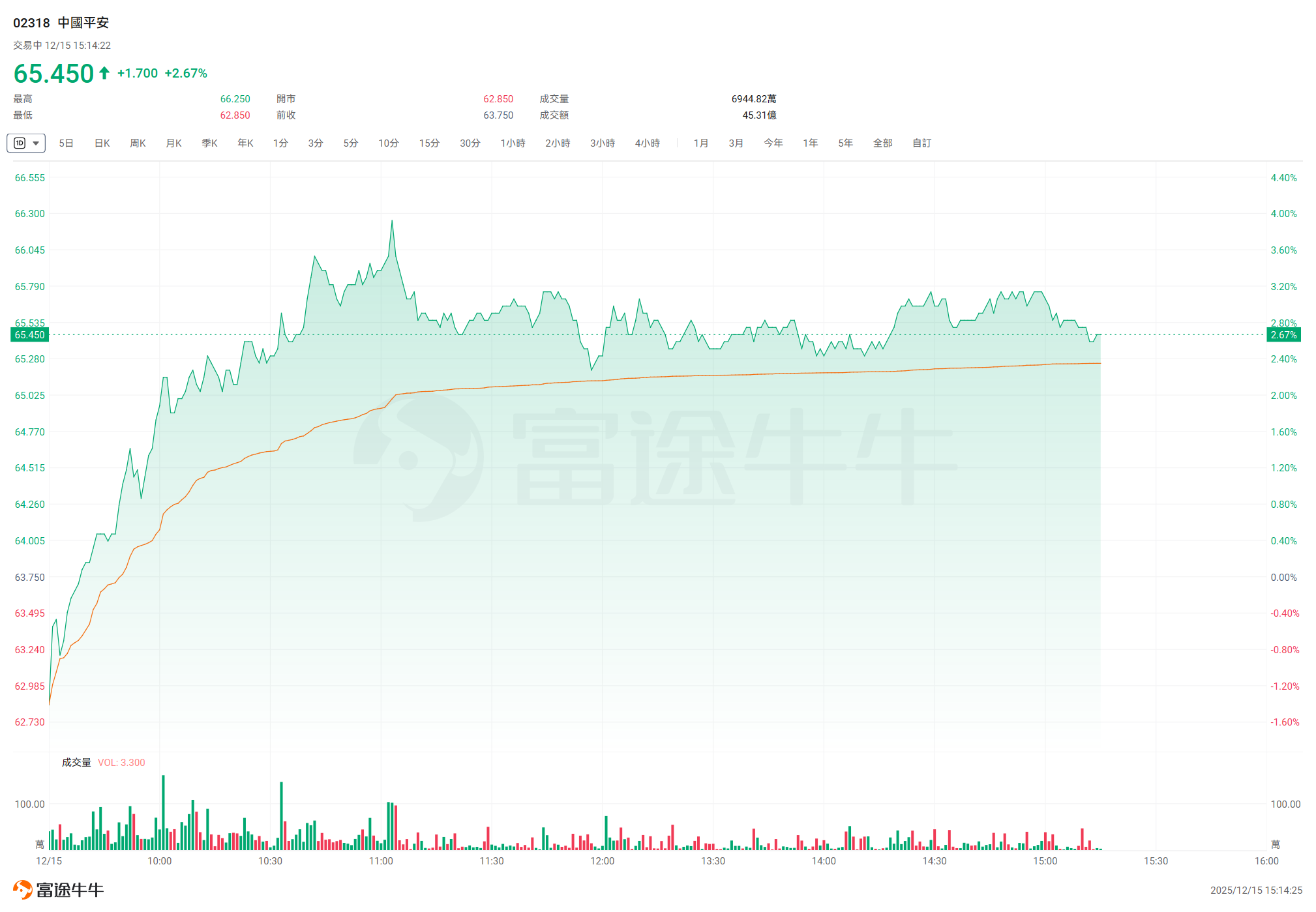
中国平安成交额达100亿元,现涨5.04%
Mei Ri Jing Ji Xin Wen· 2025-12-15 07:07
每经AI快讯,12月15日,中国平安成交额达100亿元,现涨5.04%。 (文章来源:每日经济新闻) ...
收评:深成指、创指双双跌超1% 消费股逆势反弹
Xin Lang Cai Jing· 2025-12-15 07:05
Market Performance - The indices accelerated their decline in the afternoon, with the Shenzhen Component Index falling over 1% and the ChiNext Index dropping nearly 2% [1] - The Shanghai Composite Index closed at 3867.92 points, down 0.55%; the Shenzhen Component Index closed at 13112.09 points, down 1.10%; and the ChiNext Index closed at 3137.80 points, down 1.77% [1] Sector Performance - Consumer stocks rebounded against the trend, with dairy, liquor, and retail sectors leading the market [1] - Notable gainers included Huangtai Liquor, Huanlejia, and Huangshi Group, which all hit the daily limit [1] - The precious metals sector saw a recovery, with Chifeng Jilong Gold Mining leading the gains [1] - The insurance sector remained strong, with China Ping An rising over 5% [1] - Conversely, computing hardware stocks collectively declined, with the CPO sector leading the losses, and companies like Tengjing Technology and Shijia Photon dropping over 10% [1] - The semiconductor sector also fell, with Chipone Technology dropping over 10% [1] Overall Market Sentiment - Overall, there were more decliners than gainers in the two markets, with over 2900 stocks declining [1] - The beverage manufacturing, dairy, and insurance sectors showed the highest gains, while AI mobile, optical fiber concepts, and CPO sectors experienced the largest declines [1]
中国平安成交额创2024年11月8日以来新高
Zheng Quan Shi Bao Wang· 2025-12-15 07:03
(文章来源:证券时报网) 数据宝统计,截至14:16,中国平安成交额90.12亿元,创2024年11月8日以来新高。最新股价上涨 4.90%,换手率1.28%。上一交易日该股全天成交额为69.26亿元。 据天眼查APP显示,中国平安保险(集团)股份有限公司成立于1988年03月21日,注册资本1810764.1995 万人民币。(数据宝) ...
中国版“标普500”ETF加速扩容,“A股新七舰”龙头中国平安创四年新高!
Mei Ri Jing Ji Xin Wen· 2025-12-15 07:03
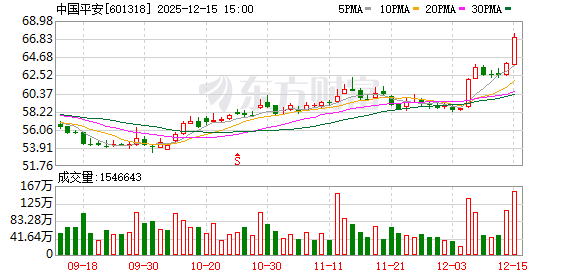
2025年12月15日,A股万亿保险巨头中国平安盘中涨幅超过5%,股价创出4年多的新高,盘中市值突破 1.2万亿元。而中国平安也是每经投研院在今年7月份发布的研究报告《"A股新七舰":寻找中国版"标普 500"之中的创新重估牛》中的龙头股之一。 每经记者|闫峰峰 每经编辑|吴永久 近期,在大盘持续调整的态势下,中国平安这种万亿巨头能够逆势上涨,除了其自身基本面的情况外, 也离不开两则消息的催化。 首先是政策红利的释放,保险板块整体迎来估值修复。 除了政策面和资金面的推动,中国平安能够表现强势,更多的还是在于其自身的经营与估值。2025年前 三季度,中国平安实现营业收入8329.40亿元,同比增长7.42%;实现净利润1328.56亿元,同比增长 11.47%。以12月15日中国平安中午收盘价67.09元计算,中国平安的市盈率(TTM)约为8.66倍,股息 率约为3.83%。当前A股正处于低利率环境与经济复苏预期下,具备盈利确定性与估值安全边际的龙头 更受青睐。 作为A股核心宽基指数代表,中证A500指数和标普500指数有诸多相似点,可以说是中国版的标普500指 数(详见《"A股新七舰":寻找中国版"标普500 ...
ETF盘中资讯 保险投资政策优化!中国平安涨近4%创阶段新高!香港大盘30ETF(520560)近5日吸金4349万元
Jin Rong Jie· 2025-12-15 06:15
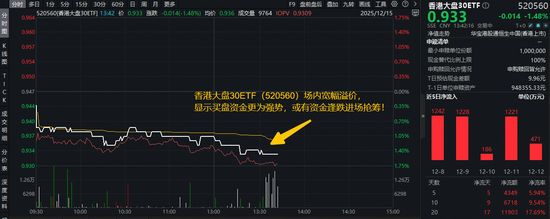
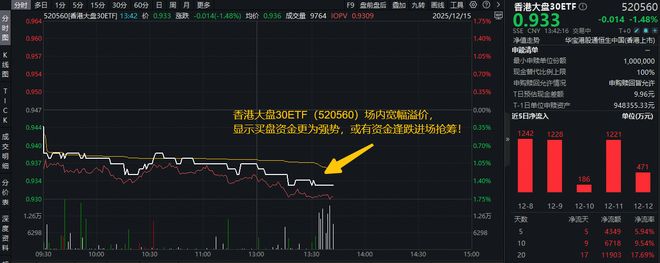
Core Viewpoint - The Hong Kong stock market is experiencing a pullback, with the Hang Seng Technology Index dropping over 2%, while the Hong Kong Large Cap 30 ETF (520560) shows strong buying interest despite market corrections, indicating potential investment opportunities in the sector [1][3]. Market Performance - On December 15, all three major indices in the Hong Kong stock market retreated, with the Hang Seng Technology Index falling more than 2% [1]. - The Hong Kong Large Cap 30 ETF (520560) saw a price decline of 1.48%, but it exhibited a wide premium in the market, suggesting strong buying momentum [1]. - Over the past five days, the Hong Kong Large Cap 30 ETF has attracted a net inflow of 43.49 million yuan, and in the last 20 days, it has accumulated a total of 119 million yuan, reflecting positive sentiment towards the future performance of Hong Kong stocks [1]. Sector Analysis - The insurance sector in Hong Kong showed resilience, with China Ping An rising nearly 4% to reach a new high, and China Life increasing by over 1% [1]. - In the consumer sector, Yum China and Anta Sports both rose by over 1%, leading the gains [1]. - Conversely, leading innovative pharmaceutical company BeiGene fell nearly 7%, while technology leaders like SMIC and Kuaishou dropped over 2%, negatively impacting index performance [1]. Regulatory Changes - The National Financial Regulatory Administration has announced adjustments to the risk factors for insurance companies, which will enhance the capacity for insurance capital to enter the market [3]. - The adjustments include a reduction in risk factors for investments in the CSI 300 Index, the CSI Dividend Low Volatility 100 Index, and STAR Market stocks, potentially releasing a minimum capital of approximately 19.8 billion yuan, which could lead to an additional 72.6 billion yuan in stock investments if fully utilized [3]. Investment Strategy - Analysts suggest that the adjusted valuation of Hong Kong stocks presents better opportunities, particularly in technology and dividend sectors, with a focus on core assets for long-term investment [3]. - The "barbell strategy" is recommended, combining stable value assets with growth-oriented assets in the Hong Kong market [3]. - The dividend yield of Hong Kong stocks is noted to be higher than that of A-shares, with the banking sector in Hong Kong yielding 6.1% compared to 4.3% in A-shares, indicating greater investment value [3]. ETF Overview - The Hong Kong Large Cap 30 ETF (520560) is highlighted as the first in the market to adopt a "technology + dividend" barbell strategy, comprising 30 major Hong Kong stocks, including high-growth tech companies like Alibaba and Tencent, as well as stable dividend payers like China Ping An and China Construction Bank [4].
保险投资政策优化!中国平安涨近4%创阶段新高!香港大盘30ETF(520560)近5日吸金43...
Xin Lang Cai Jing· 2025-12-15 06:03
Core Viewpoint - The Hong Kong stock market is experiencing a pullback, with the Hang Seng Technology Index dropping over 2%, while the Hong Kong Large Cap 30 ETF (520560) shows strong buying interest despite market corrections, indicating potential investment opportunities in the sector [1][3]. Group 1: Market Performance - The Hong Kong Large Cap 30 ETF (520560) has seen a price drop of 1.48% amid market consolidation, but it has recorded a net inflow of 43.49 million yuan over the past five days, totaling 119 million yuan in the last 20 days, reflecting positive sentiment towards the Hong Kong stock market [1][3]. - The insurance sector in Hong Kong is performing well, with China Ping An rising nearly 4% to reach a new high, and China Life increasing over 1% [1]. Group 2: Regulatory Changes - The National Financial Regulatory Administration has announced adjustments to risk factors for insurance companies, which will release approximately 19.8 billion yuan in minimum capital, potentially leading to an additional 72.6 billion yuan in stock investments if fully allocated [3]. Group 3: Investment Strategy - Analysts suggest adopting a "barbell strategy" for long-term investment in Hong Kong stocks, focusing on stable value assets as a base while also considering growth-oriented assets [3][4]. - The dividend yield of Hong Kong stocks is higher than that of A-shares, with the banking sector yielding 6.1% compared to 4.3% for A-shares, indicating greater investment value in Hong Kong [3]. - The long-term investment value of Hong Kong technology stocks is expected to increase, driven by developments in AI applications and the ongoing interest rate cycle [3].