
PICC P&C(02328)

Search documents
24%高息产品被叫停,两大平台业务关停退场
21世纪经济报道· 2026-01-25 12:52
Core Viewpoint - The recent regulatory changes in the small loan sector have led to significant disruptions in the credit guarantee insurance business, with major players like Dadi Insurance and Sunshine Insurance halting their financing guarantee services due to increased compliance pressures and risk management challenges [1][5][13]. Group 1: Regulatory Changes and Business Impact - The annualized interest rate cap for small loans has been set at 24%, leading to the cessation of products exceeding this rate [1][9]. - Dadi Insurance and Sunshine Insurance have announced the closure of their financing guarantee business, with Dadi stopping new business from the end of 2025 and Sunshine closing its related offline outlets and systems [1][4]. - The financing guarantee insurance business, which previously accounted for over 90% of the credit guarantee insurance market, is experiencing a significant contraction due to stricter regulations and the need for strategic focus [5][7][10]. Group 2: Industry Trends and Player Responses - Major players in the credit guarantee insurance sector, including Dadi and Sunshine, are not alone in their exit; other companies like Pacific Insurance have also withdrawn from this business segment [7][8]. - The industry has seen a clear trend of consolidation, with leading firms focusing on lower-risk insurance products such as health and auto insurance, while scaling back on high-risk financing guarantee services [8][12]. - The shift in focus is driven by the need to optimize resources and reduce capital occupation associated with high-risk financing guarantee insurance [8][14]. Group 3: Market Dynamics and Future Outlook - The financing guarantee insurance business is fundamentally linked to credit risk, which has been exacerbated by economic fluctuations and rising default rates among borrowers [8][14]. - The tightening of regulations is expected to reshape the credit landscape, leading to a potential consolidation of smaller players and a focus on high-quality borrowers [15][16]. - The overall impact of these regulatory changes is anticipated to lead to a more sustainable credit environment, aligning with the needs of the real economy [15].



拒收现金?央行点名:罚!
Sou Hu Cai Jing· 2026-01-23 14:03
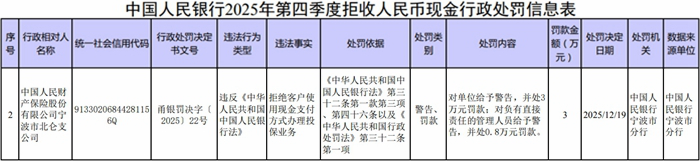
Core Viewpoint - The People's Bank of China has imposed economic penalties on two entities for refusing to accept cash payments, emphasizing the importance of respecting consumer payment choices and maintaining the legal status of the Renminbi [1] Group 1: Penalties Imposed - Jiangsu Urban Space Operation Management Co., Ltd. received a warning and a fine of 20,000 yuan for refusing cash payments for parking fees, with the responsible manager fined 2,000 yuan [1] - China Pacific Insurance Co., Ltd. Ningbo Beilun Branch was fined 30,000 yuan for refusing cash payments for insurance services, with the responsible manager fined 8,000 yuan [1] Group 2: Regulatory Intent - The People's Bank of China aims to strengthen legal awareness among businesses and promote a harmonious cash circulation environment [1] - Ongoing efforts will be made to address the refusal of cash payments to protect consumer rights and uphold the legal status of the Renminbi [1]
财险公司人均产能排行榜:财险职工人数三连降之后开始止跌企稳,自2016年以来人均产能复合增速8.9%!
13个精算师· 2026-01-23 11:03
Core Viewpoint - The article discusses the stability and growth of the average productivity per employee in the property insurance sector, highlighting a compound annual growth rate of 8.9% since 2016, with a projected average productivity of 3.953 million yuan per employee for 2024, indicating a stabilization in workforce numbers at approximately 423,000 employees [1][11][12]. Group 1: Employee Productivity - The total number of employees in the property insurance sector for 2024 is approximately 423,000, showing signs of stabilization compared to the previous year [11]. - The average productivity per employee for 2024 is projected to be 3.953 million yuan, which represents a 98% increase since 2016, with an annual compound growth rate of 8.9% [12]. - The average productivity for the top three companies (China Life Property, Ping An Property, and Taiping Property) is 4.468 million yuan, reflecting a year-on-year growth of 4.8% [3]. Group 2: Impact on Company Performance - An increase of 1% in average productivity leads to a decrease of 0.051 percentage points in the comprehensive expense ratio, ultimately improving the return on equity (ROE) by 0.017 percentage points [6][24]. - There are 7 companies with average productivity exceeding 10 million yuan, 5 companies between 5-10 million yuan, 26 companies between 3-5 million yuan, 42 companies between 1-3 million yuan, and 5 companies below 1 million yuan [6][30]. - The average productivity across 85 property insurance companies for 2024 is 4.084 million yuan, with a weighted average of 3.953 million yuan and a median of 2.851 million yuan [26]. Group 3: Empirical Analysis - The empirical model indicates a significant negative correlation between average productivity and the comprehensive expense ratio, confirming that higher productivity correlates with lower operational costs [20]. - The analysis of 640 sample points shows that average productivity significantly impacts the comprehensive expense ratio at a 1% confidence level [19]. - The relationship between average productivity and ROE is positively correlated, with a 1% increase in productivity resulting in a 0.017 percentage point increase in ROE [24][25]. Group 4: Company Rankings - The top ten property insurance companies by average productivity for 2024 include Zhonghui Mutual, Guotai Property, and Taikang Property, with Zhonghui Mutual leading at 36.724 million yuan [33]. - The rankings reveal that companies with internet attributes or self-insurance characteristics tend to have higher productivity levels [29]. - The detailed rankings of the top 30 companies are available for further analysis [32].



The Capital Group Companies, Inc.减持中国财险1229.4万股 每股作价约16.03港元
Zhi Tong Cai Jing· 2026-01-23 11:03
香港联交所最新资料显示,1月21日,The Capital Group Companies,Inc.减持中国财险(02328)1229.4万 股,每股作价16.0336港元,总金额约为1.97亿港元。减持后最新持股数目约为4.12亿股,最新持股比例 为5.97%。 ...
人保财险宁波市北仑支公司被罚 拒收人民币现金
Zhong Guo Jing Ji Wang· 2026-01-23 07:56
中国经济网北京1月23日讯 中国人民银行网站昨日公布2025年第四季度拒收人民币现金行政处罚情况。 中国人民财产保险股份有限公司宁波市北仑支公司(以下简称"人保财险宁波市北仑支公司")拒绝客户 使用现金支付方式办理投保业务。 中国人民银行宁波市分行对人保财险宁波市北仑支公司下发的行政处罚决定书(甬银罚决字〔2025〕22 号)显示,人保财险宁波市北仑支公司上述行为违反《中华人民共和国中国人民银行法》。 中国人民银行宁波市分行依据《中华人民共和国中国人民银行法》第三十二条第一款第三项、第四十六 条以及《中华人民共和国行政处罚法》第三十二条第一项,对人保财险宁波市北仑支公司给予警告,并 处3万元罚款;对负有直接责任的管理人员给予警告,并处0.8万元罚款。 (责任编辑:马先震) ...
国信证券:新能源车险长期增长空间与战略价值明确 传统龙头更有望享受超额成长
智通财经网· 2026-01-23 07:54
Core Viewpoint - The new energy vehicle insurance sector is transitioning from initial rapid growth to a high-quality competitive stage centered on technology and ecology, with clear long-term growth potential despite short-term profitability pressures [1] Group 1: Industry Cycle and Growth - The new energy vehicle insurance market in China has entered a "golden development period" characterized by simultaneous increases in volume and price, driven by national strategies and policy incentives [2] - By 2024, the sales of new energy vehicles are expected to account for 40.9% of total new car sales, with retail penetration nearing 50%, significantly outpacing traditional fuel vehicles [2] - The penetration of Advanced Driver Assistance Systems (ADAS) exceeding 50% and the adoption of Usage-Based Insurance (UBI) are reshaping risk management and pricing logic in the insurance industry [2] Group 2: Challenges and Cost Pressures - The high growth in new energy vehicle insurance is accompanied by significant "high cost, high claim" pressures, stemming from the fundamental differences in risk structure between new energy vehicles and traditional fuel vehicles [3] - The costs associated with the "three electric systems" (battery, motor, and electronic control) are high, and the complexity of accident liability due to smart components leads to increased claim frequency [3] - The industry is projected to face an underwriting loss of 5.7 billion yuan in 2024, highlighting the mismatch between traditional insurance models and the structural characteristics of new energy vehicles [3] Group 3: Industry Profitability Model and Competitive Barriers - The profitability model of the industry needs reconstruction, focusing on risk reduction, ecological integration, and international standardization to build competitive barriers [4] - Leading insurance companies, represented by the "old three" (Ping An, PICC, and China Life), are developing risk reduction services to enhance risk management and optimize operational efficiency [4] - Strategic collaborations between insurance companies and manufacturers are evolving from zero-sum games to symbiotic relationships, addressing data silos and repair cost challenges [4] - Chinese insurance companies are expanding internationally, leveraging domestic data and risk management capabilities to support the global expansion of local new energy vehicle brands [4]

央行对两家拒收人民币现金单位作出处罚
Jin Rong Shi Bao· 2026-01-23 01:32
Core Viewpoint - The People's Bank of China has imposed economic penalties on two entities for refusing to accept cash payments, emphasizing the importance of cash as a legal tender and its role in supporting the real economy and financial stability [1][3]. Group 1: Penalties Imposed - Jiangsu Urban Space Operation Management Co., Ltd. received a warning and a fine of 20,000 yuan for refusing cash payments for parking fees, with the responsible manager fined 2,000 yuan [1]. - China Pacific Insurance Co., Ltd.'s Ningbo Beilun branch was fined 30,000 yuan for refusing cash payments for insurance services, with the responsible manager fined 8,000 yuan [1]. Group 2: Regulations on Cash Payments - The newly established "Regulations on Cash Payment and Service" will be implemented to ensure cash payment acceptance in various scenarios, including face-to-face services and online transactions completed offline [2]. - Entities using self-service models must clearly indicate payment methods and cash acceptance policies, while fully respecting the public's right to know and choose payment options [2]. Group 3: Banking Sector Requirements - Financial institutions are required to provide cash deposit and withdrawal services at their branches and ensure that the layout of ATMs meets the needs of different customer groups [3]. - Banks must also manage cash circulation properly to prevent the distribution of unfit currency and support cash acceptance when acting as payment agents [3].
人保财险宁波市北仑支公司被罚3万元:拒绝客户使用现金方式办理投保业务
Xin Lang Cai Jing· 2026-01-22 08:23
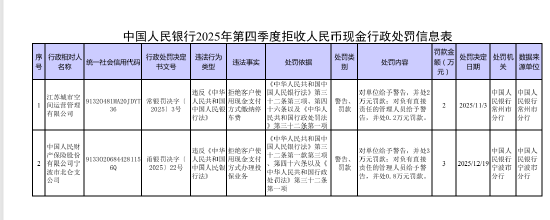
责任编辑:王馨茹 1月22日金融一线消息,中国人民银行今日公布2025年第四季度拒收人民币现金行政处罚情况。中国人 民财产保险股份有限公司宁波市北仑支公司因违反《中华人民共和国中国人民银行法》相关规定,拒绝 客户使用现金方式办理投保业务,被给予警告,并处以3万元罚款;同时负有直接责任的管理人员被给 予警告,并处以0.8万元罚款。 责任编辑:王馨茹 1月22日金融一线消息,中国人民银行今日公布2025年第四季度拒收人民币现金行政处罚情况。中国人 民财产保险股份有限公司宁波市北仑支公司因违反《中华人民共和国中国人民银行法》相关规定,拒绝 客户使用现金方式办理投保业务,被给予警告,并处以3万元罚款;同时负有直接责任的管理人员被给 予警告,并处以0.8万元罚款。 | 序 行政相对人 | | | 行政处题改编 | 遇洁行为 | | | 处罚线 | | 罚款会 | | 处罚决定 让罚机 数据来 | | --- | --- | --- | --- | --- | --- | --- | --- | --- | --- | --- | --- | | r | 名称 | 统一社会信用代码 | 书文学 | 学型 | 课法事实 | ...
人保财险护航传统金属锻錾技艺,探索“保险+非遗”文化保护新路径
Jin Rong Jie· 2026-01-22 07:16
Group 1 - The core idea of the news is the innovative insurance policy launched by PICC Property and Casualty Beijing Branch, which provides product liability insurance for traditional metal forging craftsmanship, marking a new opportunity for the modern inheritance of this ancient skill [1] - The insurance covers economic compensation responsibilities for third-party personal injury or property damage caused by product defects during normal use of the forged products, along with necessary legal fee protection [1] - PICC has previously explored non-material cultural heritage insurance, having issued the first batch of agricultural cultural heritage protection insurance in 2025, providing comprehensive coverage for various agricultural cultural heritages [1] Group 2 - The insurance mechanism offers a full-chain protection system for intangible cultural heritage skills, including pre-prevention, in-process control, and post-compensation [2] - In Chaozhou, PICC provides exclusive risk protection for the Phoenix Dan Cong tea museum and the Chaozhou hand-pulled red clay pot craftsmanship transmission platform, creating a dual protection system for both material and non-material aspects [2] - PICC's Ningbo branch launched "artisan insurance" to cover various risks faced by traditional artisans, enhancing their operational security and allowing them to focus on their craft with peace of mind [2] - The company aims to implement the "14th Five-Year Plan" recommendations for the systematic protection of cultural heritage, continuing to deepen the "insurance + intangible cultural heritage" innovative model [2]
喀什金融监管分局同意人保财险巴楚支公司阿拉格尔乡营销服务部变更营业场所
Jin Tou Wang· 2026-01-22 04:58
Group 1 - The article discusses the approval of a change in the business location for the Kashgar branch of China People's Property Insurance Company [2] - The new business location is specified as being next to the square in Group 2 of Kuanawutang Village, Bachu County, Kashgar Prefecture, Xinjiang Uygur Autonomous Region [2] - The company is required to handle the change and obtain the necessary permits in accordance with relevant regulations [2] Group 2 - The stock price of China People's Property Insurance Company is reported at 15.76, reflecting a decrease of 0.27, or 1.68% [1] - The stock price has shown fluctuations within a range of 15.73 to 16.33 during the trading session [1]