
WuXi AppTec(02359)

Search documents
药明康德:预计2025年营收454.56亿元,净利润同比增102.65%
Xin Lang Cai Jing· 2026-01-12 08:45
药明康德公告称,预计2025年实现营业收入约454.56亿元,同比增长15.84%,其中持续经营业务收入同 比增21.40%;经调整归母净利润约149.57亿元,同比增长41.33%;扣非净利润约132.41亿元,同比增长 32.56%;归母净利润约191.51亿元,同比增长102.65%;基本每股收益约6.70元/股,同比增长 104.27%。业绩增长因公司聚焦CRDMO业务模式,且非经常性损益包括出售股权等净收益约55.95亿 元。 ...
港股通医疗ETF华宝(159137)涨0.38%,成交额1.73亿元
Xin Lang Cai Jing· 2026-01-12 07:15
Core Insights - The Huabao CSI Hong Kong Stock Connect Medical Theme ETF (159137) closed with a gain of 0.38% on January 12, with a trading volume of 173 million yuan [1] Fund Overview - The fund was established on December 31, 2025, and is officially named Huabao CSI Hong Kong Stock Connect Medical Theme Exchange-Traded Fund [1] - The management fee is set at 0.50% per annum, while the custody fee is 0.10% per annum [1] - The performance benchmark for the fund is the return of the CSI Hong Kong Stock Connect Medical Theme Index, adjusted for the RMB exchange rate [1] Fund Management - The current fund manager is Zhang Fang, who has managed the fund since its inception, achieving a return of 4.33% during the management period [1] Top Holdings - The latest report indicates that the top holdings of the ETF include: - WuXi Biologics: 2.65% holding, valued at approximately 7.49 million yuan [2] - JD Health: 2.02% holding, valued at approximately 5.71 million yuan [2] - WuXi AppTec: 1.44% holding, valued at approximately 4.07 million yuan [2] - Crystal Digital Holdings: 0.98% holding, valued at approximately 2.76 million yuan [2] - Alibaba Health: 0.93% holding, valued at approximately 2.63 million yuan [2] - WuXi AppTec Holdings: 0.86% holding, valued at approximately 2.43 million yuan [2] - Sinopharm: 0.72% holding, valued at approximately 2.04 million yuan [2] - Genscript Biotech: 0.55% holding, valued at approximately 1.55 million yuan [2] - Ping An Good Doctor: 0.46% holding, valued at approximately 1.31 million yuan [2] - CSPC Pharmaceutical Group: 0.41% holding, valued at approximately 1.17 million yuan [2]



一周医药速览(1.5-1.9)
Cai Jing Wang· 2026-01-09 09:16
Group 1 - Insilico Medicine announced a collaboration with Servier valued at $888 million focused on the discovery and development of innovative anti-cancer therapies [1] - Insilico will receive up to $32 million in upfront and milestone payments, leveraging its AI-driven drug development platform [1] - Servier will lead the clinical validation and commercialization of promising drug candidates globally [1] Group 2 - Weigao Blood Products announced a major asset restructuring involving the acquisition of 100% equity in Weigao Purui for approximately $8.511 billion [2] - Post-transaction, Weigao Purui will become a wholly-owned subsidiary, expanding the company's business into pharmaceutical packaging [2] - Weigao's shareholding in Weigao Blood Products will increase to 84.36%, maintaining absolute control [2] Group 3 - Earendil Labs (HuaShen ZhiYao) entered a strategic partnership with Sanofi worth up to $2.56 billion for the development of bispecific candidates targeting autoimmune and inflammatory diseases [3] - Earendil Labs will receive up to $160 million in upfront and milestone payments linked to early project outcomes [3] - The agreement includes tiered royalties based on net sales [3] Group 4 - WuXi AppTec announced that its controlling shareholders have reduced their stake by 2%, totaling 59.68 million shares [4] - The reduction was completed as per the previously disclosed plan, with the controlling shareholders holding 18.211% of the total shares before the reduction [4] Group 5 - Nanhua Biological announced plans for a significant asset restructuring to acquire 51% of Huize Pharmaceutical for cash [5] - The transaction is expected to constitute a major asset restructuring without involving share issuance or control changes [5] - Due diligence and negotiations are ongoing, with no formal agreement signed yet [5] Group 6 - Kangchen Pharmaceutical projected a net profit of between 145 million to 175 million yuan for 2025, representing a year-on-year increase of 243% to 315% [6] - The expected net profit excluding non-recurring gains is projected to be between 140 million to 170 million yuan, reflecting a significant increase from the previous year [6] Group 7 - Yilian Biotech signed a new exclusive licensing agreement with Roche for the YL201 project, with an upfront payment of $570 million [7] - The agreement allows Roche exclusive rights to develop and commercialize the YL201 project globally, excluding mainland China and certain regions [7] - This partnership builds on a successful collaboration on the YL211 project, aiming to accelerate the development of YL201 [7]



香港交易所将于1月19日推出百济神州等六只新股票期权
智通财经网· 2026-01-09 06:01
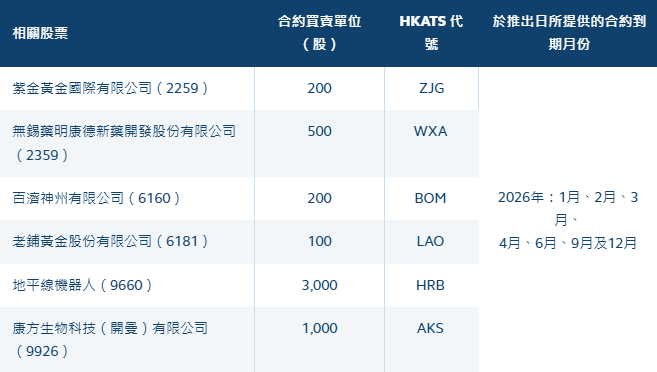
Group 1 - The Hong Kong Stock Exchange (HKEX) will launch six new stock options on January 19, 2026, expanding the stock options market and providing investors with more choices [2] - The new stock options will include Zijin Mining International (02259), WuXi AppTec (02359), BeiGene (06160), Lao Poo Gold (06181), Horizon Robotics (09660), and CanSino Biologics (09926) [2] - The average daily trading volume of the derivatives market at HKEX reached a record high of 1,662,751 contracts last year, representing a 7% year-on-year increase [2] Group 2 - Stock options, including monthly and weekly expiry contracts, were among the most actively traded products, with an average daily trading volume of 879,831 contracts, marking a 22% year-on-year increase [2] - The new stock options will have varying contract sizes, such as 200 shares for Zijin Mining International and BeiGene, and 500 shares for WuXi AppTec [3] - The launch will include contracts for multiple months in 2026, specifically January, February, March, April, June, September, and December for certain stocks [3]




香港交易所将于1月19日推出百济神州(06160)等六只新股票期权
智通财经网· 2026-01-09 05:50
Core Viewpoint - Hong Kong Stock Exchange (HKEX) will launch six new stock options on January 19, 2026, expanding the stock options market and providing investors with more choices [1] Group 1: New Stock Options - The new stock options will include Zijin Gold International (02259), WuXi AppTec (02359), BeiGene (06160), Lao Poo Gold (06181), Horizon Robotics (09660), and CanSino Biologics (09926) [1] - The contract sizes for the new options are as follows: Zijin Gold International (200 shares), WuXi AppTec (500 shares), BeiGene (200 shares), Lao Poo Gold (100 shares), Horizon Robotics (3,000 shares), and CanSino Biologics (1,000 shares) [2] Group 2: Market Performance - The average daily trading volume of HKEX's derivatives market reached 1,662,751 contracts last year, marking a 7% year-on-year increase and setting a new record [1] - Stock options, including monthly and weekly expiry contracts, were among the most actively traded products, with an average daily trading volume of 879,831 contracts, a 22% year-on-year increase and a new record high [1]
药明康德涨2.04%,成交额21.18亿元,主力资金净流入5026.47万元
Xin Lang Zheng Quan· 2026-01-09 02:55
Core Viewpoint - WuXi AppTec's stock price has shown a significant increase, with a year-to-date rise of 10.51% and a market capitalization of approximately 298.83 billion yuan as of January 9 [1][2]. Group 1: Stock Performance - On January 9, WuXi AppTec's stock rose by 2.04%, reaching 100.17 yuan per share, with a trading volume of 2.118 billion yuan and a turnover rate of 0.87% [1]. - The stock has increased by 10.51% year-to-date, with a 10.51% rise over the last five trading days, an 8.00% increase over the last 20 days, and a 0.71% increase over the last 60 days [1]. Group 2: Financial Performance - For the period from January to September 2025, WuXi AppTec reported a revenue of 32.857 billion yuan, reflecting a year-on-year growth of 18.61%, and a net profit attributable to shareholders of 12.076 billion yuan, which is an increase of 84.84% [2]. Group 3: Shareholder Information - As of September 30, 2025, the number of shareholders for WuXi AppTec reached 274,100, an increase of 16.39% from the previous period, with an average of 9,024 circulating shares per shareholder [2]. - The company has distributed a total of 14.06 billion yuan in dividends since its A-share listing, with 10.406 billion yuan distributed over the last three years [3]. Group 4: Institutional Holdings - As of September 30, 2025, Hong Kong Central Clearing Limited is the second-largest circulating shareholder, holding 249 million shares, a decrease of 52.607 million shares from the previous period [3]. - Other notable institutional shareholders include Huaxia SSE 50 ETF and Huatai-PineBridge CSI 300 ETF, both of which have seen a reduction in their holdings [3].
科研服务CXO板块延续高景气度-2026年进一步兑现业绩
2026-01-08 16:02
Summary of Conference Call Records Industry Overview - The life sciences service sector, particularly the CXO segment, continues to experience high growth and is expected to deliver strong performance in 2026, benefiting from the upward cycle in innovative drugs and improved investment conditions [1][2][3] Key Companies and Performance - Notable companies in the life sciences service industry include: - **Hao Yuan Medicine**: Q3 revenue growth close to 30%, with a non-recurring profit growth of 70%. The company has secured orders exceeding 630 million yuan, a 50% year-on-year increase [2][8] - **Bai Ao Sai Tu**: Achieved a revenue growth of 60% in Q3 and recorded its first annual profit, with significant potential in humanized mouse sales and antibody business [2][8] - **WuXi AppTec**: Expected to see over 60% revenue growth in the ADC sector in the first half of 2026, with a strong order backlog [10][19] - **Kailai Ying**: Positioned well in the ADC market, with significant growth potential [10][19] - **Yangguang Nuohe**: Anticipated to achieve a profit of 300 million yuan in 2026, with a promising drug pipeline [20] Financial Performance - In the first three quarters of 2025, 16 representative life sciences service companies reported revenue and profit growth rates of high single digits and double digits, respectively. In Q3 alone, revenue and profit growth rates were double digits and 50%, indicating significant operational improvement [4][6] - The gross profit margin is expected to improve due to a clearer competitive landscape, leading to enhanced industry profitability [4] Market Trends - The overseas market is benefiting from improved investment conditions and the Federal Reserve's interest rate cuts, leading to an increase in the share of overseas business and expanding global market potential [7] - The domestic CRO market is experiencing a price recovery trend after years of intense competition, with expectations for more significant price improvements by 2027 as supply conditions stabilize [11][12] Growth Opportunities - The ADC and small nucleic acid sectors are projected to bring substantial order increases in 2026, with companies like WuXi AppTec and Hao Yuan Medicine expected to lead this growth [10][19] - The CRO sector is seeing a shift towards innovation, with companies like Yangguang Nuohe and Chengdu Xian Dao making progress in developing innovative drugs [13] Investment Recommendations - Recommended companies for investment include: - **WuXi AppTec**: Strong growth in peptide business and expected to achieve significant revenue increases [14][17] - **Kailai Ying**: Leading in peptide capacity expansion [14] - **Tigermed**: Positioned well in the CRO market with growth potential [21] - **Norseg and Prasis**: Expected to benefit from overall industry trends [17] Conclusion - The life sciences service industry is poised for continued growth, driven by innovative drug development, improved investment conditions, and a recovering market landscape. Key players are expected to deliver strong financial performance, making them attractive investment opportunities.



药明康德(02359):2026年一季度催化因素蓝图
citic securities· 2026-01-08 13:29
Investment Rating - The report does not explicitly provide an investment rating for WuXi AppTec [2][3]. Core Insights - The report highlights three major catalysts that may drive WuXi AppTec's stock performance in Q1 2026: 1) Updates from the industry summit scheduled for January 12-15, which is expected to support the CRO industry's outlook; 2) The release of the 1260H list in January-February 2026, which should alleviate the impact of pending policy decisions; 3) The company's full-year guidance for 2026, to be announced in March 2026 [5]. - The report indicates that in 2026, the focus for the Chinese healthcare sector will shift towards earnings realization rather than valuation multiple expansion, with WuXi AppTec expected to lead in visibility of earnings growth [7]. - The report anticipates a recovery in outsourcing demand in 2026 due to the resolution of policy and tariff uncertainties, which had previously delayed biotech financing and new R&D initiatives in 2025 [6]. Summary by Sections Company Overview - WuXi AppTec is a global enterprise with operations across Asia, Europe, and North America, providing a comprehensive range of R&D and manufacturing services to advance the pharmaceutical and healthcare industries [10]. - The company covers the entire drug development cycle through five core business segments: small molecule R&D and manufacturing, biologics R&D and manufacturing, cell and gene therapy R&D and manufacturing, medical device testing, and molecular testing and genomics [10]. Revenue Breakdown - Revenue by product category: Chemical business (72.3%), Testing business (16.2%), Biological business (6.3%), High-end therapeutic CTDMO (3.2%) [11]. - Revenue by region: Middle East and Africa (8.7%), Asia (36.5%), Europe (27.3%), Americas (27.5%) [11]. Stock Information - Stock price as of January 5, 2026: 104.2 HKD - Market capitalization: 40.33 billion USD - Consensus target price (Refinitiv): 130.76 HKD [13].
智通AH统计|1月8日
智通财经网· 2026-01-08 08:17
Group 1 - The article highlights the top three companies with the highest AH premium rates: Northeast Electric (00042) at 785.25%, Zhejiang Shibao (01057) at 433.39%, and Hongye Futures (03678) at 275.07% [1] - The bottom three companies with the lowest AH premium rates are Ningde Times (03750) at -12.17%, Hengrui Medicine (01276) at -1.77%, and China Merchants Bank (03968) at -0.48% [1] - The article also lists the top three companies with the highest deviation values: Zhejiang Shibao (01057) at 104.40%, Goldwind Technology (02208) at 57.76%, and Nanjing Panda Electronics (00553) at 27.70% [1] Group 2 - The companies with the lowest deviation values include Northeast Electric (00042) at -95.85%, Chenming Paper (01812) at -26.90%, and Nanhua Futures (02691) at -19.11% [2] - The top ten AH stocks by premium rate include Sinopec Oilfield Service (01033) at 266.67% and Fudan Zhangjiang (01349) at 242.24% [1] - The bottom ten AH stocks by premium rate include WuXi AppTec (02359) at 4.34% and Weichai Power (02338) at 7.12% [1]

药明康德授出12.62万股奖励股份
Zhi Tong Cai Jing· 2026-01-07 14:52
Core Viewpoint - WuXi AppTec (603259)(02359) announced the granting of 126,200 incentive shares to 24 selected participants, representing approximately 0.0247% of the total issued H shares and about 0.0042% of the total issued share capital as of the announcement date [1] Summary by Relevant Categories - **Incentive Shares Granted** - A total of 126,200 incentive shares have been awarded to 24 selected participants [1] - This represents around 0.0247% of the total issued H shares [1] - The awarded shares account for approximately 0.0042% of the total issued share capital [1]