CM BANK(03968)

Search documents
兴业恒泰债券型证券投资基金基金份额发售公告
Shang Hai Zheng Quan Bao· 2025-07-28 18:57
登录新浪财经APP 搜索【信披】查看更多考评等级 重要提示 1、兴业恒泰债券型证券投资基金(以下简称"本基金")的募集已获中国证监会2025年3月14日证监许可 【2025】491号文准予募集注册。中国证监会对本基金募集的注册并不代表其对本基金的投资价值和市 场前景作出实质性判断、或保证,也不表明投资于本基金没有风险。 2、本基金的基金类型是债券型证券投资基金,基金运作方式是契约型开放式,基金存续期限为不定 期。 3、本基金的基金管理人和登记机构为兴业基金管理有限公司(以下简称"本公司"、"兴业基金"),基 金托管人为招商银行股份有限公司。 4、本基金募集对象包括符合法律法规规定的可投资于证券投资基金的个人投资者、机构投资者、合格 境外投资者以及法律法规或中国证监会允许购买证券投资基金的其他投资人。 5、本基金自2025年8月4日至2025年8月22日通过基金管理人指定的销售机构公开发售。本基金的募集期 限不超过3个月,自基金份额开始发售之日起计算。基金管理人根据认购的情况可适当调整募集时间, 并及时公告,但最长不超过法定募集期限。 6、本基金通过兴业基金管理有限公司直销机构及其他销售机构进行公开发售,基金管 ...

21次!险资举牌创五年新高,投资逻辑告别“野蛮人”
Xin Lang Cai Jing· 2025-07-28 12:28
Core Viewpoint - The recent surge in insurance capital's significant stake acquisitions in the secondary market reflects a shift towards long-term value investment strategies, driven by declining interest rates, regulatory encouragement, and asset-liability management needs [1][2]. Group 1: Insurance Capital Activity - As of July 28, 2025, insurance companies have completed 21 stake acquisitions, surpassing the total for 2024 and setting a five-year record, with major players including Ping An Life, China Post Insurance, and New China Life [1]. - Ping An Life and its affiliated asset management companies have been the primary force behind these acquisitions, triggering seven stake purchases, including three for China Merchants Bank H-shares, increasing their holding from 5% to 15% [1]. Group 2: Investment Rationale - The frequent buying of state-owned bank H-shares by insurance capital is a strategic decision based on factors such as dividend yield, tax advantages, market liquidity, regulatory requirements, and counter-cyclical attributes [2]. - Stake acquisitions allow insurance companies to optimize financial statements and mitigate the impact of market volatility by accounting for investment income using the equity method [2]. Group 3: Asset Allocation Trends - As of Q1 2025, the proportion of stocks and funds in domestic insurance capital reached a historical high of 13.3%, indicating a strong desire among insurance companies to increase equity investments due to declining yields in bonds and non-standard assets [3]. - New China Life has shown a strong commitment to increasing its equity asset ratio, which reached nearly 20% in 2024, with a further increase of 2 percentage points in the first half of 2025 [3]. Group 4: Regulatory Support - The regulatory framework is encouraging long-term equity investments by insurance capital, with a recent notice from the Ministry of Finance introducing a five-year cycle indicator for assessing the performance of insurance funds [4]. - The new assessment method adjusts the evaluation of net asset return rates and capital preservation rates to include annual, three-year, and five-year indicators, promoting stability and sustainability in long-term investments [4].
金融业也反“内卷”,首先抵制恶性价格战
Nan Fang Du Shi Bao· 2025-07-27 23:13
Core Viewpoint - The financial industry is increasingly focusing on resisting "involution" competition, with institutions like Ping An Bank taking steps to promote self-discipline and strategic adjustments to combat this issue [3][5][10]. Group 1: Company Actions - Ping An Bank held a mid-year meeting to outline its business development plan and promote anti-"involution" competition efforts, with over 2,000 employees required to sign a commitment letter [3]. - In the first quarter, Ping An Bank reported a revenue of 33.709 billion, a year-on-year decrease of 13.1%, and a net profit of 14.096 billion, down 5.6% [3]. - The bank's total assets reached 5.78 trillion at the end of the first quarter, reflecting a slight increase of 0.1% from the end of the previous year [3]. Group 2: Industry Trends - The Guangdong Banking Association has established a "1+3+N" system to combat "involution" competition, which includes a negative list from regulatory bodies and self-discipline agreements [5]. - The call for resisting "involution" is echoed nationwide, with provinces like Fujian and Anhui issuing self-discipline agreements to prevent malicious competition [6]. - The financial sector is facing pressure from low interest rates and low spreads, with banks like China Merchants Bank reporting a revenue decline of 3.09% and a net profit drop of 2.08% in the first quarter [9]. Group 3: Regulatory Environment - Regulatory bodies are actively opposing "involution" competition, with measures including the issuance of negative lists and guidance for industry associations to create self-discipline agreements [5][6]. - The implementation of the "reporting and operation unity" policy in the insurance sector aims to standardize market practices and curb malicious competition, resulting in a 30% reduction in average commission levels [8]. Group 4: Challenges and Perspectives - The banking industry is experiencing a critical point with net interest margins dropping to around 1.43%, leading to concerns about profitability and sustainability [9]. - Some industry professionals argue that the focus on commission rates and fees is merely a superficial response to deeper issues of homogeneity in the market, suggesting that true reform requires addressing these underlying problems [10].



2Q25主动型公募基金持仓更分散,银行股持仓占比环比上升
Huachuang Securities· 2025-07-27 11:15
Investment Rating - The report maintains a "Buy" rating for the banking sector [1] Core Insights - The proportion of bank stocks held by active equity funds increased to 4.88% in Q2 2025, marking a 1.13 percentage point increase from the previous quarter, driven by both volume and price increases [2][3] - The banking sector's performance outpaced the broader market, with A-share banks rising by 11.23% in Q2 2025, outperforming the CSI 300 and Wind All A indices by 10.7 and 8.25 percentage points respectively [2] - The report highlights a significant increase in holdings of joint-stock banks and quality regional banks, with notable increases in positions for institutions like China Merchants Bank, Minsheng Bank, and others [2][3] Summary by Sections Fund Holdings - In Q2 2025, the number of bank stocks held by active funds reached 4.88%, the second highest since Q1 2021 [2] - The total number of bank shares held by active funds increased by 6.64 billion shares, reaching 48.17 billion shares [2] - The market capitalization of index funds holding bank stocks rose by 27.7% to 133.385 billion yuan, with an increase of 16.3 billion shares [3] Sector Performance - The active fund's allocation to bank stocks saw a quarter-on-quarter increase, although the sector still has the largest allocation gap among 31 sectors, with a shortfall of 7.8% [3] - The report notes that while state-owned banks saw a slight decrease in allocation, joint-stock and regional banks experienced significant increases due to improved fundamentals and lower valuations [2][3] Investment Recommendations - The report suggests a diversified investment strategy focusing on state-owned banks and stable joint-stock banks, recommending specific banks such as China Merchants Bank and CITIC Bank for their long-term investment value [8] - It emphasizes the importance of banks with high dividend yields and strong asset quality, indicating that these banks still offer absolute returns [8] - The report also highlights the potential for banks with low valuations to improve their return on equity, suggesting a focus on banks like Pudong Development Bank [8] Key Company Forecasts - The report provides earnings per share (EPS) and price-to-earnings (PE) ratios for several banks, with recommendations for Ningbo Bank, Jiangsu Bank, and others based on their projected performance [9]



门槛暗升权益缩水?信用卡行业摆脱“低水平内耗”悄然蔓延
Nan Fang Du Shi Bao· 2025-07-25 15:29
Core Viewpoint - The credit card industry is undergoing significant changes as banks, including China Merchants Bank (CMB), adjust their high-end credit card offerings in response to regulatory pressures and market competition, aiming for sustainable business models rather than short-term promotions [2][3][5]. Group 1: Changes in Credit Card Offerings - CMB announced that starting September 1, 2025, it will replace its dual-branded high-end magnetic stripe credit cards with chip versions, introducing new spending thresholds for benefits [2]. - The classic platinum credit card now requires an annual spending of 180,000 yuan to redeem 3,600 yuan in annual fees, while supplementary cards have a new threshold of 100,000 yuan [2]. - Other banks, such as Everbright Bank and SPDB, have also announced adjustments to their high-end credit card benefits, including changes to lounge access and reward redemption [3]. Group 2: Industry Trends and Responses - The credit card sector is experiencing a broader trend of increasing usage thresholds, adjusting point systems, and reducing high-end benefits across multiple banks [3][5]. - CMB's credit card circulation decreased by 259,100 cards to 9,685,900 by the end of 2024, with a decline in transaction volume by 8.23% year-on-year [5]. - The adjustments in high-end benefits are seen as a response to the "involution" phenomenon in various industries, aiming to shift focus from aggressive expansion to high-quality development [5][6]. Group 3: Cost Management and Value Creation - High-end credit card benefits are significant resource consumers for banks, with operational costs exceeding 1,000 yuan per card for certain privileges [7]. - The industry is facing pressure from third-party entities exploiting high-end benefits, leading to increased costs for credit card centers [7]. - The shift towards rationalizing benefits is intended to encourage banks to focus on sustainable practices and value creation in the credit card sector [8].

招商银行中标结果:企业年金基金受托管理机构服务采购项目的结果公告(非政府采购项目)
Sou Hu Cai Jing· 2025-07-25 12:35
Group 1 - The core point of the news is that China Merchants Bank's Hangzhou branch has won the bid for the entrusted management of enterprise annuity funds, indicating a significant opportunity for the bank in the asset management sector [1] - The procurement project is organized by the Zhejiang Provincial Water Resources and Estuary Research Institute, with a public bidding process initiated [1] - The winning bid includes a management fee rate of 0.08%, an investment management fee rate of 0.24% for fixed income portfolios, a custody fee rate of 0.056%, and an account management fee of 1 yuan per account per month [1] Group 2 - The announcement was made on July 25, 2025, with the procurement project number being 202*****-0001 [1] - The evaluation committee for the bidding process consisted of five members, indicating a structured and formal assessment process [1] - Contact information for both the procuring entity and the bidding agency is provided, ensuring transparency and accountability in the procurement process [1]
2025Q2泛固收类基金季报点评:如何进行资产配置?
HWABAO SECURITIES· 2025-07-25 12:03
1. Report Industry Investment Rating There is no information provided regarding the report's industry investment rating. 2. Core Viewpoints of the Report - In Q2 2025, A - shares and Hong Kong stocks showed different performances, with the overall market - value style in A - shares being dominant, and the bond market slightly recovered in June after fluctuations from April to May. REITs and convertible bond funds led the performance, and "fixed - income +" funds performed well driven by the equity market [4]. - Most fund managers expect the economy to continue a weak recovery in Q3 2025, with monetary policy remaining loose but limited room for interest - rate decline. Strategies focus on coupon income from medium - short - duration, medium - high - grade urban investment bonds and financial bonds, and the overall tone is prudent and flexible [40]. 3. Summary by Directory 3.1 固收型公募基金2025Q2季报数据解读 Performance - In Q2 2025, in the context of weak economic recovery, gradually restored equity sentiment, and intensified long - short game and fluctuations in the bond market, REITs and convertible bond funds led the performance, and "fixed - income +" funds performed well driven by the equity market. Pure - bond fund net values generally recovered [4]. - The top - performing funds in terms of Q2 2025 compounded unit net - value growth rate (%) were REITs funds (8.07%), convertible bond funds (3.49%), and QDII bond - type funds (1.38) [5]. Scale - By the end of Q2 2025, passive index - type bond funds received significant capital inflows and had the fastest scale growth [8]. Leverage - As of June 30, 2025, compared with March 31, 2025, the overall fund leverage showed an upward trend [11]. Duration - As of June 30, 2025, compared with March 31, 2025, the fitted durations of pure - bond funds all showed an upward trend [14]. Weighted Position Changes of Fixed - Income + Funds - By the end of Q2 2025, the convertible - bond positions of different types of fixed - income + funds were basically the same as in the previous quarter, while the stock positions all showed a downward trend [17]. - The top five industries for stock increase were non - bank finance, banking, communications, electronics, and medicine; the top five industries for stock reduction were food and beverage, automobiles, coal, basic chemicals, and home appliances [28]. Individual Stock Positions of Fixed - Income + Funds - The top ten stocks with the highest market value of holdings in Q2 2025 were Zijin Mining, Tencent Holdings, Yangtze Power, Contemporary Amperex Technology, China Merchants Bank, Midea Group, Kweichow Moutai, Alibaba - W, SF Holdings, and Haier Smart Home [30]. - The top ten stocks with the largest increase in market value of holdings in Q2 2025 were New H3C Technologies, Inphi Corporation, AVIC Shenyang Aircraft, Bank of Hangzhou, China Minsheng Bank, Yunnan Aluminum Co., Ltd., Zhaojin Mining Industry, China Merchants Bank, Zhongjin Gold, and SF Holdings [32]. - The top ten stocks with the largest decrease in market value of holdings in Q2 2025 were Wuliangye, Midea Group, Kweichow Moutai, Wanhua Chemical, Zijin Mining, Honglu Steel Structure, Hunan Gold, BYD, Shunxin Agriculture, and Luzhou Laojiao [34]. 3.2 固收型重点基金2025Q2后市展望观点汇总 Key Short - Term Bond Fund Managers' Views - Most short - term bond fund managers expect the bond market to continue the volatile market with high winning probability but low odds, and the bond - market trend is mainly determined by the liability side and policy orientation [39]. - Strategies focus on coupon income from medium - short - duration, medium - high - grade urban investment bonds and financial bonds, and the overall tone is prudent and flexible [40]. Key Medium - and Long - Term Bond Fund Managers' Views - Most medium - and long - term bond fund managers expect the bond market to continue the volatile pattern, with loose monetary policy continuing to support the bond market, while domestic demand is weak and the real - estate market is weakening marginally [41]. - Some managers suggest actively participating in interest - rate bond band trading, while others believe that the space for credit - spread compression is limited. Most still focus on medium - high - grade credit bonds [41]. Equity - Linked Fixed - Income Fund Managers' Views - For stock assets, most managers are relatively optimistic about the medium - term market outlook. Low - equity - position fixed - income + fund managers are relatively conservative, while some medium - and high - equity - position managers will increase the exploration and allocation in industries with relatively guaranteed short - and medium - term supply - demand environments and reasonable valuations [42]. - For convertible - bond assets, the supply - demand balance in the convertible - bond market remains tight, with overall high valuations and potential increased volatility, but there are still structural opportunities. Some managers will maintain a neutral - to - low position and shift to equity - oriented and balanced varieties [42]. - For pure - bond assets, managers generally maintain a neutral view, expecting the central - bank policy to remain consistent, the capital market to remain loose, and limited upward space for interest rates [42]. Key High - Position Convertible - Bond Enhanced Fund Managers' Views - Managers will maintain a relatively positive position, seize structural opportunities, and pay attention to the layout opportunities in technology self - controllability and the allocation opportunities after the sentiment of new consumption and innovative drugs cools down [45]. - They believe that the convertible - bond market has a relatively high valuation, with short - term cost - effectiveness and fault - tolerance rate reduced, but there are still structural opportunities, especially in equity - oriented convertible bonds [45]. QDII Bond - Fund Managers' Views - The global market in Q2 2025 was still dominated by policy. The impact of Trump's tariff policy continued to push up inflation expectations, and there were differences in the market's pricing of the Fed's interest - rate cut [46]. - In the future, although the probability of a US recession is relatively low, attention should be paid to the recurrence of tariff policies, and the US bond market may fluctuate bidirectionally in the short term [46][47]. REITs Fund Managers' Views - In Q2 2025, the performance of different types of REITs varied. The performance of rental - protection REITs was stable, the industrial - park REITs were under pressure, the consumer - infrastructure REITs performed steadily, the transportation REITs showed growth driven by traffic flow, the warehousing - logistics REITs were under pressure in terms of revenue, and the energy and environmental - protection REITs showed different performances [50][51][52].



二季度公募基金大幅增持银行股
Cai Jing Wang· 2025-07-25 10:45
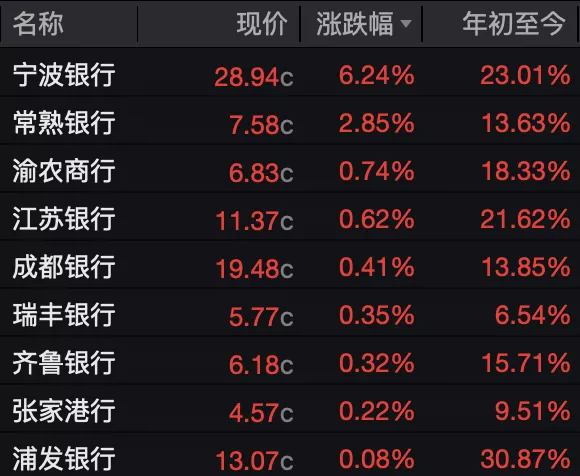
Core Viewpoint - Ningbo Bank's revenue and profit are accelerating, leading to a stock price increase of over 6%, reaching a nearly two-year high, with other city commercial banks also experiencing gains [1] Group 1: Stock Performance - Ningbo Bank's current price is 28.94c, with a year-to-date increase of 23.01% [2] - Other banks such as Changshu Bank, Chongqing Rural Commercial Bank, and Jiangsu Bank also saw price increases, with year-to-date gains of 13.63%, 18.33%, and 21.62% respectively [2] - The banking sector has cumulatively risen over 12% this year, significantly outperforming the broader market [2] Group 2: Institutional Investment - As of the end of Q2 2025, public funds held a total market value of approximately 25.837 billion yuan across 2,917 A-share companies, with significant investments in the banking sector [3] - Public funds increased their holdings in banks and telecommunications by over 40 billion yuan, leading the industry [3] - Major banks like China Merchants Bank, Industrial Bank, and Jiangsu Bank have seen substantial public fund investments, with China Merchants Bank leading at 75.9 billion yuan [3] Group 3: ETF Inflows - In the first half of the year, a total of 12.2 billion yuan flowed into the banking sector through ETFs, primarily from the CSI 300 ETF and dividend ETFs [4] - Individual banks such as Industrial Bank, Agricultural Bank, and China Merchants Bank benefited from significant net inflows exceeding 500 million yuan [4] Group 4: Future Outlook - The banking sector's weight in active equity funds is currently 3.35%, while the CSI 300 index has a weight of 15.71%, indicating potential for increased allocation [5] - The recent reforms in public funds are expected to align fund allocation closer to benchmark weights, benefiting the underweighted banking sector [5] - Insurance capital is also anticipated to further support inflows into the banking sector [5]



银行“新规”出台后,这“2类”业务被叫停,多家银行已行动
Sou Hu Cai Jing· 2025-07-25 06:41
Core Viewpoint - The Chinese financial industry is undergoing a profound transformation driven by new regulatory measures aimed at tightening monetary policy and mitigating systemic financial risks, particularly in the areas of internet lending and shadow banking [1][4]. Group 1: Regulatory Changes - The People's Bank of China (PBOC) issued guidelines on July 15 to strengthen financial risk prevention, marking a new phase of tightened monetary policy [1]. - New regulations significantly increase the required contribution of banks in joint lending from 30% to 70%, effectively reducing the leverage of internet platforms [2]. - The regulations also target shadow banking, which had a scale of approximately 25.3 trillion yuan at the end of 2024, accounting for 19.7% of GDP [4]. Group 2: Impact on Financial Institutions - Major banks like Industrial and Commercial Bank of China (ICBC) and China Construction Bank are adjusting their strategies, with ICBC halting joint lending with 10 internet platforms [2]. - Smaller banks are particularly affected, with internet loan income constituting an average of 17.3% of their operating revenue, and some exceeding 30% [5]. - Banks are responding by tightening their investment in non-standard assets and focusing on compliance and risk management [4][5]. Group 3: Long-term Outlook - The adjustments are expected to lead to a healthier and more sustainable financial ecosystem, with improved transparency in fund flows and more reasonable risk pricing [5]. - Analysts predict that the overall non-performing loan ratio in the banking sector will decrease to around 1.2% by 2026 following the adjustment period [5]. - The regulatory changes are part of a broader systemic effort to reduce financial leverage and prevent risks, with 23 significant policy documents issued since 2021 [4][5]. Group 4: Balancing Act - The new regulations reflect the regulatory authorities' commitment to balancing financial openness with risk prevention amid increasing global economic uncertainties [7]. - The adjustment process is expected to be ongoing, requiring adaptation from all market participants [7].


增配金融股!公募二季度仓位提高,银行股的共识与分歧出现
券商中国· 2025-07-25 06:03
以银行股为代表的红利资产,除了保险资金不断举牌加仓外,公募基金也在增配。 近日,公募基金二季度持仓公布,主动权益类基金持有银行股的占比上升了0.9个百分点,非银金融持仓也提高了0.6个百分点,不过相对于 行业配置基准(行业市值占全A市值的比例)仍有空间。目前银行股的股息率仍然突出,平均市净率PB也低于1,但出于对净息差收窄和地 产下行拖累的担忧,市场对银行股的看法也存在分歧。 值得注意的是,当险资频频举牌银行H股,公募基金也开始增配, 部分银行股的A/H价差收窄,招商银行A/H价格倒挂,邮储银行、民生银 行等A/H溢价率大幅收窄,考虑到港股通20%或28%的红利税成本,后续在具体个股和A/H股的选择上,资金偏好可能有所分化。 金融股持仓比例提升 整体上,主动权益类基金在二季度明显增配了银行股和非银金融(券商、保险等),保险资金也在港股市场上频繁举牌银行股,但局部上一 些资金也获利了结,关于银行股的共识与分歧已经出现。 比如中泰资管的百亿基金经理姜诚,二季度就小幅减仓工商银行、招商银行,不过这两只银行股仍是他管理的中泰星元灵活配置混合A前十 大重仓股。姜诚一直认为选择红利股的关键不仅是股息率高,而且有持续且稳定 ...