BeiGene(06160)

Search documents
【百强透视】业绩改善!美联储降息+政策松绑,创新药接着涨?
Sou Hu Cai Jing· 2025-09-18 12:47
Core Viewpoint - The innovative drug sector in Hong Kong has become a market focus again, with significant stock price increases following a prolonged period of adjustment and low valuations [2][3]. Group 1: Market Performance - Beihai Kangcheng-B (01228.HK) has surged nearly 19 times, while other companies like Deqi Pharmaceutical-B (06996.HK) and Hengrui Medicine (01276.HK) have also shown impressive gains, with some stocks increasing over four times [2]. - The overall profitability of the Hong Kong innovative drug sector has significantly improved in 2025, with many companies reporting substantial increases in net profit [6][7]. Group 2: Policy Support - The Chinese government has included "innovative drugs" in key emerging industries, with policies introduced to support the development of innovative drugs, including price management and financing [3]. - In June 2025, the National Healthcare Security Administration and the National Health Commission launched measures to support the high-quality development of innovative drugs, providing robust policy backing [3]. Group 3: Company Performance - Hengrui Medicine reported a 29.67% increase in net profit to 4.45 billion RMB in the first half of the year, achieving record highs in revenue and profit [4]. - Baijie Shenzhou's net profit increased by 115.63% to 450 million RMB, marking its first half-year profit, primarily due to the strong performance of its core product [5]. Group 4: Financing Trends - Many innovative drug companies are launching placement financing plans to raise funds for ongoing research and daily operations, driven by improved stock prices [8][10]. - As of 2025, nearly 60 companies in the Hong Kong medical and biopharmaceutical sectors have announced placement financing plans, with innovative drug companies being the main contributors [8]. Group 5: Future Outlook - The innovative drug sector is expected to continue its rapid development, supported by favorable external conditions and ongoing policy support [12][14]. - The recent interest rate cuts by the Federal Reserve may facilitate easier financing for innovative drug companies, which is crucial for those yet to achieve commercialization [13].


百济神州“PD-1之父”李康因病去世
经济观察报· 2025-09-18 07:22
Core Viewpoint - The article highlights the significant contributions of Li Kang, a key figure in the development of the PD-1 drug, Tislelizumab (百泽安), at BeiGene, and reflects on his legacy following his recent passing due to a brain hemorrhage at the age of 69 [2][3]. Group 1: Contributions and Achievements - Li Kang was the principal inventor of Tislelizumab, recognized as the "father of 百泽安," and played a crucial role in establishing the biopharmaceutical department at BeiGene after joining in August 2011 [2]. - Tislelizumab is BeiGene's second-largest product and the highest-grossing domestic PD-1 drug, with total sales reaching 16.5 billion yuan and approvals in 47 global markets [2]. - Li Kang's efforts were instrumental in generating nearly 1 billion USD in net profit for the company through two key business development deals during its early challenging years [3]. Group 2: Personal Background and Legacy - Li Kang had nearly 30 years of experience in biomedical research, particularly in tumor biology, antibody drug development, and tumor immunotherapy, holding a master's degree from Wuhan University and a Ph.D. from Emory University [3]. - His personal journey included significant sacrifices, such as selling his home in San Diego and relocating to Beijing with his wife to pursue his vision of developing better cancer therapies [2]. - Following his death, BeiGene's co-founder Wang Xiaodong shared memories of their time together, emphasizing Li Kang's impact on the company and the lives of cancer patients [2][3].

百济神州“PD-1之父”李康因病去世
Jing Ji Guan Cha Wang· 2025-09-18 07:16
Core Insights - The recent passing of Li Kang, former Senior Vice President and Head of Biopharmaceutical R&D at BeiGene, is a significant loss for the company and the industry [2][3] - Li Kang was a key figure in the development of the PD-1 drug Tislelizumab (百泽安), which has become BeiGene's second-largest product and the highest-grossing domestic PD-1 drug in China [3] Company Overview - Tislelizumab has been approved in 47 global markets, achieving total sales of 16.5 billion yuan [3] - Li Kang joined BeiGene in August 2011 and established the biopharmaceutical division, contributing significantly to the company's growth and success [2][3] Industry Impact - Li Kang's contributions included driving the上市 (listing) of Tislelizumab, which has provided hope for over a million cancer patients [3] - His efforts in securing two critical business development deals brought nearly 1 billion dollars in net profit to the company during its early challenging years [3]

医药生物行业2025H1财报总结:Q2环比改善,创新药迎发展机遇
East Money Securities· 2025-09-18 06:26
Investment Rating - The report maintains an investment rating of "Outperform" for the pharmaceutical and biotechnology industry, indicating a positive outlook compared to the broader market [4]. Core Insights - The pharmaceutical and biotechnology industry is experiencing a recovery in Q2 2025, with innovative drugs poised for significant development opportunities [1][10]. - The overall revenue for 461 A-share pharmaceutical companies in H1 2025 was CNY 11,939.5 billion, a year-on-year decrease of 3.21%, while net profit attributable to shareholders was CNY 1,016.2 billion, down 8.55% [8][24]. - The medical services sector showed positive growth, with revenue increasing by 3.92% year-on-year, while other segments like raw materials, chemical preparations, traditional Chinese medicine, and medical devices faced declines [8][24]. Summary by Sections 1. Market Review - The pharmaceutical and biotechnology index rose by 7.36% in H1 2025, outperforming the CSI 300 index by 7.33 percentage points, with the chemical preparation sector leading with a 20.09% increase [15][21]. 2. Industry Performance - In H1 2025, the chemical preparation sector reported a revenue of CNY 2,044.3 billion, down 5.77%, and a net profit of CNY 223.1 billion, down 22.92% [43]. - The medical services sector achieved a revenue of CNY 890.2 billion, with a significant net profit increase of 40.22% [8][24]. - The report highlights a trend of improving performance in Q2 compared to Q1, with several sectors showing signs of recovery [30]. 3. Subsector Analysis Raw Materials - The raw materials sector generated CNY 459.1 billion in revenue, a decrease of 6.74%, with a net profit of CNY 45.4 billion, down 2.71% [32][38]. - The report suggests a long-term growth outlook for the raw materials sector, driven by increasing demand and regulatory changes [38]. Chemical Preparations - The chemical preparations sector is expected to benefit from new policies supporting innovative drugs, with a focus on balancing price and clinical needs [48][49]. - The sector's revenue and profit are under pressure but are anticipated to recover as innovation and reform take hold [43][48]. Traditional Chinese Medicine - The traditional Chinese medicine sector reported a revenue of CNY 1,731.95 billion, with a slight profit increase of 0.24% [52]. - The sector is seen as having structural opportunities despite overall revenue declines [52]. Medical Services - The medical services sector is highlighted for its robust growth, with a focus on integrated service platforms [30][31]. Medical Devices - The medical devices sector is expected to recover as demand for equipment updates increases, with a revenue of CNY 1,155.6 billion, down 4.47% [8][30]. 4. Recommendations - The report recommends focusing on leading companies in various sectors, such as Tianyu Co. in raw materials, BeiGene in innovative drugs, and Yifeng Pharmacy in medical commerce [8][42][50].



中国创新药企“闯美”,如何预防政策风险?
Hu Xiu· 2025-09-18 06:03
Core Viewpoint - The Trump administration is drafting an executive order that will impose three major restrictions on commercial transactions involving Chinese innovative drug patents or rights, focusing on national security reviews by the Committee on Foreign Investment in the United States (CFIUS) [1][2]. Summary by Sections Executive Order Details - The draft includes three main provisions: 1. Inclusion of Chinese innovative drug BD transactions in the CFIUS mandatory review list, ending the previous "low-risk automatic exemption" practice [2]. 2. FDA will implement "racial sensitivity supplementary reviews" for drugs relying on Chinese clinical data, requiring at least 20% comparative data from non-Asian populations [2]. 3. Establishment of a "key drug domestic production fund" to provide production subsidies for 15 categories of drugs, including antibiotics and acetaminophen, while implementing a "domestic priority" principle in federal procurement [2]. Market Reaction - The market reacted swiftly to the policy risks, with the Hong Kong innovative drug index (HK1105) dropping 3.82% on September 11, 2025, and the A-share innovative drug sector (BK1106) declining 2.17%, with over 80% of stocks in the sector experiencing pullbacks [3]. - The following day, the indices showed signs of recovery, indicating investors' responses to policy uncertainties and rational corrections [3]. Globalization Trends - Despite the geopolitical risks, the trend of Chinese innovative drugs going global remains intact, with total license-out transactions to Europe and the U.S. reaching $9.43 billion as of September 2025 [3]. - Major transactions include a $950 million licensing deal between BeiGene and Royalty Pharma, and a $6 billion global licensing agreement between 3SBio and Pfizer, highlighting a shift towards milestone payments and regional licensing [3]. Industry Challenges - The domestic market faces challenges, with annual growth in medical insurance fund spending (approximately 12%) lagging behind the growth in innovative drug R&D investment (approximately 25%) [4]. - The average reduction in medical negotiations remains high at 54%, and commercial health insurance coverage for innovative drugs is below 15%, creating a supply-demand imbalance that necessitates going global [4]. Risk Resilience Assessment - Goldman Sachs has categorized Chinese innovative drug companies into three risk resilience tiers based on their sensitivity to policy changes and operational capabilities [4][5]. - Companies with mature global layouts exhibit the strongest resilience, while those heavily reliant on domestic markets show the weakest resilience [5][10]. Strategic Defense Framework - A three-dimensional defense system is proposed to address risks associated with the executive order, focusing on transaction review, data compliance, and supply chain security [13]. - Strategies include conducting national security risk pre-assessments for transactions over $50 million and establishing partnerships with U.S. law firms to navigate regulatory challenges [14][15]. Conclusion - The construction of a quantifiable "risk resilience index" is essential for Chinese innovative drugs in the global 2.0 era, emphasizing the need for companies to embed policy hedging clauses in transaction structures and consider racial diversity data in clinical stages [23].



智通港股通持股解析|9月18日
智通财经网· 2025-09-18 00:33
Group 1 - The top three companies by Hong Kong Stock Connect holding ratios are China Telecom (00728) at 71.84%, Green Power Environmental (01330) at 69.15%, and China Shenhua (01088) at 68.07% [1] - The latest holding ratio rankings for the top 20 companies show significant ownership levels, with companies like Kaisa New Energy (01108) and COSCO Shipping Energy (01138) also exceeding 67% [1] - The recent five trading days saw Alibaba-W (09988) leading in increased holdings with a rise of 143.50 billion, followed by Yingfu Fund (02800) with an increase of 41.59 billion [1][2] Group 2 - The companies with the largest decreases in holdings over the last five trading days include Meituan-W (03690) with a reduction of 12.14 billion, Great Wall Motors (02333) with a decrease of 8.01 billion, and Xiaomi Group-W (01810) with a drop of 7.57 billion [2] - Other notable companies experiencing significant reductions in holdings include Tencent Holdings (00700) and Li Auto-W (02015), with decreases of 4.65 billion and 4.06 billion respectively [2] - The data reflects a dynamic trading environment, with substantial shifts in investor sentiment towards various companies within the Hong Kong market [2]


智通港股通资金流向统计(T+2)|9月18日
智通财经网· 2025-09-17 23:34
Key Points - The top three stocks with net inflow of southbound funds are Alibaba-W (09988) with 5.278 billion, Yingfu Fund (02800) with 2.782 billion, and Hang Seng China Enterprises (02828) with 1.566 billion [1] - The top three stocks with net outflow of southbound funds are Xiaomi Group-W (01810) with -0.721 billion, Innovent Biologics (01801) with -0.466 billion, and Pop Mart (09992) with -0.458 billion [1] - In terms of net inflow ratio, Yuexiu Transportation Infrastructure (01052) leads with 63.76%, followed by Crystal International (02232) with 56.34%, and China Resources Gas (01193) with 53.63% [1] - The stocks with the highest net outflow ratio include QuanFeng Holdings (02285) at -59.36%, Yadea Group (01585) at -54.53%, and TCL Electronics (01070) at -54.28% [1] Net Inflow Rankings - The top ten stocks by net inflow include Alibaba-W (09988) with 5.278 billion, Yingfu Fund (02800) with 2.782 billion, and Hang Seng China Enterprises (02828) with 1.566 billion [2] - Other notable stocks in the net inflow list are Meituan-W (03690) with 0.670 billion and Southern Hang Seng Technology (03033) with 0.620 billion [2] Net Outflow Rankings - The top ten stocks by net outflow include Xiaomi Group-W (01810) with -0.721 billion, Innovent Biologics (01801) with -0.466 billion, and Pop Mart (09992) with -0.458 billion [2] - Other significant stocks in the net outflow list are Li Auto-W (02015) with -0.298 billion and China Construction Bank (00939) with -0.254 billion [2] Net Inflow Ratio Rankings - The top three stocks by net inflow ratio are Yuexiu Transportation Infrastructure (01052) at 63.76%, Crystal International (02232) at 56.34%, and China Resources Gas (01193) at 53.63% [3] - Additional stocks with high net inflow ratios include China Ship Leasing (03877) at 49.13% and Jiangsu Ninghu Expressway at 45.49% [3] Net Outflow Ratio Rankings - The stocks with the highest net outflow ratios include QuanFeng Holdings (02285) at -59.36%, Yadea Group (01585) at -54.53%, and TCL Electronics (01070) at -54.28% [3] - Other notable stocks with significant net outflow ratios are Kangji Medical (09997) at -53.77% and QiuTai Technology (01478) at -47.17% [3]



智通ADR统计 | 9月18日




智通财经网· 2025-09-17 22:38
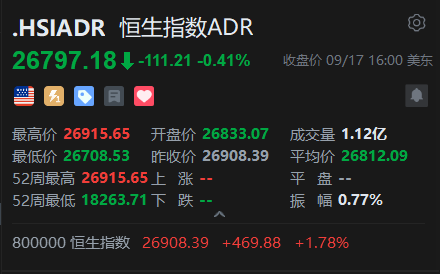
Market Overview - The Hang Seng Index (HSI) closed at 26,797.18, down by 111.21 points or 0.41% on September 17 [1] - The index reached a high of 26,915.65 and a low of 26,708.53 during the trading session, with a trading volume of 112 million shares [1] Major Blue-Chip Stocks Performance - HSBC Holdings closed at HKD 108.373, up by 1.66% compared to the Hong Kong close [2] - Tencent Holdings closed at HKD 661.407, down by 0.01% compared to the Hong Kong close [2] Stock Price Movements - Tencent Holdings (00700) saw an increase of HKD 16.500, or 2.56%, with an ADR price of HKD 661.407, showing a slight decline of HKD 0.093 compared to the Hong Kong market [3] - Alibaba Group (09988) increased by HKD 8.100, or 5.28%, with an ADR price of HKD 161.550, down by HKD 0.050 [3] - Other notable movements include: - Meituan (03690) up by HKD 4.900, or 4.89% [3] - Baidu Group (09888) up by HKD 17.800, or 15.72% [3] - Kuaishou (01024) up by HKD 2.650, or 3.51% [3]
外资机构密集调研A股 多行业受关注
Huan Qiu Wang· 2025-09-17 02:39
Group 1 - A total of 395 foreign institutions have participated in A-share listed company research since the beginning of the second half of the year, with a cumulative research count of 1,782 times as of September 16 [1] - Point72 has conducted the most research, with 59 instances, while Goldman Sachs, Bank of America Securities, and Citigroup have each exceeded 40 research instances [1] Group 2 - Key sectors attracting foreign institutional attention include industrial machinery, electrical equipment, electronic instruments, and medical care equipment [3] - Companies such as Estun, Huaming Equipment, Opto, Tianfu Communication, Lens Technology, United Imaging, Mindray, and BeiGene have received research from over 50 foreign institutions [3] - Estun's recent investor relations activity indicates that foreign institutions like Merrill Lynch, Citigroup, Morgan Stanley, BNP Paribas, Deutsche Bank, and Point72 are focused on the demand situation in downstream industries, with Estun expecting continued growth in automotive, electronics, and lithium battery sectors [3] - United Imaging has reported that its AI-driven smart operation system has significantly improved efficiency and reduced costs, supporting its long-term development in the global medical imaging industry [3] - Many foreign institutions believe that the A-share market currently offers rich investment opportunities, particularly in the technology and pharmaceutical sectors [3] - Morgan Stanley recently highlighted areas to watch in the A-share market, including AI computing and applications, innovative drugs, new energy (benefiting from policy adjustments), semiconductors, new consumption, resource products, and high-end manufacturing [3]





国内市场需求与政策支持双轮驱动 创新药板块表现亮眼
Huan Qiu Wang· 2025-09-16 02:27
Core Insights - The Chinese innovative drug sector has become a hot area in the capital market this year, driven by the real demand for high-quality innovative drugs from domestic patients, which is seen as the core driver for industry recovery [1] Group 1: Market Performance - In the first half of this year, 21 innovative drug companies listed on A-shares achieved a revenue of 28.69 billion yuan, a year-on-year increase of approximately 42%, while 32 innovative drug companies listed on H-shares reported a revenue of 42.13 billion yuan, a year-on-year increase of about 10% [2] - Leading companies have shown particularly strong performance, with Heng Rui Medicine's innovative drug sales revenue reaching 7.57 billion yuan, a year-on-year increase of approximately 14.5% [2] - Innovative drugs from Bai Jie Shen Zhou, such as Bai Yue Ze and Bai Ze An, reported sales of 1.192 billion yuan and 2.643 billion yuan respectively, with year-on-year growth rates of 36.5% and 20.6% [2] Group 2: Policy and Market Dynamics - The Chinese innovative drug market is entering a dual development cycle with domestic medical insurance and overseas markets, leading to a gradual path to profitability for companies [2] - Since its establishment in 2018, the National Medical Insurance Bureau has included 149 innovative drugs in the medical insurance catalog through seven rounds of adjustments, significantly optimizing the clinical medication structure [3] - By May 2025, the medical insurance fund is expected to pay a cumulative 410 billion yuan for negotiated drugs, driving related drug sales to exceed 600 billion yuan [3] Group 3: Future Outlook - The innovative drug market in China is projected to reach a scale of 162 billion yuan by 2024, with medical insurance payments accounting for approximately 43.8% [4] - The commercial success of innovative drugs is seen as a starting point for higher-level research and development, with many companies increasing their R&D investments despite revenue growth [4] - China currently holds a 30% share in global drug research and development, with 1,775 first-in-class drug pipelines, representing 19% of the global total [4]