BeiGene(06160)

Search documents
百济神州9月15日获融资买入2.41亿元,融资余额13.14亿元
Xin Lang Cai Jing· 2025-09-16 01:35
Group 1 - On September 15, BeiGene's stock increased by 1.40%, with a trading volume of 2.1 billion yuan [1] - The financing data shows that on the same day, BeiGene had a financing purchase amount of 241 million yuan and a financing repayment of 231 million yuan, resulting in a net financing purchase of 10.32 million yuan [1] - As of September 15, the total balance of margin trading for BeiGene was 1.334 billion yuan, with a financing balance of 1.314 billion yuan, accounting for 3.57% of the circulating market value, which is above the 90th percentile level over the past year [1] Group 2 - As of June 30, the number of BeiGene shareholders was 23,300, a decrease of 3.90% from the previous period, while the average circulating shares per person increased by 4.11% to 4,976 shares [2] - For the first half of 2025, BeiGene achieved operating revenue of 17.518 billion yuan, a year-on-year increase of 46.03%, and a net profit attributable to shareholders of 450 million yuan, up 115.63% year-on-year [2] - In terms of institutional holdings, as of June 30, 2025, the top ten circulating shareholders included several notable funds, with changes in their holdings indicating varying levels of investment interest [2]
智通ADR统计 | 9月16日
智通财经网· 2025-09-15 22:37
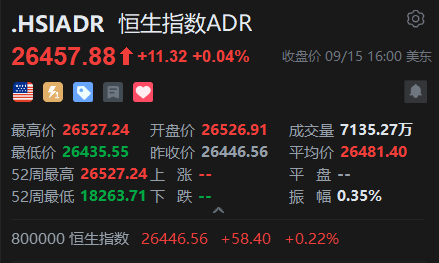
Market Overview - The Hang Seng Index (HSI) closed at 26,457.88, up by 11.32 points or 0.04% as of September 15, 16:00 Eastern Time [1] - The index reached a high of 26,527.24 and a low of 26,435.55 during the trading session, with an average price of 26,481.40 [1] - The trading volume was 71.35 million shares, indicating active market participation [1] Major Blue-Chip Stocks Performance - HSBC Holdings closed at HKD 108.054, reflecting an increase of 1.46% compared to the Hong Kong closing price [2] - Tencent Holdings closed at HKD 644.822, with a slight increase of 0.21% from the Hong Kong closing price [2] - Alibaba Group (ADR) saw a price of HKD 153.679, down by 0.921 compared to its Hong Kong price, despite a 2.32% increase in its latest price [3] - Other notable performances include BYD Company, which rose by 3.44% to HKD 108.100, and Xiaomi Group, which increased by 1.90% to HKD 56.200 [3] Summary of Stock Movements - Tencent Holdings remained stable with no change in its latest price [3] - HSBC Holdings showed a minor increase of 0.19% [3] - Alibaba's stock experienced a decline when compared to its ADR price [3] - The overall performance of major blue-chip stocks was mixed, with some stocks like BYD and Xiaomi showing positive movements while others like China Ping An and AIA Group faced declines [3]





江苏优质企业赴港上市热潮涌动
Zhong Guo Zheng Quan Bao· 2025-09-15 20:22
Core Viewpoint - The article highlights the increasing trend of high-quality enterprises from Jiangsu province pursuing IPOs in the Hong Kong market, driven by favorable policies and a recovering market environment [1][3]. Group 1: Market Trends - In the first eight months of this year, the Hong Kong Stock Exchange (HKEX) raised HKD 1,345 billion in new stock financing, with approximately 70% of this coming from "A+H" companies [2]. - The number of Jiangsu enterprises successfully listed in Hong Kong has reached 11, with over 20 more in the pipeline, indicating a vibrant market activity [1][3]. - The HKEX has seen a shift in listing methods, including share swaps and privatization, providing new avenues for companies to enter international markets [2]. Group 2: Policy Support - The China Securities Regulatory Commission and HKEX have introduced multiple favorable policies since 2024 to encourage high-quality domestic enterprises to list in Hong Kong, including a "green channel" for A-share companies [3]. - The ongoing optimization of listing regulations by HKEX has made it more attractive for companies at various development stages to consider going public [4]. Group 3: Corporate Strategies - Leading companies are increasingly looking to the Hong Kong capital market to enhance their international presence and operational capabilities, as exemplified by SF Express's international supply chain growth [2]. - Jiangsu's government is actively promoting the listing of enterprises in Hong Kong as a means to integrate into the global capital market and enhance international competitiveness [4]. Group 4: Compliance and Considerations - Companies are advised to evaluate their suitability for the Hong Kong market by considering factors such as listing efficiency, valuation, regulatory environment, and overall costs [6][5]. - Compliance with legal requirements, including corporate history, ownership clarity, and operational legality, is crucial for companies considering a Hong Kong listing [6]. Group 5: Future Outlook - The positive momentum in the Hong Kong market is expected to be supported by macroeconomic improvements, ongoing policy enhancements, and a strong demand from enterprises seeking to strengthen their international competitiveness [7].



需求旺盛!国产创新药,从“吞金巨兽”变成了“现金奶牛”!
Sou Hu Cai Jing· 2025-09-15 03:19
Core Viewpoint - The Chinese innovative drug sector has shown remarkable performance in the capital market this year, driven by record-high business development (BD) amounts for overseas expansion and a rapid growth in domestic revenue, indicating a shift from a "cash-burning" model to a "cash cow" model [1][2]. Group 1: Domestic Demand - The demand for high-quality innovative drugs in China is continuously being released, with A-share innovative drug companies achieving a revenue of 28.69 billion yuan in the first half of the year, a year-on-year increase of approximately 42% [2]. - Leading companies like Heng Rui Medicine reported a 14.5% increase in innovative drug sales revenue to 7.57 billion yuan, primarily from the domestic market [2]. - Other companies such as Bai Jie Shen Zhou and Yi Fan Medicine also reported significant revenue growth, with Bai Jie Shen Zhou's flagship product achieving a 36.5% increase in sales [3]. Group 2: Policy Support - The Chinese government has been actively supporting the development of innovative drugs, with 149 innovative drugs included in the national medical insurance directory since 2018 [4]. - The National Healthcare Security Administration has indicated that by May 2025, the cumulative payment for negotiated drugs will reach 410 billion yuan, driving related drug sales to exceed 600 billion yuan [4]. - New policies are being introduced to address pricing and reimbursement challenges for innovative drugs, including the establishment of a commercial health insurance directory for innovative drugs [5]. Group 3: Research and Development Investment - Despite revenue growth, many innovative drug companies are increasing their R&D investments, creating a positive cycle of revenue growth leading to increased R&D and a rich pipeline [7]. - Heng Rui Medicine invested 3.87 billion yuan in R&D, with over 100 innovative products in clinical development [7]. - The overall trend indicates that companies are focusing on building a robust pipeline to sustain future revenue growth [7]. Group 4: Global Positioning - China currently holds nearly 30% of the global drug R&D market share, with a significant number of first-in-class drug pipelines [8]. - The country has become an important source of global pharmaceutical innovation, with a notable increase in technology licensing and overseas expansion [8]. - The past years of investment during the "innovation drug bubble" period are expected to yield significant results in the coming years [8].

百济神州涨2.02%,成交额8.29亿元,主力资金净流出552.19万元
Xin Lang Cai Jing· 2025-09-15 02:35
Core Viewpoint - BeiGene's stock has shown significant growth this year, with a year-to-date increase of 99.95%, indicating strong market performance and investor interest [1][2]. Group 1: Stock Performance - As of September 15, BeiGene's stock price reached 321.96 CNY per share, with a trading volume of 8.29 billion CNY and a turnover rate of 2.27%, resulting in a total market capitalization of 496.04 billion CNY [1]. - The stock has experienced a 1.25% increase over the last five trading days, a 32.49% increase over the last 20 days, and a 28.58% increase over the last 60 days [1]. - The company has appeared on the "龙虎榜" (a stock trading list) once this year, with the most recent appearance on September 2 [1]. Group 2: Financial Performance - For the first half of 2025, BeiGene reported a revenue of 17.518 billion CNY, representing a year-on-year growth of 46.03%, and a net profit attributable to shareholders of 450 million CNY, which is a 115.63% increase compared to the previous period [2]. - The number of shareholders decreased by 3.90% to 23,300 as of June 30, 2025, while the average number of circulating shares per person increased by 4.11% to 4,976 shares [2]. Group 3: Shareholder Composition - As of June 30, 2025, the fourth largest shareholder is 中欧医疗健康混合A (China Europe Medical Health Mixed A) with 4.8254 million shares, an increase of 1.2436 million shares from the previous period [2]. - 万家优选 (Wanjia Youxuan) is the sixth largest shareholder with 3 million shares, a decrease of 500,000 shares [2]. - 新进股东 (new shareholder) 南方中证500ETF (Southern CSI 500 ETF) holds 1.7259 million shares [2].
金改前沿|“多元上市路径”激活潜力 科创板为未盈利企业打开“资本入口”
Xin Hua Cai Jing· 2025-09-15 02:33
Core Insights - The Shanghai Stock Exchange emphasizes its mission to support technological innovation and enhance its role as a capital market hub, particularly through the STAR Market [1] - The STAR Market has established five sets of listing standards, with the second to fifth sets not requiring profitability, thus providing diverse listing pathways for unprofitable companies [1][2] - As of now, 54 unprofitable companies have collectively raised over 200 billion yuan through IPOs, demonstrating effective transformation of R&D capabilities into operational performance [1][3] Listing Standards - The STAR Market's second to fourth listing standards focus on revenue scale combined with R&D intensity, cash flow, or market capitalization, catering to hard-tech companies with specific characteristics [1][2] - The fifth standard does not set performance requirements but emphasizes market capitalization and developmental achievements, suitable for innovative companies with clear market prospects [1][2] Company Performance - Among the 54 unprofitable companies, 40% have achieved profitability, with a total revenue of 1,745 billion yuan in 2024, marking a 24% year-on-year increase [3] - Notable companies like BeiGene and Cambricon have shown significant R&D investments, with BeiGene's R&D expenditure reaching 7.278 billion yuan, accounting for 42% of its revenue [2][3] - The semiconductor sector, led by companies like SMIC, has seen substantial advancements, enhancing the industry's self-sufficiency and innovation capabilities [3][4] Market Developments - The STAR Market's fifth standard companies are entering a new phase of commercial development, with 46 drugs/vaccines approved for market entry, showcasing rapid commercialization [4] - The introduction of the "1+6" policy framework aims to further support unprofitable companies in high-tech sectors, balancing innovation support with market risk management [4][5] - Since the implementation of the "1+6" policy, 15 new IPO applications have been accepted, including four from unprofitable companies, indicating ongoing market dynamism [5]



科创板"多元入口"激活未盈利企业潜力 加速创造行业"DeepSeek时刻"
Zheng Quan Shi Bao· 2025-09-14 15:19
Core Viewpoint - The Sci-Tech Innovation Board (STAR Market) has successfully created a multi-path listing approach for unprofitable companies, allowing them to access capital markets without the traditional profit threshold, thus promoting the transformation of R&D capabilities into operational performance and industrial value [1][2]. Group 1: Listing Standards - The STAR Market has five sets of listing standards, with the second to fifth sets not requiring profit, instead focusing on revenue scale and R&D intensity, cash flow, and market capitalization [2]. - The second to fourth sets cater to "hard technology" companies with characteristics such as R&D strength and stable business models, while the fifth set evaluates companies based on market capitalization and developmental achievements, suitable for innovative firms with clear market prospects [2][4]. Group 2: Performance of Unprofitable Companies - Among the 54 unprofitable companies listed, 40% have achieved profitability, with a total revenue of 1,745 billion yuan in 2024, marking a 24% year-on-year increase, and a net loss of 136 billion yuan, reduced by 36% [3]. - By the first half of 2025, these companies reported a revenue of 999 billion yuan, an 8% increase year-on-year, with a net loss of 15 billion yuan, a 70% reduction compared to the previous year [3][6]. Group 3: Industry Innovations - Leading companies like Cambricon and SMIC are driving significant advancements in the semiconductor sector, enhancing the self-sufficiency of the supply chain and breaking foreign monopolies [4]. - The fifth set of standards has enabled unprofitable companies to transition into a new phase of commercial development, with 46 drugs/vaccines approved for market, including 20 innovative drugs that have not been previously launched domestically or internationally [4]. Group 4: Policy Impact - The introduction of the "1+6" policy and the establishment of the "Sci-Tech Growth Layer" aim to support unprofitable companies in high-tech sectors, balancing innovation support with market risk prevention [5][6]. - Since the policy's implementation, 15 new IPO applications have been accepted, including four from unprofitable companies, indicating a positive response to the new listing standards [6].

用“多元入口”激活“盈利潜力” 科创板助力企业加速从“U”到优
Zheng Quan Ri Bao Wang· 2025-09-14 14:05
Core Viewpoint - The Shanghai Stock Exchange emphasizes its mission to support the real economy and enhance its capacity to support technological innovation through the STAR Market, which has established inclusive listing standards for unprofitable companies [1][5]. Group 1: Listing Standards - The STAR Market has developed five sets of listing standards, with the second to fifth sets not imposing profit thresholds, thereby creating diverse pathways for unprofitable companies to access the capital market [1][2]. - The second to fourth sets of standards assess companies based on "revenue scale + R&D intensity," "revenue scale + cash flow," and "revenue scale + market capitalization," respectively, catering to hard technology enterprises with strong R&D capabilities [1][2]. - The fifth set of standards evaluates companies based on "market capitalization + stage of R&D achievements," allowing innovative firms with promising technologies but no commercialization to list [2]. Group 2: Performance of Unprofitable Companies - As of 2024, 54 unprofitable companies listed on the STAR Market achieved a total revenue of 1,745 billion, a 24% year-on-year increase, with 26 companies exceeding 100 million in revenue [3]. - These companies collectively reduced their net losses by 36% to 136 billion, with 22 companies achieving profitability and "delisting" from the unprofitable category [3]. - In the first half of 2025, these companies reported a total revenue of 999 billion, an 8% increase, and reduced net losses by 70% to 15 billion [3]. Group 3: Industry Highlights - Leading companies in the innovative drug sector, such as BeiGene and Baillie Gifford, have achieved significant sales milestones, with BeiGene's new drug generating over 10 billion in sales in just six months [4]. - In the semiconductor sector, companies like SMIC and Cambrian are breaking foreign monopolies and enhancing domestic capabilities in AI chip development [4]. - The STAR Market has facilitated the approval of 46 drugs/vaccines, with 20 new innovative drugs launched domestically, showcasing the rapid advancement of unprofitable companies towards commercialization [6]. Group 4: Policy Impact - The STAR Market's "1+6" policy framework aims to further support unprofitable companies by creating a "STAR Growth Layer" that focuses on emerging sectors like AI and commercial aerospace [6]. - Since the implementation of this policy, 15 new IPO applications have been accepted, including four from unprofitable companies, indicating a positive market response [6]. - Companies in the STAR Growth Layer reported a 38% year-on-year revenue growth and a significant reduction in net losses by 71 billion in the first half of 2025 [6]. Group 5: Future Outlook - The STAR Market is positioned to assist unprofitable hard technology companies in transitioning from research to market, reinforcing the importance of capital support for technological self-reliance [7].

科创板“多元入口”激活未盈利企业潜力 加速创造行业“DeepSeek时刻”
Zheng Quan Shi Bao Wang· 2025-09-14 14:02
Core Viewpoint - The Sci-Tech Innovation Board (STAR Market) has successfully created a multi-path listing approach for unprofitable companies, allowing them to access capital markets without the traditional profit threshold, thus facilitating the transformation of R&D capabilities into operational performance and industrial value [1][2]. Group 1: Listing Standards - The STAR Market has five sets of listing standards, with the second to fifth sets not requiring profit, instead focusing on revenue scale combined with various factors such as R&D intensity, cash flow, and market capitalization [2]. - The second to fourth sets cater to "hard technology" companies with strong R&D capabilities, while the fifth set targets innovative companies with leading technologies but no commercialized products yet, based on market capitalization and R&D achievements [2][4]. Group 2: Performance of Unprofitable Companies - Among the 54 unprofitable companies listed, 40% have achieved profitability, with a total revenue of 1,745 billion yuan in 2024, marking a 24% year-on-year increase, and a net loss reduction of 36% [3]. - By the first half of 2025, these companies reported a revenue of 999 billion yuan, an 8% increase year-on-year, with a significant reduction in net loss by 70% [3]. Group 3: Industry Leaders and Innovations - Leading companies like BeiGene and Cambricon have achieved significant milestones, with BeiGene's new cancer drug generating over 10 billion yuan in half-year sales, and Baillie Gifford's ADC drug achieving record overseas licensing deals [3][4]. - In the semiconductor sector, companies like SMIC and Cambrian are driving innovation and breaking foreign monopolies, enhancing the self-sufficiency of the industry [4]. Group 4: Policy Support and Market Dynamics - The introduction of the "1+6" policy and the establishment of the "Sci-Tech Growth Layer" aim to support unprofitable companies in emerging fields like AI and commercial aerospace, balancing innovation support with market risk management [5][6]. - Since the policy's implementation, 15 new IPO applications have been accepted, including four from unprofitable companies, indicating a positive trend in capital market access for innovative firms [6].
内卷缓解改善行业利润,DRG落地重塑行业生态
青侨阳光投资交流· 2025-09-14 02:49
Core Viewpoint - The pharmaceutical sector in Hong Kong is experiencing a paradox where revenue growth is slowing down while profit growth is accelerating, primarily driven by systemic reforms such as DRG [1][12]. Group 1: Performance of Domestic Innovative Pharmaceutical Companies - The 18A biotech stocks listed in Hong Kong are projected to see sustainable revenue growth from 27.2 billion in the first half of 2024 to 37.6 billion in the first half of 2025, with total annual revenue expected to reach 78-80 billion [2]. - Net losses for these companies are expected to improve significantly, from a loss of 11.2 billion in the first half of 2024 to a loss of 2.5 billion in the first half of 2025, with profitability anticipated by 2026 [2]. Group 2: Overall Pharmaceutical Sector Performance - The overall revenue growth rate for major listed pharmaceutical companies in Hong Kong is expected to decline from 5.7% in 2024 to 2.1% in the first half of 2025, despite strong profit growth [4][5]. - The profit growth is attributed to a shift in operational strategies from aggressive expansion to cost control, leading to improved profit margins [8][9]. Group 3: Reasons for Revenue Slowdown - The slowdown in revenue growth is linked to the DRG reform, which has introduced a competitive pricing mechanism that pressures hospitals and healthcare providers to reduce costs [15][19]. - The DRG reform has resulted in a decrease in average hospitalization costs, which has negatively impacted hospital revenues and, consequently, the upstream pharmaceutical sector [14][15]. Group 4: Impact of DRG Reform - The DRG payment model emphasizes standardized clinical value over individual physician decision-making, which is expected to accelerate the growth of innovative pharmaceuticals while putting pressure on traditional hospital revenue streams [24][25]. - The reform is likely to create a more competitive environment among hospitals, potentially leading to the exit of less efficient operators from the market [23][36]. Group 5: Future Outlook - Despite the current challenges, the pharmaceutical industry is expected to eventually return to a stable growth trajectory as the pressures from the DRG reform ease and new growth drivers emerge [20][36]. - The focus on clinical value is anticipated to foster innovation in pharmaceuticals and medical devices, particularly for those that can demonstrate significant clinical benefits [28][32].