
TRIP.COM(09961)

Search documents
携程度假农庄解锁文旅乡村振兴ESG密码
Huan Qiu Wang· 2025-11-28 07:57
Core Insights - The article emphasizes the role of Ctrip's rural vacation farms in promoting rural revitalization through the integration of culture and tourism, benefiting local residents, intangible cultural heritage practitioners, tourists, and local tourism agencies [1][12] - The project focuses on sustainable tourism models centered around farm construction and green energy, exploring talent development, green operations, community building, and brand marketing [1][12] Employment and Economic Impact - Over 500 employees have been absorbed by 34 rural farms, creating more than 40,000 new jobs in related industries, with over 80% being local villagers, leading to an increase in local per capita annual income by over 40,000 yuan [1] - Each farm establishment has led to approximately 40 new guesthouses in the surrounding area, increasing order volume by 82.4% and average transaction price by 18.7%, with upstream and downstream industries seeing an annual output value increase of over 20 million yuan [1] Talent Development and Training - Ctrip's rural vacation farms have established a sustainable talent cultivation mechanism through the "Ctrip Rural Revitalization Academy," training over 10,000 rural tourism talents, focusing on rural practitioners and guesthouse operators [2] - The "New Farmers Growth Plan" has received over 5,000 resumes, with 80% from the post-2000 generation, providing new opportunities for young people and encouraging their return to rural employment [2] Innovative Models and Cultural Integration - Each farm includes at least one experiential content related to agriculture, animal husbandry, fishing, and forestry, developing unique cultural tourism products based on traditional festivals and local customs [3] - The farms utilize a combination of "online platforms + offline farms + industry chain cooperation" to create a high-end rural vacation ecosystem, enhancing tourism consumption and local product sales [3] Sustainable Practices and Environmental Impact - Ctrip's rural vacation farms have implemented low-carbon hotel models, achieving a 30% reduction in carbon emissions at the Jinzhai Dawan store through renewable energy technologies [7][11] - The Ningxia Zhongning Huangyang Ancient Ruins scenic area has established a photovoltaic project that provides approximately 500,000 kWh of electricity, saving around 200,000 yuan in electricity costs [8] Social Value and ESG Performance - The rural vacation farms have created a model that combines social value with commercial sustainability, enhancing ESG performance and attracting partnerships from government and enterprises [12][13] - The "New Farmers Growth Plan" and the "Rural Revitalization Academy" address the issue of talent hollowing in rural areas, while the farms' low-carbon initiatives provide quantifiable environmental benefits [13][14]


紧急捐赠!多家企业捐款捐物 驰援中国香港大埔火灾救援



Zheng Quan Ri Bao· 2025-11-28 07:42
Group 1 - Multiple companies have pledged significant donations to support fire relief efforts in Hong Kong, demonstrating corporate social responsibility and community support [1][2][3][4][5][6] - China Resources Group has donated 20 million HKD for emergency rescue and medical assistance for victims [1] - Anta Group has committed a total of 30 million HKD, including 10 million HKD in cash and 20 million HKD in cold-weather gear for disaster relief [1] - Xtep Group has announced a donation of 20 million HKD in cash and equipment for disaster recovery efforts [1] - Bosideng has pledged 10 million HKD in cash and 20 million HKD in supplies for post-disaster support [2] - Nongfu Spring has donated 10 million HKD in cash and 5 million HKD in supplies for emergency relief and recovery [2] - Heytea has contributed 5 million HKD for resident support and rebuilding efforts [3] - Alibaba has initiated a donation of 20 million HKD and activated an emergency response mechanism to provide essential supplies [5] Group 2 - Companies are actively coordinating with local organizations to ensure timely delivery of aid and resources to affected residents [5][6] - Meituan's delivery platform Keeta has donated 5 million HKD for transitional housing and community recovery [5] - JD Group has mobilized resources to provide essential supplies and meals to affected individuals and rescue workers [5] - Ctrip Group has pledged 10 million HKD to assist affected residents and communities [5] - Various companies are continuing their support efforts, indicating a sustained commitment to aid the recovery process [6]
多家企业驰援香港大埔火灾救援,捐款捐物总额超6亿港元
Xin Lang Cai Jing· 2025-11-28 02:02
Group 1: Incident Overview - A major fire occurred in Hong Kong's Tai Po district, resulting in 94 fatalities, including one firefighter, and 76 injuries, with 11 being firefighters [1] - The Hong Kong government established a relief fund with an initial allocation of 300 million HKD to assist affected residents [1] Group 2: Corporate Donations - Alibaba Group announced a donation of 20 million HKD for immediate relief efforts and additional support for affected families [2] - Tencent Charity Foundation pledged a total of 30 million HKD, including an initial 10 million HKD and an additional 20 million HKD to the relief fund [2] - ByteDance (Hong Kong) and Baidu each committed 10 million HKD for emergency relief and community recovery efforts [2] Group 3: Additional Corporate Contributions - Various companies, including NetEase, Xiaomi, and Kuaishou, each donated 10 million HKD to support emergency relief and community recovery [3] - Anta Group and Bosideng Group each contributed 30 million HKD, while Li Ning Group and Xtep Group donated 20 million HKD each for disaster relief [4][5][6] - Other companies like 361°, Chow Tai Fook, and Nongfu Spring also made significant contributions, totaling millions in cash and supplies [7][8] Group 4: Broader Industry Response - Multiple sectors, including automotive, real estate, and finance, participated in the relief efforts, with companies like Chery Automobile and BYD each donating 10 million HKD [9][10] - Financial institutions and logistics companies, such as Didi and SF Express, also pledged substantial amounts for emergency aid and recovery efforts [15]


携程集团捐赠1000万港元支援香港救援
Bei Jing Shang Bao· 2025-11-27 15:04
Core Viewpoint - Ctrip Group announced a donation of 10 million HKD to assist residents affected by the fire in Hong Kong's Tai Po district, demonstrating corporate social responsibility and commitment to community support [1] Group 1: Donation and Support - Ctrip Group's donation aims to help affected residents and communities recover from the disaster [1] - The company expressed deep condolences to the victims and sincere sympathy to the affected families and citizens [1] - Ctrip Group will continue to monitor the situation and coordinate resources with local agencies to support recovery efforts [1] Group 2: Customer Service and Assistance - Ctrip Group has a 24-hour customer service team ready to assist travelers and families affected by the incident with itinerary changes or cancellations [1]
首批捐款超1亿港元,阿里、腾讯、小米、网易等驰援香港大埔火灾救援
Guo Ji Jin Rong Bao· 2025-11-27 08:32
Core Points - A significant fire occurred in Hong Kong's Tai Po district, prompting widespread concern and support from various organizations and individuals [1] Group 1: Donations and Support Initiatives - Alibaba, led by Jack Ma, donated a total of 60 million HKD, including 30 million HKD from the Jack Ma Foundation for economic aid to affected families and support for firefighters [2] - Tencent Charity Foundation announced a donation of 10 million HKD for emergency relief and support for affected residents [5] - Xiaomi's founder Lei Jun announced a donation of 10 million HKD through the Xiaomi Foundation for fire relief efforts [7] - ByteDance pledged 10 million HKD for emergency rescue and community recovery efforts [9] - NetEase also committed 10 million HKD for emergency relief and community support [11] - Midea Group and Trip.com each announced donations of 10 million HKD for urgent rescue and post-disaster recovery efforts [12][13] Group 2: Emergency Response and Logistics - Alibaba initiated an emergency response mechanism to mobilize essential supplies like food and bedding to the affected area [2] - JD.com was the first to deliver rescue supplies to the scene, coordinating with local councils to provide essential items like water and food [14]


携程集团-清晰的海外增长空间
2025-11-27 02:17
Trip.com Group Ltd - Conference Call Summary Company Overview - **Company**: Trip.com Group Ltd (TCOM) - **Industry**: Online Travel Agency (OTA) - **Market Focus**: Asia Pacific, excluding China and India Key Points Industry and Market Position - Trip.com aims to become the number one player in Asia (excluding China and India) in terms of market share, which is considered a challenging yet achievable target [2] - The company is currently the market leader in Singapore, Hong Kong, and Thailand, and is rapidly gaining market share in Korea and Japan [2] - The APAC travel market is expected to grow, with online penetration increasing, providing a favorable environment for Trip.com [2] Financial Performance and Projections - Trip.com anticipates that by 2030, international and outbound business will contribute to 50% of its revenue [2] - Revenue growth projections indicate a slowdown from over 55% in 2025 to around 25% by 2030 [2] - The company expects year-over-year margin improvements for both domestic and overseas operations, although mixed revenue sources may introduce uncertainty [4] Strategic Initiatives - Trip.com has a structured approach to entering new markets, focusing first on product and localization, followed by performance-based marketing, and then brand marketing once a market share of 2-5% is achieved [3] - The company prioritizes branding and service quality over pricing, believing its pricing is competitive [2] - A significant marketing push has been noted, which has positively impacted overseas expansion efforts [1] Competitive Landscape - Concerns regarding competition from Alibaba's Fliggy are downplayed, with Trip.com’s strong supply chain control seen as a competitive advantage [5] - The company is positioned to achieve profitability levels similar to global peers, potentially exceeding them if the revenue mix favors accommodation [3] Financial Metrics - Current stock price (as of November 25, 2025): US$70.30 - Price target set at US$86.00, indicating a potential upside of 22% [7] - Projected revenue growth from Rmb 53,294 million in FY25 to Rmb 77,641 million in FY27, with a net profit forecast of Rmb 32,156 million in FY25 [31] Risk Factors - Risks include rising competition in the domestic market, uncertainties related to the pandemic, and macroeconomic slowdowns that could affect travel demand [50] - The company is also exposed to foreign exchange headwinds, which could impact profitability [51] Investment Thesis - Trip.com is viewed as uniquely positioned to benefit from multiple growth engines, including domestic travel, outbound travel, and international expansion [39] - The company has announced a US$5 billion share repurchase program, representing over 10% of its market cap at the time of announcement, which is seen as a positive signal for investors [39] Conclusion - Trip.com Group Ltd is strategically positioned for growth in the APAC travel market, with a focus on enhancing its market share and profitability through targeted marketing and operational efficiencies. The company’s financial outlook remains positive, despite potential risks from competition and macroeconomic factors.
携程集团-S(09961):国内业绩稳健,海外延续高增
Haitong Securities International· 2025-11-27 01:15
Investment Rating - The report assigns an "Outperform" rating to the company, indicating expected relative performance above the market benchmark over the next 12-18 months [3][12]. Core Insights - Domestic growth is stable while overseas growth continues to be high, with the company expanding its user share and influence. Adjusted net profit attributable to shareholders is projected to be RMB 31.86 billion, RMB 20.76 billion, and RMB 23.16 billion for the years 2025, 2026, and 2027 respectively [3][12]. - A valuation of 23x PE for 2026 is set, leading to a target market capitalization of RMB 476.4 billion, equivalent to HKD 523.3 billion, with a target price of HKD 733 [3][12]. Financial Summary - For Q3 2025, the company reported revenue of RMB 18.37 billion, a year-on-year increase of 15.52%. Adjusted EBITDA was RMB 6.35 billion, up 11.73%, and adjusted operating profit was RMB 6.13 billion, reflecting a 12.2% increase. Net profit attributable to shareholders surged to RMB 19.89 billion, a 194.01% increase, largely due to partial investment profit sales [3][13]. - The company’s revenue growth in transportation accelerated due to peak season and overseas demand, while hotel growth remained in double digits but showed signs of sequential slowdown. Group tours have seen a decline in growth since Q1 2025, attributed to a shift towards independent travel and regional risks [3][13]. Performance Metrics - The adjusted EBITDA margin is projected to be 30.5% in 2025, with a slight decline expected in subsequent years. The company has maintained stable profit margins despite increased competition in overseas markets [3][12][13]. - The report highlights that the company has increased its investment in Trip, leading to a rise in marketing expenses, which has contributed to rapid growth in overseas markets and an increase in user share [3][13].
智通ADR统计 | 11月27日
智通财经网· 2025-11-26 22:25
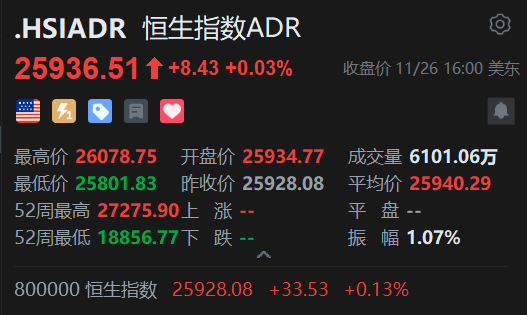
Market Overview - The Hang Seng Index (HSI) closed at 25,936.51, up by 8.43 points or 0.03% on November 26 [1] - The index reached a high of 26,078.75 and a low of 25,801.83 during the trading session, with a trading volume of 61.01 million shares [1] Stock Performance - Major blue-chip stocks showed mixed performance, with HSBC Holdings closing at HKD 109.799, up by 2.04% compared to the Hong Kong close [2] - Tencent Holdings closed at HKD 614.101, down by 0.87% compared to the Hong Kong close [2] Individual Stock Movements - Tencent Holdings (00700) reported a price of HKD 619.500, down by HKD 5.500 or 0.88%, with an ADR price of USD 614.101, reflecting a decrease of 0.87% [3] - Alibaba Group (09988) saw a decline of HKD 3.000 or 1.90%, with a latest price of HKD 154.800 and an ADR price of USD 153.233, down by 1.01% [3] - HSBC Holdings (00005) increased by HKD 0.800 or 0.75%, with a latest price of HKD 107.600 and an ADR price of USD 109.799, up by 2.04% [3] - AIA Group (01299) rose by HKD 1.450 or 1.83%, with a latest price of HKD 80.700 and an ADR price of USD 81.128, up by 0.53% [3] - Meituan (03690) increased significantly by HKD 5.550 or 5.65%, while other stocks like Baidu (09888) and Kuaishou (01024) experienced declines of 2.05% and 2.83% respectively [3]



TRIP.COM-S(09961.HK):STRONG 3Q25 RESULTS
Ge Long Hui· 2025-11-26 04:02
Core Viewpoint - Trip.com Group reported strong financial performance in Q3 2025, with revenue growth driven by various business segments and a reduction in sales and marketing expenses, leading to an increase in profit forecasts and target price [1][2]. Financial Performance - Q3 2025 revenue reached Rmb 18.4 billion, representing a 16% year-over-year increase [1]. - Non-GAAP operating profit for the same period was Rmb 6.1 billion, exceeding expectations due to lower-than-expected sales and marketing expense ratios [1]. - The company raised its 2025 non-GAAP EPS forecast from Rmb 27.8 to Rmb 45.4, primarily due to investment gains from MakeMyTrip [1]. Business Segment Performance - Accommodation reservation revenue increased by 18% year-over-year [2]. - Transportation ticketing revenue grew by 12% [2]. - Packaged-tour revenue saw a 3% increase [2]. - Corporate travel revenue rose by 15% [2]. - Other business revenue surged by 34% [2]. - Overall reservations on the Trip.com brand increased by over 60% year-over-year, with inbound travel bookings more than doubling and outbound hotel and air ticket bookings up 140% compared to 2019 levels [2]. Market Outlook - The company maintains a Buy rating, reflecting optimism about its leading position in China's online travel industry and potential for market share growth internationally [3]. - The target price has been raised from HK$ 618 to HK$ 657, indicating a 21% upside [1].
国泰海通:维持携程集团-S(09961)“增持”评级 国内业绩稳健 海外延续高增
智通财经网· 2025-11-26 03:42
Group 1 - The core viewpoint of the report is that Ctrip Group-S (09961) maintains a "Buy" rating with a target price of 733 HKD, supported by steady domestic growth and continued high growth overseas, alongside increased investment returns and expanding user share and influence [1] Group 2 - In Q3 2025, the company achieved revenue of 18.367 billion CNY, a year-on-year increase of 15.52%, with adjusted EBITDA of 6.346 billion CNY, up 11.73%, and adjusted operating profit of 6.134 billion CNY, up 12.2% [1] - The net profit attributable to shareholders reached 19.890 billion CNY, a significant increase of 194.01%, while the adjusted net profit excluding non-recurring items was 19.156 billion CNY, up 221.25% [1] Group 3 - The travel segment saw a rebound in growth, with transportation growth accelerating to 11.6% year-on-year in Q3 2025, compared to 10.8% in Q2 2025, driven by peak season and overseas demand [2] - Hotel growth maintained double-digit year-on-year increases, although it showed a sequential slowdown, attributed to normalization factors in both domestic and overseas markets [2] - Group tours have experienced a noticeable slowdown since Q1 2025, continuing into this quarter, influenced by a structural shift towards independent travel and risk factors affecting key destinations in Southeast Asia and East Asia [2] - Business travel revenue showed a recovery, marking the highest growth rate since Q1 2024, indicating a stabilization in business travel demand [2] Group 4 - The company maintained stable growth in operating profit, with a slight decline in gross margin primarily due to the increased share of overseas business and structural factors [3] - Increased marketing investments in Trip since 2025 have been aligned with budget consumption, reflecting competitive pressures in overseas markets, yet these investments have led to rapid growth in overseas Trip and a swift increase in user share [3] - The company has sustained multiple quarters of profit margin improvement, indicating a favorable competitive landscape and high stability and certainty in profits, with smooth progress in overseas markets [3]
