
TRIP.COM(09961)

Search documents
港股开盘|恒生指数高开0.17% 京东健康等涨逾3%
Xin Lang Cai Jing· 2025-12-04 03:53
Group 1 - The Hang Seng Index opened up by 0.17%, while the Hang Seng Tech Index increased by 0.21% [1] - JD Health, Zijin Mining, and Trip.com all saw gains of over 3% [1] - New energy vehicle stocks experienced a decline, with Li Auto, Xpeng Motors, and NIO all reporting drops [1]


恒生指数开盘涨0.17%,恒生科技指数涨0.21%
Zheng Quan Shi Bao Wang· 2025-12-04 02:24
人民财讯12月4日电,恒生指数开盘涨0.17%,恒生科技指数涨0.21%。携程集团涨超3%,理想汽车跌超 2%。 ...

智通ADR统计 | 12月3日
智通财经网· 2025-12-02 22:39
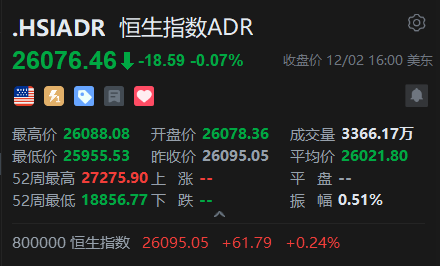
Market Overview - The Hang Seng Index (HSI) closed at 26,076.46, down by 18.59 points or 0.07% on March 10 [1] - The index reached a high of 26,088.08 and a low of 25,955.53 during the trading session, with a trading volume of 33.66 million [1] Blue-Chip Stocks Performance - HSBC Holdings closed at HKD 112.111, up by 1% compared to the previous close [2] - Tencent Holdings closed at HKD 616.297, down by 0.11% compared to the previous close [2] Individual Stock Movements - Tencent Holdings: Latest price HKD 617.000, down by HKD 2.500 or 0.40% [3] - Alibaba Group: Latest price HKD 157.000, up by HKD 2.100 or 1.36% [3] - China Construction Bank: Latest price HKD 8.160, up by HKD 0.010 or 0.12% [3] - HSBC Holdings: Latest price HKD 111.000, up by HKD 0.500 or 0.45% [3] - Xiaomi Group: Latest price HKD 40.700, up by HKD 0.400 or 0.99% [3] - AIA Group: Latest price HKD 80.800, up by HKD 0.300 or 0.37% [3] - NetEase: Latest price HKD 224.400, up by HKD 2.000 or 0.90% [3] - BYD Company: Latest price HKD 100.100, up by HKD 2.150 or 2.19% [3] - Ctrip Group: Latest price HKD 543.000, down by HKD 1.000 or 0.18% [3] - JD Group: Latest price HKD 116.000, down by HKD 1.100 or 0.94% [3]






大行评级丨花旗:中国互联网板块成为今年迄今表现最好板块,明年上半年首选腾讯、阿里、携程等
Ge Long Hui· 2025-12-02 03:23
Core Insights - The Chinese internet sector has emerged as the best-performing sector this year, with a cumulative return of 36.5% [1] - In comparison, other indices such as the Seoul Composite Index, Hang Seng Index, Nikkei Index, S&P 500, and India's Nifty 50 have shown lower cumulative returns of 64%, 29%, 26%, 15.8%, and 10.4% respectively [1] - There is a growing risk-averse sentiment in the markets of China, Japan, and the United States, attributed to year-end profit-taking and portfolio rebalancing [1] Industry Analysis - Ongoing debates regarding whether AI valuations are excessively high persist, but geopolitical risks and AI supply chain issues are expected to keep the valuations of Chinese internet companies at a discount compared to global peers [1] - The acceleration of AI adoption is anticipated to intensify competition among Chinese AI participants by 2026, covering areas such as AI cloud infrastructure, chatbots, and various application scenarios [1] Company Preferences - Citigroup's top picks for the first half of 2026 include core AI concept stocks: Tencent and Alibaba [1] - Companies with stable profit growth and anti-cyclical characteristics include Trip.com and NetEase [1] - Companies with high exposure to cross-border business include Jitu Express [1] - Potential stocks in gaming and AI applications include Century Huatong [1]

恒生科技ETF鹏华(520590)红盘向上,可灵AI发布全新视频和图像模型
Xin Lang Cai Jing· 2025-12-02 02:59
Core Insights - The Hang Seng Tech Index (HSTECH) has shown a positive trend, with notable increases in key component stocks such as BYD (3.52%), Alibaba (2.39%), Kuaishou (2.27%), Xiaomi (2.23%), and NetEase (1.89%) [1][2] - The launch of AI applications, particularly Alibaba's Quark AI glasses and Keling AI's new product, is expected to drive demand for AI computing power and upgrade the edge hardware industry [1][2] Company Developments - Alibaba has officially released the Quark AI glasses, featuring the latest Qianwen AI assistant, which integrates deeply with Alibaba's application ecosystem [1] - Keling AI has introduced the Keling O1, a multi-modal creation tool that addresses consistency issues in AI video generation, providing a comprehensive solution for various applications [1] Industry Trends - Open-source securities highlight that AI edge applications, such as the Quark AI glasses, may reshape AI interaction modes and accelerate the deployment of AI applications [2] - Dongwu Securities notes that the current AI development is primarily driven by large models, with the US and China being the leading regions in AI infrastructure and hardware investments, indicating rapid growth in the global AI industry [2] Market Composition - As of December 1, 2025, the top ten weighted stocks in the Hang Seng Tech Index account for 69.48% of the index, including Alibaba, Tencent, SMIC, NetEase, Meituan, BYD, Xiaomi, Kuaishou, JD.com, and Trip.com [2]


携程集团:调研要点-利润端担忧与日本出境游预期引发回调,当前是良好买入机会
2025-12-01 00:49
Summary of Trip.com Group (TCOM) Conference Call Company Overview - **Company**: Trip.com Group (TCOM) - **Market Cap**: $44.3 billion - **Enterprise Value**: $38.0 billion - **Current Price**: $69.72 - **12-Month Price Target**: $91.00 (Upside: 30.5%) [1][5] Key Industry Insights - **Industry**: Online Travel Agency (OTA) in Asia, particularly focusing on travel to Japan and other Asian markets - **Recent Trends**: Concerns over profit margins and geopolitical tensions affecting travel to Japan, presenting a potential buying opportunity [1][19] Core Points Discussed 1. **Profit Margin Outlook**: - Management addressed concerns regarding lower EBIT margin guidance for 4Q25 (20.8% vs. 21.6% in 4Q24), attributing it to a revenue mix shift towards the loss-making Trip.com platform (18% of revenue vs. 14% in 4Q24) [1][19] - Confidence in improving profitability from domestic and outbound businesses into FY26 due to scale economies and a shift towards higher-margin hotel business [1][19] 2. **Revenue Growth Projections**: - Base case scenario assumes Trip.com's revenue growth will slow to 40% YoY (from 50-60% in recent quarters), with a narrower loss from Trip.com supporting group margin expansion to 29.8% in FY26E [1][19] - Stronger top-line growth (60%+) could dilute margin trends, projecting a decline to 27.5% [1][19] 3. **Impact of Geopolitical Tensions**: - Acknowledgment of cancellations due to the Chinese government's advisory against traveling to Japan, but management remains optimistic about revenue/earnings impact due to the low travel season in 4Q [2][18] - Potential diversion of travel demand to other destinations like Thailand, Hong Kong, and Korea [18] 4. **AI Integration**: - AI is being leveraged to enhance service quality and automate customer interactions, with current automation rates at 75-80% in mainland China [21] - AI is expected to improve cross-selling predictions, potentially boosting revenue [21] 5. **Market Focus and Competitive Strategy**: - Trip.com will prioritize expansion in Asia over Europe, focusing on under-penetrated markets like Korea and Japan [19][21] - Differentiation from competitors through a focus on local Asian travelers and a one-stop shop model for travel services [21] 6. **Financial Projections**: - Revenue forecasts for FY26E: Rmb 70,907.8 million, with EBITDA of Rmb 22,049.5 million and EPS of Rmb 31.43 [5][16] - Expected EBIT margin improvement for domestic/outbound business by 1.3-1.5 percentage points YoY in FY26E [19] Additional Important Insights - **Travel Booking Volume**: A 30-40% YoY decline in travel booking volume was noted, but management is not overly concerned due to the timing and potential for re-arrangements for upcoming holidays [18] - **Investment in MakeMyTrip**: Trip.com retains a 16.9% stake in MakeMyTrip, expecting synergies from shared travel resources [18] - **Valuation Metrics**: The stock is trading at 17x FY26E P/E, 11x EV/EBITDA, and a 6.3% FCF yield, indicating an undemanding valuation [19] This summary encapsulates the key takeaways from the Trip.com Group conference call, highlighting the company's strategic focus, financial outlook, and market dynamics.
中国消费者(HA):中国仍在消费不足吗
Sou Hu Cai Jing· 2025-12-01 00:46
Core Conclusion - The notion of "insufficient consumption in China" is a distorted perception amplified by pricing and statistical methods. Bank of America provides extensive data showing that the true picture of Chinese consumption is not "volume shrinkage," but rather "high volume, low price." Total commodity consumption has reached or even surpassed that of the US, Japan, and South Korea; service consumption has met basic standards but still has gaps in quality. The main contradiction in the current market is the mismatch between "mass supply" and "upgraded demand." Companies focusing on the four key areas of "Efficiency, Experience, Service, Globalization (E2SG)" will thrive through cycles [1]. Group 1: Commodity Consumption - China's total commodity consumption is impressive, with certain categories outperforming developed countries. For example, per capita egg consumption is 128.5 g/day, which is 6% higher than the US and 42% higher than the global average. Sulfur consumption is 1117.9 g/day, which is 3.2 times that of the US. Seafood consumption is 114 g/day, nearly double that of the US. However, dairy consumption is only 86.9 g/day, which is 1/7 of the US level, but this gap is mitigated by plant proteins and eggs. The ownership of cooking appliances is 2.14 times the global average and 1.22 times that of the US. The number of new energy vehicles is 7.7 per thousand people, surpassing the US by 1.66 times and Japan by 8.75 times [3][4]. Group 2: Service Consumption - In terms of service consumption, China has met basic standards but still has quality gaps. The average housing area per person is 49 m², slightly below the US's 65 m² but higher than the UK and France. Medical visits average 6.8 times per year, exceeding the US by 3.4 times. Education duration is 15.5 years, on par with the US and Japan, but extracurricular spending is only $140/year, which is 1/28 of South Korea's. The prices for leisure and entertainment, such as concerts and exhibitions, have increased by 53%, indicating a significant supply-demand gap in high-quality offerings [5][6]. Group 3: Misconceptions of Consumption - The illusion of "insufficient consumption" stems from three main sources: 1. Low prices: Most goods/services are priced at only 20%-60% of US prices (e.g., mobile plans at 15%, taxis at 20%, utilities at 24%). 2. Supply chain advantages: China's role as the "world's factory" and innovations in distribution (like community group buying) continue to drive prices down. 3. Statistical discrepancies: If government transfer payments are included, the actual consumption to GDP ratio aligns with that of South Korea, which is approximately 40% [6]. Group 4: Mismatches and E2SG Investment Framework - There are three core mismatches in the market: 1. Supply vs. Demand: There is an oversupply of mass-market products, but insufficient emotional value and experience. 2. Channels vs. Communication: Fragmented media and ineffective traditional marketing require precise targeting and content-driven e-commerce. 3. Expectations vs. Reality: While income expectations are weak, there is a high demand for quality, necessitating affordable yet high-quality offerings [7]. Group 5: E2SG Investment Tracks - The E2SG investment framework emphasizes four key dimensions for companies to succeed in a "high volume, low price" market: 1. Efficiency: Achieving low costs and quick turnover through supply chain optimization and scale effects. 2. Experience: Creating differentiation through product innovation and capturing emotional consumption needs. 3. Service: Filling the gap in high-quality supply. 4. Globalization: Leveraging China's high volume and low price advantage to expand into international markets [10][11][12]. Group 6: Recommended Companies - Bank of America has identified seven companies with long-term competitive advantages across various sectors, including: - Pop Mart: Strong IP operation capabilities and global expansion, with an expected EPS growth of 30% by 2026. - Midea: Leading in global white goods with supply chain efficiency, focusing on overseas OBM business growth. - Geely: Rich in new energy vehicle reserves, planning to launch over 10 new models by 2026 with a target growth of 50%-80%. - Huazhu Group: Benefiting from leisure travel demand recovery and expanding through a light asset model, with a projected 21% CAGR in profits from 2024-2026. - Trip.com Group: Leading in OTA with expected 45% growth in international business revenue over the next six years. - Tencent Holdings: Dominating digital entertainment with stable mobile game revenue and AI-driven efficiency improvements. - Damai Entertainment: Leading in live entertainment ticketing with a projected 60% CAGR in profits from 2025-2028 [20][21].



超百家企业捐赠总额超12亿港元,企业驰援香港大埔火灾救援


第一财经· 2025-11-29 07:06
Core Points - A significant fire occurred in Hong Kong's Tai Po district, resulting in major casualties and prompting over 100 companies and foundations to donate for emergency relief and community recovery efforts, with total donations exceeding HKD 1.2 billion [2][4]. Donation Summary - Major companies such as Yuexiu Group donated HKD 10 million, while China Overseas and China State Construction contributed HKD 20 million [3]. - Tencent donated HKD 30 million, and Alibaba made an initial donation of HKD 20 million [3]. - Other notable contributions include HKD 30 million from the Li Ka Shing Foundation and HKD 12 million from the Chaozhou Association [4]. - The total amount of donations has surpassed HKD 1.2 billion as of the latest reports [4].

海外消费周报(20251121-20251128):海外社服:携程和同程旅行3Q25业绩稳健增长-20251128
Shenwan Hongyuan Securities· 2025-11-28 09:02
Group 1: Investment Ratings - The report maintains a "Buy" rating for both Ctrip and Tongcheng Travel, indicating a positive outlook on their performance in the online travel industry [1][2][5][6]. Group 2: Core Insights - Ctrip's Q3 2025 revenue increased by 16% year-on-year to 18.4 billion yuan, with non-GAAP operating profit reaching 6.1 billion yuan, exceeding expectations due to lower marketing expenses [1][5]. - Tongcheng Travel reported a 10% year-on-year revenue growth to 5.5 billion yuan in Q3 2025, with adjusted net profit rising 17% to 1.06 billion yuan, driven by better-than-expected accommodation business performance [2][6]. - Ctrip's accommodation booking revenue grew by 18%, transportation revenue by 12%, and international OTA platform bookings increased by over 60% year-on-year [1][5]. - Tongcheng Travel's core OTA business revenue grew by 15%, with accommodation booking revenue also up by 15%, benefiting from increased hotel average prices and record daily room nights [2][6]. - Ctrip's international hotel and flight bookings have increased by 140% compared to 2019, while Tongcheng Travel expects outbound travel business to grow rapidly, contributing 10-15% to overall revenue by 2027 [1][2][5][6]. Group 3: Summary by Sections Section 1: Overseas Social Services - Ctrip's Q3 2025 performance shows strong growth across various segments, with significant increases in international bookings and a solid market position in China [1][5]. - Tongcheng Travel's performance reflects a robust growth trajectory, particularly in accommodation and outbound travel, with a strong user base [2][6]. Section 2: Overseas Pharmaceuticals - CSPC Pharmaceutical Group reported a 12.3% year-on-year decline in revenue for the first three quarters of 2025, totaling 19.89 billion yuan, but showed a 3.4% revenue growth in Q3 [3][10]. - The company's net profit for Q3 2025 increased by 27.2% to 964 million yuan, aligning with expectations despite a decline in overall revenue for the year [3][10]. Section 3: Overseas Education - The education index saw a 2% increase, with a year-to-date growth of 7.3%, indicating a recovery in the sector [4][16]. - The report suggests a positive outlook for private higher education companies, with expectations of improved profitability and growth potential [4][18].
海外消费周报:海外社服:携程和同程旅行3Q25业绩稳健增长-20251128
Shenwan Hongyuan Securities· 2025-11-28 08:15
Investment Rating - The report maintains a "Buy" rating for both Ctrip and Tongcheng Travel, indicating a positive outlook for their performance in the online travel industry [2][3]. Core Insights - Ctrip's 3Q25 revenue increased by 16% year-on-year to 18.4 billion yuan, with a non-GAAP operating profit of 6.1 billion yuan, exceeding expectations due to lower marketing expenses [2][7]. - Tongcheng Travel's 3Q25 revenue grew by 10% year-on-year to 5.5 billion yuan, with adjusted net profit rising 17% to 1.06 billion yuan, driven by better-than-expected accommodation business performance [3][8]. - Both companies are expected to benefit from the recovery in outbound tourism, with Ctrip's international OTA platform bookings increasing over 60% year-on-year and inbound tourism bookings more than doubling [2][7]. - The report highlights the stability of the online travel industry and the potential for market share growth for both companies, particularly in international markets [2][3]. Summary by Sections 1. Overseas Social Services: Ctrip and Tongcheng Travel 3Q25 Performance - Ctrip's accommodation booking revenue rose by 18%, transportation revenue by 12%, and business travel management revenue by 15% [2][7]. - Tongcheng Travel's core OTA business revenue increased by 15%, with accommodation booking revenue also up by 15% [3][8]. - Both companies are positioned well for future growth, particularly in outbound travel, with expectations for international flight and hotel contributions to increase significantly by 2027 [3][8]. 2. Overseas Pharmaceuticals: CSPC Pharmaceutical Group - CSPC's revenue for the first three quarters of 2025 decreased by 12.3% to 19.89 billion yuan, but third-quarter revenue grew by 3.4% to 6.62 billion yuan, aligning with expectations [4][13]. - The report notes a decline in gross margin and a decrease in the contribution of the prescription drug segment to total sales [4][13]. 3. Overseas Education: Profitability Management Conditions Mature - The education index rose by 2% this week, with a year-to-date increase of 7.3% [19]. - The report suggests focusing on Hong Kong higher education companies, anticipating a recovery in profitability and expansion potential [21][29].