
SMIC(688981)

Search documents
中芯国际(00981) - 董事会会议日期通知
2026-01-27 10:41
香港交易及結算所有限公司及香港聯合交易所有限公司對本公告的內容概不負責,對其準確性或完整 性亦不發表任何聲明,並明確表示,概不對因本公告全部或任何部份內容而產生或因倚賴該等內容而 引致的任何損失承擔任何責任。 SEMICONDUCTOR MANUFACTURING INTERNATIONAL CORPORATION 中 芯 國 際 集 成 電 路 製 造 有 限 公 司 * 公司秘書 / 董事會秘書 郭光莉 中國上海,2026 年 1 月 27 日 於本公告日期,本公司董事分別為: 執行董事 劉訓峰 非執行董事 (於開曼群島註冊成立之有限公司) (股份代號:00981) 董事會會議日期通知 根據香港聯合交易所有限公司證券上市規則第13.43條,中芯國際集成電路製造有限公司(「本 公司」)特此通知,本公司謹訂於2026年2月10日(星期二)舉行董事會會議,旨在批准刊發 本公司截至2025年12月31日止三個月未經審計業績公告。 承董事會命 中芯國際集成電路製造有限公司 范仁達 劉明 吳漢明 陳信元 * 僅供識別 魯國慶 陳山枝 楊魯閩 黃登山 獨立非執行董事 ...
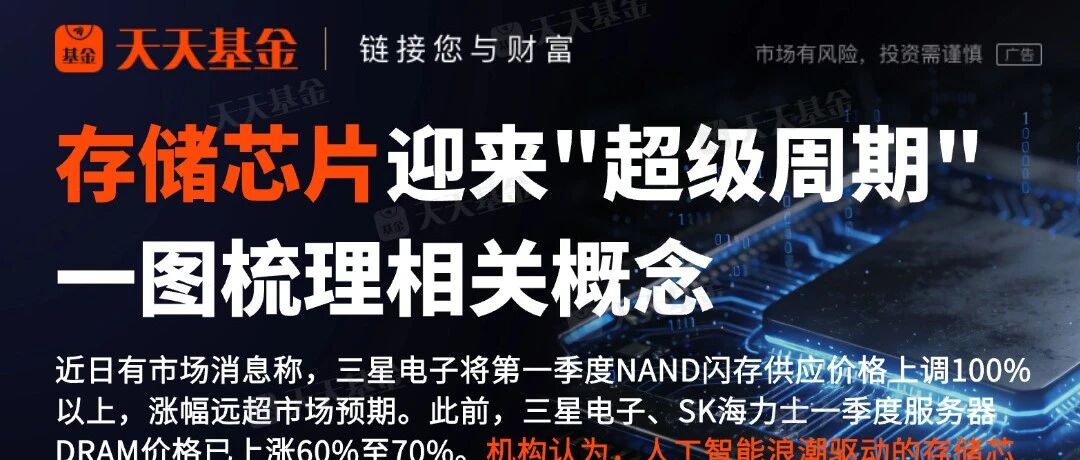
存储芯片迎来"超级周期"!一图梳理相关概念
天天基金网· 2026-01-27 10:26
Core Viewpoint - The storage chip industry is entering a "super cycle" driven by the demand surge from artificial intelligence (AI) and supply constraints, with significant price increases expected in NAND flash and DRAM products [1][6][7]. Price Increases - Samsung Electronics has raised NAND flash supply prices by over 100% in Q1, exceeding market expectations [6]. - DRAM prices for servers have increased by 60% to 70% in the same period [7]. Demand Drivers - The demand for storage chips is expanding due to increased investments in AI infrastructure, leading to a notable rise in enterprise solid-state drive (SSD) requirements [7]. - The trend of "edge AI," where devices perform AI computations directly, is further amplifying the need for high-performance storage solutions [7]. Market Outlook - Analysts predict that the storage chip market will experience a "super cycle" supported by both AI demand and domestic substitution, with price increases likely to continue [7]. - Global storage prices are expected to remain tight through 2026, with AI demand outpacing production capacity [7][8]. Investment Opportunities - The current market conditions suggest that various segments of the storage industry, including manufacturers, module companies, and testing/packaging firms, will benefit from the price surge [7]. - Investment in semiconductor-related funds and indices, such as the National Semiconductor Index and the China Semiconductor Index, is recommended for those looking to capitalize on the storage chip trend [9].




华安基金科创板ETF周报:政策持续赋能硬科技,科创芯片指数周涨2.42%
Xin Lang Cai Jing· 2026-01-27 09:59
Group 1: Core Insights - The Sci-Tech Innovation Board (STAR Market) has surpassed 600 listed companies with a total market capitalization exceeding 10 trillion yuan [1][16] - The Beijing Municipal People's Congress emphasized the development of high-tech industries, including integrated circuits, international pharmaceutical innovation parks, and advanced energy projects [1][16] - Policies are increasingly supportive of technology-driven enterprises, particularly those focusing on "hard technology" and core technological breakthroughs [2][17] Group 2: Industry Dynamics - The STAR Market is witnessing significant growth in sectors such as electronics, biomedicine, computing, power equipment, and machinery, which together account for 88% of the market capitalization [3][19] - Recent trends indicate a rebound in the STAR Market, particularly in the chip, information technology, and new materials sectors [3][18] - The demand for high-end semiconductors is driven by AI infrastructure development, leading to increased orders for semiconductor equipment and materials [5][20] Group 3: Investment Opportunities - The STAR Market's focus on hard technology includes sectors like electronic chips, emerging software, and intelligent manufacturing, reflecting the rise of advanced manufacturing in China [2][17] - ETFs related to hard technology, such as the Sci-Tech Chip ETF (588290) and Sci-Tech Information ETF (588260), are highlighted as long-term investment opportunities [2][17] - The pharmaceutical sector is experiencing a dual push for innovation, with Chinese companies both exporting their products and acquiring foreign assets to enhance their portfolios [8][22]




南向资金 | 中国移动遭净卖出11.47亿港元

Di Yi Cai Jing· 2026-01-27 09:52
(本文来自第一财经) 南向资金今日净卖出6.35亿港元,中国移动、紫金矿业、中芯国际分别遭净卖出11.47亿港元、8.43亿港 元、5.53亿港元。净买入方面,腾讯控股、中国人寿、长飞光纤光缆净买入额位列前三,分别获净买入 10.24亿港元、5.11亿港元、3.55亿港元。 ...
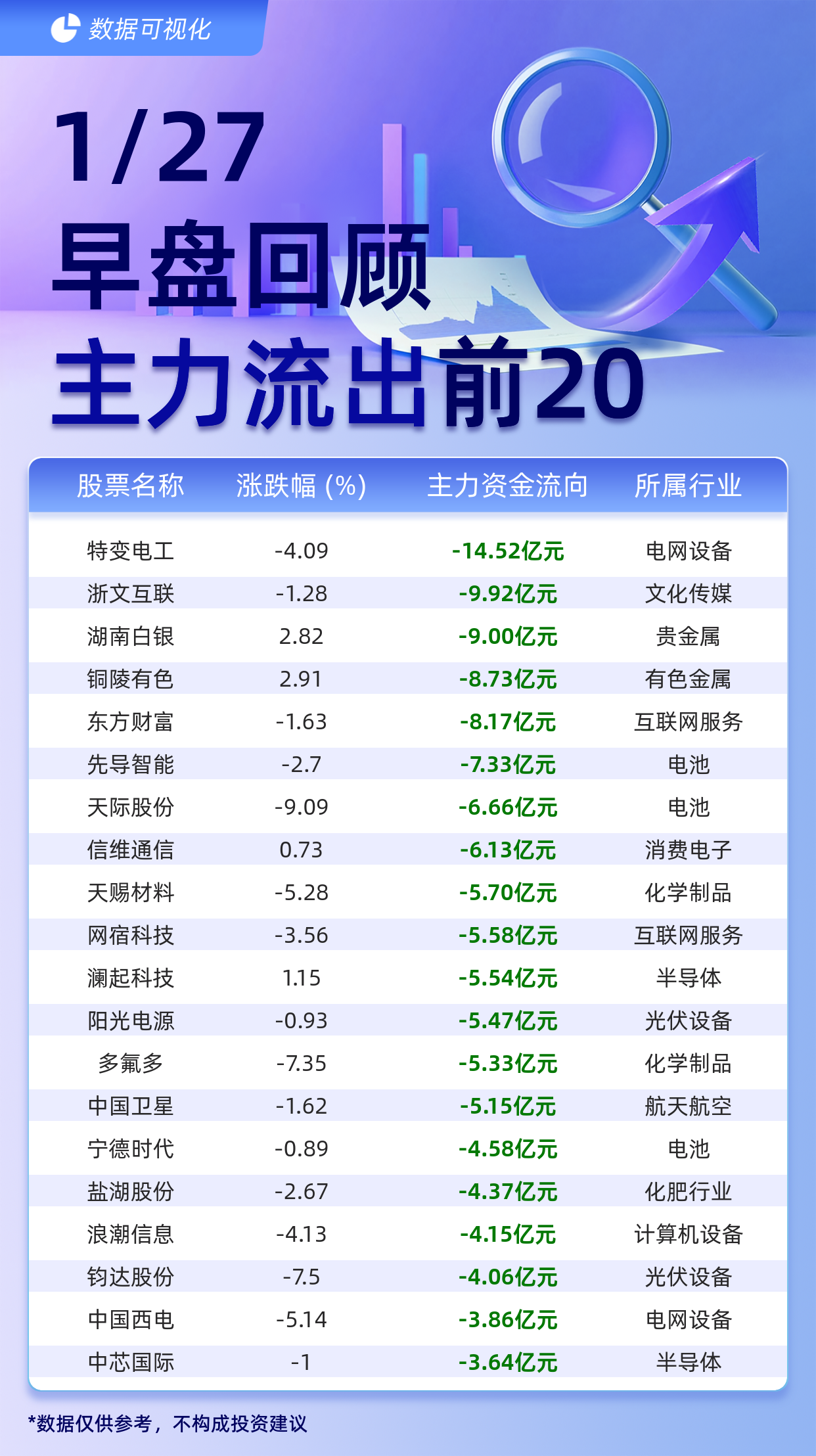
主力个股资金流出前20:特变电工流出14.52亿元、浙文互联流出9.92亿元
Jin Rong Jie· 2026-01-27 04:21
Core Viewpoint - The data indicates significant outflows of capital from various stocks, with notable amounts withdrawn from companies across different sectors, particularly in the electric equipment and battery industries [1][2][3]. Group 1: Major Stocks with Capital Outflows - TBEA Co., Ltd. experienced a capital outflow of 1.452 billion yuan, with a decline in stock price of 4.09% [2]. - Zhejiang Wenlian reported a capital outflow of 992 million yuan, with a stock price decrease of 1.28% [2]. - Hunan Silver saw a capital outflow of 900 million yuan, with a stock price increase of 2.82% [2]. - Tongling Nonferrous Metals had a capital outflow of 873 million yuan, with a stock price increase of 2.91% [2]. - Dongfang Fortune experienced a capital outflow of 817 million yuan, with a stock price decrease of 1.63% [2]. Group 2: Additional Stocks with Notable Outflows - Leading Intelligent reported a capital outflow of 733 million yuan, with a stock price decrease of 2.7% [2]. - Tianji Co., Ltd. faced a capital outflow of 666 million yuan, with a significant stock price drop of 9.09% [2]. - Xinyi Communication had a capital outflow of 613 million yuan, with a stock price increase of 0.73% [2]. - Tianci Materials saw a capital outflow of 570 million yuan, with a stock price decrease of 5.28% [2]. - Wangsu Science & Technology experienced a capital outflow of 558 million yuan, with a stock price decrease of 3.56% [2]. Group 3: Other Companies with Capital Outflows - Longi Green Energy reported a capital outflow of 547 million yuan, with a stock price decrease of 0.93% [3]. - Dufeng Co., Ltd. faced a capital outflow of 533 million yuan, with a stock price decrease of 7.35% [3]. - China Satellite had a capital outflow of 515 million yuan, with a stock price decrease of 1.62% [3]. - Contemporary Amperex Technology experienced a capital outflow of 458 million yuan, with a stock price decrease of 0.89% [3]. - Salt Lake Potash reported a capital outflow of 437 million yuan, with a stock price decrease of 2.67% [3].






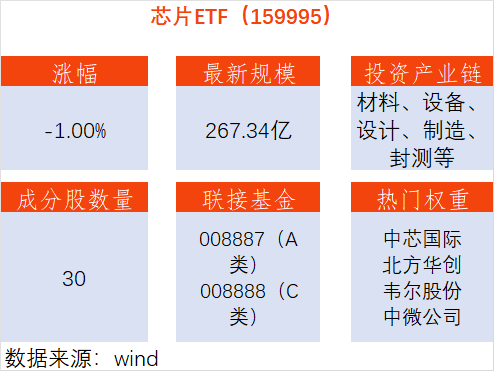
AI服务器出货与存储价格双升,芯片ETF(159995.SZ)跌1%,瑞芯微涨2.85%
Mei Ri Jing Ji Xin Wen· 2026-01-27 02:22
Group 1 - The A-share market experienced a collective decline on January 27, with the Shanghai Composite Index down by 0.32%. The sectors showing gains included metals, banking, and oil, while electric equipment and pharmaceuticals saw the largest declines [1] - In the semiconductor sector, the performance was mixed. The chip ETF (159995.SZ) fell by 1.00%, while some component stocks like Ruixin Micro and Zhongwei Company increased by 2.85% and 2.23%, respectively. However, companies like Jing Sheng Machinery and Sanan Optoelectronics performed poorly, with declines of -3.82% and -3.07% [1] Group 2 - According to TrendForce, the global server shipment volume is expected to grow at an annual rate of 12.8% by 2026, with AI server shipments projected to grow over 28%, up from 24.2% in 2025. This growth is driven by significant investments in AI infrastructure by global CSPs [3] - The storage industry, including DRAM and NAND Flash, is expected to see its market value reach $551.6 billion by 2026, a year-on-year increase of 134%, and continue to grow by 53% to $842.7 billion in 2027. Samsung Electronics is reported to increase NAND flash supply prices by over 100% in Q1 2026, highlighting a severe supply-demand imbalance in the semiconductor market [3] - The packaging and testing segment of the storage chip industry is benefiting from a recovery in downstream demand, with leading manufacturers operating at near full capacity and service prices increasing by approximately 30%. This indicates a positive trend in the storage industry, with growth in both volume and price [3]



聚焦“高精尖”· “20CM”高弹性|科创芯片ETF华宝(589190)今起全“芯”上市!
Xin Lang Cai Jing· 2026-01-27 01:32
Core Insights - The "14th Five-Year Plan" emphasizes extraordinary measures to achieve decisive breakthroughs in key core technologies across various sectors, including integrated circuits and artificial intelligence [1][2] - The launch of the Huabao Science and Technology Chip ETF (589190) aims to provide investors with opportunities to engage in the domestic chip industry, tracking the Shanghai Stock Exchange Science and Technology Chip Index [1][2] Industry Overview - The chip industry is a core battleground for major countries, with the Huabao Science and Technology Chip ETF tracking an index that includes 50 companies involved in semiconductor materials, design, manufacturing, packaging, and testing [2][14] - As of December 2025, the index's components focus on upstream and midstream sectors, with nearly 80% in chip design and semiconductor materials and equipment [2][15] Performance Metrics - The Shanghai Stock Exchange Science and Technology Chip Index has shown a significant annualized return of 17.93% from December 31, 2019, to December 31, 2025, outperforming similar indices [5][17] - The index's maximum drawdown during the same period was -56.81%, which is better than other comparable indices [5][17] Key Holdings - The top three holdings in the index are SMIC (10.36%), Haiguang Information (10.05%), and Cambricon (9.45%), with a weight limit of 10% for individual stocks [3][16] - The index includes a diverse range of companies, with a significant focus on integrated circuit manufacturing [3][16] Financial Highlights - The net profit of the index's constituent companies surged by 94.22% in the first three quarters of 2025, leading among similar indices [7][17] - R&D investment for these companies reached 119.745 billion yuan, with a research intensity of 11.22%, significantly higher than the overall A-share market [7][17] Fund Management - As of January 26, 2026, Huabao Fund's equity ETF assets reached 139.8 billion yuan, ranking 9th in the industry [19] - The fund has established a comprehensive ETF matrix covering AI and technology sectors, with the Science and Technology Chip ETF being a crucial addition [19]
硬科技 · 『芯』动力!科创芯片ETF华宝(589190)今日全“芯”上市, 锚定硬科技,聚焦高精尖
Xin Lang Cai Jing· 2026-01-27 01:27
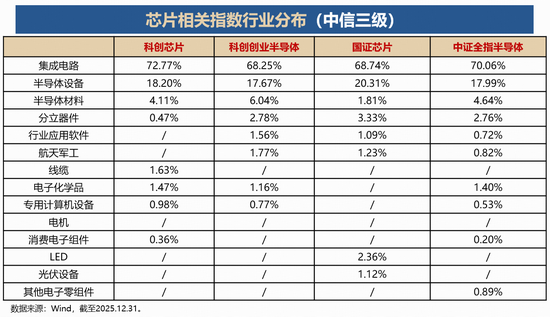
Core Insights - The article highlights the strong performance of the Sci-Tech Innovation Board Chip Index, which has achieved a cumulative increase of over 161% since its base date, with an annualized return of 17.93%, significantly outperforming similar indices such as the Sci-Tech Innovation Entrepreneur Semiconductor and the National Chip Index [3][12][13]. Performance Metrics - The Sci-Tech Chip Index has a higher annualized Sharpe ratio and lower maximum drawdown compared to its peers, indicating a better risk-reward profile [3][12]. - The maximum drawdown for the Sci-Tech Chip Index is less severe at -56.81%, compared to -60.05% for the Sci-Tech Innovation Entrepreneur Semiconductor Index [4][12]. Industry Composition - The index is heavily weighted towards integrated circuits, which account for 72.77% of its composition, significantly higher than other similar indices [6][14]. - The index includes companies involved in semiconductor materials, equipment, design, manufacturing, packaging, and testing, reflecting the overall performance of the representative chip industry on the Sci-Tech Innovation Board [14][15]. Financial Growth - The index's net profit attributable to shareholders surged by 94.22% year-on-year, leading among similar indices [17]. - The R&D investment in the chip industry on the Sci-Tech Innovation Board exceeded 119.7 billion yuan, with an R&D intensity of 11.22%, far surpassing the overall A-share market level of 2.16% [7][17]. Top Holdings - The top ten weighted stocks in the index include: - Zhongke International (10.36%) - Haiguang Information (10.05%) - Cambricon Technologies (9.45%) - Lattice Semiconductor (7.73%) - Zhongwei Company (6.85%) [14][18].


科技主题观点综述:全球算力多点突破,AI驱动端侧应用渗透(更正)
Shanghai Securities· 2026-01-27 00:45
Investment Rating - The report maintains an "Overweight" rating for the electronics industry [1] Core Insights - The "hard technology" sector is expected to perform well under the influence of AI, with domestic computing chips, AI-PCB, AIDC supporting facilities, and AI edge SoC chip design/testing showing rapid growth in 2024 and maintaining high growth in Q1-Q3 of 2025 [4] - The valuation system of the technology industry is likely to be restructured due to the ongoing competition between major powers, particularly in semiconductor manufacturing, equipment, and design, which are areas of low domestic production [4] - Computing power remains the most important theme for the year, with a focus on AI-PCB and AI optical modules, suggesting investment in companies like Shenghong Technology, Huitian Technology, and others [4] - Some consumer electronics stocks, particularly those in the "Apple supply chain," are seen as having good value due to recent price corrections, with potential for performance and valuation recovery driven by AIoT and automotive electronics [4] Summary by Sections AI and Computing Power - The demand for AI computing technology is increasing, with PCB manufacturers achieving significant breakthroughs in AI server applications [22] - The market for AI chips is expected to grow, with the Chinese market projected to reach approximately 342.46 billion yuan by 2024, reflecting a 10.7% year-on-year growth [44] Semiconductor and PCB Industry - The semiconductor industry is experiencing a shift towards more diverse application scenarios, with automotive electronics and IoT driving growth [18] - The PCB equipment market is expected to reach 29.025 billion yuan in 2024, growing by 11.89% year-on-year, and is projected to reach 34.709 billion yuan by 2026 [27] Consumer Electronics - The CIS market is recovering, driven by demand from smartphones, security, and automotive sectors, with a focus on high-end products [46] - AI is providing new growth potential for consumer electronics, with ODM companies gaining competitive advantages [47]

科技主题观点综述:全球算力多点突破,AI驱动端侧应用渗透(更正)-20260126
Shanghai Securities· 2026-01-26 13:03
Investment Rating - The report maintains an "Overweight" rating for the electronics industry [1] Core Insights - The "hard technology" sector is expected to perform well under the influence of AI, with domestic computing chips, AI-PCB, AIDC supporting facilities, and AI edge SoC chip design/testing showing rapid growth in 2024 and maintaining high growth in Q1-Q3 of 2025. This sector is projected to benefit from continued growth in domestic computing capital investment and increasing penetration of edge applications, becoming one of the fastest-growing areas in the electronics and technology industries [4] - The valuation system of the technology industry is likely to be restructured due to the ongoing competition between major powers, particularly in the semiconductor manufacturing and equipment sectors, where the domestic production ratio is currently low. Companies such as Cambricon, SMIC, North Huachuang, Haiguang Information, and Zhongwei Company are recommended for attention [4] - Computing power remains the most important theme for the year, with a focus on AI-PCB (semiconductors) and AI optical modules. Companies like Shenghong Technology, Huitian Technology, and others are highlighted for their potential [4] - Some consumer electronics stocks, particularly those in the "Apple supply chain," have become more cost-effective due to macroeconomic impacts on stock prices. Leading companies in the fruit chain and ODM sectors are expected to leverage demand in AIoT, humanoid robots, and automotive electronics to achieve performance and valuation improvements in the second half of the year [4] Summary by Sections AI and Computing Power - The demand for AI computing technology is increasing, leading to significant breakthroughs for PCB manufacturers in the AI server field. The overall market for AI chips is expected to grow, with China being a major consumer market [18][22] - The AI-driven demand for computing power is pushing the development of various applications, including automotive electronics and IoT, which are expected to drive growth in the chip industry [18] Semiconductor and Equipment - The semiconductor manufacturing sector is projected to see substantial growth, with companies like SMIC and North Huachuang showing promising revenue and profit growth rates [17] - The PCB equipment market is expected to grow significantly, with a projected market size of 290.25 billion yuan in 2024, increasing to 347.09 billion yuan by 2026 [27] Consumer Electronics - The CIS market is experiencing a recovery, driven by demand from smartphones, security, and automotive applications. Domestic manufacturers are increasing their market presence with high-end products [46] - The SoC market is expected to grow, with AI technology becoming a crucial component for various applications, including smart home devices and automotive electronics [44]