
BSU(600010)

Search documents
稀土指数显著走低,盛和资源跌超5%
Mei Ri Jing Ji Xin Wen· 2025-08-12 01:45
Group 1 - The rare earth index experienced a significant decline, with a daily drop of 2.01% [1] - Among the component stocks, Shenghe Resources fell over 5%, China Rare Earth dropped by 2.80%, Northern Rare Earth decreased by 2.35%, Guangsheng Nonferrous fell by 1.90%, and Baotou Steel dropped by 1.56% [1]


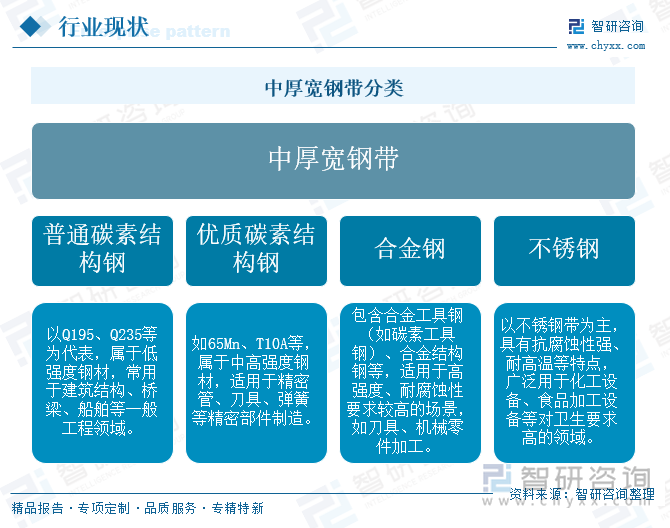
研判2025!中国中厚宽钢带行业产业链、产量及价格分析:短期供需失衡与成本下行压力凸显,行业转型面临价格与需求双重挑战[图]
Chan Ye Xin Xi Wang· 2025-08-10 00:36
Industry Overview - The medium and thick wide steel strip industry is experiencing structural growth opportunities due to the transformation and upgrading of the manufacturing industry and the rapid development of the new energy sector [1][8] - The production of medium and thick wide steel strips in China reached 114 million tons in the first half of 2025, representing a year-on-year increase of 4.47% [1][8] Industry Chain - The upstream of the medium and thick wide steel strip industry includes raw materials such as iron ore, coal, scrap steel, and electricity, as well as production equipment like blast furnaces and rolling mills [4] - The downstream applications encompass construction, machinery manufacturing, shipbuilding, energy equipment, bridges, and the automotive industry [4] Market Dynamics - The global iron ore supply is expected to increase, with major producers like Rio Tinto and BHP expanding capacity, leading to a projected global output of 2.45 billion tons in 2025, a year-on-year increase of 3.8% [6] - The price of iron ore futures in China fell to 715.5 yuan per ton by the end of June 2025, a decrease of 13.27% year-on-year, which significantly reduced production costs for medium and thick wide steel strips [6] Key Enterprises - The medium and thick wide steel strip industry has a relatively high market concentration, with a few large enterprises dominating the market, such as Baosteel Group and Ansteel [12] - Baosteel is recognized for its advanced production technology and equipment, while Ansteel has a strong market share in various sectors including construction and machinery [12][14] Development Trends - The industry is shifting towards high-end and intelligent transformation, with a focus on high-strength and corrosion-resistant steel [18] - The green and low-carbon development trend is becoming mainstream, with expectations of a 15% reduction in carbon emission intensity through the adoption of hydrogen metallurgy and short-process steelmaking technologies [19] - The application of medium and thick wide steel strips in new infrastructure projects, such as rail transit and new energy vehicles, is expected to expand significantly [20]




包钢时速400公里高铁钢轨成功供货国家重大项目,“中国速度”迈向新高度!
Nei Meng Gu Ri Bao· 2025-08-09 15:25
Core Viewpoint - The successful development and supply of high-speed rails suitable for 400 km/h by Baogang Group marks a significant breakthrough in China's high-speed rail technology, providing a solid foundation for achieving higher speeds in the future [1][3]. Group 1: Product Development and Features - The newly developed high-speed rails meet domestic leading performance standards and represent the culmination of Baogang's advanced manufacturing technology [3]. - The rails have improved straightness by 20% compared to traditional high-speed rails, with significantly reduced harmful inclusions, ensuring safety and stability for high-speed operations [3][5]. - The research and development team overcame key technical challenges in precision control and metallurgical purity over a six-month period [3]. Group 2: Market Position and Future Plans - Baogang Group is the largest rail production base in China, covering a full range of railway steel products, with a domestic market share exceeding 30% [5]. - The company plans to leverage the unique advantages of rare earth steel to enhance product quality and optimize the variety structure, focusing on expanding into high-speed passenger and heavy freight railway markets [5][8]. - The successful launch of this high-speed rail product is a key achievement in Baogang's pursuit of its "14th Five-Year Plan" development goals, contributing to national strategic initiatives [8].

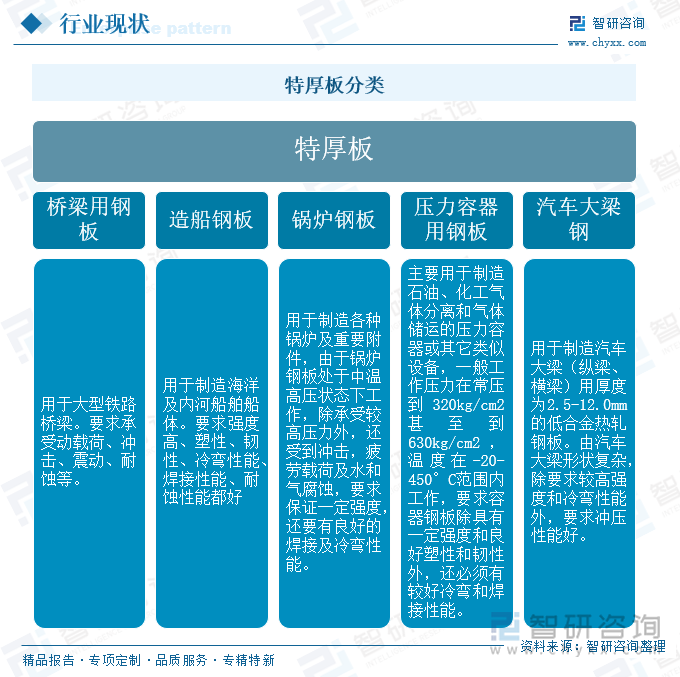
研判2025!中国特厚板行业产业链、产量及价格分析:2025年上半年特厚板市场呈“窄幅震荡、重心下移”特征,6月均价环比微增0.95%但同比降8.18%[图]
Chan Ye Xin Xi Wang· 2025-08-09 02:22
Industry Overview - The thick plate industry is characterized by its high strength, excellent plasticity, and weather resistance, making it irreplaceable in shipbuilding, energy equipment, and bridge engineering [1][7] - In 2023, China's thick plate production reached 11.18 million tons, a year-on-year decrease of 1.81%, but it maintained a steady growth trend amidst fluctuations [1][7] - The short-term decline is attributed to slow global economic recovery, increased international trade friction, and deep adjustments in domestic industrial structure [1][7] - The high-end trend in the industry is emerging, with the production of high-value-added products like 15CrMoR for nuclear power and chromium-molybdenum steel increasing against the trend [1][7] Industry Chain - The upstream of the thick plate industry includes raw materials such as iron ore, coal, scrap steel, and electricity, as well as production equipment like blast furnaces and rolling mills [3] - The midstream involves the production and manufacturing of thick plates, while the downstream includes industries with high material performance requirements such as construction, aerospace, marine engineering, and energy [3] Market Trends - The thick plate market is expected to experience a "narrow fluctuation and downward shift" in the first half of 2025, with an average price of 4,364 yuan per ton in June 2025, reflecting a 0.95% increase month-on-month but an 8.18% decrease year-on-year [9] - The market dynamics have shifted significantly, with prices remaining stable in the first quarter due to concentrated infrastructure project releases and export orders, but showing a gradual decline in the second quarter due to weakened global economic recovery [9] Key Enterprises - Major companies in the thick plate industry include Baosteel, Shagang, Ansteel, and Hesteel, with Baosteel holding a significant market share due to its advanced production technology [11][13] - Ansteel is recognized for its high-quality thick plates used in pressure vessels and bridges, while Hesteel's products are favored in mining and engineering machinery [11][13] Development Trends - The industry will focus on technological innovation and product upgrades, with increased R&D investment to develop high-strength, high-toughness, and high-corrosion-resistant thick plates [17] - Environmental policies are driving the industry towards green and low-carbon development, with companies investing in clean energy and energy-saving technologies [18][19] - The market demand for thick plates is expected to grow due to infrastructure construction, manufacturing transformation, and developments in the renewable energy sector [20]
包钢股份中标某钢轨联合采购项目
Zheng Quan Shi Bao Wang· 2025-08-08 14:18
Group 1 - Baogang Co., Ltd. has successfully won a bid for a joint procurement project of railway tracks, which will provide critical material support for national key projects [1] - This achievement signifies the continuous strengthening of Baogang's competitiveness in the high-end railway steel sector [1] - The project is expected to significantly accelerate the implementation of major national railway engineering projects [1]
稀土板块大涨!概念股盘点来了(名单)
Zheng Quan Zhi Xing· 2025-08-08 02:03
Industry Overview - The rare earth sector has seen a significant increase, with companies like Zhenghai Magnetic Materials and Aishichuang hitting the daily limit up, indicating strong market performance [1] - Rare earth elements are classified into light and heavy rare earths, with China being the sole source of heavy rare earth separation globally [1] - The rare earth industry is entering a traditional consumption peak season in August, leading to increased demand and procurement [1] Supply and Demand Dynamics - The demand for rare earth materials is expected to rise due to increased orders from major manufacturers, with some orders scheduled until mid-September [1] - The import volume of domestic rare earth products has significantly decreased due to factors like US-China tariff conflicts and political issues in Myanmar [1] - Recent price increases in rare earth materials are a key catalyst for the sector's heightened interest, with expectations of continued upward price momentum driven by strong demand [1][2] Applications of Rare Earth Materials - Rare earth permanent materials are crucial in the electric vehicle sector, with approximately 2 kilograms of rare earth used per vehicle [2] - The consumer electronics sector also shows stable growth in demand for high-performance permanent materials, used in devices like smartphones and computers [2] - Emerging industries, such as humanoid robotics, are projected to create substantial demand for rare earth materials, with estimates suggesting a potential market of $800 billion [2] Key Companies in the Rare Earth Sector - Northern Rare Earth: One of the largest suppliers of light rare earth products globally, with a target utilization rate of 90% for praseodymium and neodymium by 2025 [3] - Zhongke Magnetic Materials: A significant domestic producer of permanent magnetic materials, focusing on sintered neodymium-iron-boron and ferrite magnets [3] - China Rare Earth: The only listed platform for China Minmetals, specializing in ion-type rare earth separation and processing [3] - Galaxy Magnet: Engaged in the development and production of bonded neodymium-iron-boron magnets and samarium-cobalt magnets [3] - Inlohua: Produces neodymium-iron-boron permanent materials and serves major clients like Apple and Samsung [3] - Baotou Steel: Supplies rare earth concentrates and is known for its rich mineral resources [3] - Guangxi Rare Earth: A key player in the Guangdong rare earth industry, holding significant mining rights [4] - Xiamen Tungsten: Involved in rare earth permanent magnets with an annual production capacity of 4,000 tons [4]



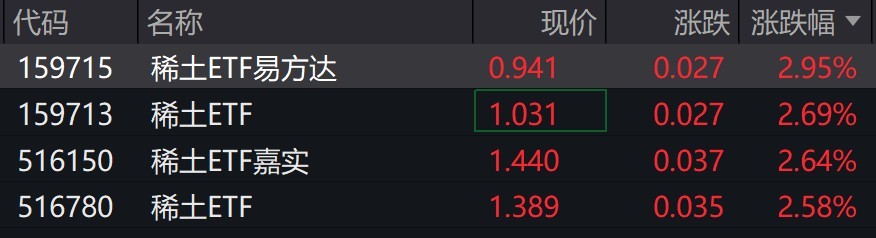
稀土概念股午后拉升,稀土相关ETF涨超2%
Mei Ri Jing Ji Xin Wen· 2025-08-07 06:43
Group 1 - Rare earth concept stocks surged in the afternoon, with Northern Rare Earth and Shenghe Resources rising over 5%, and China Rare Earth and Baotou Steel increasing over 2% [1] - The ETF tracking the CSI Rare Earth Industry Index rose over 2% due to market influence [1] - The CSI Rare Earth Industry Index includes listed companies involved in rare earth mining, processing, trading, and applications, reflecting the overall performance of the rare earth industry [2] Group 2 - Analysts indicate that rare earths are a strategically advantageous industry in China with significant pricing power and widespread downstream applications, leading to increased overall attention on the sector [2] - The "supply-side reform" policy catalyst, combined with the status of rare earths as a "national strategic resource," presents opportunities for value reassessment [2] - The permanent magnet sector benefits from the booming demand in humanoid robotics and the low-altitude economy [2]
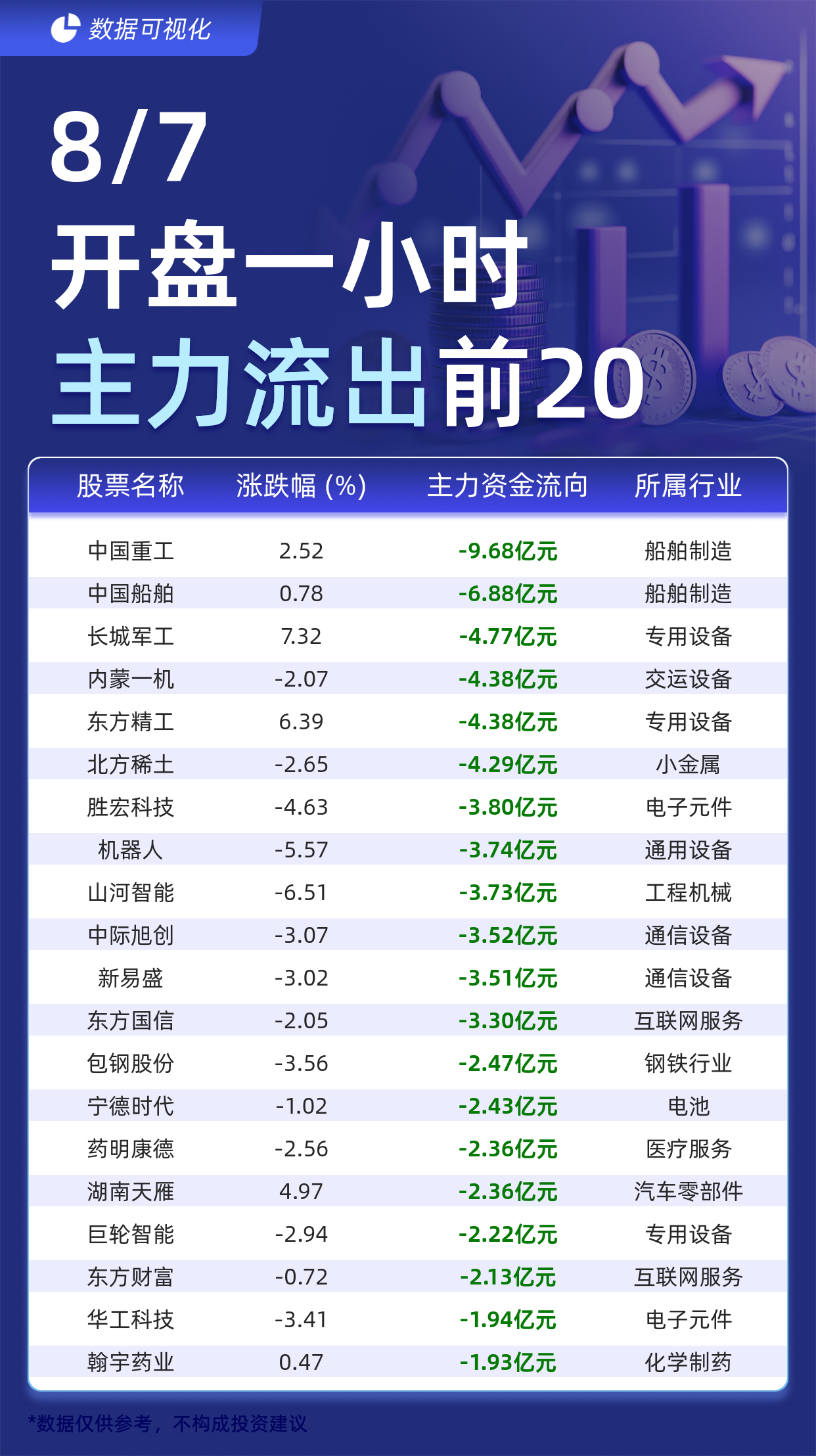
主力个股资金流出前20:中国重工流出9.68亿元、中国船舶流出6.88亿元
Jin Rong Jie· 2025-08-07 03:10
截至8月7日开盘一小时,主力资金流出前20的股票分别为:中国重工(-9.68亿元)、中国船舶(-6.88亿元)、长城军工(-4.77亿元)、内蒙一机(-4.38亿 元)、东方精工(-4.38亿元)、北方稀土(-4.29亿元)、胜宏科技(-3.80亿元)、机器人(-3.74亿元)、山河智能(-3.73亿元)、中际旭创(-3.52亿 元)、新易盛(-3.51亿元)、东方国信(-3.30亿元)、包钢股份(-2.47亿元)、宁德时代(-2.43亿元)、药明康德(-2.36亿元)、湖南天雁(-2.36亿 元)、巨轮智能(-2.22亿元)、东方财富(-2.13亿元)、华工科技(-1.94亿元)、翰宇药业(-1.93亿元)。 | 股票名称 | 涨跌幅 (%) | 主力资金流向 | 所属行) | | --- | --- | --- | --- | | 中国重工 | 2.52 | -9.68亿元 | 船舶制送 | | 中国船舶 | 0.78 | -6.88亿元 | 船舶制送 | | 长城军工 | 7.32 | -4.77亿元 | 专用设备 | | 内蒙一机 | -2.07 | -4.38亿元 | 交运设备 | | 东方精工 | ...




中证指数月度报告(7月)
Shang Hai Zheng Quan Bao· 2025-08-06 18:33
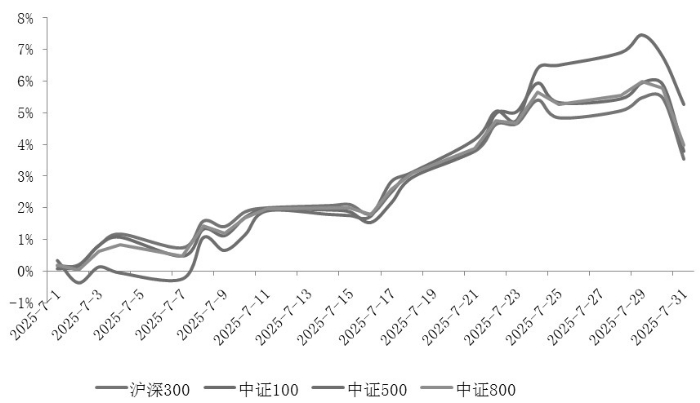
Market Performance - The major stock indices showed positive monthly performance, with the CSI 300 index closing at 4075.59, up by 3.54% [12] - The CSI 500 index had the highest monthly gain of 5.26%, closing at 6226.34 [12] - The Shanghai Composite Index increased by 3.74%, closing at 3573.21 [13] Sector Performance - The healthcare sector led with a monthly increase of 12.70% in the CSI 300 index [21] - The communication services sector also performed well, rising by 15.02% [21] - The energy sector showed a modest increase of 2.44% [21] Stock Contributions - The top-performing stocks included WuXi AppTec, which rose by 38.42%, and Industrial Fulian, which increased by 65.05% [18][19] - The worst-performing stocks included Sichuan Road and Bridge, which fell by 12.38% [20] - The top contributors to the CSI 300 index included Guizhou Moutai and Ningde Times, with weightings of 4.13% and 3.23% respectively [18] Trading Volume and Turnover - The average daily trading volume for the CSI 300 was 20,650 million shares, with an average daily turnover of 361 billion yuan [12] - The top traded stocks by turnover included Baogang Co., with a turnover of 874 billion yuan [14] Valuation Metrics - The CSI 300 index has a P/E ratio of 12.56 and a P/B ratio of 1.28 [14] - The financial sector has the lowest P/E ratio at 8.04, while the healthcare sector has the highest at 28.14 [14] Bond Market Performance - The China Bond Index showed a slight decline, with the China 10-Year Treasury Bond Index closing at 265.23, down by 0.09% [22] - The China Corporate Bond Index remained stable, closing at 283.87, with a minimal increase of 0.02% [22]



坐拥全球最大稀土矿,中国基建都不能没它?
2 1 Shi Ji Jing Ji Bao Dao· 2025-08-06 12:48
Group 1 - The steel industry is currently facing challenges due to cyclical downturns and tariffs imposed by certain countries, which adds to the industry's difficulties [1] - In 2024, China's largest steel export destination will be the ASEAN countries, with an expected export volume of 33.549 million tons, significantly higher than the Gulf Cooperation Council (12.315 million tons) and the European Union (3.974 million tons) [1] - Baogang Group holds exclusive mining rights to the world's largest rare earth mine, Baiyun Obo, and offers rare earth steel that outperforms regular steel in terms of ductility, wear resistance, corrosion resistance, and low-temperature resistance, providing a unique competitive edge [1] Group 2 - Baogang Group plans to expand its market presence in countries involved in the Belt and Road Initiative, with ongoing projects such as the Hungary-Serbia Railway and the China-Laos Railway already featuring Baogang's products [1] - By the first half of 2025, Baogang's international steel exports are projected to exceed 700,000 tons, covering over 40 countries and regions, with more than 300,000 tons exported to Belt and Road Initiative countries, accounting for over 90% of total exports [1] - The products are primarily utilized in infrastructure construction, rail transportation, and oil and gas pipeline projects [1]