
CMBC(600016)

Search documents
机构看好板块价值重估,银行ETF指数(512730)上涨近1%,上市银行上半年营收及利润增速双双转正
Xin Lang Cai Jing· 2025-09-04 07:18
Group 1 - The core viewpoint is that the banking sector is experiencing a recovery in revenue and profit growth, with overall operating income and net profit growth rates for listed banks turning positive [1][2] - The banking sector is expected to benefit from a stable low interest rate environment, leading investors to prefer lower-risk and more predictable return assets [1][2] - The banking sector's price-to-book (PB) ratio is considered undervalued, especially given the systemic risk concerns have been alleviated [1][2] Group 2 - Recent market conditions have led to increased long-term investments in banks by institutional investors, such as insurance funds and asset management companies [2] - The banking sector's asset quality is stable, and the pressure on interest margins is manageable, with expectations for interest margins to stabilize in the coming quarters [2] - The banking sector is anticipated to enter a new phase of stable return on equity (ROE), supported by fiscal stability and risk management from the central bank [2] Group 3 - The CSI Bank Index closely tracks the performance of the banking sector, with the top ten weighted stocks accounting for 65% of the index [3] - The top ten stocks in the CSI Bank Index include major banks such as China Merchants Bank, Industrial and Commercial Bank of China, and Agricultural Bank of China [3]






银行研究框架及25H1业绩综述:营收及利润增速双双转正
GOLDEN SUN SECURITIES· 2025-09-04 06:14
Investment Rating - The report indicates a positive outlook for the banking industry, with overall revenue and net profit growth rates turning positive in the first half of 2025, at 1.0% and 0.8% respectively, showing improvements from the previous quarter [4]. Core Insights - The banking sector's net interest margin for the first half of 2025 is reported at 1.42%, a decrease of 10 basis points compared to the previous year, but the decline is narrowing due to improved cost management on the liability side [5]. - Non-interest income, particularly from fees and commissions, has increased by 3.1% year-on-year, driven by a recovery in wealth management and a more active market environment [5]. - The asset quality remains stable, with a non-performing loan ratio of 1.23% and a provision coverage ratio of 239%, indicating a solid credit environment [5]. Summary by Sections Financial Performance Overview - The overall revenue and net profit growth for listed banks in the first half of 2025 were 1.0% and 0.8%, respectively, with both metrics showing improvement from the first quarter [4][22]. - The total assets of listed banks reached 321.3 trillion yuan, growing by 6.35% year-to-date, with loans and advances totaling 179.4 trillion yuan, accounting for 55.84% of total assets [21][24]. Income Sources - Net interest income decreased by 1.3% year-on-year, but the decline rate has slowed, reflecting better management of funding costs [5]. - Fee and commission income grew by 3.1% year-on-year, benefiting from a recovering market and the gradual impact of regulatory changes [5]. - Other non-interest income saw a significant increase of 10.7%, primarily due to favorable market conditions in the bond market [5]. Asset Quality and Management - The non-performing loan ratio remained stable at 1.23%, with a provision coverage ratio of 239%, indicating a robust asset quality [5]. - The credit cost for the first half of 2025 was 0.81%, a decrease of 5 basis points year-on-year, suggesting manageable credit risks [5]. Loan Growth and Composition - Loan growth was primarily driven by corporate lending, with significant contributions from infrastructure and manufacturing sectors [20]. - Personal loan growth was weaker, with a year-on-year increase of only 3.6%, reflecting a cautious approach to consumer lending amid rising risks [20]. Investment and Market Conditions - The investment asset proportion decreased to 34% as banks adjusted their strategies in response to market volatility [20]. - The overall yield on bonds fluctuated significantly, prompting banks to engage in tactical trading to enhance returns [20].



中期分红队伍持续壮大
Jin Rong Shi Bao· 2025-09-04 03:03
Core Viewpoint - The recent announcements of interim dividend plans by A-share listed banks highlight a trend towards increased shareholder returns, with a total proposed dividend amount exceeding 200 billion yuan from major state-owned banks and several joint-stock banks [1][4]. Group 1: State-Owned Banks - Six major state-owned banks have announced their interim dividend plans for 2025, with a total proposed dividend amount exceeding 200 billion yuan [1]. - Industrial and Commercial Bank of China leads with a proposed dividend of 1.414 yuan per 10 shares, totaling 503.96 billion yuan [1]. - Other state-owned banks, including Agricultural Bank of China, Bank of China, China Construction Bank, Bank of Communications, and Postal Savings Bank, have proposed dividends of 418.23 billion yuan, 352.50 billion yuan, 486.05 billion yuan, 138.11 billion yuan, and 147.72 billion yuan respectively [1]. Group 2: Joint-Stock Banks - Several joint-stock banks, including China Merchants Bank, CITIC Bank, Minsheng Bank, Ping An Bank, and Huaxia Bank, have confirmed their interim dividend plans for 2025 [1][2]. - China Merchants Bank announced its first interim profit distribution plan since its listing, with a cash dividend amounting to 35% of its net profit attributable to ordinary shareholders for the first half of 2025 [1][2]. - CITIC Bank plans to increase its interim dividend payout ratio to 30.7%, enhancing investor return expectations [2]. Group 3: New Participants in Interim Dividends - New entrants to the interim dividend group include Ningbo Bank, Changsha Bank, Su Nong Bank, and Jiangyin Bank, indicating a growing trend among listed banks to adopt interim dividends [2][4]. - Su Nong Bank announced its first interim dividend plan, proposing a cash dividend of 0.9 yuan per 10 shares, totaling 1.82 billion yuan [2][3]. Group 4: Overall Market Trends - A total of 23 A-share listed banks implemented interim dividends in 2024, distributing over 250 billion yuan, with the number of banks participating expected to increase in 2025 [4]. - The push for interim dividends is seen as a response to regulatory guidance aimed at enhancing shareholder returns and stabilizing market expectations [5].

A股近六成上市银行上半年中间业务收入同比增长
Zheng Quan Ri Bao Zhi Sheng· 2025-09-03 16:40
Core Viewpoint - The intermediary business income of A-share listed banks in China has shown improvement in the first half of 2025, becoming a crucial area for banks to transform and develop amid narrowing net interest margins [1][4]. Group 1: Overall Performance - In the first half of 2025, the total net income from fees and commissions of 42 listed banks reached 409.53 billion yuan, an increase of 3.06% compared to the same period last year [1]. - Out of the 42 listed banks, 25 reported positive growth in net income from fees and commissions, with three banks experiencing growth rates exceeding 100% and nine banks exceeding 10% [2]. Group 2: Performance by Bank Type - Among the six major state-owned banks, Bank of China and China Construction Bank both saw their fee and commission income grow by over 4%, while Agricultural Bank of China and Postal Savings Bank of China reported growth exceeding 10% [2]. - In the joint-stock banks category, four out of nine banks reported positive growth in net income from fees and commissions, with CITIC Bank achieving 16.91 billion yuan (up 3.38%), Industrial Bank at 13.08 billion yuan (up 2.59%), Huaxia Bank at 3.10 billion yuan (up 2.55%), and Minsheng Bank at 9.69 billion yuan (up 0.41%) [2]. Group 3: Notable Performers - Some city commercial banks and rural commercial banks exhibited significant growth in their fee and commission income, with Changshu Bank reporting a remarkable increase of 637.77% to 142 million yuan, followed by Ruifeng Bank with a 274.07% increase to 54 million yuan, and Zhangjiagang Bank with a 140% increase to 61 million yuan [3]. Group 4: Future Outlook - Analysts predict that the growth trend in intermediary business income is likely to continue in the second half of 2025, driven by supportive macroeconomic policies and increasing demand for high-yield products among residents [4]. - The focus for banks will be on expanding non-interest income, particularly in wealth management and other light-capital businesses, to optimize their income structure [4][6].

信用卡业务“跑马圈地”退潮后,转型创新路在何方?
Bei Jing Shang Bao· 2025-09-03 15:01
Core Insights - The credit card business in China's banking sector is undergoing a significant adjustment, shifting from an era of aggressive expansion to a focus on optimizing existing customer bases and asset quality [1][2][3] Group 1: Credit Card Business Performance - In the first half of 2025, 11 out of 15 listed banks reported a decline in credit card loan balances, with China Bank showing the most significant reduction of 13.89% to 510.97 billion yuan [2] - The total credit card loan balance for the 15 banks showed a mixed trend, with only four banks, including Industrial and Agricultural Banks, experiencing growth [2] - Credit card transaction volumes also declined, with a notable drop of 8.54% for China Merchants Bank, despite leading the sector with a transaction amount of 2.02 trillion yuan [3] Group 2: Bad Debt and Risk Management - The total bad credit card loans across 11 banks reached 162.69 billion yuan, an increase of 5.88 billion yuan from the beginning of the year, with notable increases in bad loans for banks like China Communications Bank and Industrial Bank [4] - Only three banks managed to improve their bad loan ratios, while eight banks, including China Merchants Bank and Industrial Bank, saw increases in their bad loan ratios [4] - The overall credit card market is experiencing a contraction, with the total number of credit cards decreasing to 715 million by Q2 2025, down from 727 million in Q4 2024 [5] Group 3: Strategic Adjustments and Future Directions - Banks are actively working to optimize asset quality and manage bad debts, with nearly a thousand bad loan transfer announcements made in 2025 [6] - The focus is shifting towards product innovation and differentiated competition, emphasizing quality over quantity in credit card offerings [6][7] - Strategies include targeting high-end customers and meeting basic customer needs, with an emphasis on enhancing customer experience and integrating credit cards with other retail banking services [7]





金融中报观|银行零售业务梯队格局背后,谁在领跑,谁在补课
Bei Jing Shang Bao· 2025-09-03 14:17
Core Insights - The competitive landscape of retail banking in A-shares is becoming clearer as the 2025 mid-year reports are disclosed, revealing a distinct tiered structure in retail AUM (Assets Under Management) [1][2] - The first tier consists of major state-owned banks and China Merchants Bank, all exceeding 16 trillion yuan in retail AUM, while the second tier includes joint-stock banks and some leading city commercial banks [1][2] - The retail business performance is mixed, with many banks facing pressure on retail revenue and net profit, highlighting a structural issue of profit growth without revenue increase [1][6] Tiered Structure of Retail AUM - The first tier banks, including Industrial and Commercial Bank of China (ICBC) and Agricultural Bank of China (ABC), lead with AUM exceeding 16 trillion yuan, with ICBC at over 24 trillion yuan and ABC at 23.68 trillion yuan [2][3] - China Construction Bank (CCB) and Postal Savings Bank of China also show strong performance, with CCB managing over 22 trillion yuan and Postal Savings Bank at 17.67 trillion yuan [2] - China Merchants Bank, known as the "king of retail," has a retail AUM of 16.03 trillion yuan, reflecting a 7.39% increase from the previous year [2] Second Tier Performance - The second tier banks have retail AUM ranging from 1 trillion to 6 trillion yuan, with notable growth from banks like Bank of Communications at 5.79 trillion yuan and Industrial Bank at 5.52 trillion yuan [3] - Joint-stock banks are active in this tier, with CITIC Bank and Shanghai Pudong Development Bank also showing significant growth in retail AUM [3] Third Tier Characteristics - The third tier banks have retail AUM mostly below 1 trillion yuan, with Nanjing Bank and Shanghai Rural Commercial Bank showing notable growth rates of 14.25% and 3.99% respectively [4] - Regional banks are leveraging local advantages to deepen market penetration, but face challenges in competing with larger banks [5] Retail Profitability Challenges - The retail banking sector is undergoing significant adjustments, with a shift in customer demand towards diversified financial solutions, which raises the bar for product innovation and service customization [6] - Leading banks like ICBC and China Merchants Bank are showing resilience, with ICBC's net profit rising by 46.05% despite a slight revenue decline [6][7] - However, some banks, including ABC and Ping An Bank, are experiencing declines in both revenue and net profit, indicating a challenging environment [7] Asset Quality Concerns - The retail banking sector is facing challenges in asset quality, particularly in personal loans, with rising non-performing loan (NPL) ratios reported by several banks [9][10] - For instance, China Merchants Bank's retail loan NPL ratio increased to 1.04%, while Chongqing Rural Commercial Bank's rose to 2.04% [9] - Some banks, like Ping An Bank and Industrial Bank, have managed to improve their asset quality through refined risk management practices [10] Strategic Recommendations - Analysts suggest that banks, especially smaller ones, should focus on enhancing their support for small and micro enterprises and optimizing financial resource allocation to uncover new growth points [8] - There is a call for banks to improve their digital capabilities and customer experience to better compete with larger institutions [8]
半年新增15万高净值客户,私人银行成中收增长动力
2 1 Shi Ji Jing Ji Bao Dao· 2025-09-03 11:01
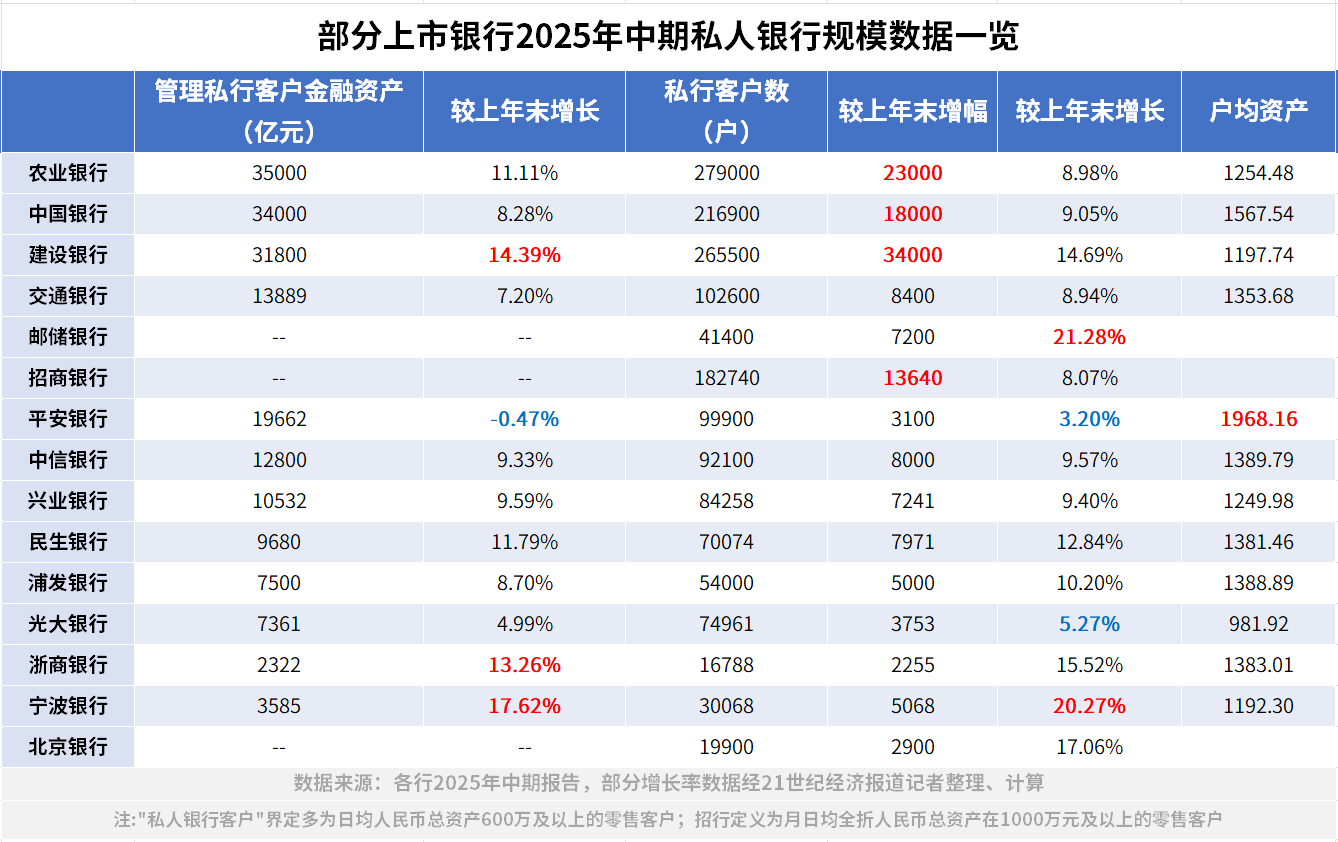
Core Insights - The private banking sector has shown robust growth in the first half of 2025, with many banks reporting double-digit increases in both client numbers and assets under management (AUM) despite a complex economic environment [1][2][5] - The total number of private banking clients across 15 banks exceeded 1.63 million, with an increase of nearly 150,000 clients, reflecting a growth rate of over 10% [1] - Major banks like Agricultural Bank and China Bank have AUM exceeding 3 trillion yuan, while Industrial Bank has crossed the 1 trillion yuan mark for the first time [1][4] Client and AUM Growth - Agricultural Bank's AUM reached 3.5 trillion yuan, growing by 11.11%, with client numbers increasing by 23,000 to 279,000 [2][4] - China Bank's AUM stood at 3.4 trillion yuan with 216,900 clients, while Construction Bank reported a 14.39% increase in AUM, reaching 3.18 trillion yuan and 265,500 clients [2][4] - The overall expansion of private banking clients and AUM indicates a strong performance among large banks, which continue to dominate the market [2][5] Performance of Listed Banks - Among listed banks, the performance varied, with some banks like Ping An Bank experiencing a slight decline in AUM by 0.47% [4] - Industrial Bank reported a significant increase in private banking clients, reaching 92,100, with AUM at 1.28 trillion yuan [5] - Regional banks like Ningbo Bank and Beijing Bank also showed impressive growth, with Ningbo Bank's AUM increasing by 17.62% [5][4] Focus on High-Net-Worth Clients - The industry is shifting from rapid expansion to a more refined approach, focusing on high-net-worth clients and family trusts [1][8] - Banks are implementing differentiated services for ultra-high-net-worth clients, with some banks reporting a 40.96% increase in such clients [8][9] - Family trusts have become a key area of development, with banks like Everbright Bank and China Bank reporting significant growth in this segment [9] Wealth Management and Revenue Growth - Private banking is increasingly contributing to banks' middle-income revenue, with Beijing Bank reporting a 16.89% increase in product sales, boosting its middle-income revenue by 17.77% [10] - Construction Bank noted that over 60% of its fee income comes from wealth management and related services, indicating a strategic focus on enhancing its advisory capabilities [11] - The establishment of private banking centers is accelerating, with banks like Construction Bank and China Bank expanding their networks to improve client retention and service quality [10]

民生银行(01988) - 截至二零二五年八月三十一日止股份发行人的证券变动月报表
2025-09-03 11:00
呈交日期: 2025年9月3日 I. 法定/註冊股本變動 | 1. 股份分類 | 普通股 | 股份類別 | H | | | 於香港聯交所上市 (註1) | 是 | | | | --- | --- | --- | --- | --- | --- | --- | --- | --- | --- | | 證券代號 (如上市) | 01988 | 說明 | H 股 | | | | | | | | | | 法定/註冊股份數目 | | | 面值 | | | 法定/註冊股本 | | | 上月底結存 | | | 8,320,295,289 | RMB | | 1 | RMB | | 8,320,295,289 | | 增加 / 減少 (-) | | | 0 | | | | RMB | | 0 | | 本月底結存 | | | 8,320,295,289 | RMB | | 1 | RMB | | 8,320,295,289 | | 2. 股份分類 | 普通股 | 股份類別 | A | | 於香港聯交所上市 (註1) | | 否 | | | --- | --- | --- | --- | --- | --- | --- | -- ...
富时中国A50指数季度调整:纳入百济神州-U(688235.SH)、药明康德(603259.SH) 剔除中国核电(601985.SH)等
智通财经网· 2025-09-03 10:17
Group 1 - FTSE Russell announced changes to the FTSE China 50 Index and FTSE China A50 Index, effective after market close on September 19, 2025 [1] - The FTSE China A50 Index will include companies such as BeiGene Ltd (688235.SH), Xinyisheng (300502.SZ), WuXi AppTec (603259.SH), and Zhongji Xuchuang (300308.SZ) [1] - Companies removed from the FTSE China A50 Index include China National Nuclear Power (601985.SH), China Unicom (600050.SH), Guodian Nanjing Automation (600406.SH), and Wanhua Chemical (600309.SH) [1] Group 2 - The FTSE China A50 Index serves as an important reference for overseas investors, and historical adjustments to the index typically attract significant passive capital from abroad [1] - The FTSE China 50 Index remains unchanged, with only the list of candidate stocks updated to include China Hongqiao Group (01378), Hansoh Pharmaceutical (03692), Huatai Securities (06886), JD Health (06618), and New China Life Insurance (01336) [1]





不搞“内卷式”竞争!民生银行业绩会三大亮点凸显战略定力
2 1 Shi Ji Jing Ji Bao Dao· 2025-09-03 08:16
Core Viewpoint - Minsheng Bank emphasizes a strategy of avoiding "involution" competition, focusing on high-quality and sustainable development through strategic execution and customer-centric approaches [1][2]. Financial Performance - In the first half of 2025, Minsheng Bank reported a total operating income of 72.384 billion yuan, a year-on-year increase of 7.83%, with both net interest income and non-interest income showing growth [1]. - The net interest margin for the bank was 1.39%, reflecting a slight year-on-year increase of 1 basis point despite overall industry pressure [1][7]. Strategic Focus - The bank is committed to deepening customer management and enhancing services to the real economy, with a focus on strategic customer groups that have reached a loan and deposit scale of 12 trillion yuan and 15 trillion yuan, respectively [1][2]. - Minsheng Bank's strategy includes a focus on five key areas to balance quantity, price, and quality instead of pursuing extensive scale expansion [2]. Retail Business Growth - The retail business has shown significant growth, with the number of strategic customers increasing by 36.62% year-on-year, and the financing balance reaching 374.319 billion yuan [2][4]. - The bank's retail assets under management (AUM) have seen substantial growth, with the AUM for clients with over 20,000 yuan exceeding the total increase for the previous year [5][6]. Asset and Liability Management - The bank is focusing on optimizing asset quality and managing liabilities effectively, with a decrease in interest-bearing liabilities cost to 1.93%, down 34 basis points from the beginning of the year [2][8]. - The non-performing loan (NPL) ratio stood at 1.48%, with a slight increase of 0.01 percentage points from the end of the previous year, while the real estate sector showed improvement with a reduction in NPLs [8]. Future Outlook - Minsheng Bank plans to continue enhancing customer management and accelerating digital transformation to promote high-quality development in the second half of the year [9]. - The bank has proposed a mid-term dividend plan, intending to distribute a cash dividend of 1.36 yuan per 10 shares to shareholders [9].