CMBC(600016)

Search documents
超50家银行宣布暂停各类无卡业务
2 1 Shi Ji Jing Ji Bao Dao· 2026-02-11 06:34
Core Viewpoint - Several banks in China are tightening their no-card deposit and withdrawal services, with over 50 banks having announced the suspension of various no-card services in the past year, citing reasons such as optimizing financial services, risk management, and cost efficiency [1][2]. Group 1: Bank Actions - China Merchants Bank will stop its ATM QR code deposit service starting April 9, requiring customers to use bank cards for deposits [1]. - Major state-owned banks, including Industrial and Commercial Bank of China, have already suspended no-card cash withdrawal services since April 2022, with other banks like Bank of Communications following suit [3]. - In the second half of last year, several joint-stock banks and leading city commercial banks, such as Minsheng Bank and Industrial Bank, also announced the cessation of no-card withdrawal functionalities [4]. Group 2: Reasons for Changes - The shift away from no-card services is attributed to the low security of identity verification methods used in these transactions, as well as the limited demand from customers for such services [6]. - The rise of mobile payments has led to a decrease in cash usage, prompting banks to close ATM QR code deposit functions to enhance customer fund security and streamline service processes [5]. Group 3: Industry Implications - The adjustments in no-card services are expected to have a minimal impact on banks, as customers can still utilize other methods for deposits and withdrawals [6]. - The changes are seen as a way for banks to improve risk management and reduce operational costs, while also exploring digital technology to enhance service levels and optimize ATM functionalities [6].






多家银行官宣“年中红包”!六大行数额亮了
Guo Ji Jin Rong Bao· 2026-02-11 06:34
Core Viewpoint - Increasing number of banks are adopting mid-year dividend plans, with 17 A-share listed banks planning to implement mid-year dividends for 2024, reflecting a shift towards more frequent cash distributions to investors [1][2][3] Group 1: Mid-Year Dividend Plans - CITIC Bank has expressed its intention to implement a mid-year dividend for 2024, following the lead of Minsheng Bank, marking it as the second shareholding bank to announce such plans [2] - As of July 4, 2023, 17 out of 42 A-share listed banks have decided to implement mid-year dividends for 2024, with six major state-owned banks already having made arrangements [2][3] - The mid-year dividend plans are part of a broader trend among banks to enhance investor returns and improve liquidity [1][4] Group 2: Regulatory Influence - The Chinese government has introduced policies to strengthen cash dividend regulations, encouraging companies to adopt stable and predictable dividend policies, including multiple distributions within a year [4][5] - The new regulations aim to enhance the frequency of dividends, aligning domestic banks with international practices where dividends are distributed more frequently [5] Group 3: Impact on Investor Sentiment - Increased dividend frequency is expected to enhance investor confidence and attract more investments, as it reflects banks' profitability and commitment to shareholder returns [3][5] - Analysts suggest that mid-year dividends can serve as a sign of banks' confidence in their earnings and can improve investor sentiment towards bank stocks [3][5] Group 4: Considerations for Banks - Banks need to balance dividend payouts with their profitability, capital adequacy, and risk management capabilities to ensure sustainable operations [5][6] - There is a need for banks to improve internal governance and operational efficiency to better serve the real economy while managing dividend policies [6]


瑞达期货为全资子公司5000万元授信额度提供担保
Xin Lang Cai Jing· 2026-02-11 04:16
格隆汇2月11日|瑞达期货公告,全资子公司瑞达置业为瑞达新控向民生银行厦门分行申请5000万元授 信额度提供连带责任保证担保。瑞达新控注册资本7.5亿元,2024年末资产总额18.51亿元,负债总额 8.96亿元,净资产9.55亿元;2024年度营业收入8.15亿元,净利润1.36亿元。担保总额度为11.76亿元, 实际担保余额4.06亿元,占公司净资产的14.05%。 ...

平安基金管理有限公司关于新增北京创金启富基金销售有限公司为旗下基金销售机构的公告
Shang Hai Zheng Quan Bao· 2026-02-10 18:28
Group 1 - The company announced that starting from February 11, 2026, investors can open accounts, subscribe, redeem, and perform regular investment and conversion operations for certain funds through Chuangjin Qifu [1] - The company has signed a supplementary sales agreement with Beijing Chuangjin Qifu Fund Sales Co., Ltd. to enhance service offerings to investors [1] - Investors can enjoy fee discounts when subscribing or performing regular investment and conversion operations through Chuangjin Qifu, with the specifics determined by Chuangjin Qifu [2] Group 2 - The company will suspend subscription, conversion, and regular investment operations for the Ping An Jin Guanjia Money Market Fund from February 12 to February 23, 2026, while redemption and conversion out operations will continue [4][6] - The Ping An Zhongzheng Interbank Certificate of Deposit AAA Index 7-Day Holding Period Securities Investment Fund will also suspend similar operations during the same period [8][10] - The company will resume these operations on February 24, 2026, and will not issue further announcements regarding this resumption [4][8] Group 3 - The company has appointed Fangzheng Securities Co., Ltd. as a liquidity service provider for the Ping An Hang Seng Hong Kong Stock Connect Technology Theme ETF, effective February 11, 2026 [12] - The company has announced the establishment of the Ping An New Sharp Quantitative Stock Selection Mixed Fund, with the fund contract becoming effective on February 11, 2026 [21][22] - The company will handle subscription and redemption operations for the new fund within three months of the fund contract's effectiveness [22]


管控成本、做活App,银行免费动账短信加速“退场”
第一财经· 2026-02-10 14:46
Core Viewpoint - The article discusses the increasing threshold for free transaction SMS notifications by banks, indicating a shift from universal service to tiered offerings due to cost pressures and a push towards digital channels [3][4][10]. Group 1: Changes in SMS Notification Services - Since 2025, multiple banks have raised the minimum amount for free transaction SMS notifications, with China Merchants Bank increasing the threshold to 5000 yuan [3][4]. - Other banks, including China Bank and Minsheng Bank, have also adjusted their thresholds, generally ranging from 100 to 500 yuan for free SMS notifications [5][6]. - Smaller banks, such as Guangxi Pingguo Rural Bank, have set their thresholds at 200 yuan, aligning with the trend towards financial technology [5][6]. Group 2: Cost Implications of SMS Services - The cost of providing free SMS services is significant, with banks incurring substantial expenses due to high customer volumes and frequent usage [6][8]. - For instance, a bank with 100 million customers sending one free SMS per month could face operational costs exceeding 36 million yuan annually [8]. - Banks are now charging fees for SMS notifications, typically around 2 to 3 yuan per month per card, which helps cover the costs of SMS procurement [8][10]. Group 3: Digital Transformation and Customer Engagement - The increase in SMS notification thresholds is not solely driven by cost but also reflects banks' digital transformation strategies [10]. - Banks are encouraging customers to use digital channels like apps and WeChat for notifications, which have lower marginal costs compared to SMS [10][11]. - The shift aims to enhance service efficiency and customer engagement, with a potential future model of "large transactions free, small transactions paid" emerging in the industry [10][11].


大额买入与资金流向跟踪(20260202-20260206)
GUOTAI HAITONG SECURITIES· 2026-02-10 08:59
Quantitative Factors and Construction Methods - **Factor Name**: Large Order Transaction Amount Ratio **Factor Construction Idea**: This factor captures the buying behavior of large capital by analyzing the proportion of large order transaction amounts in the total daily transaction amount[8] **Factor Construction Process**: 1. Use tick-by-tick transaction data to identify buy and sell orders based on the sequence numbers of bids and asks 2. Filter transactions by order size to identify large orders 3. Calculate the proportion of large buy order transaction amounts in the total daily transaction amount **Formula**: $ \text{Large Order Transaction Amount Ratio} = \frac{\text{Large Buy Order Transaction Amount}}{\text{Total Daily Transaction Amount}} $ **Evaluation**: This factor effectively reflects the buying behavior of large capital[8] - **Factor Name**: Net Active Buy Transaction Amount Ratio **Factor Construction Idea**: This factor measures the active buying behavior of investors by calculating the net active buy transaction amount as a proportion of the total daily transaction amount[8] **Factor Construction Process**: 1. Use tick-by-tick transaction data to classify each transaction as either active buy or active sell based on the buy/sell indicator 2. Subtract the active sell transaction amount from the active buy transaction amount to obtain the net active buy transaction amount 3. Calculate the proportion of the net active buy transaction amount in the total daily transaction amount **Formula**: $ \text{Net Active Buy Transaction Amount Ratio} = \frac{\text{Active Buy Transaction Amount} - \text{Active Sell Transaction Amount}}{\text{Total Daily Transaction Amount}} $ **Evaluation**: This factor provides insights into the active buying tendencies of investors[8] --- Factor Backtesting Results - **Large Order Transaction Amount Ratio**: - Top 10 stocks with the highest 5-day average values: 1. Hanjiang Heshan (603616.SH): 93.5%, 99.2% time-series percentile[10] 2. Minbao Optoelectronics (301362.SZ): 89.7%, 98.4% time-series percentile[10] 3. Hangdian Co., Ltd. (603618.SH): 86.1%, 99.6% time-series percentile[10] 4. Jinzhengda (002470.SZ): 85.2%, 83.9% time-series percentile[10] 5. Guofa Co., Ltd. (600538.SH): 84.9%, 92.4% time-series percentile[10] 6. Shunna Co., Ltd. (000533.SZ): 84.7%, 100.0% time-series percentile[10] 7. Quanzhu Co., Ltd. (603030.SH): 84.6%, 94.4% time-series percentile[10] 8. Beijing Investment Development (600683.SH): 84.5%, 96.0% time-series percentile[10] 9. Chongqing Steel (601005.SH): 84.3%, 52.2% time-series percentile[10] 10. Huadian International (600027.SH): 83.6%, 95.2% time-series percentile[10] - **Net Active Buy Transaction Amount Ratio**: - Top 10 stocks with the highest 5-day average values: 1. Minsheng Bank (600016.SH): 21.1%, 100.0% time-series percentile[11] 2. Kairuide (002072.SZ): 20.3%, 99.6% time-series percentile[11] 3. Intercontinental Oil & Gas (600759.SH): 19.5%, 100.0% time-series percentile[11] 4. Boen Group (001366.SZ): 17.8%, 100.0% time-series percentile[11] 5. Bowan Technology (600883.SH): 17.5%, 99.6% time-series percentile[11] 6. Xiangyou Technology (600476.SH): 16.8%, 99.2% time-series percentile[11] 7. Zhejiang Commercial Bank (601916.SH): 16.8%, 94.4% time-series percentile[11] 8. General Elevator (300931.SZ): 15.9%, 100.0% time-series percentile[11] 9. Weier Pharmaceutical (603351.SH): 15.3%, 94.0% time-series percentile[11] 10. Ruierte (002790.SZ): 15.2%, 98.4% time-series percentile[11]




微信信用卡账单分期还款可享“国补”贴息,首批接入七家银行
Bei Jing Shang Bao· 2026-02-10 08:32
据了解,微信信用卡还款平台已与超100家银行达成合作,为用户提供查账还款、账单分期、场景分期 等服务。 通过微信信用卡还款平台,用户可以同时申请多家银行的账单分期"国补"贴息,不同银行的贴息额度互 不占用。根据财政部近期发布的《关于优化实施个人消费贷款财政贴息政策有关事项的通知》,信用卡 账单分期还款已纳入财政贴息政策支持范围,每人在单个银行机构可享受的累计财政贴息金额上限为 3000元,年贴息比例为1个百分点,政策实施期限延长至2026年底。 北京商报讯(记者 董晗萱)2月10日,北京商报记者获悉,微信信用卡还款平台正式上线信用卡账单分 期"国补"贴息服务。农业银行、邮储银行、浦发银行、招商银行、民生银行、光大银行、建设银行共七 家银行首批接入,用户办理上述银行信用卡的账单分期还款时,可享受1个百分点的"国补"贴息,更多 银行正在陆续接入中。 对于符合贴息条件的分期订单,银行将自动调整分期手续费或将贴息返还至账户,用户无需额外申请操 作。以10000元分12期为例,在银行分期利率折扣优惠的基础上,叠加"国补"再减免1%利率,用户可节 省利息约50元。 ...




瑞银:上调民生银行(01988)评级至“买入” 看好盈利拐点与估值重评
智通财经网· 2026-02-10 07:59
Group 1 - UBS upgraded the rating of Minsheng Bank (01988) from "Neutral" to "Buy" due to its valuation being at a deep discount, with a projected price-to-book ratio of only 0.22 times for 2026 compared to 0.47 times for CITIC Bank (00998) [1] - The bank is expected to benefit from revenue improvement and a significant release of balance sheet risks, with profitability likely to reach a turning point starting in 2026 [1] - UBS slightly adjusted the target price from HKD 5.43 to HKD 5.30, while also raising the earnings per share forecast for 2026 to 2029 by 5-6% [1] Group 2 - The current market perception is that profitability pressures will continue for Minsheng Bank, but UBS believes that provisioning risks may have peaked [1] - Profitability is expected to stabilize in 2026 and turn to positive growth starting in 2027, indicating potential for valuation re-rating that could exceed recent weak returns on equity [1] - Due to short-term market volatility, UBS slightly increased the cost of equity (CoE) to 11.5% [1]
瑞银:上调民生银行评级至“买入” 看好盈利拐点与估值重评
Zhi Tong Cai Jing· 2026-02-10 07:55
Core Viewpoint - UBS upgraded the rating of Minsheng Bank (600016)(01988) from "Neutral" to "Buy" based on its valuation being at a deep discount, with a projected price-to-book ratio of only 0.22 times for 2026 compared to 0.47 times for CITIC Bank (00998) [1] Group 1: Valuation and Earnings Outlook - The target price for Minsheng Bank was slightly adjusted down from HKD 5.43 to HKD 5.30 [1] - UBS believes that the market is currently pricing in ongoing profit pressure for Minsheng Bank, while the analysis suggests that provisioning risks may have peaked [1] - Earnings are expected to reach a balance in 2026 and turn to positive growth starting in 2027, indicating significant potential for valuation re-rating beyond recent weak equity returns [1] Group 2: Earnings Forecast Adjustments - UBS raised the earnings per share forecast for Minsheng Bank for the years 2026 to 2029 by 5-6% [1] - Due to short-term market volatility, the cost of equity (CoE) was slightly increased to 11.5% [1]
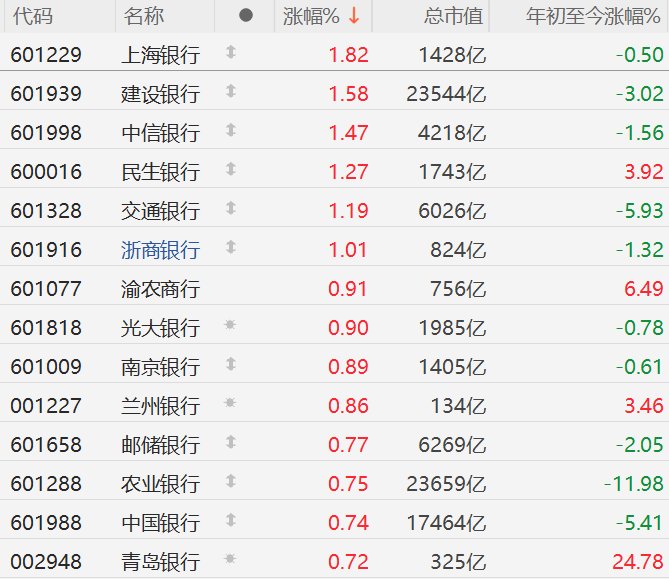
A股银行股普涨,建设银行、交通银行续涨超1%
Ge Long Hui A P P· 2026-02-10 05:25
Core Viewpoint - The A-share market saw a broad increase in bank stocks, with Shanghai Bank, Construction Bank, CITIC Bank, Minsheng Bank, Bank of Communications, and Zheshang Bank all rising over 1% [1] Group 1: Stock Performance - Shanghai Bank (601229) increased by 1.82%, with a total market capitalization of 142.8 billion and a year-to-date decline of 0.50% [2] - Construction Bank (601939) rose by 1.58%, holding a market cap of 2,354.4 billion, and has a year-to-date decline of 3.02% [2] - CITIC Bank (601998) saw a rise of 1.47%, with a market cap of 421.8 billion and a year-to-date decline of 1.56% [2] - Minsheng Bank (600016) increased by 1.27%, with a market cap of 174.3 billion and a year-to-date increase of 3.92% [2] - Bank of Communications (601328) rose by 1.19%, with a market cap of 602.6 billion and a year-to-date decline of 5.93% [2] - Zheshang Bank (601916) increased by 1.01%, with a market cap of 82.4 billion and a year-to-date decline of 1.32% [2] Group 2: Additional Bank Performance - Chongqing Rural Commercial Bank (601077) rose by 0.91%, with a market cap of 75.6 billion and a year-to-date increase of 6.49% [2] - Everbright Bank (601818) increased by 0.90%, with a market cap of 198.5 billion and a year-to-date decline of 0.78% [2] - Nanjing Bank (6000009) rose by 0.89%, with a market cap of 140.5 billion and a year-to-date decline of 0.61% [2] - Lanzhou Bank (001227) increased by 0.86%, with a market cap of 13.4 billion and a year-to-date increase of 3.46% [2] - Postal Savings Bank (601658) rose by 0.77%, with a market cap of 626.9 billion and a year-to-date decline of 2.05% [2] - Agricultural Bank (601288) increased by 0.75%, with a market cap of 2,365.9 billion and a year-to-date decline of 11.98% [2] - Bank of China (601988) rose by 0.74%, with a market cap of 1,746.4 billion and a year-to-date decline of 5.41% [2] - Qingdao Bank (002948) increased by 0.72%, with a market cap of 32.5 billion and a year-to-date increase of 24.78% [2]