Sinopec Corp.(600028)

Search documents
朗坤科技:与中石化合作项目正稳步推进
Sou Hu Cai Jing· 2026-01-14 00:56
Core Viewpoint - The collaboration between Langkun Technology and Sinopec Group focuses on establishing a full industrial chain for the collection, pre-treatment, and deep processing of waste oil into biodiesel and sustainable aviation fuel (SAF) [1] Group 1: Company Collaboration - On August 15, 2025, a tripartite cooperation signing ceremony was held between China Petroleum & Chemical Corporation Guangzhou Branch, Sinopec Refining Sales Co., Ltd., and Guangzhou Langkun to jointly build the full industrial chain for waste oil [1] - The cooperation project is progressing steadily according to the agreement, with the company actively cooperating with relevant parties to implement various aspects of the collaboration [1] Group 2: Business Environment - The specific details of the cooperation are not disclosed due to confidentiality agreements [1] - The related business is subject to uncertainties influenced by policy changes and macroeconomic factors [1]

国企改革成绩单发布
Di Yi Cai Jing Zi Xun· 2026-01-13 15:21
Core Insights - The three-year action plan for deepening state-owned enterprise (SOE) reform has largely been completed, with significant achievements in structural layout, technological innovation, corporate governance, and regulatory mechanisms [2][3] - The State-owned Assets Supervision and Administration Commission (SASAC) emphasizes that while the action plan has concluded, the reform process must continue to deepen and consolidate its results [2] Group 1: Achievements in Reform - SOEs have undergone fundamental changes through multiple rounds of reform, contributing significantly to economic and social development, although challenges remain in original innovation capabilities and safety support in key areas [3] - Central enterprises have established 97 original technology sources and 23 innovation consortia, promoting collaborative research and development [3] - Central enterprises have opened 134 pilot verification platforms and created over 800 application scenarios across 16 key industries [3] Group 2: Strategic Developments - In the strategic emerging industries, central enterprises achieved revenues exceeding 11 trillion yuan from January to November 2025, with significant investments in biopharmaceuticals and low-altitude economy sectors [4][5] - The SASAC is promoting the restructuring and professional integration of SOEs to enhance efficiency and focus on key sectors [5] Group 3: Future Reform Directions - The "14th Five-Year Plan" and subsequent actions have shifted SOE reform from institutional construction to efficiency enhancement, laying a foundation for deeper changes in the "15th Five-Year Plan" [7] - The SASAC plans to further improve the modern enterprise system with a focus on enhancing core functions and competitiveness of SOEs [7][8] - The restructuring of major state-owned enterprises, such as the merger between Sinopec and China Aviation Oil, is seen as a significant step towards optimizing layout and responding to international competition [8][9]


国企改革成绩单发布
第一财经· 2026-01-13 15:18
Core Viewpoint - The article discusses the significant progress made in the reform of state-owned enterprises (SOEs) in China, highlighting achievements in structural layout, technological innovation, corporate governance, and regulatory mechanisms, while also acknowledging existing challenges that need to be addressed for future reforms [4][5]. Reform Achievements - The State-owned Assets Supervision and Administration Commission (SASAC) reported that the reform of SOEs has fundamentally changed their overall appearance and contributed significantly to economic and social development, although issues such as insufficient original innovation capabilities remain [4][5]. - Central enterprises have established 97 original technology sources and led the construction of 23 innovation consortia, promoting collaborative research and development [5][6]. - In the strategic emerging industries sector, central enterprises achieved over 11 trillion yuan in revenue from January to November 2025, with significant investments in biopharmaceuticals and low-altitude economy sectors [5][6]. Strategic Restructuring and Integration - The SASAC has facilitated the restructuring and integration of state-owned enterprises to enhance their core competitiveness, with notable mergers involving assets exceeding 100 billion yuan [6][11]. - New central enterprises have been established, improving resource allocation efficiency, and various regions have initiated strategic reorganizations involving 229 primary enterprises [6][11]. Future Reform Directions - The "14th Five-Year Plan" and subsequent directives emphasize the need for SOEs to strengthen their core functions and enhance competitiveness, setting a clear direction for the next five years [9][11]. - The SASAC aims to deepen reforms by focusing on problem-solving and improving the effectiveness of reforms, with an emphasis on modern corporate governance and management systems [10][11]. - The recent merger between China Petroleum and Chemical Corporation and China Aviation Oil is highlighted as a significant event in the ongoing restructuring of central enterprises, aimed at optimizing their operational focus and responding to international competition [11].

中国石化出手了,战略投资一家氢能公司!
Xin Lang Cai Jing· 2026-01-13 11:54
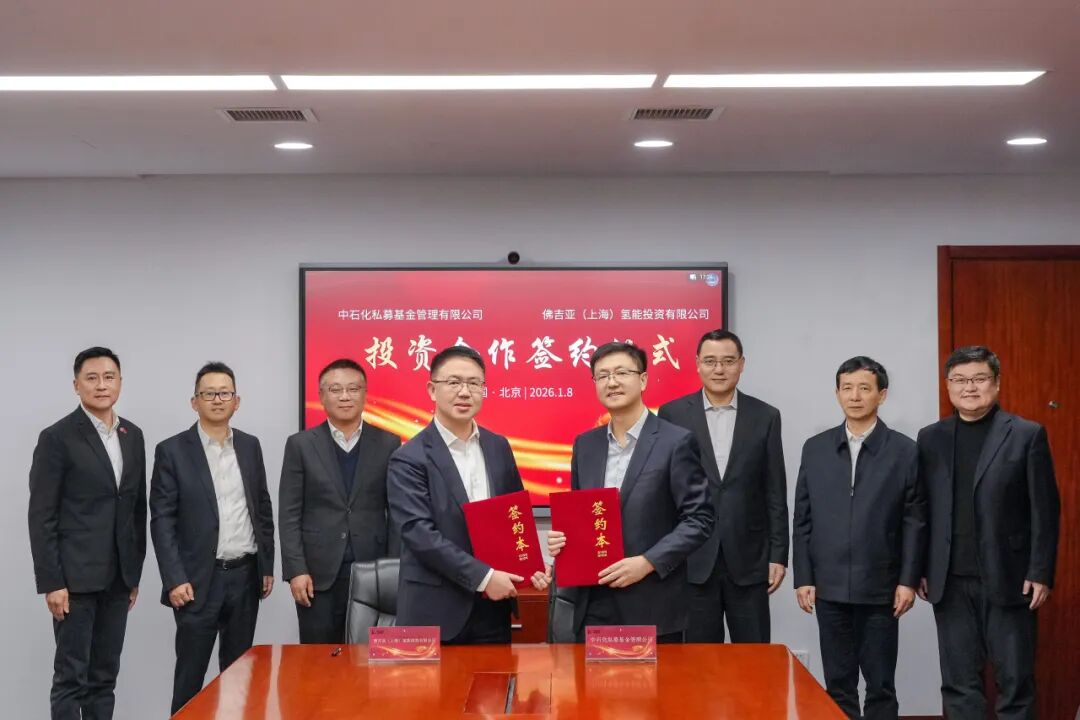
Core Viewpoint - Sinopec has strategically invested 300 million RMB in Faurecia Hydrogen, aiming to strengthen its hydrogen energy supply chain, particularly in hydrogen storage and transportation technology, which is a critical gap in its operations [3][12][20]. Group 1: Investment Details - Sinopec Capital has made a strategic investment of 300 million RMB in Faurecia Hydrogen, a subsidiary of Faurecia Group, which is the first in China to produce IV-type hydrogen storage bottles [1][5][36]. - This investment is part of Sinopec's broader goal to become the leading hydrogen energy company in China, having already established a significant presence in hydrogen production and refueling stations [3][25]. Group 2: Technology and Market Position - Faurecia Hydrogen specializes in IV-type hydrogen storage bottles, which are lighter and have higher hydrogen density compared to traditional III-type bottles, making them suitable for heavy-duty vehicles [5][29]. - The IV-type bottles developed by Faurecia can store up to 16 kilograms of hydrogen, making them particularly advantageous for long-haul heavy trucks [6][30]. Group 3: Strategic Implications - The investment allows Sinopec to avoid the lengthy and costly process of developing IV-type technology in-house, thus enhancing its technological capabilities and integrating Faurecia into its hydrogen energy ecosystem [7][31]. - For Faurecia, this investment not only provides funding but also access to Sinopec's extensive refueling network and logistics capabilities, enhancing its market competitiveness [8][33]. Group 4: Industry Context - The hydrogen energy sector in China is experiencing significant growth, with the country projected to produce over 36.5 million tons of hydrogen in 2024, leading the world [39]. - Despite the growth, challenges remain, particularly in reducing the costs of green hydrogen and improving storage and transportation technologies [40][46]. - The collaboration between major state-owned enterprises and technology firms is seen as essential for overcoming industry challenges and achieving large-scale commercialization of hydrogen energy [42][45].
声音 | 剧锦文:国资新重组体现国家战略引领
Xin Lang Cai Jing· 2026-01-13 11:27
Core Viewpoint - The recent restructuring of state-owned enterprises (SOEs) in China, specifically the merger of China Petroleum & Chemical Corporation (Sinopec) and China Aviation Oil Group, reflects a continuation of strategic reorganizations aimed at optimizing the state-owned economy in alignment with national strategies [3][13]. Group 1: Ensuring Economic Security - The restructuring aims to safeguard the operation of the national economy amidst increasing external complexities and uncertainties, emphasizing the importance of economic security [4][14]. - The merger of Sinopec and China Aviation Oil is particularly focused on enhancing energy security, as Sinopec is the world's largest refining company and a major aviation fuel producer, while China Aviation Oil is the largest aviation fuel service provider in Asia [4][14]. Group 2: Improving Asset Allocation Efficiency - The restructuring seeks to enhance the efficiency of state asset allocation, addressing the need for improved operational efficiency within SOEs, which have historically prioritized stability [5][15]. - The total assets of central enterprises under the State-owned Assets Supervision and Administration Commission (SASAC) are projected to reach 90 trillion yuan by 2025, highlighting the necessity for better asset allocation [5][15]. Group 3: Cultivating World-Class Enterprises - The goal of fostering globally competitive world-class enterprises has been reiterated in multiple national congresses, with a focus on characteristics such as product excellence, brand strength, innovation leadership, and modern governance [6][16]. - The merger of Sinopec and China Aviation Oil is expected to set a benchmark in the petrochemical sector, enhancing resource allocation, technological leadership, and industry influence [6][16]. Group 4: Responding to Technological and Industrial Revolutions - The restructuring is also a response to the new technological and industrial revolution, emphasizing the need for SOEs to integrate and invest in strategic emerging industries [7][17]. - The focus on high-tech sectors such as renewable energy, artificial intelligence, quantum technology, and 6G is crucial for advancing the capabilities of SOEs, leveraging their strengths in data and power supply [7][17].

石油石化行业资金流入榜:中国海油等5股净流入资金超亿元
Zheng Quan Shi Bao Wang· 2026-01-13 08:54
Market Overview - The Shanghai Composite Index fell by 0.64% on January 13, with six industries experiencing gains, led by the oil and petrochemical sector, which rose by 1.62% [1] - The pharmaceutical and biological industry also saw an increase of 1.21% [1] - The defense and military industry and electronics sector faced the largest declines, with drops of 5.50% and 3.30% respectively [1] Capital Flow - The net outflow of capital from the two markets reached 162.743 billion yuan for the day [1] - Four industries experienced net inflows, with the pharmaceutical and biological sector leading at a net inflow of 4.348 billion yuan [1] - The oil and petrochemical industry followed with a net inflow of 586 million yuan [1] Oil and Petrochemical Sector - The oil and petrochemical industry rose by 1.62%, with a total net inflow of 586 million yuan [2] - Out of 47 stocks in this sector, 28 saw gains, including two that hit the daily limit [2] - The top stocks with significant net inflows included China National Offshore Oil Corporation (1.86 billion yuan), Sinopec (1.26 billion yuan), and Bohai Chemical (1.22 billion yuan) [2] Individual Stock Performance - The top performers in the oil and petrochemical sector included: - China National Offshore Oil Corporation: +3.57% with a turnover rate of 2.63% and a net inflow of 186.43 million yuan [2] - Sinopec: 0.00% change with a turnover rate of 0.26% and a net inflow of 125.57 million yuan [2] - Bohai Chemical: +10.14% with a turnover rate of 10.92% and a net inflow of 121.55 million yuan [2] - Conversely, the stocks with the largest net outflows included: - Intercontinental Oil and Gas: -0.56% with a net outflow of 1.6717 billion yuan [3] - China National Petroleum Corporation: +2.23% with a net outflow of 537.68 million yuan [3] - Zhongman Petroleum: +3.64% with a net outflow of 359.65 million yuan [3]

油气ETF(159697)收涨超1.1%,今日净申购1500万份
Sou Hu Cai Jing· 2026-01-13 08:03
Group 1: Industry Overview - According to Raytad Energy, global upstream exploration and development spending is expected to be around $600 billion in 2025, a decrease of 4% year-on-year, with deepwater investments projected to decline by 6% [1] - China's crude oil production has rebounded since 2019 due to a long-term strategy for increasing reserves and production, with a CAGR of 2.2% from 2019 to 2024, while natural gas production has a CAGR of 7.3% during the same period [1] - The "Big Three" oil companies in China have significantly increased capital expenditures from 2020 to 2023 and are expected to maintain high levels in 2024 and 2025, which will support upstream reserve growth and benefit their oil service subsidiaries [1] Group 2: Company Performance - In the first half of 2025, major oil service companies benefited from the ongoing domestic "increase reserves and production" initiative and the gradual release of overseas business performance, leading to improved operational quality despite falling oil prices [2] - CNOOC's oil service subsidiary reported a 23.3% year-on-year increase in net profit attributable to shareholders, while other companies like Haiyou Development and Haiyou Engineering saw net profit changes of +13.1% and -8.2% respectively, with the latter experiencing a 27% increase in gross profit [2] - The annualized ROE for CNOOC's oil service companies in the first half of 2025 showed resilience, with CNOOC at +1.5 percentage points compared to the full year of 2024, indicating a potential improvement in international competitiveness [2] Group 3: Market Performance - As of January 13, 2026, the National Petroleum and Natural Gas Index (399439) rose by 0.81%, with significant increases in stocks such as CNOOC's oil service (+6.03%) and China National Petroleum (+3.57%) [3] - The oil and gas ETF (159697) increased by 1.15%, reflecting a four-day consecutive rise, with the latest price reported at 1.23 yuan and a net subscription of 15 million units [3] - The top ten weighted stocks in the National Petroleum and Natural Gas Index account for 67.11% of the index, including major players like China National Petroleum, Sinopec, and CNOOC [3]




国泰海通:我国SAF产业化加速落地 全面推荐废油脂-SAF全产业链投资机会
Zhi Tong Cai Jing· 2026-01-13 07:45
Core Viewpoint - The restructuring between Sinopec and China National Aviation Fuel Corporation aims to streamline the aviation fuel supply chain from upstream production to downstream refueling, accelerating the industrialization of Sustainable Aviation Fuel (SAF) in China, which is expected to benefit domestic biodiesel producers [1][4]. Group 1: Restructuring Details - Sinopec and China National Aviation Fuel Corporation are undergoing a restructuring approved by the State Council, marking a significant move in the integration of state-owned enterprises [2]. - This merger combines the strengths of Sinopec, the world's largest refining company, and China National Aviation Fuel, Asia's largest aviation fuel service provider, enhancing the competitiveness of China's aviation fuel industry [3]. Group 2: SAF Market Dynamics - The global demand for SAF is increasing, driven by regulations such as the EU's ReFuelEU, which mandates that by 2025, 2% of aviation fuel used at EU airports must be SAF, with targets of 6%, 20%, and 70% by 2030, 2035, and 2050 respectively [5]. - In China, a pilot program for SAF blending will begin in March 2025, with an estimated annual SAF blending volume of 32,000 tons from four major airports, contributing to the growing domestic demand [5]. Group 3: Investment Opportunities - The rising demand and prices for SAF are expected to tighten the supply of raw materials, particularly waste oils, which have a theoretical annual production capacity of 12 million tons in China, with current collection at about 5 million tons [6]. - As the SAF industry accelerates, the focus of supply chain challenges will shift from SAF availability to raw material supply, prompting a comprehensive recommendation for investment in the waste oil-SAF full industry chain [6].

对日二氯二氢硅反倾销调查启动,中石化与中航油实施重组
Huaan Securities· 2026-01-13 07:10
Investment Rating - The industry investment rating is "Overweight" [3] Core Insights - The chemical industry is expected to continue its differentiated trend in 2026, with recommendations to focus on synthetic biology, pesticides, chromatography media, sweeteners, vitamins, light hydrocarbon chemicals, COC polymers, and MDI [6][7] - The arrival of a pivotal moment in synthetic biology is anticipated, driven by the adjustment of energy structures, which may disrupt fossil-based materials and favor low-energy products [7] - The implementation of quota policies for third-generation refrigerants is expected to lead to a high prosperity cycle, with demand remaining stable due to market expansion in Southeast Asia [8] - The electronic specialty gases market is characterized by high technical barriers and value, presenting significant opportunities for domestic substitution [10] - The trend of light hydrocarbon chemicals is becoming global, with a shift towards lighter raw materials in the olefin industry, which is expected to lead to a revaluation of leading companies in this sector [10] - The industrialization process of COC polymers is accelerating, with domestic companies likely to break through supply bottlenecks and expand market space [11] - Potash fertilizer prices are expected to rebound as the industry enters a destocking cycle, with supply pressures easing due to production cuts by major companies [12] - The MDI market is characterized by oligopoly, with a favorable supply structure expected to develop as demand gradually recovers [13] Industry Performance - The chemical sector's overall performance ranked 12th with a weekly change of 5.03%, outperforming the Shanghai Composite Index by 1.21 percentage points [5][22] - The top three performing sub-sectors were inorganic salts (10.92%), modified plastics (9.94%), and oil and gas refining engineering (8.67%) [25] Company Performance - The top three performing companies in the chemical sector for the week were Pulit (42.59%), Dawi Technology (35.34%), and Sanfu Co., Ltd. (32.29%) [29][30] - The companies with the largest declines included Hangzhou High-tech (-11.24%), Yahua Group (-6.59%), and Wind God Co., Ltd. (-5.48%) [31][32] Industry Dynamics - A recent anti-dumping investigation has been initiated against imports of dichlorodihydrosilane from Japan, which is expected to impact the domestic industry [38] - The restructuring of Sinopec and China Aviation Oil is a significant event in the state-owned enterprise reform landscape, aiming to enhance competitiveness in a complex international environment [38]
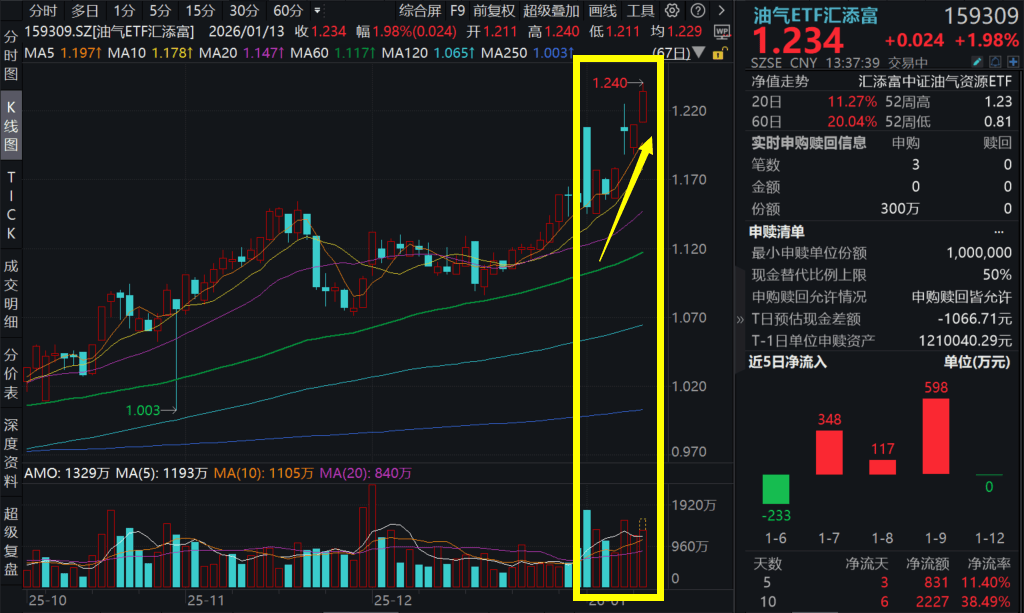
油气板块表现强势,中国海油涨超3%,油气ETF汇添富(159309)涨2%创新高!地缘风险推动油价回升,资源行情轮动到石油了?
Sou Hu Cai Jing· 2026-01-13 06:05
Core Viewpoint - The A-share market shows a mixed trend with the oil and gas sector experiencing significant inflows and price increases, particularly in the oil and gas ETF Huatai (159309), which reached a new high since its listing [1] Group 1: Market Performance - As of 13:38, the oil and gas ETF Huatai (159309) rose by 1.98%, hitting a new intraday high and attracting over 3.6 million yuan in capital [1] - The oil and gas sector saw most component stocks rise, with China National Offshore Oil Corporation (CNOOC) increasing over 3% and China Petroleum & Chemical Corporation (Sinopec) rising over 1% [5] Group 2: Geopolitical Factors - Concerns over the situation in Iran are supporting oil prices, with crude oil futures stabilizing near a one-month high [2] - Citic Futures indicates that geopolitical disturbances are likely to drive oil prices higher in the short term, despite a current oversupply in the global oil market [3] Group 3: Supply and Demand Dynamics - The OPEC+ group has decided to maintain its oil production levels, reflecting a desire to balance oil prices amid geopolitical tensions [4] - The International Energy Agency (IEA) projects a global oil demand increase of 860,000 barrels per day in 2026, with chemical feedstock demand expected to dominate this growth [6] Group 4: Investment Insights - The oil and gas sector is showing signs of recovery, with high dividend characteristics making it attractive for investors [6] - The oil and gas ETF Huatai (159309) focuses on the oil and gas industry chain, presenting long-term investment value amid external uncertainties [7]