Sinopec Corp.(600028)

Search documents
中石化取得柴油馏分高效分离方法专利
Sou Hu Cai Jing· 2026-01-02 03:14
国家知识产权局信息显示,中国石油化工股份有限公司;中石化石油化工科学研究院有限公司取得一项 名为"柴油馏分的分离方法"的专利,授权公告号CN117821108B,申请日期为2022年9月。 天眼查资料显示,中国石油化工股份有限公司,成立于2000年,位于北京市,是一家以从事石油和天然 气开采业为主的企业。企业注册资本12173968.9893万人民币。通过天眼查大数据分析,中国石油化工 股份有限公司共对外投资了267家企业,参与招投标项目5000次,财产线索方面有商标信息45条,专利 信息5000条,此外企业还拥有行政许可41个。 中石化石油化工科学研究院有限公司,成立于2022年,位于北京市,是一家以从事研究和试验发展为主 的企业。企业注册资本30000万人民币。通过天眼查大数据分析,中石化石油化工科学研究院有限公司 共对外投资了2家企业,参与招投标项目3844次,专利信息1624条,此外企业还拥有行政许可293个。 声明:市场有风险,投资需谨慎。本文为AI基于第三方数据生成,仅供参考,不构成个人投资建议。 来源:市场资讯 ...

中石化取得低浓度瓦斯安全配气控制专利
Sou Hu Cai Jing· 2026-01-02 02:23
中石化(大连)石油化工研究院有限公司,成立于2022年,位于大连市,是一家以从事研究和试验发展 为主的企业。企业注册资本338459.08万人民币。通过天眼查大数据分析,中石化(大连)石油化工研 究院有限公司共对外投资了1家企业,参与招投标项目2796次,专利信息5000条,此外企业还拥有行政 许可65个。 声明:市场有风险,投资需谨慎。本文为AI基于第三方数据生成,仅供参考,不构成个人投资建议。 来源:市场资讯 国家知识产权局信息显示,中国石油化工股份有限公司取得一项名为"低浓度瓦斯安全配气控制方法、 系统、设备和存储介质"的专利,授权公告号CN116066735B,申请日期为2021年10月。 天眼查资料显示,中国石油化工股份有限公司,成立于2000年,位于北京市,是一家以从事石油和天然 气开采业为主的企业。企业注册资本12173968.9893万人民币。通过天眼查大数据分析,中国石油化工 股份有限公司共对外投资了267家企业,参与招投标项目5000次,财产线索方面有商标信息45条,专利 信息5000条,此外企业还拥有行政许可41个。 ...
中国石化石油工程技术研究院智能压裂软件正式发布
Zhong Guo Jing Ji Wang· 2026-01-01 13:01
近日,中国石化石油工程技术研究院自主研发的智能压裂设计及决策系统FracAgent V1.0在北京对外发 布,标志着我国在非常规油气开发领域成功打破国外技术垄断,迈入自主可控的智能化压裂新阶段。 背景及行业痛点:压裂软件的"卡脖子"困境 应用成效:现场实践验证系统可靠性 FracAgent V1.0已在涪陵、普光等页岩油气区域应用80余口井、1000余段压裂作业,覆盖页岩油、页岩 气、致密气等非常规油气藏。系统借助定制化的设计模板和一键式报告生成功能,大幅缩短设计周期; 智能决策调控模块与压裂车组现场联动,超前60砂施工压力预测和堵预警精准度超过90%以上。 在中原油田普光区块的铁北1侧HF井压裂施工中,系统提前60秒预测施工压力上涨3~5MPa,迅速采取 降排量措施,成功避免了两次砂堵。 未来展望:能源安全与产业升级的双重意义 当前,智能压裂技术整体处于学术性研究向工业级应用的过渡阶段,有着广阔的发展前景。FracAgent V1.0成功入选"2025中国油气人工智能科技优秀案例",实现了软件完全自主可控,将继续向更智能、更 精确、更环保的方向发展,打造石油装备界的"L5级"水准,实现近乎无人的智能压裂作业 ...
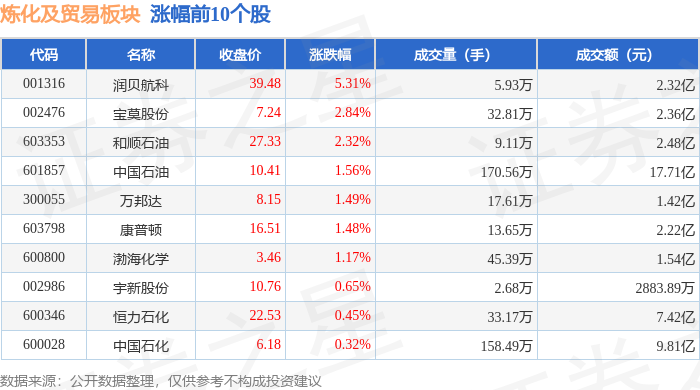
炼化及贸易板块12月31日涨0.73%,润贝航科领涨,主力资金净流出6.55亿元
Zheng Xing Xing Ye Ri Bao· 2025-12-31 09:07
Group 1 - The refining and trading sector increased by 0.73% compared to the previous trading day, with Runbei Hangke leading the gains [1] - On the same day, the Shanghai Composite Index closed at 3968.84, up 0.09%, while the Shenzhen Component Index closed at 13525.02, down 0.58% [1] - Key stocks in the refining and trading sector showed varied performance, with Runbei Hangke closing at 39.48, up 5.31%, and China Petroleum at 10.41, up 1.56% [1] Group 2 - The refining and trading sector experienced a net outflow of 655 million yuan from main funds, while retail investors saw a net inflow of 549 million yuan [2] - The table of fund flows indicates that major stocks like Heshun Petroleum and Runbei Hangke had mixed net inflows and outflows from different investor types [3] - Heshun Petroleum had a main fund net inflow of 29.66 million yuan, while Runbei Hangke saw a net outflow of 30.16 million yuan from retail investors [3]





全国产化DCS系统首用于石化装置
Zhong Guo Hua Gong Bao· 2025-12-31 06:05
中国石化天津分公司副总经理彭乾冰对项目成果给予高度评价:"本次投用的100%全国产化DCS系统, 是中国石化在关键生产装置上的首次成功尝试,具有开创性意义。系统的成功投用,为集团乃至整个石 化行业推进关键控制系统国产化替代,树立了一个可参考、可复制、可推广的实践标杆。" 中化新网讯 12月18日,中国石化天津南港120万吨/年乙烯及下游高端新材料产业集群项目(以下简称天 津南港乙烯项目)POE装置100%全国产化分布式控制系统(DCS)系统投用暨乙烯国产控制系统验收总结 会在中国石化天津分公司召开。 据介绍,POE装置是天津南港乙烯项目的主要生产装置之一,该装置选用和利时研发的HOLLiAS MACS IC完全自主可控DCS系统,实现从核心硬件到软件生态的全链条自主化,这也是100%全国产化 DCS系统首次在石化工艺装置上的成功应用。装置控制系统总点数10126点,配置控制器14对,操作站 12台。可与现有Windows操作系统、国外芯片I/O卡件及信息网络等品牌国产化DCS系统全面兼容,实 现数据互联互通。 ...

油气ETF(159697)盘中净申购400万份,区域局势不断扰动原油市场
Sou Hu Cai Jing· 2025-12-31 03:57
Core Viewpoint - The news highlights the recent performance of the National Petroleum and Natural Gas Index and the impact of geopolitical tensions in Venezuela on the oil market, with expectations of a price range for Brent crude oil in early 2026 [1][2]. Group 1: Market Performance - As of December 31, 2025, the National Petroleum and Natural Gas Index (399439) increased by 0.01%, with notable gains from stocks such as Haimer Technology (300084) up 4.26%, Yutong Co. (603036) up 3.10%, and China Petroleum (601857) up 1.56% [1]. - The oil and gas ETF (159697) was quoted at 1.19 yuan, with a net subscription of 4 million units during the trading session [1]. Group 2: Geopolitical Impact - The escalation of the regional situation in Venezuela is causing disturbances in the crude oil market, adding uncertainty to supply and demand forecasts [1]. - China Galaxy Securities anticipates a significant accumulation of supply in the near term, projecting Brent crude oil prices to range between $55 and $63 per barrel in January 2026, with potential downward pressure [1]. Group 3: Index Composition - As of November 28, 2025, the top ten weighted stocks in the National Petroleum and Natural Gas Index include China Petroleum (601857), China Petrochemical (600028), and China National Offshore Oil Corporation (600938), collectively accounting for 65.78% of the index [2]. - The oil and gas ETF (159697) closely tracks the National Petroleum and Natural Gas Index, reflecting the price changes of publicly listed companies in the oil and gas sector [1].




研判2025!中国藻类生物燃料行业背景、产业链全景、发展现状、技术创新及未来发展趋势分析:从示范验证到商业落地,藻基绿能迈向规模化[图]
Chan Ye Xin Xi Wang· 2025-12-31 01:51
Core Insights - Algal biofuels, derived from microalgae, represent a third-generation renewable fuel with significant advantages, including non-food production on marginal land and wastewater, thus avoiding competition with traditional agriculture and offering substantial carbon reduction potential [1][3][6] - The global market for algal biofuels is growing, driven by the need for low-carbon alternatives in hard-to-decarbonize sectors like aviation, with China integrating algal biofuels into its green development strategy through comprehensive policies and technological advancements [1][8] Industry Overview - Algal biofuels are produced from microalgae and macroalgae using various technologies such as oil extraction, fermentation, and gasification, focusing on renewable energy and carbon cycling [2][6] - The industry is characterized by four key features: high non-food yield, low carbon footprint, diverse raw materials, and compatibility with existing fuel systems [3][4] Development Background - The Chinese algal biofuel industry began in the late 1990s, gaining momentum after 2005 with government support, leading to the establishment of a preliminary industrial chain by 2010 [6][7] - Recent policies have emphasized the importance of algal biofuels in achieving energy transition and food security, with multiple strategic documents supporting technological research, market promotion, and industry standards [6][7] Current Industry Status - The global biofuel market is projected to reach $141 billion by 2025 and $257.6 billion by 2034, with a compound annual growth rate (CAGR) of 6.9% from 2025 to 2034, highlighting the increasing demand for advanced biofuels like algal biofuels [8] - In China, the algal biofuel sector is transitioning from demonstration to commercialization, with significant technological breakthroughs in genetic editing, AI cultivation, and magnetic flocculation [8][9] Industry Chain - The algal biofuel industry chain in China includes upstream biomass production, midstream processing, and downstream application, with a focus on producing biofuels and high-value co-products [9][10] - The market is currently dominated by biodiesel, which is compatible with existing infrastructure and has clear policy support, with projections indicating a market size of 1.17 billion yuan by 2025 [10] Future Trends - The industry is expected to evolve through technological breakthroughs, industrial upgrades, and market expansion, focusing on cost reduction and efficiency improvements across the entire value chain [11][12] - The integration of policies and market demand will drive applications into high-end sectors such as aviation and heavy transportation, enhancing international competitiveness through participation in global standards [12][13]


中国石化(600028)12月30日主力资金净买入2.27亿元
Sou Hu Cai Jing· 2025-12-31 00:28
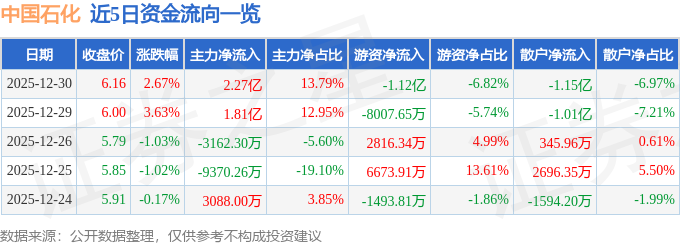
证券之星消息,截至2025年12月30日收盘,中国石化(600028)报收于6.16元,上涨2.67%,换手率 0.28%,成交量269.0万手,成交额16.45亿元。 12月30日的资金流向数据方面,主力资金净流入2.27亿元,占总成交额13.79%,游资资金净流出1.12亿 元,占总成交额6.82%,散户资金净流出1.15亿元,占总成交额6.97%。 近5日资金流向一览见下表: | | | | 日期 收盘价 涨跌幅 主力净流入 主力净占比 游资净点比 散户净流入 散户净占比 | | | | | | --- | --- | --- | --- | --- | --- | --- | --- | | 2025-12-30 | 6.16 2.67% | 2.27亿 | 13.79% | -1.12亿 | -6.82% | -1.15 Z | -6.97% | | 2025-12-29 | 6.00 3.63% | 1.81亿 | 12.95% | -8007.65万 | -5.74% | -1.01亿 | -7.21% | | 2025-12-26 | 5.79 -1.03% | -3162.30万 | -5. ...
入井前“休眠”,下井后“苏醒”挡砂
Qi Lu Wan Bao· 2025-12-30 16:12
在渤海湾盆地,有一个让无数石油工程师"又爱又恨"的地方——临盘油田。这里的油藏薄得像纸,断层 多得像摔碎的镜子,油、水、砂纠缠在一起,被人称作"地质迷宫"。更让人头疼的是,地层里藏着大量 粉细砂,一开井就跟着原油往外涌,防砂成了头号难题。 2022年以来,胜利油田临盘采油厂与中石化石油工程技术研究院加强一体化技术攻关,让形状记忆筛管 技术在全国首次实现规模化工业应用,为复杂油气藏高效开发贡献了力量。 大众新闻记者顾松通讯员周国庆王泉 打造技术攻关擂台 "四成的生产井都需要防砂,传统方法试遍了,效果都不理想。"临盘油田一位资深工程师回忆道,"有 时候刚防住砂,一加大开采强度,砂又出来了。就像用竹篮打水,总有漏网之'砂'。" 转机,始于一次主动的"走出去"。2022年初,临盘油田技术团队在一次技术交流中,听说了中石化石油 工程技术研究院正在攻关一项"会自己长大"的防砂技术——形状记忆筛管。研究院的段友智博士介绍 说:"这筛管像有'记忆'一样,下井时是瘦的,到了地下遇到一定温度,自己能'醒'过来,膨胀成型,紧 紧贴住井壁,既挡砂又支撑。" "听起来很'未来',但我们这儿情况太复杂了,老井多、套管状况差、层间差异大, ...
10万→8610万吨,中国可持续航空燃料(SAF)的"长征"才刚开始
DT新材料· 2025-12-30 16:03
Core Viewpoint - The article discusses the urgent need for Sustainable Aviation Fuel (SAF) in China, highlighting the growing demand for aviation fuel and the challenges posed by carbon emission reduction requirements. It emphasizes the importance of SAF in achieving carbon neutrality goals by 2050 and outlines the technological advancements and strategies being developed to meet this demand [4][5][19]. Group 1: Industry Demand and Policy - China's aviation fuel consumption is projected to reach nearly 40 million tons in 2024, with CO2 emissions of 126 million tons, and is expected to grow to over 76 million tons by 2040-2045 [4][19]. - The International Civil Aviation Organization (ICAO) has set a carbon neutrality target for the aviation industry by 2050, with a zero growth target for carbon emissions from 2021 to 2035 [4]. - The ReFuelEU regulation mandates a blending ratio for SAF of 2% by 2025, 6% by 2030, and 70% by 2050, indicating a strong policy push for SAF adoption [9]. Group 2: Technological Development - The HEFA (Hydroprocessed Esters and Fatty Acids) route currently dominates the SAF production landscape, accounting for approximately 80% of the expected production in the next five years [20]. - HEFA technology utilizes waste oils and fats, achieving a carbon emission reduction of 65%-85% compared to traditional jet fuel, but faces raw material supply challenges [23][25]. - Sinopec's research institute is developing five technological routes to diversify raw material sources and address supply bottlenecks, including HEFA, gasification-Fischer-Tropsch, ethanol-to-jet fuel, waste plastic pyrolysis, and electrochemical conversion [26][31]. Group 3: Market Opportunities and Challenges - The SAF market in China is expected to grow significantly, with existing production capacity of approximately 1.05 million tons per year and planned additional capacity of 5.8 million tons per year by 2024 [37]. - Despite the high cost of SAF, which is 2-3 times that of traditional jet fuel, there is a lack of terminal subsidies and product prioritization mechanisms in China, unlike in the US and EU [37]. - The article concludes that achieving the ambitious SAF production targets will require a combination of technological innovation, raw material security, and supportive policies [38].