
CSN(600029)

Search documents
广州白云机场起飞!国内首架C919全运会主题彩绘机首航
Nan Fang Du Shi Bao· 2025-11-04 12:30
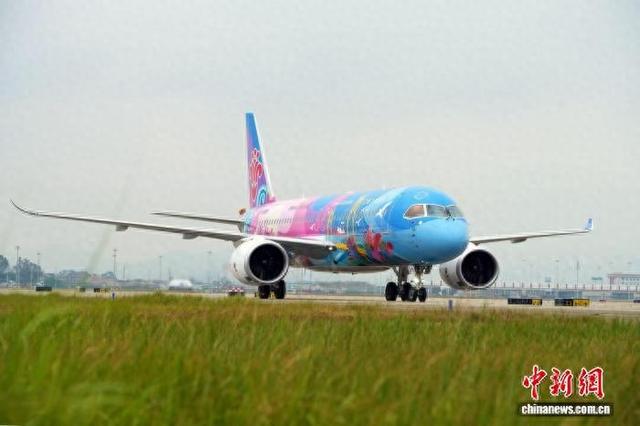
Core Points - The first C919 aircraft themed "Great Bay Area" successfully took off from Guangzhou Baiyun International Airport to Shanghai Hongqiao International Airport, marking a significant achievement in the commercial operation of domestically produced large aircraft in China [2][4] - The aircraft is operated by China Southern Airlines and is the seventh C919 aircraft in its fleet, serving the Guangzhou-Shanghai route [2] - The design of the "Great Bay Area" aircraft features vibrant colors and key visual elements representing the Guangdong-Hong Kong-Macao Greater Bay Area, including the Hong Kong-Zhuhai-Macao Bridge and symbols of cultural confidence [6][7] Company and Industry Insights - The "Great Bay Area" aircraft is the first to utilize the C919 model for a special paint scheme, employing advanced aerospace coatings that enhance durability and reduce maintenance frequency [7] - The use of this special paint significantly lowers the amount of paint required compared to traditional coatings, thereby reducing volatile organic compound emissions, showcasing the airline's commitment to green and low-carbon aviation [7] - The captain of the C919 fleet expressed hopes for the aircraft to support the upcoming "15th National Games" and emphasized the pride and responsibility associated with operating domestically produced aircraft [7]



中国南航集团资本控股有限公司增持中国外运30万股 每股作价约5.33港元
Zhi Tong Cai Jing· 2025-11-04 11:41
Group 1 - China Southern Airlines Group Capital Holdings Limited increased its stake in China National Foreign Trade Transportation Group Corporation (China National Foreign Trade) by 300,000 shares at a price of HKD 5.3335 per share, totaling approximately HKD 1.60005 million [1] - After the transaction, the total number of shares held by China Southern Airlines Group Capital is approximately 221.9 million shares, representing an ownership stake of 11.00% [1] - The transaction involves other related parties, specifically China Southern Airlines Group Limited [1]

便捷舒心,畅行四方,扬泰机场冬航季重磅打造“广深”“川渝”两大快线
Yang Zi Wan Bao Wang· 2025-11-04 11:00
Core Points - The Yangzhou Taizhou International Airport is enhancing its services and flight capacity for the winter-spring season, introducing two major fast lines: "South China" and "Chuan-Yu" [1][8] - The "South China Fast Line" connects Guangzhou and Shenzhen, offering high-frequency flights and dedicated ground services to improve passenger experience [3][8] - The "Chuan-Yu Fast Line" focuses on the Southwest market, increasing flight frequency to Chengdu and Chongqing to cater to diverse travel needs [8] Flight Schedule Summary - The Guangzhou route offers six daily flights from Yangzhou, with departure times ranging from 07:10 to 20:35, allowing flexible travel options [3][4] - The Shenzhen route provides three to four daily flights, efficiently connecting to the Shenzhen hub and facilitating international transfers [3][6] - The Chengdu route has four to five daily flights, while the Chongqing route operates two daily flights, ensuring convenient access to these popular destinations [8] Service Enhancements - The airport has implemented a "Fast Line Fast Check" service, featuring dedicated counters and expedited security checks to minimize wait times for passengers [8] - The overall goal is to provide a seamless travel experience from the moment passengers arrive at the airport to boarding their flights [8]

C919十五运会彩绘飞机“大美湾区”号今日首航
2 1 Shi Ji Jing Ji Bao Dao· 2025-11-04 10:52
国产大飞机C919首架彩绘机 11月4日12时27分,国内首架C919十五运会彩绘飞机"大美湾区"号搭载157名旅客从广州白云国际机场 顺利起飞,前往上海虹桥国际机场,该飞机是中国南方航空(以下简称"南航")第7架C919国产大飞 机,执飞广州—上海虹桥往返航线。此次"大美湾区"号彩绘机的首航,既是国产大飞机商业化运营的重 要成果,也是中国民航携手国家重大体育盛会的创新实践。 南航推出赛事专属特色服务 为更好服务十五运会赛事相关人员,南航在广州白云国际机场F值机区常态化开设值机专柜,对中转涉 赛旅客设立中转值机柜台与专属安检通道。针对运动员出行存在的运动器材、医疗设备多的情况,南航 提供专业包装、优先托运、粘贴专属标识等服务。南航重点关注残特奥会运动员,精准对接轮椅旅客需 求,提供值机高效办理、装备单独贴标、联动安检、登机口"一对一"引导与无障碍衔接等服务,让轮椅 旅客感受全程无忧的乘机体验。此外,全新推出的十五运会和残特奥会主题登机牌,实现了"出行工具 +赛事纪念+服务载体"的三重融合,让赛事旅途绽放南航温度。 空中服务方面,南航乘务组统一身着岭南风格旗袍,让传统文化底蕴与全运赛事的热烈氛围在万米高空 交相 ...
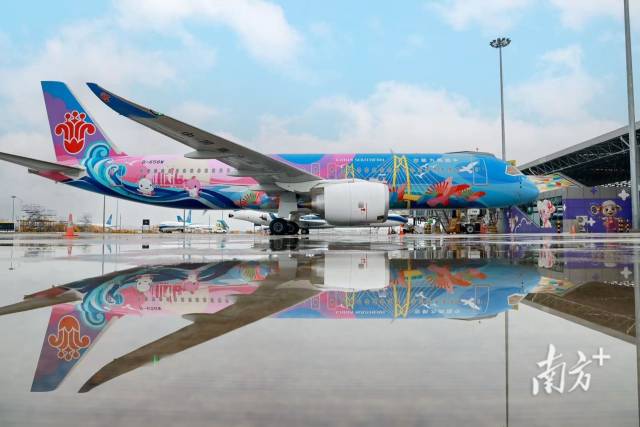
(粤港澳全运会)首架C919十五运会主题彩绘飞机首航
Zhong Guo Xin Wen Wang· 2025-11-04 10:52
Core Points - The first C919 aircraft with a special paint scheme named "Great Bay Area" took off from Guangzhou Baiyun International Airport to Shanghai Hongqiao International Airport, carrying 157 passengers [1][3] - The design of the "Great Bay Area" aircraft features vibrant colors and focuses on key visual elements representing the Guangdong-Hong Kong-Macao Greater Bay Area, including the Hong Kong-Zhuhai-Macao Bridge and cultural symbols [1][3] Company Developments - The "Great Bay Area" aircraft is the first painted C919 model in the fleet, utilizing special aerospace coatings that enhance durability and reduce maintenance frequency [3] - Compared to traditional paints, the new coating significantly lowers the amount of paint used, thereby reducing volatile organic compound emissions [3] Service Enhancements - Guangzhou Baiyun International Airport has established dedicated check-in counters and security channels for passengers related to the 15th National Games, improving service for athletes and their equipment [3] - China Southern Airlines has introduced specialized services for athletes, including priority baggage handling and personalized assistance for wheelchair users [3] - The airline has launched themed boarding passes for the 15th National Games and the Special Olympics, integrating travel, event memorabilia, and service [3] Operational Performance - China Southern Airlines' fleet of C919 aircraft has expanded, with the "Great Bay Area" being the seventh C919 in operation [4] - The C919 has been in operation for over a year, covering 14 routes, flying more than 9,700 hours, and transporting over 590,000 passengers [4] - Regular commercial operations have been established in major cities such as Shanghai, Beijing, and Wuhan, with operational bases in Guangzhou and Changsha [4]
南方航空(600029) - 南方航空H股公告-月报表
2025-11-04 09:30
致:香港交易及結算所有限公司 公司名稱: 中國南方航空股份有限公司 呈交日期: 2025年11月4日 I. 法定/註冊股本變動 | 1. 股份分類 | 普通股 | 股份類別 | H | | | 於香港聯交所上市 (註1) | | 是 | | | --- | --- | --- | --- | --- | --- | --- | --- | --- | --- | | 證券代號 (如上市) | 01055 | 說明 | | | | | | | | | | | 法定/註冊股份數目 | | | 面值 | | | 法定/註冊股本 | | | 上月底結存 | | | 4,643,997,308 | RMB | | | 1 RMB | | 4,643,997,308 | | 增加 / 減少 (-) | | | 0 | | | | RMB | | 0 | | 本月底結存 | | | 4,643,997,308 | RMB | | | 1 RMB | | 4,643,997,308 | | 2. 股份分類 | 普通股 | 股份類別 | A | | 於香港聯交所上市 (註1) | | 否 | | | --- | --- | - ...
中国南方航空股份(01055) - 截至二零二五年十月三十一日止之股份发行人的证券变动月报表
2025-11-04 08:31
股份發行人及根據《上市規則》第十九B章上市的香港預託證券發行人的證券變動月報表 截至月份: 2025年10月31日 狀態: 新提交 致:香港交易及結算所有限公司 公司名稱: 中國南方航空股份有限公司 呈交日期: 2025年11月4日 I. 法定/註冊股本變動 | 1. 股份分類 | 普通股 | 股份類別 | H | | | 於香港聯交所上市 (註1) | | 是 | | | --- | --- | --- | --- | --- | --- | --- | --- | --- | --- | | 證券代號 (如上市) | 01055 | 說明 | | | | | | | | | | | 法定/註冊股份數目 | | | 面值 | | | 法定/註冊股本 | | | 上月底結存 | | | 4,643,997,308 | RMB | | | 1 RMB | | 4,643,997,308 | | 增加 / 減少 (-) | | | 0 | | | | RMB | | 0 | | 本月底結存 | | | 4,643,997,308 | RMB | | | 1 RMB | | 4,643,997,308 | | 2. ...
美银证券:料国内机票价格承压影响盈利 料三大航空H股“跑输大市”
Zhi Tong Cai Jing· 2025-11-04 08:00
Group 1 - The performance of four mainland airlines in Q3 showed divergence, with China Eastern Airlines experiencing the strongest net profit growth of 34% year-on-year, followed by China Southern Airlines with a 20% increase. Spring Airlines and Air China saw net profit declines of 6% and 11%, respectively [1] - Revenue per available seat kilometer exceeded expectations, with stable data reported for September. The decline in fuel costs is expected to benefit the overall cost structure, although the unit cost performance excluding fuel varied, with Air China lagging in cost optimization [1] - Adjustments were made to Air China's 2025 profit forecast, changing from a loss of 54 million yuan to a profit of 473 million yuan, while forecasts for 2026 and 2027 were lowered by 5.7% and 4.2%, respectively. China Southern Airlines' 2025 profit forecast was reduced by 54%, but forecasts for 2026 and 2027 were raised by 16% and 14%. China Eastern Airlines' forecasts for 2025 to 2027 were increased by 56%, 0.8%, and 0.7%, respectively. Spring Airlines' 2025 profit forecast was lowered by 2.7%, with 2026 and 2027 forecasts remaining unchanged [1] Group 2 - The firm reiterated "underperform" ratings for Air China, China Eastern Airlines, and China Southern Airlines due to ongoing pressure on domestic ticket prices, which pose downside risks to profits in 2025 and 2026. Conversely, a "buy" rating was maintained for Spring Airlines, attributed to its cost leadership position and expected stable growth in 2025 and 2026 [2]

航站楼投运折射大湾区天空新棋局,广深港三机场直面竞合提速
Nan Fang Du Shi Bao· 2025-11-04 06:51
Core Insights - The opening of Guangzhou Baiyun Airport's T3 terminal and the fifth runway marks a significant upgrade in the airport's capabilities, enhancing its status as a major aviation hub [1][8] - Shenzhen has been selected as the host city for the 2026 APEC meeting, presenting new development opportunities for Shenzhen Bao'an International Airport [2] - The three major airports in the Guangdong-Hong Kong-Macao Greater Bay Area (Guangzhou, Shenzhen, and Hong Kong) are engaged in both competition and collaboration to expand the regional aviation market [3][4] Airport Developments - Guangzhou Baiyun Airport achieved a record passenger volume of over 7.6 million in October 2025, reflecting an 11% year-on-year increase [8] - Hong Kong International Airport processed 44.7 million passengers in the first three quarters of the year, with a 14.8% increase compared to the same period in 2024 [4] - Shenzhen Airport reported a significant increase in passenger and cargo traffic during the recent holiday period, with 1.602 million passengers and 38,000 tons of cargo handled [4] Competitive Landscape - The three major airports are competing for air traffic while also working together to grow the overall aviation market in the Greater Bay Area [3][4] - Cathay Pacific and China Southern Airlines are the two main carriers competing for market share, with Cathay expanding its routes into China and Southern Airlines responding by increasing flights to Hong Kong [11][15] - Cathay Pacific's new direct flight from Hong Kong to Urumqi and increased flights to major cities in mainland China highlight its strategy to capture high-end travelers [12][14] Future Outlook - The Greater Bay Area is projected to see a total passenger throughput of over 200 million by 2024, indicating strong growth potential for the aviation sector [19] - The collaboration among the three airports aims to create a world-class airport cluster, enhancing the region's global aviation standing [20] - The competitive dynamics between Cathay Pacific and China Southern Airlines are expected to improve service quality and passenger experience, providing travelers with more options and better pricing [20]


南方航空跌2.01%,成交额2.79亿元,主力资金净流出75.94万元
Xin Lang Cai Jing· 2025-11-04 06:44
Core Viewpoint - China Southern Airlines' stock price has shown a modest increase this year, with a notable rise in recent trading days, reflecting a positive trend in the airline's performance and market sentiment [1][2]. Financial Performance - For the period from January to September 2025, China Southern Airlines reported a revenue of 137.67 billion yuan, representing a year-on-year growth of 2.23% [2]. - The net profit attributable to shareholders for the same period was 2.31 billion yuan, marking a year-on-year increase of 17.40% [2]. Stock Market Activity - As of November 4, the stock price of China Southern Airlines was 6.81 yuan per share, with a market capitalization of 123.40 billion yuan [1]. - The stock has increased by 4.93% year-to-date, with a 1.64% rise over the last five trading days, 14.45% over the last 20 days, and 19.68% over the last 60 days [1]. Shareholder Information - As of September 30, 2025, the number of shareholders for China Southern Airlines was 133,300, a decrease of 4.76% from the previous period [2]. - The top ten circulating shareholders include Hong Kong Central Clearing Limited, which holds 586 million shares, an increase of 4.32 million shares from the previous period [3].