
CM BANK(600036)

Search documents
银行板块持续走强 厦门银行涨超5%
Zheng Quan Shi Bao Wang· 2025-11-04 02:32
Core Viewpoint - The banking sector is experiencing a strong upward trend, with several banks showing significant stock price increases [1] Group 1: Stock Performance - Xiamen Bank has seen its stock price rise by over 5% [1] - Other banks including CITIC Bank, Chongqing Bank, Shanghai Bank, Industrial Bank, China Merchants Bank, Postal Savings Bank, Agricultural Bank, Industrial and Commercial Bank, and Jiangyin Bank have all increased by over 2% [1]




银行ETF指数(512730)涨超1%,上市银行营收开始企稳
Xin Lang Cai Jing· 2025-11-04 02:28
Core Insights - The banking sector in China shows signs of stabilization in operating income after two years of decline, with a slight increase of 0.9% year-on-year in the first three quarters of 2023, totaling 4.32 trillion yuan [1] - Net profit for the 42 listed banks in China reached 1.68 trillion yuan in the same period, reflecting a growth of 1.5% compared to the previous year, outpacing revenue growth by 0.6 percentage points [1] - The current low valuation of the banking sector, combined with attractive dividend yields compared to bonds and wealth management products, suggests potential for increased investment in the sector [1] Banking Index Performance - The China Securities Banking Index (399986) rose by 1.14%, with significant gains from constituent stocks such as Shanghai Bank (up 2.48%) and CITIC Bank (up 1.91%) [1] - The Banking ETF Index (512730) also increased by 1.01%, closing at 1.7 yuan [1] Dividend and Market Sentiment - The concentrated dividend distribution period for banks has largely concluded since July, leading to a shift in market sentiment and increased risk appetite among investors [1] - The ongoing dividend distribution from banks remains robust, enhancing the attractiveness of bank stocks as a viable investment option [1] Index Composition - As of October 31, 2025, the top ten weighted stocks in the China Securities Banking Index account for 64.87% of the index, with major players including China Merchants Bank and Industrial and Commercial Bank of China [2]




银行股全线上涨
第一财经· 2025-11-04 02:16
Core Viewpoint - The banking sector continues to show positive momentum, with several banks experiencing significant stock price increases on November 4th, indicating a bullish trend in the market [1]. Group 1: Stock Performance - Shanghai Bank, CITIC Bank, Industrial Bank, China Merchants Bank, Xiamen Bank, and Postal Savings Bank all saw stock price increases of over 2% [1]. - Specific stock performance data includes: - CITIC Bank: +2.29%, current price 8.04 [2] - Industrial Bank: +2.24%, current price 21.02 [2] - Shanghai Bank: +2.27%, current price 9.90 [2] - China Merchants Bank: +2.23%, current price 42.72 [2] - Xiamen Bank: +2.11%, current price 7.25 [2] - Postal Savings Bank: +2.08%, current price 5.90 [2] - Other banks also showed positive performance, with Agricultural Bank up by 1.87% and Industrial and Commercial Bank up by 1.65% [2].




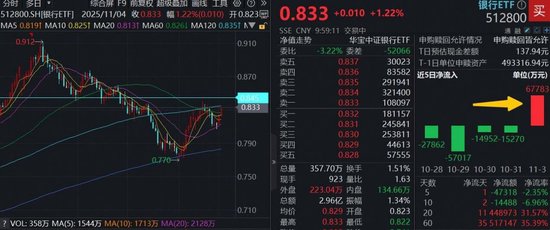
单日狂揽6.8亿元,顶流银行ETF(512800)资金面现拐点信号,银行股集体走强,招商银行涨超2%
Xin Lang Ji Jin· 2025-11-04 02:14
Core Viewpoint - The banking sector is experiencing a positive trend, with significant inflows into the bank ETF (512800) and a collective rise in A-share bank stocks, indicating a potential shift in market sentiment towards value sectors like banking [1][3]. Group 1: Market Performance - The bank ETF (512800) saw an increase of 1.22%, surpassing the 60-day moving average and approaching the six-month line [1]. - A total of 42 bank stocks in A-shares rose collectively, with five leading stocks, including China Merchants Bank and Postal Savings Bank, gaining over 2% [1]. - The bank ETF recorded a net inflow of 678 million yuan, reversing a previous trend of outflows [3]. Group 2: Institutional Investment - Insurance companies have been actively purchasing bank stocks, with six insurers entering the top ten shareholders of six A-share listed banks in Q3 [3]. - There is an expectation of increased demand for dividend allocation as the insurance sector enters a favorable phase [3]. Group 3: Investment Tools - The bank ETF (512800) passively tracks the CSI Bank Index, which includes 42 listed banks in A-shares, making it an efficient investment tool for tracking the banking sector [3]. - The latest scale of the bank ETF exceeds 19.4 billion yuan, with an average daily trading volume of over 800 million yuan, making it the largest and most liquid among ten bank ETFs in A-shares [3].
银行板块震荡走强 上海银行等涨超2%
Zheng Quan Shi Bao Wang· 2025-11-04 02:07
Core Viewpoint - The banking sector has shown a strong upward trend, with several banks experiencing significant stock price increases [1] Group 1: Stock Performance - Shanghai Bank, China Merchants Bank, and CITIC Bank have all risen by over 2% [1] - Xiamen Bank, Postal Savings Bank, and Agricultural Bank have also seen increases of over 1% [1]
机遇“金闪闪” 银行贵金属业务规模大增
Shang Hai Zheng Quan Bao· 2025-11-03 18:11
Core Viewpoint - The strong international gold prices and rising global risk aversion are driving the growth of banks' precious metals businesses, with significant year-on-year increases reported in the third-quarter financial results of listed banks. However, the recent fluctuations in gold prices present new challenges for these banking operations [1]. Group 1: Growth in Precious Metals Business - The precious metals business of banks has rapidly expanded due to the sustained rise in gold prices, with smaller banks showing particularly impressive growth. As of the end of September, Nanjing Bank's precious metals business reached 7.201 billion yuan, a staggering increase of 11,914.36% compared to the end of 2024. Hangzhou Bank's precious metals business grew to 1.217 billion yuan, up 1,523.57% from the end of 2024 [2]. - Joint-stock banks also experienced significant growth in their precious metals business. By the end of September, compared to the end of 2024, the precious metals business of Shanghai Pudong Development Bank increased by over 350%, while China CITIC Bank saw an increase of over 200%. Other banks like Zhejiang Commercial Bank, Industrial Bank, China Merchants Bank, and Minsheng Bank all reported growth exceeding 100% [2]. - Major banks maintained steady growth from a high base, with the precious metals business of Bank of China, China Construction Bank, and Agricultural Bank of China all increasing by over 10% compared to the end of 2024 [2]. Group 2: Strategic Focus on Precious Metals - The precious metals business combines wealth management and increased intermediary income, potentially becoming a significant factor in banks' intermediary income. Precious metals, especially gold, are seen as irreplaceable in banks' wealth management offerings and are crucial for customer asset allocation [3]. - Analysts note that the demand for gold as a hedge and a store of value is rising among residents. Banks, as key channels for gold bar sales and coin distribution, are well-positioned to meet this demand through the continued popularity of online investment products like account gold and gold accumulation [3]. - The decline in gold jewelry consumption may lead banks to reduce reliance on traditional jewelry sales and instead focus on innovation and promotion of their precious metals business [3]. Group 3: Risk Management Amid Price Volatility - Despite the growth, the high volatility of precious metals, particularly gold and silver, poses challenges for banks. Since October, these metals have entered a period of high volatility, prompting banks to enhance their risk management strategies [4]. - In response to market fluctuations, banks have adjusted trading rules and increased the minimum purchase thresholds for gold accumulation products to a range of 950 to 1,200 yuan, compared to around 500 yuan last year. Additionally, some banks have modified their precious metals wallet services to align with real-time gold price fluctuations [4]. - Looking ahead, institutions expect gold to retain its upward potential, maintaining its importance in asset allocation. The profitability of banks' precious metals business will increasingly depend on their internal capabilities, including the establishment of robust risk management systems to mitigate price volatility risks and the optimization of asset allocation for stable returns [4].




前三季度42家上市银行非利息收入同比增长5% 手续费及佣金净收入实现正增长 投资净收益增速放缓
Zheng Quan Ri Bao· 2025-11-03 16:21
Core Viewpoint - Non-interest income is a crucial component of banks' revenue structure, reflecting operational resilience amid pressure on net interest income. The performance of non-interest income among 42 listed banks in A-shares for the first three quarters shows a total of 1.22 trillion yuan, a year-on-year increase of 583 billion yuan, representing a growth rate of 5% [1][2]. Summary by Category Non-Interest Income Growth - In the first three quarters, 18 banks reported year-on-year growth in non-interest income, with 16 banks increasing the proportion of non-interest income in total revenue [1][2]. - Notably, Zijin Bank, Changshu Bank, and Zhangjiagang Bank, all located in Jiangsu, exhibited remarkable growth rates of 54%, 35%, and 22%, respectively, contributing significantly to their total revenues [2][3]. Performance of Different Bank Types - Among the six major state-owned banks, all reported year-on-year growth in non-interest income, with five achieving double-digit growth rates. In contrast, only one national joint-stock bank saw an increase [2][3]. - The non-interest income growth rates for major state-owned banks were as follows: Agricultural Bank (21%), Postal Savings Bank (20%), Bank of China (16%), China Construction Bank (14%), and Industrial and Commercial Bank (11%) [2]. Fee and Commission Income - The total net fee and commission income for the 42 listed banks reached 578.2 billion yuan, a year-on-year increase of 4.6%, with over 60% of banks reporting growth in this area [4][5]. - Noteworthy increases in fee and commission income were observed in Changshu Bank and Ruifeng Bank, with growth rates exceeding 364% and 162%, respectively [5]. Investment Income Trends - The total investment net income for the listed banks was 477 billion yuan, reflecting a year-on-year growth of 21%, although this growth rate has slowed compared to the previous year's 24% [6]. - The investment income of many banks was impacted by fluctuations in the bond market, particularly affecting smaller banks such as city commercial banks and rural commercial banks [6].


前三季度42家上市银行非利息收入同比增长5%
Zheng Quan Ri Bao· 2025-11-03 15:48
Core Insights - Non-interest income is a crucial component of banks' revenue structure, especially under pressure on net interest income, reflecting operational resilience [1] - In the first three quarters of this year, 42 listed banks in A-shares reported a total non-interest income of 1.22 trillion yuan, an increase of 58.3 billion yuan, or 5% year-on-year [1] - The growth in non-interest income is driven by the performance of wealth management businesses and the overall market activity, although investment income has been affected by fluctuations in the bond market [1][6] Non-Interest Income Growth - Among the 42 listed banks, 18 reported a year-on-year increase in non-interest income, with 16 banks seeing an increase in the proportion of non-interest income in total revenue [1][2] - Notably, Zijin Bank, Changshu Bank, and Zhangjiagang Bank, all from Jiangsu, showed remarkable growth rates of 54%, 35%, and 22% respectively, contributing significantly to their total revenues [2] - State-owned banks demonstrated strong growth in non-interest income, with Agricultural Bank, Postal Savings Bank, Bank of China, China Construction Bank, and Industrial and Commercial Bank reporting double-digit growth rates [2][3] Fee and Commission Income - The total fee and commission income for the 42 listed banks reached 578.2 billion yuan, a year-on-year increase of 4.6%, with over 60% of banks reporting growth [4][5] - Notable increases in fee and commission income were observed in Changshu Bank and Ruifeng Bank, with growth rates exceeding 364% and 162% respectively [4] - State-owned banks also reported growth in fee and commission income, with major banks like China Merchants Bank seeing a 0.9% increase, driven by significant growth in various subcategories of income [5] Investment Income Trends - The investment net income for the 42 listed banks totaled 477 billion yuan, reflecting a year-on-year growth of 21%, although this growth rate has slowed compared to the previous year [6] - The fluctuations in the bond market have particularly impacted the investment income of smaller banks, such as city commercial banks and rural commercial banks [6] - Analysts suggest that differences in client bases and operational strategies between state-owned and smaller banks are influencing their respective non-interest income growth [3][6]
数说公募权益及FOF基金三季报:成长主线多层次扩散,机构抱团同步推进
SINOLINK SECURITIES· 2025-11-03 15:32
Report Title - The report is titled "Analysis of Public Offering Equity and FOF Fund Q3 Reports: Growth Mainline Spreading at Multiple Levels, Institutional Herding Progressing Synchronously" [1] Investment Rating - The document does not mention the industry investment rating. Core Viewpoints - In Q3 2025, the A-share market showed characteristics of a high-beta, comprehensively rising, growth-led structural bull market, with the Hong Kong stock market moving in tandem. Growth indices outperformed value indices, and the market showed multi-level diffusion of investment opportunities and synchronous institutional herding. Active equity funds continued to experience slight net redemptions, but the overall scale increased significantly driven by net value. Funds concentrated on increasing allocations in the TMT direction and adjusted positions from relatively weak sectors [3]. Summary by Directory 1. Fund Market Overview - **Performance Review**: The A-share market in Q3 2025 showed a high-beta, comprehensively rising, growth-led structural bull market. Broad-based indices generally rose significantly, with the ChiNext leading. The Shanghai Composite Index, Shenzhen Component Index, and CSI 300 rose 12.73%, 29.25%, and 17.90% respectively, while the ChiNext Index and STAR 50 Index rose 50.40% and 49.02%. The Hong Kong stock market moved in tandem with the A-share market. In terms of style, large, medium, and small-cap growth indices significantly outperformed value indices, with large-cap growth leading [10]. - **Industry Index Performance**: In Q3, 30 out of 31 Shenwan industries, except for the banking industry, achieved positive returns. Technology manufacturing and non-ferrous metals performed well, while the financial sector was generally weak. The top 5 industries in terms of increase were communication (48.65%), electronics (47.59%), power equipment (44.67%), non-ferrous metals (41.82%), and comprehensive (32.77%) [13]. - **Equity Fund Performance**: In Q3 2025, the average net value of various types of equity funds increased significantly. The average maximum drawdown of balanced hybrid funds with lower stock positions was the lowest, at 4.72%, while that of ordinary stock funds was the highest, at 6.20%. In terms of the Sharpe ratio, partial equity hybrid and flexible allocation funds were relatively high in the short term, and balanced hybrid funds showed better risk-return performance in the long term [23]. - **Scale and Share**: As of the end of Q3 2025, the total scale of active equity funds was 3.99 trillion yuan, a significant increase of 20.81 pct quarter-on-quarter, and the total share was 2.64 trillion shares, a decrease of 5.27 pct quarter-on-quarter. Equity funds continued to experience slight net redemptions, but the overall scale increased significantly driven by net value [30]. - **Newly Issued Funds**: In Q3, the number and scale of newly issued active equity funds increased significantly. A total of 109 funds were newly issued, with a total scale of 5.3925 billion yuan, an increase of 2.3277 billion yuan compared to the previous quarter, reaching a new high in the past three years. Among them, partial equity hybrid funds had the largest newly issued scale, at 4.8082 billion yuan [32]. 2. Fund Holding Characteristics - **Stock/Hong Kong Stock Positions**: In Q3 2025, the equity fund positions increased, with an average stock position of 88.98%, an increase of 1.42 percentage points compared to the end of the previous quarter. The Hong Kong stock position of equity funds slightly decreased this quarter, with the average investment market value of Hong Kong stocks accounting for 13.55% of the net value, a slight decrease of 0.20 percentage points compared to the previous quarter [39]. - **Heavyweight Stock Sector Allocation**: In Q3, the technology sector was the most heavily held by active equity funds, and the holding ratio further increased significantly compared to Q2. The funds concentrated on increasing allocations in the TMT direction and adjusted positions from relatively weak sectors such as banking and food and beverage [43]. - **Heavyweight Stock Industry Allocation**: The electronics industry remained the most heavily held by equity funds, and the allocation ratio further increased, while the banking industry was significantly reduced. The concentration of the top five industries increased from 49.27% in Q2 to 58.58% [47]. - **Top Ten Heavyweight Stocks**: The top 10 stocks by market value accounted for by equity fund heavyweight holdings were Contemporary Amperex Technology Co., Limited, Tencent Holdings, Xinyisheng, Zhongji Innolight, Alibaba Group Holding Limited, SMIC, Industrial Foresight, Luxshare Precision Industry Co., Ltd., Zijin Mining Group Co., Ltd., and Kweichow Moutai Co., Ltd. Stocks with a relatively large increase in market value accounted for in Q3 were Zhongji Innolight, Industrial Foresight, and Xinyisheng [49]. - **Heavyweight Stock Market Value & Concentration**: The market value style of equity fund holdings strengthened towards large-cap stocks. The concentration of the top 50, 100, and 200 stocks increased significantly in Q3, and the herding trend returned [58]. 3. Fund Company Analysis - **TOP20 Fund Company Scale**: In Q3 2025, the equity fund scales of the top 20 active equity fund companies increased significantly compared to Q2. The top 5 institutions remained unchanged from the previous quarter, and among the companies ranked 6 - 20, the equity scale of Yongying Fund increased significantly, rising 11 places [61]. - **TOP20 Fund Company Heavyweight Industries**: The first major heavyweight industries of the top 20 fund companies were mainly electronics and pharmaceutical biology. Dacheng Fund's first major heavyweight industry was non-ferrous metals, showing some differentiation [62]. - **TOP20 Fund Company Heavyweight Stocks**: In Q3, the average concentration of the top three heavyweight stocks of the top 20 active equity fund companies was 13.49%, and that of the top five was 20.01%, slightly decreasing compared to the previous quarter. Xingquan Fund had the highest concentration of the top three heavyweight stocks, at 24.69% [64]. 4. Theme Fund Analysis - **Fund Performance**: In Q3, the performance of various industry theme funds was differentiated. Technology theme funds performed the best, rising 45.96% in the quarter, followed by new energy and cyclical theme funds. Financial theme funds had the worst performance, only rising 3.25% [68]. - **Pharmaceutical and Consumption Themes**: In pharmaceutical theme funds, the sub - sectors with a relatively high market value accounted for were chemical preparations and other biological products. In consumption theme funds, the sub - sectors with a relatively high market value accounted for were liquor and agriculture, forestry, animal husbandry, and fishery [72]. - **Technology and New Energy Themes**: In technology theme funds, the sub - sectors with a relatively high market value accounted for were artificial intelligence and semiconductors. In new energy theme funds, the sub - sectors with a relatively high market value accounted for were photovoltaics and energy storage [76]. 5. FOF Holding Analysis - **High - Allocation Funds**: In Q3 2025, the active equity fund with the highest allocation in FOF heavyweight holdings was "Fuguo Steady Growth", followed by "Bodaogrowth Zhihang" and "Caixin Asset Management Digital Economy" [78]. - **High - Quantity Funds**: In Q3 2025, the active equity fund most heavily held by FOF was still "Fuguo Steady Growth", followed by "Bodaogrowth Zhihang" and "Invesco Great Wall Quality Evergreen" [80]. - **Allocation/Quantity Changes**: In Q3 2025, the active equity fund with the largest increase in both allocation and quantity in FOF heavyweight holdings was "E Fund Growth Power" [82]. - **New - Generation Fund Managers**: Among the active equity funds managed by new - generation fund managers with less than 3 years of management experience, the FOF heavyweight fund with the highest allocation in Q3 was "E Fund Strategic Emerging Industries", managed by Ouyang Liangqi [84].





工行、建行暂停受理提取实体金条,招行金条价格已含税
Sou Hu Cai Jing· 2025-11-03 14:15
Group 1 - Industrial and Commercial Bank of China (ICBC) announced the suspension of its "Ruyi Gold" accumulation business effective from November 3, 2025, due to macroeconomic policy impacts and risk management requirements [1] - China Construction Bank (CCB) also announced a suspension of its "Easy Storage Gold" business, including real-time purchases and physical gold exchanges, effective from November 3, 2025, while existing customers' plans remain unaffected [1] - The recent changes in gold tax policies by the Ministry of Finance and the State Administration of Taxation have prompted system upgrades in banks to comply with the new regulations [1] Group 2 - From November 1, 2023, to December 31, 2027, standard gold traded on the Shanghai Gold Exchange and Shanghai Futures Exchange will be exempt from value-added tax (VAT) unless physical gold is withdrawn or sold outside the exchange [2] - The new tax policy increases the cost of investing in physical gold, while electronic gold investments within the exchange gain a tax advantage [2] - China Merchants Bank has adjusted the pricing of its physical gold bars in response to the new gold tax policy, indicating that the tax has been incorporated into the product pricing [2]