CM BANK(600036)

Search documents
掘金银行三季报:险资继续“扫货”
Jing Ji Wang· 2025-11-03 02:21
Core Insights - The A-share listed banking sector experienced a significant decline of over 13% in the third quarter of 2025, following a strong performance in the previous year, while insurance funds continued to increase their holdings in bank stocks [1][6] Group 1: New Shareholder Dynamics - In the third quarter, six insurance companies entered the top ten shareholders of six A-share listed banks, indicating a growing presence of insurance capital in the banking sector [1] - China Life Insurance Company entered the top ten shareholders of Industrial and Commercial Bank of China (ICBC) with 757 million shares, representing 0.21% of the bank's total shares [2] - Other banks such as Wuxi Bank, Nanjing Bank, and Changshu Bank also saw new insurance capital entering their top ten shareholder lists [2] Group 2: Continued Investment by Insurance Funds - Several insurance companies that had already entered the top ten shareholders of listed banks continued to increase their holdings in the third quarter, with some seeking board seats [4] - For instance, Dajia Life Insurance increased its stake in Industrial Bank by 62.12 million shares, raising its holding to 3.38% [4] - China Life Insurance and Guomin Pension Insurance also increased their stakes in Suzhou Bank, reaching 3.4% and 2.76% respectively by the end of September [4] Group 3: Major Shareholder Concentration - By the end of the third quarter, at least two insurance companies were listed among the top ten shareholders of 12 A-share listed banks, highlighting a trend of concentration of insurance capital [6] - Zheshang Bank had four insurance shareholders, while banks like Industrial Bank and Changsha Bank had three [6] - The top five shareholders of Industrial Bank collectively held over 50% of the bank's shares, indicating strong institutional support [6] Group 4: Investment Strategy Insights - Insurance asset management institutions are focusing on companies with strong fundamentals and stable dividend growth potential for their core holdings [7]



公募重仓股25年进化史:赛道在变,穿越牛熊“主心骨”未变
Zheng Quan Shi Bao Wang· 2025-11-03 01:13
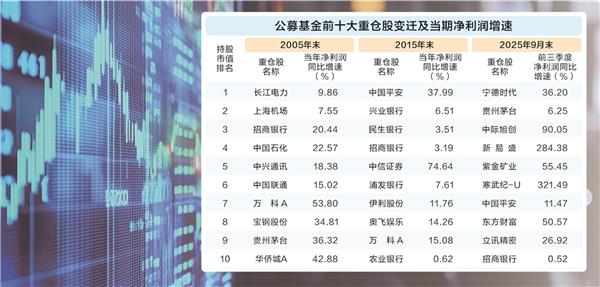
Core Viewpoint - The evolution of public fund heavyweights over 25 years reflects the changing landscape of China's economy, transitioning from industrial to consumer and now to technology-driven sectors [2][9][11] Group 1: Historical Changes in Heavyweight Stocks - From 2000 to 2010, the top heavyweights were dominated by cyclical stocks like steel and finance, mirroring the industrialization and urbanization trends in China [3][10] - Between 2010 and 2020, consumer stocks took the lead, with companies like Kweichow Moutai and Yili showcasing strong and stable profit growth, aligning with rising household incomes and consumption upgrades [4][10] - Since 2020, technology and high-end manufacturing have emerged as the new focus, with companies like CATL leading the charge, reflecting the national strategy of innovation-driven development [5][10] Group 2: Performance Metrics - The net profit growth of heavyweights correlates positively with stock price increases, indicating that strong earnings growth is crucial for long-term investment success [6][10] - For instance, in the first three quarters of 2025, New East's net profit growth reached 284.38%, with its stock price surging by 318.74% [6] Group 3: Valuation Dynamics - The evolution of price-to-earnings ratios and total market capitalization illustrates the market's dynamic re-evaluation of company values, with technology stocks commanding higher valuations due to growth potential [7][10] - For example, Kweichow Moutai's P/E ratio rose from 21.37 in 2005 to 56.3 in 2020, reflecting its brand strength and demand resilience [7] Group 4: Industry Concentration Trends - The concentration of heavyweights has shifted from a focus on a few sectors to a more diversified approach, indicating a strategic move to mitigate risks and seek alpha returns across various industries [8][10] - By 2025, the top heavyweights included a mix of sectors such as electrical equipment, communications, and non-ferrous metals, with CATL leading the technology sector [8] Group 5: Future Outlook - The historical trajectory of public fund holdings reveals a clear alignment with China's economic transformation from industrialization to innovation-driven growth, suggesting that future heavyweight stocks will continue to reflect national strategic directions and industry upgrades [9][11] - The ongoing emphasis on technology and high-end manufacturing indicates that companies aligned with these trends will likely remain favored by public funds [11]




银行业周度追踪2025年第43周:保险资本三季度继续增持银行股-20251103
Changjiang Securities· 2025-11-02 23:30
Investment Rating - The report maintains a "Positive" investment rating for the banking sector [11] Core Insights - The banking index declined by 2.3% this week, underperforming the CSI 300 and ChiNext indices by 1.9% and 2.8% respectively, indicating a high volatility in market risk preference [2][18] - The report highlights the importance of focusing on large bank stocks for dividend allocation as more banks approach mid-term dividend stages [2][9] - The third quarter results showed a slight decline in revenue and profit growth for listed banks, which was in line with expectations, with interest income growth being a key highlight [6][36] Summary by Sections Banking Sector Performance - The banking sector experienced a decline in performance, with individual stocks showing significant variability based on quarterly results [2][9] - Notable outperformers included Standard Chartered Group and Xiamen Bank, while underperformers included Pudong Development Bank due to convertible bond expirations [18] Third Quarter Financial Results - The third quarter results indicated a marginal decline in revenue and profit growth, with state-owned banks showing a recovery trend [6][36] - Interest income growth is a core highlight, with most banks showing a quarter-on-quarter increase in net interest margins, suggesting a clearer turning point [7][36] Insurance Capital Involvement - Insurance capital has accelerated its investment in bank stocks, with significant purchases in Agricultural Bank and Postal Savings Bank [8][36] - Major insurance companies are diversifying their investments into city commercial banks, indicating a growing recognition of quality banks in the Jiangsu and Zhejiang regions [8][36] Market Dynamics - The report notes a shift in market dynamics with increased trading volumes in bank stocks, reflecting a change in short-term market risk preferences [30][32] - The average dividend yield for the six major state-owned banks is reported at 3.89%, with a significant spread of 210 basis points over the 10-year government bond yield [20][23]


招商银行(600036):财富管理加速+资产质量改善+负债成本再下行
Changjiang Securities· 2025-11-02 23:30
Investment Rating - The investment rating for the company is "Buy" and is maintained [9]. Core Views - The company has shown an upward trend in performance with a revenue decline of only 0.5% year-on-year for the first three quarters, while net profit attributable to shareholders increased by 0.5% [2][6]. - Wealth management income has accelerated, growing by 18.8% year-on-year, which has positively impacted the growth of non-interest income [2][6]. - Asset quality has improved, with a non-performing loan (NPL) ratio of 0.94% at the end of Q3, and a provision coverage ratio of 406% [2][6]. Summary by Sections Revenue and Profitability - Revenue for the first three quarters decreased by 0.5% year-on-year, with a Q3 single-quarter revenue growth of 2.1% [6]. - Net profit attributable to shareholders increased by 0.5%, with a Q3 single-quarter growth of 1.0% [6]. - Net interest income grew by 1.7% year-on-year, maintaining positive growth [2][6]. Asset Quality - The NPL ratio at the end of Q3 was 0.94%, a decrease of 1 basis point from the beginning of the year [6]. - The provision coverage ratio was 406%, reflecting a strong buffer against potential losses [6]. - The new NPL generation rate for the core bank improved to 0.96%, nearing levels seen in 2021 [2][6]. Wealth Management and Non-Interest Income - Wealth management income surged by 18.8% year-on-year, contributing to a positive turnaround in non-interest income growth [2][6]. - The net fee income grew by 0.9% year-on-year, marking the end of a 13-quarter decline [2][6]. Cost of Liabilities - The net interest margin for the first three quarters was 1.87%, with a Q3 single-quarter margin of 1.83%, showing a narrowing decline [2][6]. - Deposit costs decreased significantly by 10 basis points to 1.13% in Q3 [2][6]. Loan and Deposit Growth - Total assets grew by 4.0% from the beginning of the year, with loans increasing by 3.6% [2][6]. - Retail loans grew by 1.4%, with specific segments like housing loans and consumer loans showing positive growth [2][6]. Investment Recommendations - The company is viewed as a strong candidate for investment due to its robust growth potential, improved asset quality, and strong wealth management capabilities [2][6]. - Current valuations indicate a price-to-book (PB) ratio of 0.95x for A-shares and 1.02x for H-shares, with a price-to-earnings (PE) ratio of 7.2x for A-shares and 7.8x for H-shares [2][6].
公募重仓股25年进化史赛道在变,穿越牛熊“主心骨”未变
Zheng Quan Shi Bao· 2025-11-02 18:10
Core Insights - The public fund's top ten heavy stocks have undergone structural changes, reflecting the evolution of China's economic transformation over the past 25 years, transitioning from industrial to consumer and now to technology-driven sectors [1][8] - The shift in heavy stock industries indicates a response to China's economic transition, with each phase representing a different investment focus aligned with national strategies [6][8] Heavy Stock Evolution - From 2000 to 2010, the top heavy stocks were dominated by cyclical stocks like steel and finance, mirroring the characteristics of industrialization and urbanization [1][2] - Notable examples include China Unicom and China Merchants Bank, which consistently ranked among the top heavy stocks, highlighting the strong profitability of the banking sector during this period [1][2] - From 2010 to 2020, consumer stocks took over, with Kweichow Moutai becoming a benchmark for the consumer era, reflecting the trend of rising household income and consumption upgrades [2][3] - Since 2020, technology and high-end manufacturing have emerged as the new focus, with CATL surpassing Kweichow Moutai as the top heavy stock, showcasing the advantages of the new energy sector [3][4] Stock Selection Logic - The correlation between net profit growth and stock price increases underscores the importance of fundamentals in stock selection [4][5] - For instance, New East Wisdom's net profit growth of 284.38% led to a stock price surge of 318.74% in 2025, demonstrating the strong relationship between performance and valuation [4][5] - The evolution of price-to-earnings ratios and total market capitalization reflects the market's dynamic re-evaluation of company values, with technology stocks commanding higher valuations due to growth potential [5][6] Industry Concentration Trends - The concentration of heavy stocks has shifted from a focus on cyclical industries to a more diversified approach, indicating a strategic move towards risk management and alpha generation across various sectors [6][8] - The top heavy stocks now encompass a range of sectors, including electrical equipment, communications, and electronics, with a notable decrease in the dominance of any single industry [6][8] Future Outlook - The industry landscape for heavy stocks is expected to continue evolving in line with national strategic directions and industrial upgrades, with technology-driven sectors remaining at the forefront [8] - Companies that align with the pulse of the times are likely to maintain their appeal to public funds, as evidenced by the sustained interest in both traditional and emerging sectors [8]
债市波动 挤压银行投资收益空间
Shang Hai Zheng Quan Bao· 2025-11-02 17:54
Core Viewpoint - The volatility in the bond market and the narrowing net interest margin have pressured the revenue of several listed banks in the first three quarters of this year, leading to a gradual decline in the benefits from the "bond bull" market [1][2] Group 1: Revenue Impact - Many listed banks have faced revenue pressure due to bond market fluctuations and a slowdown in credit expansion, with investment income becoming a crucial support for profits [2][3] - As of the end of Q3 2025, 24 out of 42 listed banks reported a year-on-year decline in non-interest income, and 8 banks saw a drop in net investment income [2] - Notably, China Merchants Bank reported a significant loss of 8.827 billion yuan in fair value changes, with a quarterly loss of 4.008 billion yuan in Q3 alone [2][3] Group 2: Strategies to Mitigate Losses - Some banks have managed to achieve year-on-year growth in investment income by actively selling bonds to lock in floating profits during high market conditions [4] - For instance, China Construction Bank's investment net income increased by 150.55%, while several other banks reported over 70% growth in investment income [4] - The strategy of "selling bonds to realize floating profits" is based on the classification of financial assets, where certain assets can confirm investment income upon sale [4] Group 3: Future Outlook and Adjustments - Analysts suggest that the sustainability of the "selling bonds to supplement profits" strategy will decline as previously accumulated floating profits are exhausted [5] - The People's Bank of China has signaled a return to government bond trading operations, which is expected to enhance monetary policy flexibility and stabilize market expectations [6] - As the bond market enters a low-volatility phase, banks are shifting their investment strategies from relying solely on interest margin gains to enhancing active trading and risk management capabilities [7]



债市波动挤压银行投资收益空间
Shang Hai Zheng Quan Bao· 2025-11-02 17:53
Core Viewpoint - The volatility in the bond market and the narrowing net interest margin have pressured the revenue of several listed banks in the first three quarters of the year, leading to a gradual decline in the benefits from the "bond bull" market [1][2]. Group 1: Revenue Impact - Many listed banks have faced revenue pressure due to bond market fluctuations and a slowdown in credit expansion, with investment income becoming a crucial support for profits [2][3]. - As of the end of Q3 2025, 24 out of 42 listed banks reported a year-on-year decline in non-interest income, and 8 banks saw a drop in net investment income [2]. - Notably, China Merchants Bank reported a loss of 8.827 billion yuan in fair value changes, with a quarterly loss of 4.008 billion yuan in Q3 alone [2][3]. Group 2: Strategies to Mitigate Losses - Some banks have managed to achieve year-on-year growth in investment income by actively selling bonds to lock in profits during high market conditions [4]. - For instance, China Construction Bank's investment net income increased by 150.55%, while several other banks also reported over 70% growth in investment income [4]. - The strategy of "selling bonds to realize floating profits" is based on the classification of financial assets, where certain assets can confirm investment income upon sale [4]. Group 3: Future Outlook and Adjustments - Analysts suggest that the sustainability of the "selling bonds to supplement profits" strategy will decline as previously accumulated floating profits are exhausted [5]. - The People's Bank of China has signaled a return to government bond trading operations, which is expected to enhance monetary policy flexibility and stabilize market expectations [6]. - As the bond market enters a low-volatility phase, banks are shifting their investment strategies from relying solely on interest margin gains to enhancing active trading and risk management capabilities [7].
银行2025年三季报业绩综述:业绩和息差好于预期
ZHESHANG SECURITIES· 2025-11-02 08:59
Investment Rating - The industry rating is maintained as "Positive" [3] Core Views - The performance of listed banks in Q1-Q3 2025 shows resilience, with state-owned banks achieving positive results across the board, and the improvement in net interest margins for joint-stock and city commercial banks exceeding expectations [4] - The revenue growth rate for listed banks is stable at 0.9% year-on-year, while profit growth has increased to 1.6% [4] - The non-interest income growth rate for listed banks has narrowed, with a year-on-year increase of 5.0% [4] Summary by Sections Performance Overview - Listed banks' revenue growth is stable at 0.9%, and net profit growth has improved to 1.6% in Q1-Q3 2025, slightly slowing from H1 [4] - The net interest margin for listed banks has shown marginal improvement, with a quarterly increase of 0.3 basis points to 1.37% [4] Revenue and Profit Drivers - The asset scale growth for listed banks is 9.3% year-on-year, with a decrease in loan growth to 7.7% and an increase in financial investment growth to 15.8% [4][11] - The non-interest income growth rate has decreased by 2.0 percentage points compared to the previous quarter [4] Risk and Asset Quality - The average non-performing loan (NPL) ratio for 42 sample banks remains stable at 1.23%, while the average attention rate has increased by 2 basis points to 1.69% [5] - Retail loan risks continue to rise, with notable increases in NPL ratios for retail loans at certain banks [5] Dividend Trends - More banks have disclosed mid-term dividend plans for 2025, with some banks increasing their mid-term dividend rates compared to 2024 [6] Investment Recommendations - The report suggests that bank stocks may rebound in Q4, with a focus on small and medium-sized banks in economically developed regions and stable high-dividend large banks [6]


汇金、证金持仓动向揭秘
财联社· 2025-11-02 02:19
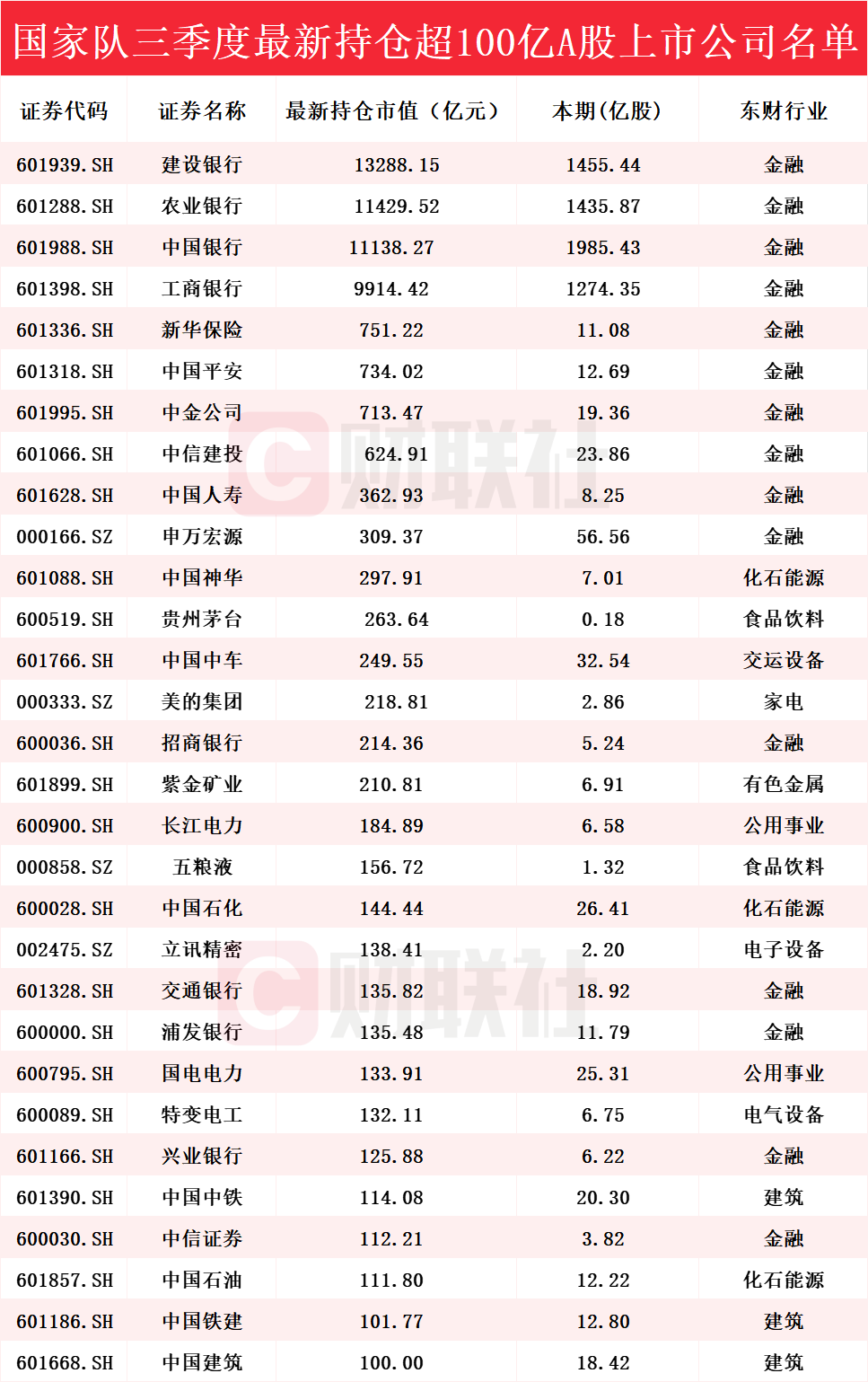
Core Viewpoint - The latest holdings of the "national team" in A-share listed companies have been revealed, with significant investments in major financial institutions and other sectors, indicating a strategic focus on stability and growth in the market [1][2]. Group 1: National Team Holdings - A total of 233 A-share listed companies have the "national team" (China Securities Finance Corporation and Central Huijin) among their top ten shareholders [1]. - There are 30 stocks with a holding value exceeding 10 billion yuan, including major banks like China Construction Bank, Agricultural Bank of China, and Bank of China, with holdings valued at 1.3288 trillion yuan, 1.1429 trillion yuan, and 1.1138 trillion yuan respectively [1][2]. - The top holdings also include companies from various sectors such as insurance, food and beverage, and energy, showcasing a diversified investment strategy [1][2]. Group 2: New Additions and Performance - Farah Electronics has been newly added to the "national team" holdings, with a market value of 158 million yuan [3]. - For the third quarter, Farah Electronics reported a revenue of 3.944 billion yuan, a year-on-year increase of 14.69%, and a net profit of 888 million yuan, also up by 14.58% [3]. - The company’s capacitor products are utilized in ultra-high voltage transmission applications, indicating a focus on high-demand technology sectors [3].




“国家队”持仓动向揭秘!Q3持仓超100亿A股上市公司名单一览
Xin Lang Cai Jing· 2025-11-02 00:45
Core Insights - The latest holdings of the "national team" in A-share listed companies have been revealed, with 233 companies having the "national team" as one of their top ten shareholders [1][2] - In the third quarter, the "national team" held over 10 billion yuan in market value in 30 stocks, including major banks and insurance companies [1] Group 1: Major Holdings - The top three holdings by market value are: - China Construction Bank: 13,288.15 billion yuan - Agricultural Bank of China: 11,429.52 billion yuan - Bank of China: 11,138.27 billion yuan [1] - Other significant holdings include: - Industrial and Commercial Bank of China: 9,914.42 billion yuan - New China Life Insurance: 751.22 billion yuan - Ping An Insurance: 734.02 billion yuan [1][2] Group 2: New Additions - Farah Electronics is a new addition to the "national team" holdings, with a market value of 1.58 billion yuan [2] - The company reported a revenue of 3.944 billion yuan for the first three quarters, a year-on-year increase of 14.69%, and a net profit of 888 million yuan, also up 14.58% [2] - In the third quarter alone, Farah Electronics achieved a revenue of 1.445 billion yuan, reflecting a year-on-year growth of 9.31% [2]