CM BANK(600036)

Search documents
2026首份银行增持公告来了!顶流银行ETF(512800)上探1%,机构:历次春节前银行胜率最高,值得重视
Xin Lang Cai Jing· 2026-01-13 11:44
Core Viewpoint - The banking sector shows resilience with significant stock price increases, driven by executive buybacks and insurance capital inflows, indicating strong confidence in the sector's fundamentals and long-term value [3][12]. Group 1: Market Performance - On January 13, the market experienced a pullback, but the banking sector remained active, with notable gains: Ningbo Bank up over 4%, Hangzhou Bank up over 3%, and several others including CITIC Bank and Chongqing Rural Commercial Bank up over 2% [1][9]. - The top-tier banking ETF (512800) saw an intraday price increase of over 1%, closing up 0.37% and surpassing the 5-day moving average [1][10]. Group 2: Executive Buybacks - The first executive buyback announcement of 2026 was made by Chongqing Rural Commercial Bank, where some directors and executives purchased 192,000 shares from the secondary market, with a maximum investment of 1.23 million yuan [3][12]. - Nanjing Bank reported that its major shareholder, Zijin Group, increased its stake by 123,472,060 shares, representing 1.00% of the total share capital, continuing from previous increases since September 2025 [3][12]. Group 3: Insurance Capital Inflows - Insurance capital has been actively purchasing bank stocks, with Ping An Life announcing it reached a 20% stake in China Merchants Bank H-shares, triggering a mandatory bid [3][12]. - In 2025, insurance capital made 41 stake increases, the highest in nearly a decade, with bank stocks accounting for about 40% of these actions, highlighting their dominance in this area [3][12]. Group 4: Seasonal Trends - Historically, the banking sector has performed well before the Spring Festival, with the Shenwan Banking Index showing over 80% win rate in the past decade, except for 2020 [4][16]. - The average absolute return of the Shenwan Banking Index before the Spring Festival is 4.4%, with an average excess return of 4.9% compared to the Shanghai Composite Index, making it the highest among 31 industry indices [4][16]. Group 5: Future Outlook - Factors expected to drive the banking sector's performance leading up to the Spring Festival in 2026 include continued growth policies, ongoing insurance asset scarcity, and increased market volatility [7][16]. - The banking ETF (512800) is noted for its efficiency in tracking the banking sector, with a current scale of 11.95 billion yuan and an average daily trading volume exceeding 800 million yuan since 2025, making it the largest and most liquid banking ETF in A-shares [7][16].






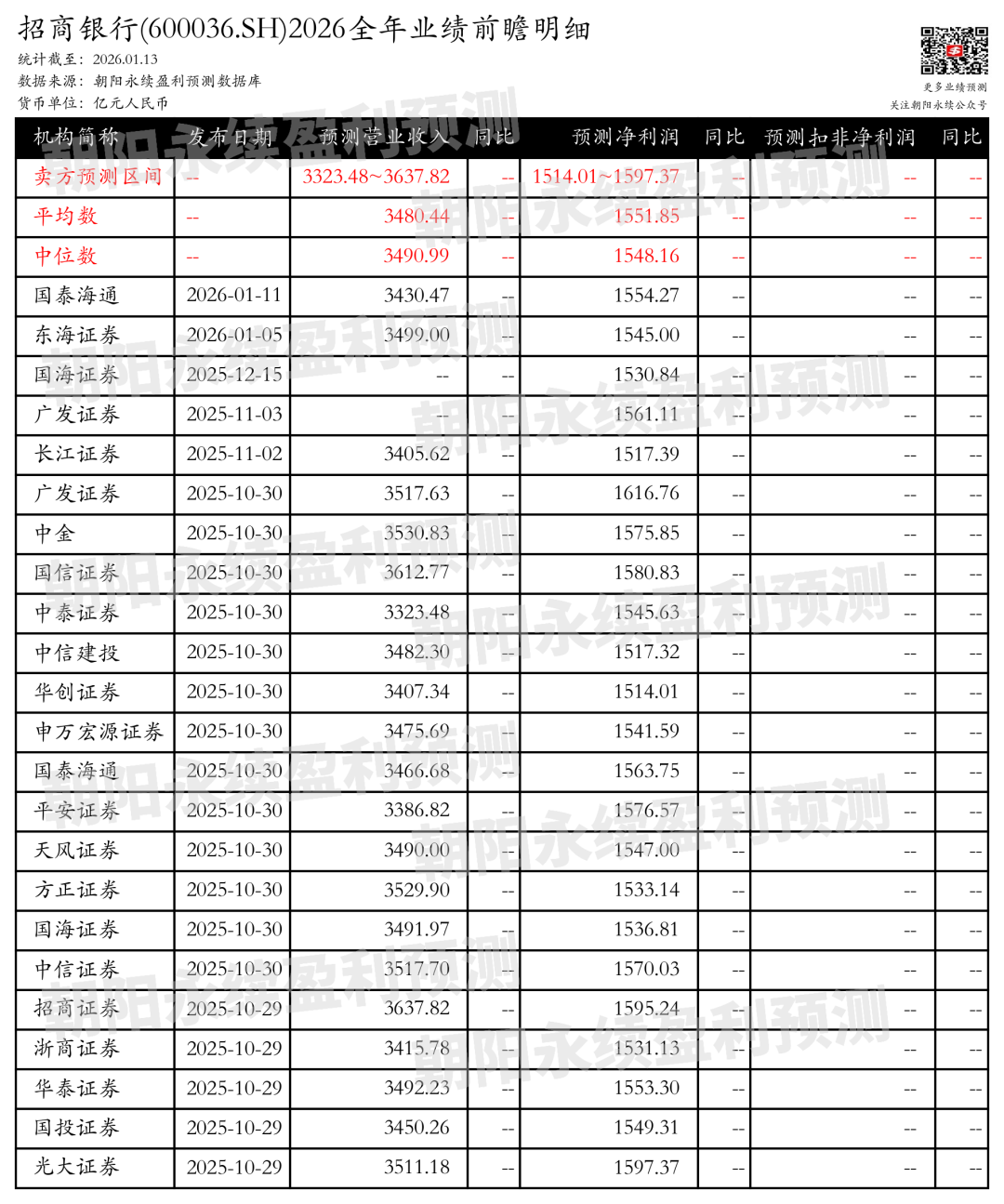
招商银行:稳健经营,业绩增长,预测全年营业收入3323.48~3637.82亿元
Xin Lang Cai Jing· 2026-01-13 11:33
Core Viewpoint - The expected annual performance of China Merchants Bank is projected to show steady growth in revenue and net profit, with revenue forecasted between 332.35 billion to 363.78 billion yuan and net profit between 151.40 billion to 159.74 billion yuan by January 13, 2026 [1][5]. Revenue and Profit Forecast - The revenue forecast range is 3323.48 to 3637.82 million yuan, with an average estimate of 3480.44 million yuan and a median of 3490.99 million yuan [2][6]. - The net profit forecast range is 1514.01 to 1597.37 million yuan, with an average estimate of 1551.85 million yuan and a median of 1548.16 million yuan [2][6]. Business Performance Insights - China Merchants Bank maintains a leading advantage in the industry during a downturn, with stable key operating indicators, high ROE, and dividend yield [3][7]. - The bank's growth rate is moderating, with a prudent expansion of the balance sheet and optimization of retail, corporate, and financial investment ratios [3][7]. - The absolute advantage in net interest margin is solid, with expectations that the downward pressure will ease in 2026 [3][7]. Asset Quality Management - The bank has adequately exposed risks in corporate real estate, and the slope of rising retail risks is expected to slow down [3][8]. - The core revenue capacity and provision coverage ratio provide ample space for write-offs and disposals [3][8]. Intermediate Business Development - After experiencing a bottoming out, the wealth management business is expected to return to being a core revenue driver, with non-interest business elasticity significantly exceeding that of peers [3][9]. Shareholder Returns - The bank's dividend payout ratio remains among the top tier in the industry, with strong internal capital generation capabilities and competitive dividend yields [3][10].

招商银行今日大宗交易平价成交19万股,成交额781.47万元
Xin Lang Cai Jing· 2026-01-13 09:42
1月13日,招商银行大宗交易成交19万股,成交额781.47万元,占当日总成交额的0.16%,成交价41.13 元,较市场收盘价41.13元持平。 | 交易日期 | 证券简称 | 证券代码 | 成交价(元) 成交金额[万元) 成交量(*) 买入营业部 | | 卖出营业部 | 是否为专场 | | --- | --- | --- | --- | --- | --- | --- | | 026-01-13 | 招商银行 | 600036 41.13 | 781.47 19 | 合肥管家材料 | 公費居家居居 | ка | ...

4.65亿元主力资金今日抢筹银行板块
Zheng Quan Shi Bao Wang· 2026-01-13 08:59
Market Overview - The Shanghai Composite Index fell by 0.64% on January 13, with six industries experiencing gains, led by the oil and petrochemical sector at 1.62% and the pharmaceutical and biotechnology sector at 1.21% [1] - The banking sector rose by 0.65% [1] - The defense and military industry and electronics sector saw the largest declines, at 5.50% and 3.30% respectively [1] Capital Flow - The net outflow of capital from the two markets was 162.743 billion yuan, with only four industries seeing net inflows [1] - The pharmaceutical and biotechnology sector had the highest net inflow of 4.348 billion yuan, followed by the oil and petrochemical sector with a net inflow of 586 million yuan [1] - The electronics sector experienced the largest net outflow, totaling 37.010 billion yuan, followed by the computer industry with a net outflow of 23.107 billion yuan [1] Banking Sector Performance - The banking sector had a net inflow of 465 million yuan, with 32 out of 42 stocks rising [2] - Agricultural Bank led the net inflow with 203 million yuan, followed by Industrial and Commercial Bank with 177 million yuan and Ping An Bank with 135 million yuan [2] - Major stocks with significant net outflows included China Merchants Bank, Nanjing Bank, and Bank of China, with outflows of 598 million yuan, 43.3815 million yuan, and 36.6624 million yuan respectively [2] Individual Bank Performance - Agricultural Bank increased by 1.20% with a turnover rate of 0.15% and a main capital flow of 202.928 million yuan [3] - Industrial and Commercial Bank rose by 0.90% with a turnover rate of 0.14% and a main capital flow of 176.699 million yuan [3] - Ping An Bank saw a slight decrease of 0.09% with a main capital flow of 134.859 million yuan [3] - Other notable performers included Ningbo Bank with a 4.24% increase and a main capital flow of 102.158 million yuan [3] Additional Banking Data - Jiangsu Bank increased by 0.95% with a main capital flow of 115.957 million yuan [4] - Xiamen Bank experienced a decrease of 0.69% with a negative capital flow of -146.21 thousand yuan [4] - China Merchants Bank had a minimal increase of 0.02% but a significant negative capital flow of -59.814 million yuan [4]





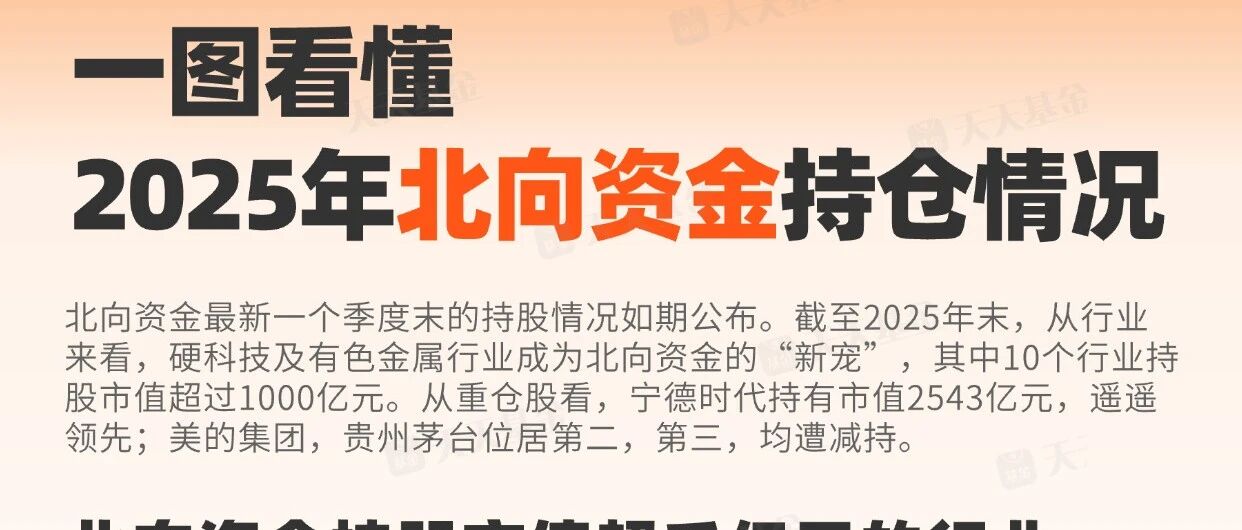
“聪明钱”持仓披露 这十大行业持股市值超千亿
天天基金网· 2026-01-13 08:47
Core Viewpoint - As of the end of 2025, the northbound capital has shifted its focus towards hard technology and non-ferrous metals industries, with ten industries having a market value of over 100 billion yuan [1][7]. Industry Summary - The top three industries by market value held by northbound capital at the end of 2025 are: - Power Equipment: 449.5 billion yuan, a 60.04% increase from 2024 [3][7]. - Electronics: 387 billion yuan, an 85.02% increase from 2024 [3][7]. - Non-ferrous Metals: 185.6 billion yuan, a 173.04% increase from 2024 [3][7]. - Other industries with significant holdings include: - Banking: 217.6 billion yuan, a 56.45% increase [3]. - Machinery: 98.6 billion yuan, a decrease of 3.49% [3]. - Pharmaceuticals: 148.2 billion yuan, a decrease of 35.52% [4]. Major Holdings - The top ten stocks held by northbound capital at the end of 2025 include: - Ningde Times: 254.3 billion yuan, a 76.57% increase [5][8]. - Midea Group: 77 billion yuan, a decrease of 7.99% [5][8]. - Kweichow Moutai: 75.8 billion yuan, a decrease of 35.82% [5][8]. - China Merchants Bank: 51.4 billion yuan, a 2.92% increase [5][8]. - Zijin Mining: 47.1 billion yuan, a 120.18% increase [5][8]. - Notable changes in the top ten include: - Northern Huachuang, Zhongji Xuchuang, and Lixun Precision entering the list, while Longjiang Power, Mindray Medical, and BYD dropped out [8].





“天量存款”即将到期 利率持续低位资金会否搬入股市?
Xin Jing Bao· 2026-01-13 07:08
Core Viewpoint - The article highlights a trend of declining deposit interest rates among banks in China, particularly as the new year begins, with many banks entering a "1 era" for their rates, indicating a significant drop in returns for savers [1][2][3]. Group 1: Deposit Rate Changes - Anhui Xin'an Bank has lowered its 2-year fixed deposit rate by 10 basis points to 2.25% starting January 16 [1]. - Several local banks, including Suzhou Commercial Bank and Puyang Zhongyuan Village Bank, have also reduced their deposit rates, with some products now offering rates as low as 1.9% for 3-year deposits [2]. - Major state-owned banks like ICBC and CCB are offering 1-year fixed deposit rates at 1.1%, while some joint-stock banks have slightly higher rates, with CITIC Bank and GF Bank offering 1.3% for 1-year deposits [3]. Group 2: Impact on Large Certificates of Deposit - The attractiveness of large certificates of deposit (CDs) has diminished, with 3-year CDs nearly extinct and 1-year CDs offering rates only marginally higher than regular fixed deposits [4][5]. - Many banks are now issuing new large CDs with rates in the "1 era," and some short-term large CDs have even dropped below 1% [5]. Group 3: Upcoming Expiration of Deposits - A significant volume of fixed deposits is set to mature in 2026, with estimates suggesting around 75 trillion yuan will be due, marking a 12% increase from 2025 [6]. - The first quarter of this year is critical as approximately 29 trillion yuan of 1-year and longer deposits will mature, representing a 4 trillion yuan increase compared to the same period in 2025 [6]. Group 4: "Deposit Migration" Trends - The trend of "deposit migration" is expected to continue, with funds potentially moving from large banks to smaller ones and then into various asset management products [7]. - Analysts suggest that while the current low-interest environment is prompting asset reallocation, the overall risk appetite among residents remains cautious, with consumption and debt repayment being primary uses for maturing deposits [7].



本周又有银行将派发“红包雨”,银行ETF天弘(515290)跟踪指数盘中涨超1%,机构:银行基本面筑底改善
Sou Hu Cai Jing· 2026-01-13 06:15
Group 1 - The A-share banking sector remains active, with the China Securities Banking Index rising over 1% during the afternoon session on January 13, 2023, driven by significant gains in stocks such as Agricultural Bank of China, Hangzhou Bank, Chongqing Rural Commercial Bank, CITIC Bank, and Nanjing Bank [1] - The Tianhong Bank ETF (515290) has seen a trading volume exceeding 38 million yuan, indicating premium trading activity, and it encompasses 42 listed banks in A-shares, covering the entire spectrum of state-owned banks, joint-stock banks, and city commercial banks [1] - The People's Bank of China emphasized key priorities for 2026, including strict governance, effective implementation of moderately loose monetary policy, financial reform, and risk prevention [1] Group 2 - Following the recent dividend distributions, including Postal Savings Bank on January 12, Jiangsu Bank and China Merchants Bank are set to distribute dividends on January 14 and January 16, respectively, with Jiangsu Bank offering 0.3309 yuan per share (totaling 6.072 billion yuan) and China Merchants Bank offering 1.013 yuan per share (totaling approximately 20.897 billion yuan) [2] - Over half of the 42 listed banks in A-shares have implemented mid-term dividends for 2025, signaling robust profitability in the banking sector [2] - Analysts from Zheshang Securities anticipate a return to positive growth in net interest income for banks, while Longjiang Securities projects stable earnings growth for mainstream banks in 2026, highlighting the increased attractiveness of the PB-ROE valuation post-recent adjustments [2]



200万元、叠加补贴最低2%!消费贷利率低位运行
Zhong Guo Jing Ying Bao· 2026-01-13 06:04
Core Viewpoint - In January 2026, consumer loan products are being offered at historically low annual interest rates, with some banks providing rates as low as 2.00% when subsidies are applied, and loan amounts reaching up to 2 million yuan [1][4]. Group 1: Consumer Loan Products - Several banks have introduced promotional policies for consumer loans in January 2026, with one bank announcing a maximum loan amount of 2 million yuan and a minimum annual interest rate of 3.00% [2]. - A city commercial bank has set a minimum interest rate of 3.00% for new customers, with a maximum loan amount of 300,000 yuan, and interest rates ranging from 3.00% to 19.80% based on actual approval results [2][3]. - The minimum annual interest rate for consumer loans is currently at 3.00%, which is the lowest level mandated by regulatory requirements, down from a previous low of 2.60% [2][3]. Group 2: Subsidy Policies - With the addition of consumer loan subsidies, the effective annual interest rate can be reduced to as low as 2.00%, although the subsidy process requires specific conditions such as having a consumption scenario and relevant documentation [4]. - The Chinese government is continuing its consumer loan subsidy policies into 2026, as outlined in a recent State Council meeting aimed at promoting domestic demand through coordinated fiscal and financial policies [4]. - The subsidy policy includes a 1% annual interest rate subsidy for loans under 50,000 yuan and up to 50% of the loan contract interest rate for larger loans in key consumption areas such as home appliances, education, and healthcare [4].


这两家银行即将派发红包!过半A股上市银行已实施中期分红
Nan Fang Du Shi Bao· 2026-01-13 05:31
Core Viewpoint - Several banks are distributing cash dividends, indicating a stable profitability in the banking sector and providing tangible returns to shareholders [2][3][4]. Group 1: Dividend Distribution - Postal Savings Bank distributed a cash dividend of 0.1230 yuan per share, totaling 12.33 billion yuan [3]. - Jiangsu Bank plans to distribute a cash dividend of 0.3309 yuan per share, amounting to 6.07 billion yuan [2][3]. - China Merchants Bank intends to distribute a cash dividend of 1.013 yuan per share, totaling approximately 20.90 billion yuan [2][3]. Group 2: Overall Banking Sector Performance - As of January 13, over half of the 42 listed A-share banks have implemented mid-term dividends for 2025, with 31 banks announcing such distributions, an increase of 7 banks compared to 2024 [4][5]. - The total proposed dividend amount for these banks is 276.49 billion yuan, reflecting a growth of 7.05% compared to 2024 [4]. Group 3: Dividend Yields - The dividend yields for the banks are as follows: Postal Savings Bank at 2.30%, Jiangsu Bank at 3.15%, and China Merchants Bank at 2.46% based on their respective closing prices [3]. Group 4: Future Dividend Plans - Huaxia Bank has announced a profit distribution plan with a cash dividend of 1.00 yuan per 10 shares, totaling 1.59 billion yuan, pending a shareholder meeting [7]. - Industrial Bank plans to hold a shareholder meeting on January 20 to review its mid-term profit distribution proposal, which includes a cash dividend of 5.65 yuan per 10 shares, totaling 11.96 billion yuan [7].

银行业 2026 年经营展望:资产负债篇:到期存款流向是资负格局的关键
Guoxin Securities Hongkong· 2026-01-13 05:12
Investment Rating - The report maintains an "Outperform" rating for the banking sector [6] Core Insights - The expected M2 growth rate for 2026 is approximately 7.5%, with credit growth around 6.0% and social financing growth at about 8.0%. This aligns with the goal of stabilizing economic growth and ensuring reasonable price recovery [2][18][19] - The banking sector is expected to see a structural differentiation in retail credit, with corporate lending remaining the primary contributor to new loans, accounting for approximately 80% to 85% of new loans [33][37] - The report highlights the importance of deposit flows, particularly the trend of deposits moving from large banks to smaller banks, which will influence the asset-liability gap for large banks in 2026 [3][41] Summary by Sections M2 and Credit Growth - The M2 increment for 2026 is estimated at about 25.4 trillion yuan, with fiscal net injection contributing approximately 12.0 trillion yuan and bank credit (including write-offs and ABS) contributing around 16.8 trillion yuan [2][29][24] - The anticipated new social financing for 2026 is about 35.3 trillion yuan, reflecting a growth rate of approximately 8.0% [30][32] Credit Allocation - Corporate lending is expected to remain strong, while retail lending will show structural improvements, contributing about 10% to 15% of new loans [33][37] - The report notes that retail credit is likely to experience a slight positive growth, particularly in quality consumption scenarios and personal operating loans [33][37] Asset-Liability Dynamics - The asset-liability gap for large banks is projected to continue, with marginal changes primarily driven by the liability side, influenced by deposit flows [3][41] - The report estimates that the maturity of fixed-term deposits for the six major banks in 2026 will be around 57 trillion yuan, with 2-year and longer-term deposits accounting for 27 to 32 trillion yuan [49][52] Investment Recommendations - The report recommends focusing on high-quality stocks with improving fundamentals, specifically highlighting Ningbo Bank and Changshu Bank, while also suggesting attention to Changsha Bank and Chongqing Rural Commercial Bank for potential excess returns [4] - Additionally, it emphasizes the value of stable, high-dividend stocks, recommending China Merchants Bank, Industrial and Commercial Bank of China, and Jiangsu Bank [4]