Hisense V.T.(600060)
Search documents
海信视像(600060) - 海信视像:关于为子公司提供担保的进展公告
2025-10-29 09:30
证券代码:600060 证券简称:海信视像 公告编号:2025-047 海信视像科技股份有限公司 关于为子公司提供担保的进展公告 本公司董事会及全体董事保证本公告内容不存在任何虚假记载、误导性陈述 或者重大遗漏,并对其内容的真实性、准确性和完整性承担法律责任。 重要内容提示: 担保对象及基本情况 | | 厦门乾照光电科技有限公司(以下简称"乾照科 | | --- | --- | | 被担保人名称 | 技")、扬州乾照光电有限公司(以下简称"扬 | | | 州乾照")、江西乾照半导体科技有限公司(以 | | | 下简称"乾照半导体") | | 被担保人关联关系 | | | | 乾照科技、扬州乾照、乾照半导体均为海信视像 科技股份有限公司(以下简称"公司")控股子 | | | 公司厦门乾照光电股份有限公司(以下简称"乾 | | | 照光电")的全资子公司 (1)本次乾照光电为乾照科技提供 1 项最高额 | | | 保证担保,被担保的主债权本金余额在债权确定 期间内最高不超过人民币 8,000 万元;(2)本 | | 担保对象 | 次乾照光电为扬州乾照提供 1 项最高额保证担 | | 本次担保金额 | 保,被担保的 ...
海信视像(600060) - 海信视像:第十届董事会第十八次会议决议公告
2025-10-29 09:28
本公司董事会及全体董事保证本公告内容不存在任何虚假记载、误导性陈 述或者重大遗漏,并对其内容的真实性、准确性和完整性承担法律责任。 一、董事会会议召开情况 海信视像科技股份有限公司(以下简称"公司")第十届董事会第十八次会 议(以下简称"会议"或"本次会议")于2025年10月29日以通讯方式召开。本 次会议由董事长于芝涛先生召集并主持,应出席董事8人,实际出席董事8人。 会议的召集和召开符合《中华人民共和国公司法》《海信视像科技股份有限公司 章程》等法律法规及相关文件的规定,形成的决议合法、有效。 二、董事会会议审议情况 (一)审议通过了《关于公司 2025 年第三季度报告的议案》 证券代码:600060 证券简称:海信视像 公告编号: 2025-045 海信视像科技股份有限公司 第十届董事会第十八次会议决议公告 (二)审议通过了《关于同一控制下企业合并追溯调整财务数据的议案》 公司本次按照同一控制下企业合并的相关规定,对 2024 年 1-9 月合并利润 表、2024 年 1-9 月合并现金流量表相关财务数据进行追溯调整,符合相关法律、 法规以及《企业会计准则》等的相关规定,追溯调整后的财务报表客观、真实 ...
海信视像(600060) - 2025 Q3 - 季度财报
2025-10-29 09:20
Financial Performance - The company's operating revenue for Q3 2025 reached ¥15.60 billion, a 2.70% increase compared to ¥15.19 billion in the same period last year[4]. - The net profit attributable to shareholders was ¥572.78 million, reflecting a 20.15% increase from ¥476.32 million year-over-year[4]. - The total profit for the period was ¥778.52 million, marking a significant increase of 34.83% compared to ¥577.02 million in the previous year[4]. - The company reported a 6.71% increase in main business revenue, totaling ¥15.07 billion compared to ¥14.12 billion in the same period last year[4]. - Total operating revenue for the first three quarters of 2025 reached CNY 42.83 billion, an increase of 5.37% compared to CNY 40.65 billion in the same period of 2024[18]. - Net profit for the first three quarters of 2025 was CNY 1.90 billion, representing a 21.77% increase from CNY 1.56 billion in 2024[18]. - Earnings per share for the first three quarters of 2025 were CNY 1.254, compared to CNY 1.011 in the same period of 2024, reflecting a growth of 24.06%[19]. - The company reported a comprehensive income total of CNY 1.99 billion for the first three quarters of 2025, compared to CNY 1.53 billion in 2024, reflecting overall growth[19]. Cash Flow - The net cash flow from operating activities was ¥1.63 billion, a decrease of 6.28% from ¥1.74 billion in the same quarter last year[4]. - The net cash flow from operating activities increased to ¥3,430,653,940.32, up from ¥2,950,742,202.99, representing a growth of approximately 16.2% year-over-year[21]. - Total cash inflow from operating activities was ¥47,960,776,509.46, compared to ¥44,305,466,342.43 in the previous period, indicating an increase of about 6.0%[21]. - Cash outflow from investing activities totaled ¥17,478,928,701.25, down from ¥19,305,622,558.68, reflecting a decrease of approximately 9.5%[21]. - The net cash flow from investing activities was negative at -¥2,034,601,207.04, compared to a positive ¥145,401,776.30 in the previous period[21]. - Cash inflow from financing activities decreased to ¥1,543,269,190.79 from ¥1,784,602,996.72, a decline of about 13.5%[21]. - The net cash flow from financing activities was -¥1,318,583,172.64, improving from -¥2,906,762,051.88 year-over-year[21]. - Cash received from operating activities related to other business activities was ¥620,294,638.68, up from ¥479,625,442.28, an increase of about 29.4%[21]. Assets and Liabilities - The company's total assets decreased by 3.11% to ¥45.29 billion from ¥46.66 billion at the end of the previous year[5]. - The total current assets as of September 30, 2025, amount to ¥35,657,220,553.09, a decrease from ¥36,986,117,879.46 as of December 31, 2024[14]. - The company's cash and cash equivalents are reported at ¥2,358,798,017.66, down from ¥2,685,963,882.75 in the previous period[14]. - Total liabilities amount to ¥26,000,000,000, with short-term borrowings at ¥773,920,766.81, up from ¥682,667,537.55[15]. - The total liabilities decreased to CNY 19.15 billion in 2025 from CNY 21.66 billion in 2024, showing a reduction in financial leverage[18]. - The total equity attributable to shareholders increased to CNY 20.44 billion in 2025 from CNY 19.67 billion in 2024, indicating a strengthening of the company's financial position[18]. Shareholder Information - Hisense Group Holdings Co., Ltd. holds 392,505,971 shares, representing 30.08% of total shares[12]. - The company has no pledged, marked, or frozen shares among its top shareholders[12]. - The company does not have any significant changes in the participation of major shareholders in margin trading and securities lending[13]. Expenses - Research and development expenses for the first three quarters of 2025 totaled CNY 1.77 billion, slightly up from CNY 1.71 billion in 2024[18]. - Financial expenses decreased to CNY 27.02 million in 2025 from CNY 60.23 million in 2024, indicating improved cost management[18]. - Cash paid for purchasing goods and services was ¥36,974,700,702.15, compared to ¥34,264,276,454.45, reflecting an increase of approximately 7.9%[21].
海信视像:第三季度净利润5.73亿元,同比增长20.15%
Xin Lang Cai Jing· 2025-10-29 08:33
Core Insights - Hisense Visual reported a third-quarter revenue of 15.066 billion yuan, representing a year-on-year increase of 6.71% [1] - The net profit for the third quarter was 573 million yuan, showing a year-on-year growth of 20.15% [1] - For the first three quarters, the total revenue reached 39.989 billion yuan, with a year-on-year increase of 5.65% [1] - The net profit for the first three quarters was 1.629 billion yuan, reflecting a year-on-year growth of 24.27% [1]
泰国,正被中国家电企业“挤爆”
3 6 Ke· 2025-10-28 08:10
Group 1: Overview of Manufacturing Developments in Thailand - The Haier air conditioning industrial park in Chonburi, Thailand, officially commenced production on September 23, with an annual planned capacity of 6 million units [1] - Hisense's HHA smart manufacturing industrial park is set to be completed by 2030, with an expected annual production capacity of 2.6 million units [1] - The Thai Investment Promotion Committee approved a 3 billion THB investment for Oma's refrigerator production base, aiming for an annual output of 1.7 million units primarily for the European market [1] Group 2: Chinese Automotive Industry Expansion - Chinese automotive brands have significantly increased their presence in Thailand, with companies like BYD, Changan, and Foton embedding deeply into the local automotive supply chain [2] - In 2024, Thailand is projected to be the fourth largest export market for China's new energy vehicles, with exports expected to reach 178,000 units, a 35% increase year-on-year [2] - By the end of 2024, seven Chinese car manufacturers will have established operations in Thailand, achieving a full cycle from planning to production and sales [2] Group 3: Thailand's Strategic Advantages - Thailand's geographical location and political stability make it an attractive manufacturing hub, connecting to major Southeast Asian markets [4] - The rise of Laem Chabang Port as Southeast Asia's second-largest container port enhances Thailand's manufacturing competitiveness by facilitating international trade [4] - Labor costs in Thailand are lower than in China, with the minimum monthly wage in Thailand being approximately 77% of that in China, making it appealing for foreign investment [4] Group 4: Market Dynamics and Consumer Demand - Thailand's automotive production accounts for 45% of ASEAN's total, positioning it as a key player in the Southeast Asian automotive industry [6] - The local production model has allowed Chinese car manufacturers to rapidly capture market share, especially in the electric vehicle segment [6] - The demand for home appliances in Southeast Asia is growing, with a projected annual growth rate of 5%-10% in the region's appliance market [8][9] Group 5: Chinese Home Appliance Industry Trends - The influx of Japanese home appliance companies into Thailand has inspired Chinese firms to follow suit, capitalizing on the growing demand for appliances [8] - Thailand is now the largest white goods manufacturing country in Southeast Asia, benefiting from the restructuring of the global white goods manufacturing industry [9] - Trade agreements like RCEP and favorable local policies have further incentivized Chinese appliance manufacturers to establish production facilities in Thailand [12][14] Group 6: Evolution of Chinese Manufacturing Strategy - The evolution of Chinese manufacturing overseas can be categorized into three phases: product export, brand export, and capability export [15] - Chinese companies are increasingly focusing on localizing their operations, including R&D and marketing, to better meet local consumer needs [16] - The market share of Chinese brands in Thailand's appliance sector has grown significantly, with Chinese brands capturing two spots in the top five air conditioning brands by 2024 [17] Group 7: Long-term Implications of Manufacturing Shifts - The successful "Thailand model" in the automotive sector is likely to influence other industries, including consumer electronics and renewable energy equipment [18] - The ongoing migration of manufacturing capabilities from China to Southeast Asia is part of a broader trend of global supply chain restructuring [19] - Thailand is positioned as a critical hub for Chinese manufacturing expansion, with the potential for continued growth and investment in the region [19]
谁才是“洗衣全能王”?中消协发布25款洗衣机测评结果
Bei Jing Shang Bao· 2025-10-28 06:49
Core Insights - The article discusses a comparative test conducted by the China Consumers Association and the Hangzhou Consumer Rights Protection Committee on various washing machines to guide consumers in making informed choices regarding energy-efficient appliances [1] Group 1: Test Overview - A total of 25 washing machines were tested, including 16 drum-type and 9 pulsator-type models from 21 different brands [1] - The testing focused on three main performance areas: usage performance, health and safety performance, and ease of use [1] Group 2: Performance Results - Most samples performed well in terms of energy consumption, cleaning effectiveness, noise during dehydration, and antibacterial performance (for drum-type machines) [1] - Significant differences were noted in the effective volume of washing drums, with some pulsator-type machines showing subpar drum cleaning performance [1] Group 3: Specific Findings - The effective volume of washing drums indicates the internal space available for washing; higher values allow for more laundry [2] - The best-performing drum-type machines had effective volumes of at least 66L, while the best pulsator-type machines had volumes of at least 70L [2] - Seven models demonstrated low energy consumption while achieving high cleaning ratios, indicating superior energy efficiency [2] Group 4: Cleaning and Wear Performance - The cleaning performance was assessed using liquid detergents, with over 50% of drum-type machines achieving a cleaning ratio of at least 1.10 [3] - The wear performance showed that some machines caused minimal damage to fabrics while maintaining high cleaning ratios [3] - Drum-type machines generally outperformed pulsator types in oil stain removal due to their heating capabilities [4] Group 5: Antibacterial Performance - Drum-type washing machines exhibited high antibacterial rates, with most achieving rates of 99.99% or higher [5] Group 6: Consumer Guidance - The China Consumers Association recommends consumers consider four key aspects when purchasing washing machines: capacity, energy efficiency, cleaning performance for specific stains, and noise levels during dehydration [6][7]
从三个数字看山东消费“账本”
Sou Hu Cai Jing· 2025-10-28 02:22
Core Insights - Shandong's economy shows resilience with a 5.6% year-on-year growth in total retail sales of consumer goods, outperforming the national average by 1.1 percentage points [3][4] - The province has hosted over 6,000 promotional activities, generating nearly 80 billion yuan in sales, indicating a strong consumer engagement [5][6] - The implementation of the old-for-new subsidy policy has led to significant sales boosts, with 160 billion yuan disbursed, driving an estimated 168 billion yuan in additional sales [7][8] Economic Performance - Total retail sales in Shandong reached 30,386.1 billion yuan in the first three quarters, reflecting a steady growth trajectory [3] - The retail sales growth rate for Shandong's key monitored sectors, including wholesale, retail, accommodation, and catering, was 5.6%, 11.7%, 5.6%, and 10.7% respectively [5] Consumer Trends - The number of online retail stores in Shandong has reached 1.958 million, with a year-on-year growth of 17.1% in physical goods sold online [9] - The shift towards smart and digital products is evident, with significant year-on-year growth in sales of new energy vehicles (25.6%), smart home appliances (44.3%), and wearable devices (116.9%) [7][8] Emerging Retail Models - Instant retail is gaining traction, with major e-commerce platforms actively participating in this market, which is projected to exceed 2 trillion yuan by 2030 [9][10] - Local supermarkets in cities like Zibo and Jinan are expanding their instant retail offerings, enhancing consumer convenience and accessibility [9][10] Policy and Market Opportunities - The old-for-new policy is seen as a catalyst for stimulating consumer demand, particularly in the context of Shandong's manufacturing strengths in smart products [8] - Experts suggest that Shandong should leverage its traditional industries to capitalize on the growth of instant retail and e-commerce, aiming to cultivate influential e-commerce enterprises [10]
黑色家电板块10月27日涨1.37%,同洲电子领涨,主力资金净流入2.43亿元
Zheng Xing Xing Ye Ri Bao· 2025-10-27 08:25
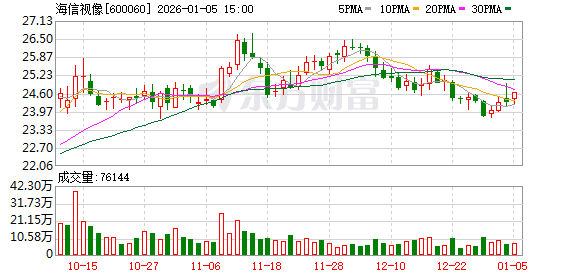
Market Overview - The black home appliance sector increased by 1.37% on October 27, with Tongzhou Electronics leading the gains [1] - The Shanghai Composite Index closed at 3996.94, up 1.18%, while the Shenzhen Component Index closed at 13489.4, up 1.51% [1] Stock Performance - Key stocks in the black home appliance sector showed varied performance: - Tongzhou Electronics (002052) closed at 16.37, up 3.61% with a trading volume of 453,300 shares and a turnover of 737 million yuan - Sichuan Changhong (600839) closed at 10.39, up 3.28% with a trading volume of 2,249,600 shares and a turnover of 2.323 billion yuan - Sichuan Jiuzhou (000801) closed at 15.80, up 1.87% with a trading volume of 171,400 shares and a turnover of 270 million yuan - Hisense Visual (600060) closed at 24.67, up 0.98% with a trading volume of 150,600 shares and a turnover of 372 million yuan - XGIMI Technology (688696) closed at 106.90, up 0.85% with a trading volume of 8,412 shares and a turnover of 89.9062 million yuan - Other stocks like ST Gauss (002848) and Skyworth Digital (000810) saw declines of 2.45% and 3.56% respectively [1] Capital Flow - The black home appliance sector experienced a net inflow of 243 million yuan from institutional investors, while retail investors saw a net outflow of 61.9178 million yuan [1] - Detailed capital flow for key stocks: - Sichuan Changhong had a net inflow of 22.6 million yuan from institutional investors but a net outflow of 77.5479 million yuan from retail investors [2] - Tongzhou Electronics saw a net inflow of 87.8210 million yuan from institutional investors but a net outflow of 61.6663 million yuan from retail investors [2] - XGIMI Technology had a net inflow of 11.9228 million yuan from institutional investors but a net outflow of 12.1622 million yuan from retail investors [2] - Skyworth Digital experienced a significant net outflow of 57.3983 million yuan from retail investors [2]
Z世代家电消费升级,品质健康引领技术|世研消费指数品牌榜Vol.79
3 6 Ke· 2025-10-24 04:23
Group 1 - The core viewpoint of the article highlights the strong performance of brands like Stone Technology, Leader, and Hualing in the home appliance market, driven by targeted strategies that cater to the younger generation's consumption needs [1][3][4] - The top three brands in the heat index are Stone Technology with a score of 1.85, Leader at 1.66, and Hualing at 1.47, indicating a competitive landscape in the home appliance sector [2][3] - The article emphasizes the importance of differentiated positioning and understanding specific consumer demands to capture market share, particularly among younger consumers [3][4] Group 2 - The article discusses how Leader and Hualing, as sub-brands under the same group, successfully implement strategies that focus on "deep youthfulness" and "extreme cost performance," respectively, to meet the needs of young consumers [3][4] - Haier and Midea are highlighted as technology-driven brands that leverage comprehensive product matrices and continuous R&D investments to address consumer demands for quality and health [4][5] - The competitive essence of the home appliance industry is underscored as being rooted in ongoing research and development, with a focus on precise consumer insights to create differentiated advantages [4][5]
海信冰箱・雨辰助学走进沂南县 捐赠教学物资
Zhong Guo Jin Rong Xin Xi Wang· 2025-10-24 02:53
Group 1 - The core idea of the article emphasizes the importance of charitable contributions to rural education, highlighting Hisense's commitment to social responsibility through its "Technology for Good" initiative [1][3] - Hisense donated essential teaching equipment and living materials, including computers, air conditioners, and dining tables, to two remote schools in Linyi, Shandong Province [1][3] - The project, initiated in 2017, has been ongoing for nearly ten years, addressing the practical difficulties faced by schools in remote areas and providing substantial educational support for children [3] Group 2 - The principal of Dongzhangshao Central Primary School expressed that the donated materials will significantly improve the school's teaching conditions and optimize the dining environment for students [3] - Hisense aims to plant the seeds of its "Technology for Good" philosophy in schools, fostering a culture of kindness and support within the educational community [3]