Hisense V.T.(600060)

Search documents
海信视像电视工厂获评“灯塔工厂” 全链AI驱动大屏电视20秒瞬时智造
Zheng Quan Shi Bao Wang· 2026-01-16 06:48
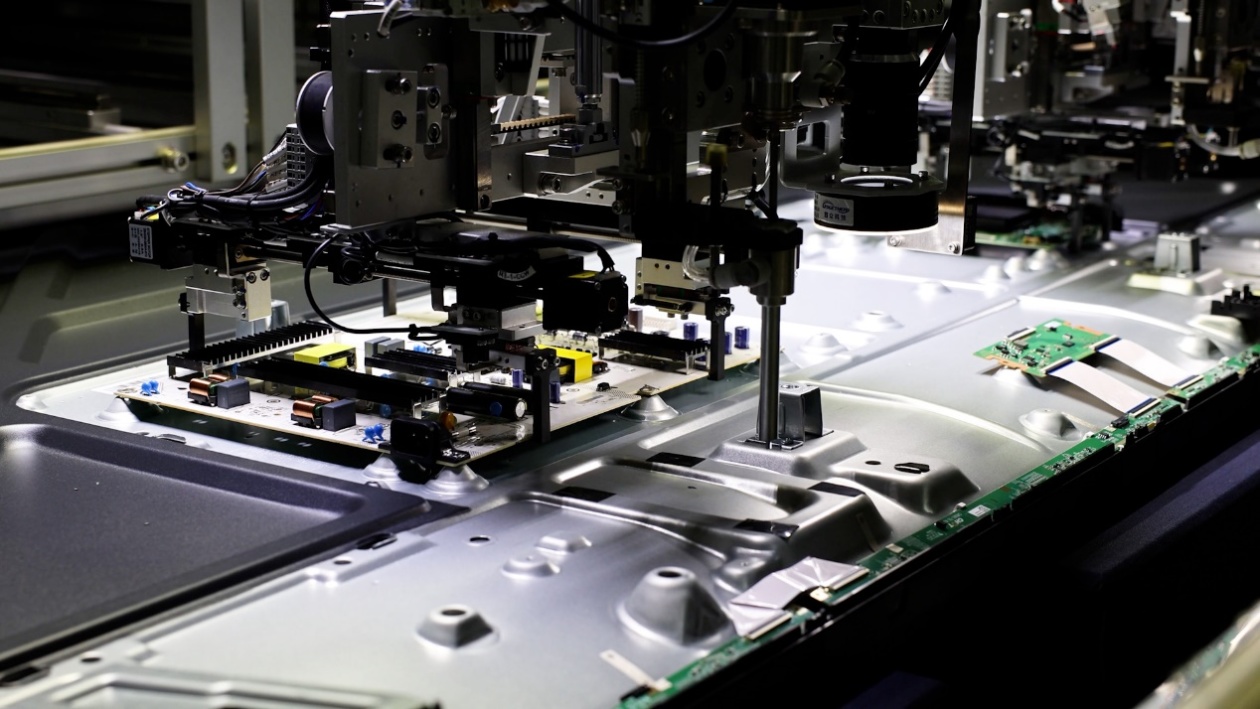
在海信视像(600060)电视工厂,一台台85英寸大屏电视正以惊人的效率流转——平均每 20秒便能完 成一台成品下线。日前,这座电视工厂被世界经济论坛(WEF)评选入最新一期全球"灯塔工厂"名单, 海信视像成为全球电视行业首家获此称号的企业,同时海信视像电视工厂也是行业首个"以用户为中心 +全链AI智造""双引擎"数字化转型工厂。 在智造环节,AI带来的效率和质量提升同样震撼。海信打造了行业领先的第三代数字化高效电视生产 线,集成了25项海信自研的首台套自动化设备,其中11项为业内首创。 以通过机器人实现"面板自动精准卡合"这一行业首创技术为例,以往85英寸大屏面板的精准装配需要5 名工人手动对齐,不仅费力,还存在精度偏差和效率瓶颈。如今,这里搭载了行业首创的矩阵式面板精 确卡合方案,通过多组高精度视觉相机为机器人赋能"眼睛",搭配AI"大脑"实现自动撕膜、精准装配和 实时校准的全流程自动化操作,它能实现0.1毫米级的精准定位,确保每次抓取和装配都毫厘不差。 "这样可以将一线制造同事从重体力、重复性的劳动中解放出来,让他们可以做技术性更强的工作 。我 们相信,技术的进步不是为了替代人,而是为了让人从重复劳动中 ...

全球首个电视“灯塔工厂”诞生记
Jing Ji Guan Cha Wang· 2026-01-16 03:27
Core Viewpoint - The World Economic Forum has welcomed 23 new "lighthouse factories" into its global network, showcasing advanced technologies that enhance production efficiency, supply chain resilience, sustainability, talent development, and customer-centric practices. Hisense's Qingdao factory is the only "lighthouse factory" in the global television industry, recognized for its intelligent, digital, and user-centered manufacturing capabilities [1]. Group 1: Factory Overview - Hisense's Qingdao factory covers an area of 310,000 square meters and produces a television every 20 seconds, representing a decade of continuous upgrades in smart manufacturing [1]. - The factory aims to combine top-tier smart manufacturing capabilities with a deep focus on user needs, transitioning from a single product technology advantage to a comprehensive advantage that includes cutting-edge technology, industrial manufacturing, and user experience [2]. Group 2: Challenges and Solutions - Hisense faced the challenge of adapting to diverse global market preferences, leading to the development of hundreds of television models annually. The company shifted its focus from merely "excellence in manufacturing" to a user-centered approach utilizing AI, big data, and VR simulation [2][3]. - The construction of a "lighthouse factory" requires significant technical accumulation and continuous investment over a decade, with Hisense starting its smart manufacturing initiative as a top priority in 2015 [3][4]. Group 3: Technological Integration - Hisense has integrated AI throughout the entire production process, utilizing over 40 use cases that combine intelligent agents, big data, VR, and digital simulation technologies to enhance efficiency, quality, and flexible manufacturing [7]. - The factory has achieved a 34% reduction in R&D cycles and an 18% decrease in material costs, while also improving employee training time by 60% [8]. Group 4: Future Vision - The future vision for Hisense includes the development of a "factory brain" that can manage and optimize multiple factories globally, enhancing standardization and intelligence in production processes [11]. - The plan to replicate the "lighthouse factory" model involves four steps: establishing IoT connectivity, empowering AI scenarios, coordinating global factories, and evolving into a smart entity capable of proactive decision-making [10].
邓庆旭对话贾少谦:恪守质量信仰,做快时代中的坚守者
Xin Lang Cai Jing· 2026-01-16 02:55
Core Viewpoint - The fundamental principle for a manufacturing enterprise, regardless of market cycles, is to prioritize quality as its core value [1][11]. Group 1: Company Development and Strategy - Hisense has shown steady growth over the past year, showcasing its latest World Cup customized products at CES, emphasizing "AI technology" and its advancements in artificial intelligence and smart hardware [1][11]. - The company has a long-standing commitment to quality, which is deeply embedded in its corporate philosophy and operational practices [3][14]. - Hisense's development strategy has evolved to include high technology, high quality, and high-level service since the maturation of the Chinese market economy in 1993 [3][13]. Group 2: Quality Management Philosophy - Hisense maintains a zero-tolerance policy towards quality issues, believing that even a 0.01% defect rate can lead to a complete failure for affected customers [3][13]. - The company has institutionalized its quality philosophy into what is known as the "Seven Military Regulations" for quality management [3][13]. - Quality is viewed as a moral obligation and a core value that cannot be overlooked, as stated by the chairman [4][18]. Group 3: Technological Innovation and R&D - Hisense has invested significantly in chip technology, being the only domestic home appliance company involved in research across various semiconductor fields [4][15]. - The RGB-Mini LED technology represents a breakthrough in display technology, requiring advanced capabilities in both RGB lighting and image quality control [5][15]. - The development of the "Xinxin" chip in 2005 marked a milestone for Hisense, enabling the company to lead in display technology [15]. Group 4: Digital Quality Management - Hisense is implementing a digital quality management system that leverages AI and machine vision for real-time monitoring and anomaly detection, shifting from post-production checks to proactive quality control [7][17]. - The company has established a digital framework that integrates research, supply chain, quality improvement, and carbon management, addressing traditional traceability challenges [6][16]. - Hisense's Qingdao factory has been recognized as a "lighthouse factory," showcasing its advanced AI-driven quality control processes that have improved detection efficiency by 70.7% [7][17]. Group 5: Global Brand Positioning - As a global sponsor for the upcoming 2026 World Cup, Hisense aims to enhance its brand visibility and trust through high-quality products showcased at major sporting events [9][19]. - The company emphasizes that quality is essential for brand strength and global competitiveness, committing to further integrate AI into its quality ecosystem [8][18]. - Hisense's approach to manufacturing focuses on long-term foundational values, ensuring that quality remains a priority in all aspects of its operations [10][19].
广东启动“广货行天下”春季行动,家电打头阵
Zhong Guo Xin Wen Wang· 2026-01-16 02:54
Group 1 - The "Guangdong Products Going Global" spring action was launched on January 15 in Foshan, marking the beginning of the 2026 promotional activities for Guangdong products [1] - The spring action covers 12 major categories including home appliances, mobile phones, clothing, food, smart terminals, automobiles, beauty and daily necessities, cultural tourism, and agriculture, attracting over 6,000 participating enterprises [1] - The first event focused on home appliances, featuring over 1,900 large-scale home appliance companies in Guangdong, with 55 well-known brands such as Midea, Gree, Galanz, and Hisense showcasing quality products and conducting live-stream sales [1] Group 2 - The promotional campaign is structured around a multi-layered discount system involving government subsidies, enterprise discounts, and platform support, providing consumers with various benefits including government "national subsidies," brand direct discounts, platform exclusive live prices, and consumer vouchers [2] - The Guangdong Provincial Department of Industry and Information Technology stated that the "Guangdong Products Going Global" initiative aims to enhance the market exposure and influence of high-quality industrial products from Guangdong, promoting online sales and contributing to economic stability [2] - The department plans to hold 12 online promotional events in a "one product per week" rhythm leading up to the Spring Festival, focusing on advantageous industries such as mobile phones, clothing, and food [2]


20秒一台电视!海信灯塔工厂藏着中国智造密码
Huan Qiu Wang· 2026-01-16 01:48
2026年1月15日,世界经济论坛(WEF)公布最新一期全球"灯塔工厂"名单,海信电视凭借行业率先构建的首个"以用户为中心+全链 AI 智造""双引擎"数字 化转型工厂,在全球众多竞争者中脱颖而出,成为全球电视行业首家获此殊荣的企业。 此次海信获此殊荣,不仅标志着海信电视在效率、质量与柔性化生产领域达到全球顶尖水平,更彰显了中国制造向"智造"跃迁的标杆力量。 海量数据分钟级深度洞察 需求到产品功能输入时间缩短 62% 海信电视工厂的智能化转型始于对用户需求的极致洞察。在当下复杂且竞争激烈的市场环境中,产品成功与否,关键在于能否以用户需求为导向进行研发与 创新。 面对这一挑战,海信电视创新性地利用大数据技术与星海大模型协同,结合多年积累的本地化产品知识库,可实现海量数据分钟级深度洞察。同时,结合海 信首创的用户需求识别智能体,自动对用户声音观点分类,精准识别用户痛点及潜在需求。在AI赋能下,用户声音转化新品功能输入的时间缩短了62%,并 实际应用于产品的改进升级。2025年,海信结合用户需求,锚定"增强动态画面流畅度与色彩稳定性"的关键方向,成功应用在海信RGB-Mini LED新品E8S 系列电视,为用户带来 ...

全球电视行业首座灯塔工厂在山东点亮
Da Zhong Ri Bao· 2026-01-16 00:55
1月15日晚间,达沃斯世界经济论坛公布新一期全球"灯塔工厂"名单。23个新晋"灯塔工厂"中,中 国有16个工厂入选。 "灯塔工厂"被誉为全球制造业的"奥斯卡",一直被视作全球智能制造的"顶级认证"。自2025年9月 起,评选分为五种类型,分别是客户至上、生产效率、供应链韧性、可持续和人才灯塔。此次海信视像 青岛工厂凭借首个"以用户为中心+全链AI智造""双引擎"数字化转型工厂成功入选,成为全球电视行业 首座"灯塔工厂",标志着中国电视在效率、质量与柔性化生产领域达到全球顶尖水平。 传统的电视制造工艺设计复杂,涉及十多个模块、上百种工艺路线组合,高度依赖工程师经 验。"以前测算瓶颈工时,需要拿着秒表去产线一个个工序掐算、调整。"海信视像工艺工程师王永嘉 说。 如今,在这座灯塔工厂,AI的数字化工艺设计模式,仅需5分钟即可自动生成涵盖工序步骤、操作 要求、物料分配等全要素的工艺方案,效率提升75%。数字化高效电视生产线,集成了25项企业自研首 台套自动化设备,其中11项为业内首创……这些使得该工厂平均每20秒就有一台85英寸大屏电视成品下 线。(记者 戴岳 吕乐) ...
开播即“卖爆”,超六千企业参与!“广货行天下”首日开门红
Nan Fang Du Shi Bao· 2026-01-15 12:07
Core Insights - The "Guangdong Goods Going Global" spring campaign has successfully boosted sales, with reports of a 100% increase in sales during the live broadcast event [1][6] - Over 6,000 enterprises from various sectors, including home appliances, electronics, and food, participated in the campaign, supported by major e-commerce platforms [2][9] - The campaign aims to enhance the competitiveness of Guangdong's manufacturing sector and promote local products both domestically and internationally [7][10] Group 1: Campaign Overview - The spring campaign features 12 online and offline promotional events throughout the first quarter, focusing on high-quality products from Guangdong [1][9] - Major brands like Midea, Gree, and Hisense showcased their products during the event, highlighting the strength of Guangdong's manufacturing base [2][3] - The campaign is designed to create a new sales trend for Guangdong products, leveraging both online and offline channels [1][7] Group 2: Product Quality and Innovation - Guangdong's manufacturing sector is characterized by a strong product base, with 44 industrial products accounting for over 10% of national output [2][3] - The campaign emphasizes product quality improvements and innovative features, such as AI technology in air conditioning units [5][6] - The introduction of "smart" products, including consumer drones and industrial robots, showcases Guangdong's technological advancements [3][5] Group 3: Marketing Strategies - The use of live streaming and influencer marketing has transformed traditional promotional methods, enhancing consumer engagement and driving sales [4][6] - The campaign's strategy includes creating immersive experiences for consumers, allowing them to interact with products in real-time [5][6] - E-commerce platforms are actively promoting Guangdong products through targeted marketing and special promotional sections [6][9] Group 4: Future Plans - The campaign aims to establish a sustainable promotional brand that will continue to drive sales and enhance market vitality [10] - Future events will focus on various product categories, including clothing and food, to further promote local advantages [9][10] - The collaboration between government, enterprises, and platforms is expected to create a positive feedback loop, enhancing brand recognition and consumer trust [7][10]
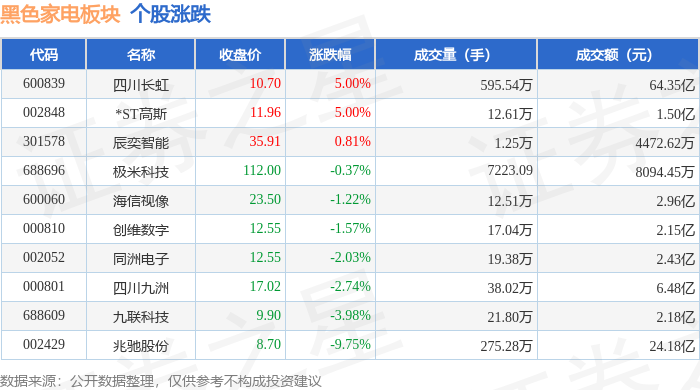
黑色家电板块1月15日跌1.85%,兆驰股份领跌,主力资金净流入3.1亿元
Zheng Xing Xing Ye Ri Bao· 2026-01-15 08:53
Market Overview - The black home appliance sector experienced a decline of 1.85% on January 15, with Zhaochi Co., Ltd. leading the drop [1] - The Shanghai Composite Index closed at 4112.6, down 0.33%, while the Shenzhen Component Index closed at 14306.73, up 0.41% [1] Stock Performance - Sichuan Changhong (600839) saw a price increase of 5.00%, closing at 10.70, with a trading volume of 5.9554 million shares [1] - ST Gauss (002848) also increased by 5.00%, closing at 11.96, with a trading volume of 126,100 shares [1] - Other notable performers included Chenyi Intelligent (301578) with a slight increase of 0.81% and a closing price of 35.91 [1] - Conversely, stocks like Feichi Co., Ltd. (002429) experienced a significant decline of 9.75%, closing at 8.70, with a trading volume of 2.7528 million shares [1] Capital Flow - The black home appliance sector saw a net inflow of 310 million yuan from institutional investors, while retail investors experienced a net outflow of 129 million yuan [1] - The capital flow data indicates that Sichuan Changhong had a net inflow of 5.90 billion yuan from institutional investors, while retail investors had a net outflow of 2.56 billion yuan [2] - Zhaochi Co., Ltd. reported a net outflow of 1.89 billion yuan from institutional investors, with a retail net inflow of 717.1 million yuan [2]


2025中国企业ESG“金责奖”最佳环境E责任奖揭晓
Xin Lang Cai Jing· 2026-01-15 07:31
Core Viewpoint - The 2025 China Enterprise ESG "Golden Responsibility Award" aims to recognize companies that have made significant contributions to ESG (Environmental, Social, and Governance) practices, with over 5,000 enterprises participating in the evaluation process [1][4]. Group 1: ESG Award Overview - The award was launched in November 2025 by Sina Finance ESG Rating Center, focusing on promoting sustainable development and responsible investment [1][4]. - The evaluation process included comprehensive performance assessments, professional scoring, and online voting to determine the winners [1][4]. Group 2: Award Winners - The winners of the Best Environmental Responsibility Award include notable companies such as Sungrow Power Supply, Industrial Fulian, Kweichow Moutai, Geely Automobile, Haier Smart Home, Hisense Visual Technology, Linyang Electronics, Tongwei Co., Weichai Power, and Luxshare Precision [2][5]. - The award committee congratulated the winners and expressed hope that these companies will lead by example in enhancing their ESG capabilities and contribute to high-quality development in China [2][5]. Group 3: ESG Rating Center Introduction - The Sina Finance ESG Rating Center is the first Chinese platform dedicated to ESG information and ratings, promoting sustainable development and responsible investment [3][6]. - The center aims to establish ESG evaluation standards suitable for China's characteristics and enhance corporate ratings through collaboration with leading ESG enterprises and partners [3][6].





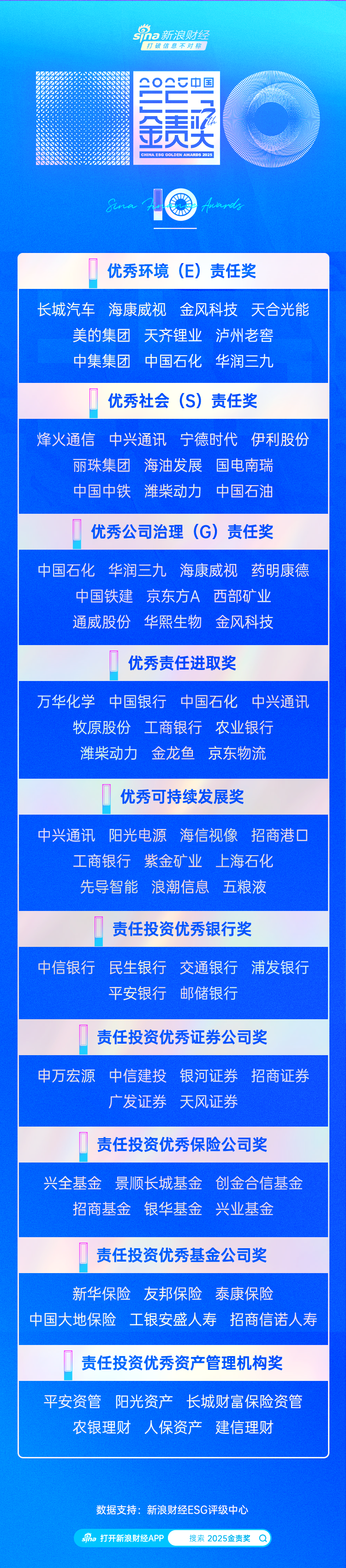
2025中国企业ESG“金责奖”优秀奖评选结果揭晓

Xin Lang Cai Jing· 2026-01-15 03:45
Core Viewpoint - The 2025 China Enterprise ESG "Golden Responsibility Award" aims to recognize companies and institutions that have made significant contributions to ESG initiatives in China, reflecting a shift from voluntary practices to compliance requirements in ESG performance [1][12]. Group 1: ESG Development and Awards Overview - By 2025, China's ESG development has transitioned from "setting standards" to "strengthening regulations," with a comprehensive disclosure standard system being established [1][12]. - The award selection attracted over 5,000 companies, with results based on ESG performance, online voting, and professional evaluations [2][12]. Group 2: Award Categories and Winners - The award categories include Excellent Environmental Responsibility Award, Excellent Social Responsibility Award, Excellent Corporate Governance Responsibility Award, Excellent Responsibility Initiative Award, Excellent Sustainable Development Award, and various responsibility investment awards [1][12]. - Notable winners of the Excellent Environmental Responsibility Award include Great Wall Motors, Hikvision, and China Petroleum [7][24]. - The Excellent Social Responsibility Award was awarded to companies such as YF Communication, ZTE, and Ningde Times [7][24]. - Winners of the Excellent Corporate Governance Responsibility Award include China Petroleum, Hikvision, and WuXi AppTec [7][24]. - The Excellent Responsibility Initiative Award was given to companies like ZTE, Sunlight Power, and Industrial and Commercial Bank of China [7][24]. - The Excellent Sustainable Development Award included companies such as WanHua Chemical, China Bank, and China Petroleum [7][24]. Group 3: Responsibility Investment Awards - The Responsibility Investment Excellent Bank Award was given to institutions like CITIC Bank and Minsheng Bank [5][21]. - The Responsibility Investment Excellent Securities Company Award included firms such as Shenwan Hongyuan and CITIC Securities [5][22]. - The Responsibility Investment Excellent Insurance Company Award recognized companies like New China Life and AIA [5][26]. - The Responsibility Investment Excellent Fund Company Award included firms such as Xinhua Fund and Harvest Fund [5][27]. - The Responsibility Investment Excellent Asset Management Institution Award recognized institutions like Ping An Asset Management and Sunshine Asset Management [5][28]. Group 4: Call to Action and Future Directions - The award committee encourages more Chinese enterprises to integrate ESG principles into their operations and strategic planning, emphasizing the importance of balancing commercial and social values [10][29].