CNRE(600111)

Search documents
2026年有色金属及新材料行业投资策略报告:供给约束叠加需求变化,多种金属价值面临重塑
Guoyuan Securities· 2026-01-30 10:24
Investment Rating - The report maintains a positive investment rating for the non-ferrous metals and new materials industry, indicating a high cost-performance investment stage with potential for sustained growth [1][5]. Core Insights - The non-ferrous metals sector has shown a significant increase, with the Shenwan Non-Ferrous Metals Index rising by 94.73% in 2025, outperforming the CSI 300 Index by 77.07 percentage points [1][13]. - Geopolitical tensions, particularly between major powers like the US and China, are expected to continue impacting the stability of the metal supply chain, leading to increased raw material costs and upward price pressures on strategic metals [2][30]. - The demand outlook for non-ferrous metals remains strong, driven by emerging industries such as electric vehicles, renewable energy, and artificial intelligence, which require high-performance materials [4][34]. Summary by Sections Industry Overview - The non-ferrous metals industry is experiencing a transformation due to supply constraints and changing demand dynamics, with certain metals reaching new price highs [1][2]. - The industry is positioned for growth, supported by favorable policies and a robust demand from new technologies [24][25]. Investment Opportunities - Investment opportunities are particularly favorable in precious metals, copper, and strategic metals, with recommendations to focus on leading companies in high-growth sectors [3][5]. - Key companies to watch include Zijin Mining, Luoyang Molybdenum, Jiangxi Copper, and Northern Rare Earth [5]. Emerging Trends - The rapid expansion of new industries is creating a strategic demand for upstream materials, which are now subject to stricter performance and purity standards [4][34]. - The shift towards electric vehicles and renewable energy is expected to sustain high demand for metals like lithium, copper, and rare earth elements [36][42]. Market Dynamics - The report highlights the tightening supply of strategic metals due to increased global regulatory controls, which is expected to lead to a supply-demand imbalance [31][32]. - The copper market is particularly noted for its supply constraints and increasing demand, with a significant reliance on imports to meet domestic needs [46][47]. Future Outlook - The profitability outlook for the non-ferrous metals sector is expected to improve, with potential for continued price increases in copper, aluminum, and gold, driven by strong industrial demand and macroeconomic conditions [15][30].

掘金日报(1.30)|300亿资金紧急撤离有色,机构称金价仍具备上涨逻辑
Sou Hu Cai Jing· 2026-01-30 09:53
Market Overview - On January 30, A-shares showed mixed performance with the Shanghai Composite Index down 0.96%, Shenzhen Component down 0.66%, and the ChiNext Index up 1.27% [1] - The total trading volume in the Shanghai, Shenzhen, and Beijing markets was 28,624 billion yuan, a decrease of 3,970 billion yuan from the previous day, with over 2,400 stocks in the green [3] Sector Performance - There was a significant sector divergence, with major funds withdrawing from previously popular cyclical sectors like non-ferrous metals and shifting towards technology growth sectors such as communications and electronics [3][5] - The top five sectors for net capital inflow included communications and electronics, each exceeding 10 billion yuan in net inflow, while the non-ferrous metals sector saw a net outflow of 298 billion yuan [5] Stock Highlights - Notable stocks with significant capital inflow included Hunan Gold, Tianfu Communication, and Zhongji Xuchuang, all showing gains of over 5% [6] - Conversely, leading stocks in the non-ferrous metals sector, such as Zijin Mining and China Aluminum, faced substantial outflows, with Zijin Mining experiencing a net outflow of 28 billion yuan and a drop of 7.62% [6] Market Sentiment - The market displayed a clear trend towards technology, with hardware, food and beverage, and construction sectors seeing concentrated gains, indicating a shift in investment focus towards manufacturing upgrades and consumption recovery [7] - The precious metals sector experienced a significant pullback, with the Wind Precious Metals Index dropping 8.27% and many stocks hitting the daily limit down, influenced by international price fluctuations and macroeconomic factors [10] Economic Influences - The market reacted to news regarding potential changes in the U.S. Federal Reserve leadership, with Kevin Warsh being viewed as a hawkish candidate, leading to concerns over tightening liquidity [11] - The U.S. dollar index rose by 0.43% to around 96.74, impacting the attractiveness of precious metals, while the 10-year U.S. Treasury yield reached a recent high of 4.266% [11] Future Outlook - Analysts suggest that while short-term volatility in gold prices is expected, the long-term outlook remains bullish, with potential for gold prices to rise to 6,000 USD per ounce, driven by ongoing geopolitical risks and structural market changes [12][13]


小金属板块1月30日跌6.82%,浩通科技领跌,主力资金净流出59.27亿元


Zheng Xing Xing Ye Ri Bao· 2026-01-30 08:54
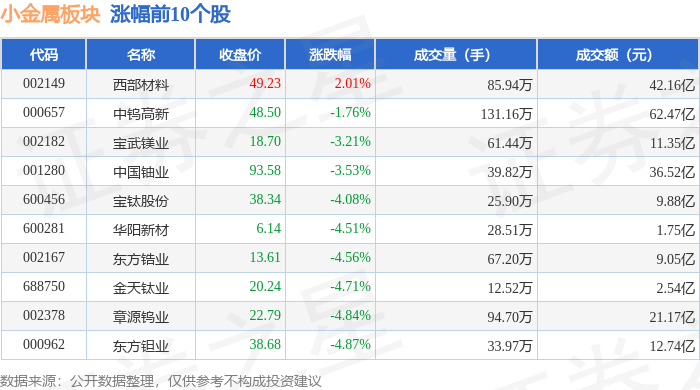
Market Overview - The small metals sector experienced a decline of 6.82% on January 30, with Haotong Technology leading the drop [1] - The Shanghai Composite Index closed at 4117.95, down 0.96%, while the Shenzhen Component Index closed at 14205.89, down 0.66% [1] Individual Stock Performance - Notable performers included: - Xibu Materials (002149) closed at 49.23, up 2.01% with a trading volume of 859,400 shares and a transaction value of 4.216 billion [1] - Haotong Technology (301026) closed at 33.65, down 11.21% with a trading volume of 213,300 shares and a transaction value of 714 million [2] - Other significant declines included: - Guoyan Platinum (600459) down 10.01% to 23.55 [2] - Jin Aluminum (601958) down 10.00% to 20.52 [2] Capital Flow Analysis - The small metals sector saw a net outflow of 5.927 billion from institutional investors, while retail investors contributed a net inflow of 4.688 billion [2] - The capital flow for individual stocks showed: - Xibu Materials had a net inflow of 18.4 million from institutional investors [3] - Haotong Technology experienced a net outflow of 64.2749 million from institutional investors [3]
2026年有色金属及新材料行业投资策略报告:供给约束叠加需求变化,多种金属价值面临重塑-20260130
Guoyuan Securities· 2026-01-30 08:43
Core Insights - The report indicates that the non-ferrous metals and new materials industry is currently in a high cost-performance investment phase, with expectations for continued growth [1] - As of December 31, 2025, the Shenwan Non-Ferrous Metals Index has seen a cumulative increase of 94.73% for the year, ranking first among 31 Shenwan primary industries, significantly outperforming the CSI 300 Index by 77.07 percentage points [1][13] - The industry is influenced by international dynamics and changes in supply patterns, with some metal prices reaching new highs [1] Supply and Demand Dynamics - The ongoing strategic competition between major powers like the US and China has made upstream metal resources a critical area of contention, leading to significant impacts on the stability of the metal supply chain [2] - Supply disruptions are expected to increase raw material costs, while tighter controls on strategic metals by various countries will further exacerbate price pressures [2] - The demand outlook for non-ferrous metals is clear, supported by long-term fundamentals [2] Investment Opportunities - The report highlights investment opportunities in precious metals, copper, and strategic metals, noting that gold has evolved into a strategic asset for managing systemic risks, with central banks likely to increase gold reserves [3] - The mining of copper is becoming increasingly challenging, with supply constraints supporting a long-term upward price trend [3] - The geopolitical competition is expected to lead to enhanced resource controls, creating structural investment opportunities in related sectors [3] Emerging Industries and Material Demand - Rapidly expanding sectors such as artificial intelligence, electric vehicles, renewable energy, and high-end semiconductors are driving unprecedented demand for upstream materials, which are now classified as "key strategic materials" or "high-tech value-added new materials" [4] - The performance, purity, form, and functionality of materials are subject to increasingly stringent standards, indicating a fundamental shift in investment logic [4] Recommendations - The report recommends focusing on sectors such as copper, gold, and strategic metals, particularly in 2026, with an emphasis on leading companies that operate in high-growth areas with strong technological monopolies [5] - Specific companies to watch include Zijin Mining, Luoyang Molybdenum, Jiangxi Copper, Tongling Nonferrous Metals, China Rare Earth, Northern Rare Earth, Shenghe Resources, Xiamen Tungsten, Zhongtung High-tech, and Zhangyuan Tungsten [5]
刚刚,A股突变
Zhong Guo Ji Jin Bao· 2026-01-30 04:54
【导读】今日上午A股三大指数涨跌不一,CPO、农牧饲渔、旅游酒店板块大涨,资源股重挫,个股掀"跌停潮" A股风云突变。 1月30日早盘,A股市场迎来大变化。三大指数上演"过山车"行情,A股多个指数开盘集体杀跌,科创综指盘中跌超2.5%,上证指数、深证成指、创业板指 均一度跌超2%。随后多个指数涨跌出现分化,创业板指翻红。 风云突变 个股跌多涨少,全市场共有3872只个股下跌,仅有1494只个股上涨,27只个股涨停。成交额方面,沪深两市半日成交额为1.93万亿元,较上个交易日缩量 836亿元。 贵金属板块领跌 今天上午,资源股重挫,有色板块大跌8%,贵金属概念股板块领跌,相关个股纷纷跌停。 十余只个股跌停。其中,晓程科技录得20%跌停,山东黄金(600547)、中金黄金(600489)、山金国际(000975)、赤峰黄金、四川黄金(001337)、 贵研铂业(600459)、金徽股份(603132)、招金黄金(000506)、恒邦股份(002237)、湖南白银(002716)、华锡有色(600301)均录得10cm跌 停,紫金矿业(601899)跌超8%。 1月最后一个交易日的早盘,A股主要指数涨跌不一。 热门 ...




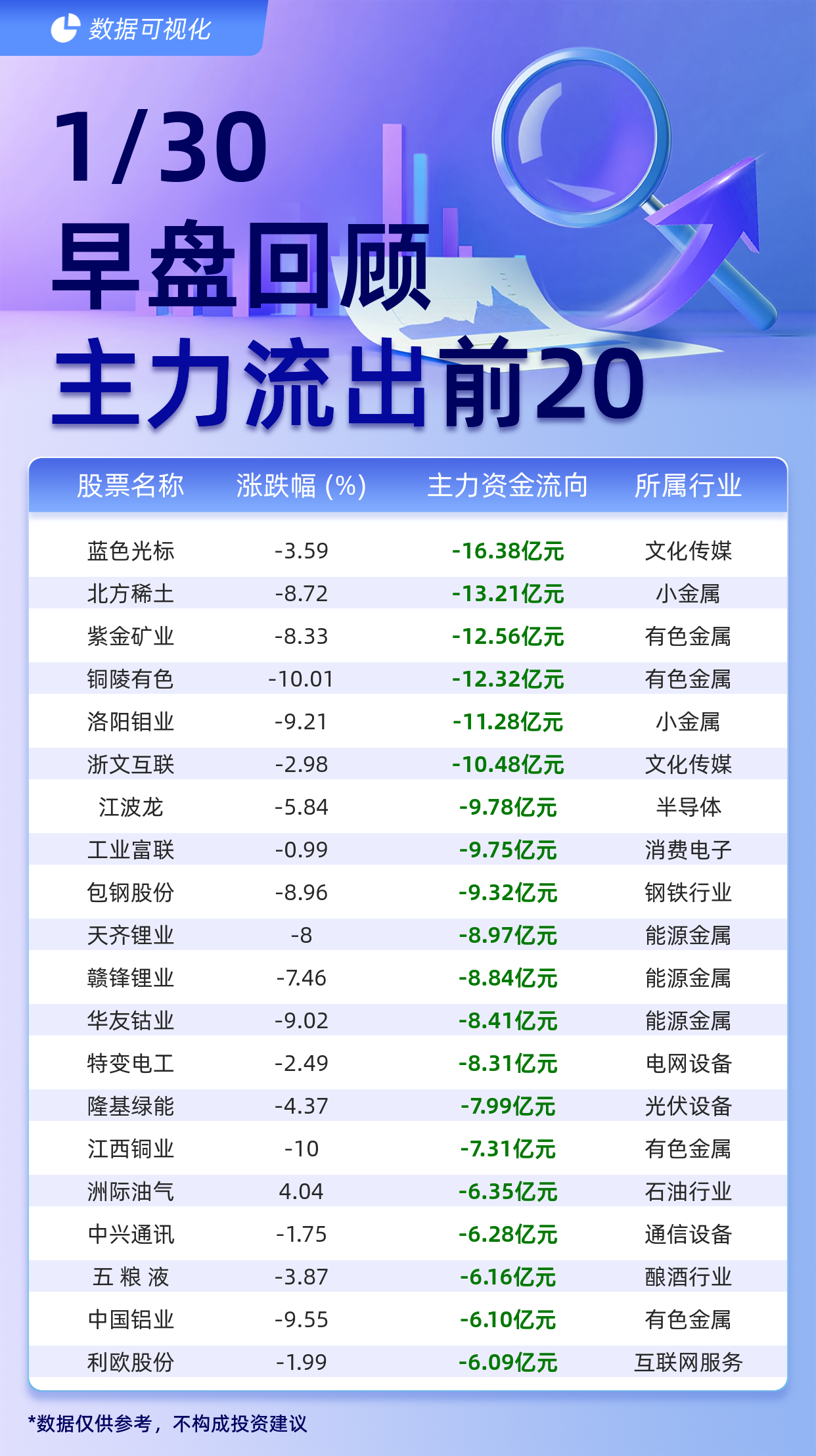
主力个股资金流出前20:蓝色光标流出16.38亿元、北方稀土流出13.21亿元



Jin Rong Jie· 2026-01-30 04:02
据交易所数据显示,截至1月30日午间收盘,主力资金流出前20的股票分别为: 蓝色光标(-16.38亿元)、 北方稀土(-13.21亿元)、 紫金矿业(-12.56亿 元)、铜陵有色(-12.32亿元)、 洛阳钼业(-11.28亿元)、 浙文互联(-10.48亿元)、 江波龙(-9.78亿元)、 工业富联(-9.75亿元)、 包钢股份(-9.32 亿元)、 天齐锂业(-8.97亿元)、 赣锋锂业(-8.84亿元)、 华友钴业(-8.41亿元)、 特变电工(-8.31亿元)、 隆基绿能(-7.99亿元)、 江西铜业(-7.31 亿元)、 洲际油气(-6.35亿元)、 中兴通讯(-6.28亿元)、五 粮 液(-6.16亿元)、 中国铝业(-6.10亿元)、 利欧股份(-6.09亿元)。 | 股票名称 | 涨跌幅 (%) | 主力资金流向 | 所属行 | | --- | --- | --- | --- | | 蓝色光标 | -3.59 | -16.38亿元 | 文化传妙 | | 北方稀土 | -8.72 | -13.21亿元 | 小金属 | | 紫金矿业 | -8.33 | -12.56亿元 | 有色金属 | | 铜 ...
金属供需逻辑依然坚实,有色ETF鹏华(159880)盘中净申购1100万份
Sou Hu Cai Jing· 2026-01-30 03:37
Group 1 - The core viewpoint of the news is the anticipation of Kevin Warsh being nominated as the new Federal Reserve Chairman, which has led to a significant drop in the prices of non-ferrous stocks [1] - The market prediction for Warsh's nomination has surged to 87% according to Polymarket, indicating strong market sentiment towards a hawkish candidate [1] - The report from Guojin Securities outlines the main logic for the non-ferrous sector this year, highlighting low supply due to low capital expenditure, domestic anti-competition measures, and overseas resource nationalism [1] Group 2 - The demand for non-ferrous metals is driven by AI, new energy, and the reconstruction of manufacturing in Europe and the US [1] - The report emphasizes strong inventory replenishment due to low existing inventories across supply chains and the initiation of a national reserve cycle in the US [1] - Despite recent price volatility due to regional issues, the fundamental outlook for commodity prices remains strong, with macroeconomic fluctuations being the only potential disruptor [1] Group 3 - As of January 30, 2026, the non-ferrous metal industry index (399395) saw significant declines in major stocks, with Nanshan Aluminum leading at a drop of 10.05% [2] - The non-ferrous ETF Penghua (159880) decreased by 8.66%, with a latest price of 2.39 yuan and a net inflow of 11 million units over the past seven days [2] - The top ten weighted stocks in the non-ferrous metal industry index account for 51.65% of the index, including companies like Zijin Mining and Ganfeng Lithium [2]




稀土指数盘中跌超7%,华宏科技跌停
Mei Ri Jing Ji Xin Wen· 2026-01-30 01:58
Group 1 - The rare earth index experienced a significant decline of 7.25% during intraday trading [1] - Among the constituent stocks, Huahong Technology hit the daily limit down, while Shenghe Resources fell over 7% [1] - Other notable declines included Zhongjin Rare Earth dropping over 6%, and Xiamen Tungsten and Northern Rare Earth both decreasing by more than 5% [1]

662股获融资买入超亿元,紫金矿业获买入41.13亿元居首
Di Yi Cai Jing· 2026-01-30 01:24
Core Insights - On January 29, a total of 3,766 stocks in the A-share market received financing funds for purchase, with 662 stocks having purchase amounts exceeding 100 million [1] Financing Purchase Amounts - The top three stocks by financing purchase amount were Zijin Mining, Bluefocus, and Northern Rare Earth, with amounts of 4.113 billion, 3.26 billion, and 2.486 billion respectively [1] Financing Purchase Proportions - Five stocks had financing purchase amounts accounting for over 30% of the total transaction amount on that day. The top three were Dezhan Health, Huilong Shares, and Shenzhen Airport, with proportions of 47.08%, 37.87%, and 37.33% respectively [1] Net Financing Purchases - A total of 52 stocks had net financing purchases exceeding 100 million. The top three in net financing purchases were Zijin Mining, Tianfu Communication, and Bluefocus, with net amounts of 1.042 billion, 891 million, and 869 million respectively [1]

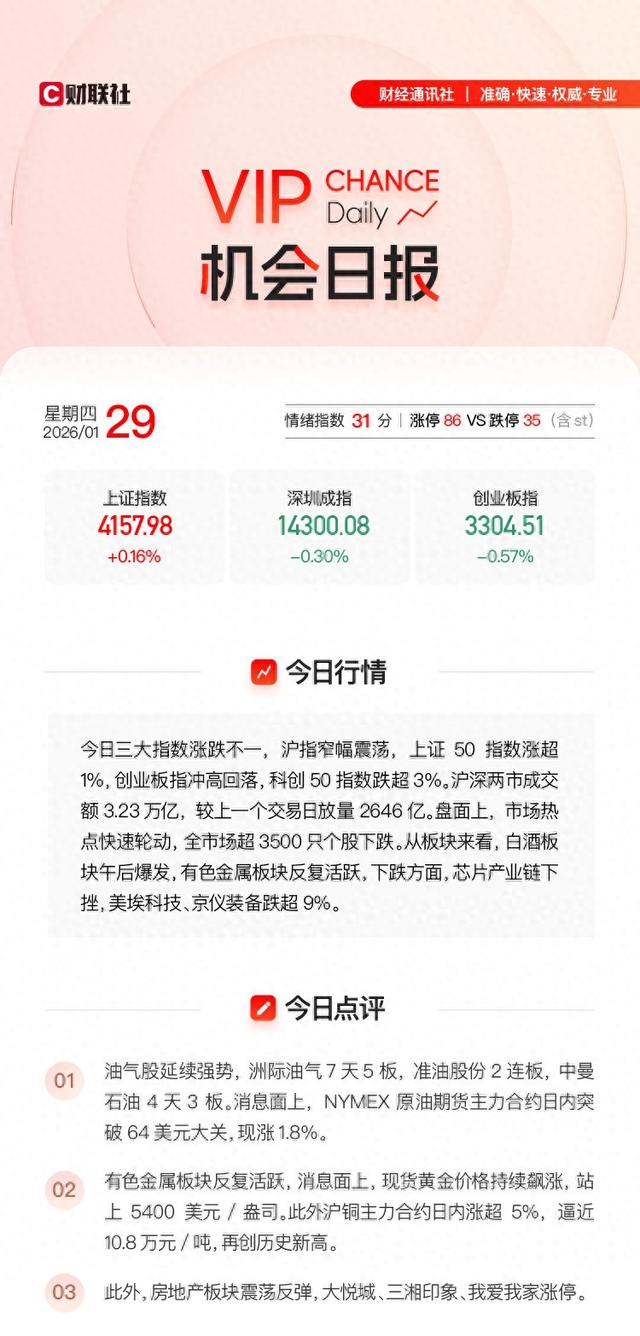
VIP机会日报资源板块再度领涨 栏目解读贵金属、油气、稀土等方向 多家焦点公司收获涨停
Xin Lang Cai Jing· 2026-01-29 09:20
转自:智通财经 注:智通财经VIP为内容资讯产品,并非投资建议。以下内容仅为资讯价值展示非对相关公 司的推荐建议,非未来走势预测。投资有风险,入市需谨慎。 市场热点一 油气 消息面上,NYMEX原油期货主力合约日内突破64美元大关,现涨1.8%。 《九点特供》:盘前必读的特供早报。 1月26日08:17《九点特供》 解读海外映射,指出国际油价涨近3%,在解读海外局势后,并梳理了涨价 的逻辑,提及国内焦点公司洲际油气,截至1月29日收盘,其4日收获3次涨停。 洲际油气(600759) < 01-29 15:43:38 沪 融 5.69 所属行业:石油石化 +4.80% > > 查看所属板块 > 油气设服 天然气 +0.52 +10.06% +1.74% 最相关 +0.97% 成交量 5.48 最 高 5.69 856万手 今 开 昨 收 5.17 最 低 5.12 成交额 46.4亿 换手率 20.65% 总市值 236亿 ▲ 213.13 市盈动 热股 财联社热股榜TOP13 > 分时 五日 日K 周K 月K 分钟▼ [0] MA5 前复权 5.69 5.69 1月26日08:17《九点特供》解读海外 指出国 ...