China Spacesat(600118)

Search documents
“制造强国”实干系列周报(11、30期)-20251203
Shenwan Hongyuan Securities· 2025-12-03 09:30
Group 1: Commercial Aerospace - Focus on core targets in satellite manufacturing: Shanghai Huanxun, Zhenlei Technology, and Aerospace Electronics, with potential for value enhancement[3] - Key application targets include communication terminal baseband, RF chips, and phased array antennas[3] - Aerospace Technology Group has strong expectations for mergers and acquisitions due to substantial external assets[3] Group 2: Liquid Cooling Industry - Global competition in the liquid cooling industry is driven by ecological positioning, technology, and manufacturing advantages[3] - Recommended targets include: Infinet and Highlan for full industry chain layout; Kangsheng and Siquan New Materials for technical breakthroughs; and Tongfei for precision manufacturing and cost control[3] Group 3: Engineering Machinery - The core of engineering machinery investment is to assess the position in the cycle, with sales as a critical observation metric[3] - Excavator sales in October reached 18,096 units, a year-on-year increase of 7.77%, with domestic sales at 8,468 units, up 2.44%[63] - Loader sales in the first ten months totaled 104,412 units, a year-on-year increase of 15.8%, with domestic sales up 21.8%[64]



“朱雀三号”成功发射,航空航天ETF(159227)跌幅收窄,上海瀚讯涨超15%
Mei Ri Jing Ji Xin Wen· 2025-12-03 05:28
Group 1 - The Aerospace ETF (159227) experienced a slight decline of 0.17% but saw a recovery with a trading volume of 216 million yuan, maintaining its position as the largest aerospace ETF in the market with a total size of 2.126 billion yuan [1] - The successful launch of the Zhuque-3 rocket by Blue Arrow Aerospace marks a significant step towards the reusable era in China's commercial space sector, despite the failure of the first-stage rocket's vertical recovery [1] - According to Dongfang Securities, the progress of satellite networking in China has accelerated this year, with an increase in satellite launch frequency and the rapid rise of private rocket companies entering the listing guidance phase [1] Group 2 - The Aerospace ETF closely tracks the Guozheng Aerospace Index, with a high military industry concentration of 98.2%, covering key sectors such as aerospace equipment, satellite navigation, and new materials [2] - The ETF includes leading companies in the military sector, with a significant weight of 56.5% allocated to commercial aerospace concepts among its top holdings [2] - Major stocks in the ETF include Aerospace Development, China Satellite, and AVIC Aircraft, representing the forefront of the industry [2]




商业航天概念股午后跳水,航天动力炸板
Cai Jing Wang· 2025-12-03 05:16
Core Viewpoint - Commercial aerospace concept stocks weakened in the afternoon of December 3, with significant declines observed in several companies including Aerospace Power, Superjet, Qian Zhao Optoelectronics, Jiayuan Technology, and China Satellite [1] Group 1 - Commercial aerospace concept stocks experienced a downturn in the afternoon session [1] - Aerospace Power faced a sharp decline, leading to a halt in trading [1] - Other companies such as Superjet, Qian Zhao Optoelectronics, Jiayuan Technology, and China Satellite also saw substantial drops in their stock prices [1]





商业航天概念股午后走弱
Mei Ri Jing Ji Xin Wen· 2025-12-03 05:13
(文章来源:每日经济新闻) 每经AI快讯,12月3日,商业航天概念股午后走弱,航天动力炸板,超捷股份、乾照光电、佳缘科技、 中国卫星等纷纷大幅跳水。 ...
捕获成功率更高、对火箭着陆指标更友好、有助简化火箭结构……“领航者”开启独具特色网系回收模式
Ke Ji Ri Bao· 2025-12-03 00:43
Core Viewpoint - The successful delivery of China's first offshore rocket recovery platform "Navigator" marks a significant advancement in the development of a stable, reliable, and precise rocket recovery system at sea [1] Group 1: Rocket Recovery Technology - The "Navigator" platform is designed to work with a network recovery system, which is a unique vertical landing recovery method that utilizes a grid-like cable system to capture rockets during descent [1][2] - Compared to traditional recovery methods, the network recovery system enhances the success rate of capturing and buffering rockets, allowing for better energy absorption during landing [2] - The system simplifies rocket structure and improves efficiency, as it can adapt to different rocket sizes without the need for custom landing gear [2] Group 2: Technical Specifications of "Navigator" - The "Navigator" measures 144 meters in length, 50 meters in width, and has a draft of 5.5 meters, with a full load displacement of 25,000 tons and DP2 dynamic positioning capability [2] - The platform faces technical challenges, including the need for precise positioning during rocket landings, which requires higher standards for stability and structural design compared to conventional vessels [3] - The design must account for concentrated loads and high center of gravity due to the network recovery system's structure, necessitating extensive load analysis and wind tunnel testing [3]
航天装备板块12月2日跌0.37%,航天环宇领跌,主力资金净流入3246.7万元
Zheng Xing Xing Ye Ri Bao· 2025-12-02 09:09
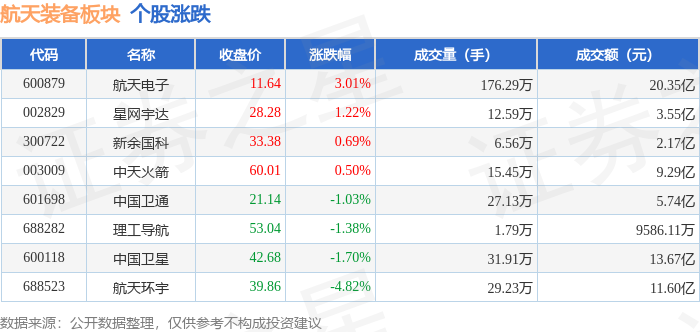
Market Overview - The aerospace equipment sector experienced a decline of 0.37% on December 2, with Aerospace Hanyu leading the drop [1] - The Shanghai Composite Index closed at 3897.71, down 0.42%, while the Shenzhen Component Index closed at 13056.7, down 0.68% [1] Stock Performance - Notable stock performances include: - Aerospace Electronics (600879) rose by 3.01% to a closing price of 11.64 [1] - Xingwang Yuda (002829) increased by 1.22% to 28.28 [1] - New Yu Guoke (300722) saw a rise of 0.69% to 33.38 [1] - Aerospace Hanyu (688523) fell by 4.82% to 39.86 [1] - China Satellite (600118) decreased by 1.70% to 42.68 [1] Capital Flow - The aerospace equipment sector had a net inflow of 32.47 million yuan from main funds, while retail funds saw a net inflow of 39.14 million yuan [1] - However, speculative funds experienced a net outflow of 71.61 million yuan [1] Detailed Capital Flow Analysis - Aerospace Electronics (600879) had a main fund net inflow of 1.67 billion yuan, but a net outflow from speculative funds of 81.15 million yuan [2] - Aerospace Hanyu (688523) recorded a main fund net inflow of 183.13 million yuan, with a net outflow from speculative funds of 7.14 million yuan [2] - China Satellite (600118) faced a significant main fund net outflow of 1.30 billion yuan, while retail funds had a net inflow of 104 million yuan [2]






我国首个海上火箭回收平台交付 什么是“网系回收”?
Ke Ji Ri Bao· 2025-12-02 06:00
Core Viewpoint - The successful delivery of China's first offshore rocket recovery platform "Navigator" marks a significant advancement in the development of a stable, reliable, and precise rocket recovery system at sea [1] Group 1: What is Network Recovery? - Network recovery is a unique method of vertical landing recovery, which involves deploying a network of cables at high altitudes to capture the rocket as it descends [2] - This method differs from traditional recovery techniques, such as parachute recovery and vertical landing, by utilizing a hook on the rocket that latches onto a grid-like structure [2] Group 2: Advantages of Network Recovery - Network recovery enhances the success rate of capturing and buffering during the recovery process through high coordination between the recovery system and the rocket's recovery device [3] - It is more forgiving on landing parameters, as the ground buffering system absorbs most of the rocket's kinetic and potential energy, reducing design requirements for the rocket's buffering structures [3] - The system simplifies the rocket's structure, improving efficiency and effectiveness, and can be adapted for different sizes of rockets [3] Group 3: Technical Challenges of "Navigator" - "Navigator" is the first offshore rocket recovery platform certified by a classification society, measuring 144 meters in length and 50 meters in width, with a displacement of 25,000 tons [4] - The platform requires high precision in positioning to coordinate with the rocket's landing, necessitating advanced design considerations for stability and load distribution [4] - The design must account for various sea conditions and the unique structural challenges posed by the network recovery system, which has a high center of gravity and significant weight [4]
把服务器“送上天”,提前布局哪些产业链?丨每日研选
Shang Hai Zheng Quan Bao· 2025-12-02 01:17
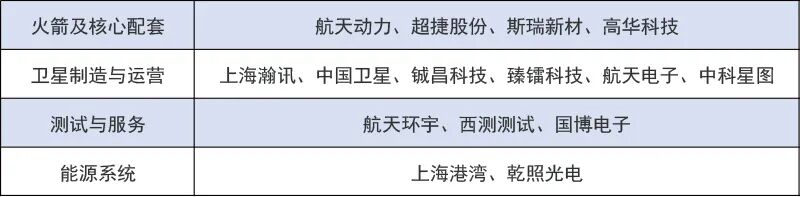
Core Insights - The establishment of a new department by the National Space Administration marks a significant step towards the commercialization of space, driven by policy and disruptive applications [1] - The concept of "space computing power" is emerging as a focal point for global tech giants, with plans for large-scale data centers in orbit to enhance AI capabilities [2] - Investment opportunities are identified in various sectors of the space industry, including rocket launch chains, satellite manufacturing, and testing services [3] Policy Developments - The National Space Administration's creation of a Commercial Space Department aims to improve the efficiency of launch approvals and licensing, promoting high-quality development in China's commercial space sector [1] - The release of the "Action Plan for Promoting High-Quality and Safe Development of Commercial Space (2025-2027)" provides a framework for long-term industry growth through research project openness and national fund establishment [1] Industry Trends - The trend of deploying data centers in space is expected to overcome limitations faced by terrestrial data centers, with significant investments from companies like NVIDIA, SpaceX, and Google [2] - The demand for AI computing and decreasing rocket launch costs are anticipated to drive substantial growth in space computing power globally [2] Investment Opportunities - Key sectors for investment include: - Rocket and core supporting fields: Companies such as Aerospace Power, Superjet, Srey New Materials, and Gaohua Technology [3][4] - Satellite manufacturing and operation: Companies like China Satellite, Chengchang Technology, Zhenlei Technology, Aerospace Electronics, and Zhongke Xingtou [3][4] - Testing and service sectors: Companies including Aerospace Universe, West Measurement Testing, and Guobo Electronics [3][4] - Energy systems: Companies such as Shanghai Port and Qianzhao Optoelectronics [3][4]


航天装备板块12月1日涨1.77%,航天环宇领涨,主力资金净流出1.6亿元
Zheng Xing Xing Ye Ri Bao· 2025-12-01 09:09
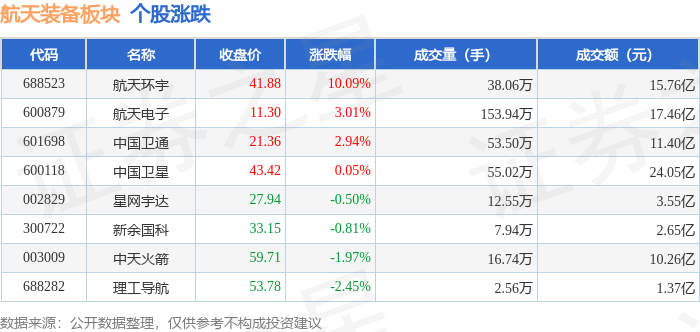
Market Performance - The aerospace equipment sector increased by 1.77% on December 1, with Aerospace Hanyu leading the gains [1] - The Shanghai Composite Index closed at 3914.01, up 0.65%, while the Shenzhen Component Index closed at 13146.72, up 1.25% [1] Stock Performance - Aerospace Hanyu (688523) closed at 41.88, up 10.09%, with a trading volume of 380,600 shares and a transaction value of 1.576 billion [1] - Aerospace Electronics (600879) closed at 11.30, up 3.01%, with a trading volume of 1,539,400 shares and a transaction value of 174.6 million [1] - China Satellite (601698) closed at 21.36, up 2.94%, with a trading volume of 535,000 shares and a transaction value of 114 million [1] - Other stocks in the sector showed mixed performance, with some experiencing declines [1] Fund Flow Analysis - The aerospace equipment sector saw a net outflow of 160 million from institutional investors, while retail investors had a net inflow of 187 million [1] - Aerospace Hanyu had a net inflow of 92.95 million from institutional investors, but a net outflow of 88.26 million from retail investors [2] - Other stocks like China Satellite and Aerospace Electronics experienced significant net outflows from institutional investors [2]
“神舟二十二号航天员乘组”将永远空缺
中国基金报· 2025-12-01 07:55
Core Viewpoint - The article discusses the emergency response to the discovery of a crack in the Shenzhou 20 spacecraft's window, leading to the postponement of its return mission and the initiation of an emergency launch for Shenzhou 21 and Shenzhou 22 [2][3][4]. Group 1: Incident Overview - On November 5, 2025, the Shenzhou 20 return mission was urgently postponed after astronauts discovered a crack on the spacecraft's window during a routine inspection [3]. - The crack was confirmed to be a through-crack, penetrating from the inner surface to the outer surface of the window [3][4]. - Within 12 hours of confirming the crack, the mission command made the decision to delay the return of Shenzhou 20 [4]. Group 2: Emergency Response - The emergency plan was activated on November 10, 2025, allowing the Shenzhou 20 astronauts to return on the Shenzhou 21 spacecraft [6]. - The Shenzhou 22 mission was launched 16 days later as part of the emergency response, marking China's first emergency launch in manned spaceflight [6][7]. Group 3: Future Implications - The Shenzhou 20 spacecraft will return to Earth in an uncrewed state, providing valuable data for future missions [9]. - The development schedule for subsequent spacecraft has been accelerated, with Shenzhou 23 expected to be completed two months ahead of schedule [11]. - The absence of the Shenzhou 22 astronaut crew in the sequence serves as a reminder of the ongoing pursuit of excellence in space missions [11][12].