China Spacesat(600118)

Search documents
商业航天行动计划出台,太空算力中心规划发布
CAITONG SECURITIES· 2025-12-01 07:48
Core Insights - The defense and military industry index increased by 2.85% in the past week, ranking 14th out of 31 in the Shenwan first-level industry [7] - Over the past month, the index decreased by 4.05%, ranking 25th out of 31 [10] - The one-year performance shows a 12.94% increase, ranking 15th out of 31 [18] - The current PE-TTM for the defense and military industry is 77.60, which is at the 73.27 percentile compared to the past ten years, indicating a relatively high valuation level [13][14] - Notable individual stock performances include LeiKe Defense (32.30%), ZhongTian Rocket (21.60%), and HongDa Electronics (14.28%) in the past week [19][29] - The total transaction amount for the defense and military industry reached 378.8 billion yuan, a year-on-year increase of 88.64% [33] - The report suggests focusing on investment themes such as commercial aerospace, military trade, unmanned equipment, military AI, and low-altitude economy [42] Industry and Stock Performance Review - The defense and military industry index performance over the past week, month, and year shows varying trends, with a notable increase in the last week [7][10][18] - Individual stock performance highlights significant gains for top performers and losses for underperformers in the past week [19][29] - The PE-TTM ratios across various sub-sectors indicate differing valuation levels, with aerospace equipment at 77.82 and military electronics at 106.55 [13][14] Funding Situation - The total transaction volume for the defense and military industry reached 378.8 billion yuan, reflecting a strong market activity compared to previous periods [33] - The military ETF fund shares decreased slightly compared to the previous week and month, but showed a significant year-on-year increase [35] Industry News - The launch of the commercial aerospace three-year action plan aims to enhance innovation and resource utilization in the industry [42] - The establishment of a space data center is underway, which will support the development of a large-scale data center system in orbit [43] - The report highlights key developments in the defense and military sector, including significant contracts and partnerships [39][41]




我国首艘火箭网系回收海上平台成功交付
Xin Hua She· 2025-12-01 07:38
Core Viewpoint - The successful delivery of China's first rocket recovery sea platform named "Navigator" marks a significant advancement in reusable rocket technology, facilitating the transition from technical verification to engineering application [1] Group 1: Technological Advancements - The platform is a crucial development in the upgrade of China's manned space transportation system, driven by the manned space program [1] - It aims to enhance the efficiency and effectiveness of key technologies for sea recovery of reusable rockets, ensuring China's core competitiveness in rapid launch and low-cost access to space [1] Group 2: Development Timeline - The platform will commence comprehensive verification work in September 2024, with design completion expected by December 2024 and construction starting in April 2025 [1] - The entire modification process is projected to take seven months, overcoming several critical technical challenges [1] Group 3: Certification and Collaboration - The platform has received classification and statutory certificates from the China Classification Society, making it the first certified sea rocket recovery platform in China [1] - Its successful development is a result of collaborative innovation among research institutes, leading enterprises, and higher education institutions in the aerospace and maritime fields [1]

“神舟二十二号航天员乘组”将永远空缺
第一财经· 2025-12-01 07:29
Core Viewpoint - The Shenzhou-20 mission was urgently paused due to the discovery of a crack in the spacecraft's window, highlighting the increasing threat of space debris to manned space missions [2][8]. Group 1: Incident Overview - On November 5, 2025, the Shenzhou-20 mission was put on hold after astronauts reported an abnormal phenomenon at the edge of the window during a routine inspection [2]. - The initial assessment by the design team suggested a triangular mark that was difficult to identify, resembling something adhered to the surface [4]. - Further evaluation confirmed the presence of a penetrating crack, with the damage extending through the entire thickness of the glass [6]. Group 2: Space Debris Threat - The crack was preliminarily attributed to a space debris impact, estimated to be less than 1 millimeter in size but traveling at high speed, resulting in a crack measuring several millimeters [8]. - The increasing number of space debris poses a growing threat to the safety of spacecraft, satellites, and astronauts [8]. Group 3: Future Missions - The emergency launch of Shenzhou-22 has accelerated the development schedule for subsequent missions, with Shenzhou-23 expected to be completed two months ahead of schedule [8]. - The next crew will be designated as the "Shenzhou-23 astronaut team," leaving the "Shenzhou-22 astronaut team" as a permanent gap in the sequence [8]. Group 4: Engineering Insights - The incident serves as a reminder that the engineering team must maintain high standards and vigilance, as there is always room for improvement in manned spaceflight [10]. - Continuous success should not lead to complacency; instead, the team should strive for higher standards to ensure future achievements [10].


神二十返回舱受损细节公布
证券时报· 2025-12-01 04:20
Core Viewpoint - The increasing number of space debris poses a significant threat to the safety of spacecraft, satellites, and astronauts, leading to the emergency suspension of the Shenzhou 20 mission due to a discovered crack in the spacecraft's window [1][3]. Group 1: Incident Overview - On November 5, 2025, the Shenzhou 20 return mission was urgently paused after a routine inspection revealed an abnormal phenomenon at the edge of the spacecraft's window [3]. - The initial assessment by the chief designer of the crewed spacecraft system indicated that the crack was likely caused by space debris smaller than 1 millimeter, but traveling at high speed, resulting in a significant crack size of several millimeters [1][3]. Group 2: Damage Assessment - The crew took photographs of the abnormal area from different angles and lighting conditions, and additional images were captured using the space station's robotic arm [7]. - Experts from over ten domestic glass-related industries were organized to evaluate the damage based on the transmitted images [7]. - The consensus among experts confirmed the presence of a penetrating crack that went through the entire thickness of the glass [9]. Group 3: Decision Making - Less than 12 hours after confirming the crack, the mission command made the decision to delay the Shenzhou 20 return mission [10].

中国卫星涨2.03%,成交额8.11亿元,主力资金净流出3084.60万元
Xin Lang Cai Jing· 2025-12-01 02:14
Core Viewpoint - China Satellite's stock has shown significant growth this year, with a year-to-date increase of 62.26% and a recent trading volume indicating active market participation [1][2] Financial Performance - For the period from January to September 2025, China Satellite achieved a revenue of 3.102 billion yuan, representing a year-on-year growth of 85.28% [2] - The net profit attributable to the parent company for the same period was 14.8114 million yuan, marking a substantial increase of 200.48% year-on-year [2] Stock Market Activity - As of December 1, the stock price of China Satellite was 44.28 yuan per share, with a market capitalization of 52.361 billion yuan [1] - The stock has experienced a trading volume of 8.11 billion yuan, with a turnover rate of 1.56% [1] - The stock has appeared on the "龙虎榜" (a list of stocks with significant trading activity) twice this year, with the latest appearance on September 1, where it recorded a net buy of -107 million yuan [1] Shareholder Information - As of September 30, 2025, the number of shareholders for China Satellite was 160,500, an increase of 27.12% from the previous period [2] - The average number of circulating shares per shareholder decreased by 21.33% to 7,366 shares [2] Dividend Distribution - Since its A-share listing, China Satellite has distributed a total of 1.383 billion yuan in dividends, with 148 million yuan distributed over the past three years [3] Institutional Holdings - As of September 30, 2025, the second-largest circulating shareholder is the Fortune CSI Military Industry Leader ETF, holding 13.2941 million shares, an increase of 1.9401 million shares from the previous period [3] - Other notable institutional shareholders include the Southern CSI 500 ETF and the Guotai CSI Military Industry ETF, with varying changes in their holdings [3]
专家:神二十返回舱玻璃裂纹为不足1毫米空间碎片撞击导致
Huan Qiu Wang Zi Xun· 2025-12-01 01:37
Core Viewpoint - The increasing number of space debris poses a significant threat to the safety of operational spacecraft, satellites, and astronauts, necessitating urgent attention and measures to mitigate risks [3]. Group 1: Space Debris Threat - The quantity of space debris has surged in recent years, leading to heightened risks for in-orbit operations [3]. - A recent incident involving the Shenzhou 20 mission was halted due to a crack found on the spacecraft's window, which was preliminarily assessed to be caused by space debris [3]. Group 2: Incident Details - The crack was estimated to be caused by debris smaller than 1 millimeter, but due to its high velocity, it resulted in a significant crack measuring several millimeters [3]. - The full extent of the damage will be assessed once the Shenzhou 20 spacecraft returns for a detailed inspection [3].
长征七号改火箭成功发射实践二十八号卫星
Ke Ji Ri Bao· 2025-12-01 01:12
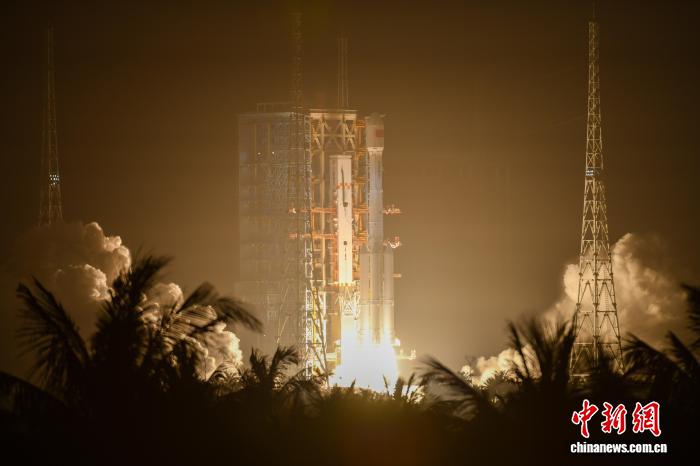
Core Viewpoint - The successful launch of the Long March 7A rocket and the deployment of the Shijian-28 satellite mark a significant achievement for China's aerospace industry, showcasing advancements in technology and operational capabilities [1] Group 1: Launch Details - The Long March 7A rocket was launched on November 30 at 20:20 from the Wenchang Space Launch Site [1] - The mission successfully placed the Shijian-28 satellite into its designated orbit, achieving a successful launch [1] - This mission represents the 611th flight of the Long March series of rockets [1] Group 2: Technological Advancements - The Long March 7A rocket is a new generation medium-sized high-orbit liquid launch vehicle developed by the China Aerospace Science and Technology Corporation [1] - The rocket features a 4.2-meter diameter fairing and utilizes a generalized ground measurement and control system for the first time, enhancing the level of standardization and intelligence of ground equipment [1] - The launch also employed a new mobile launch platform, further improving operational efficiency [1]
商业航天司官宣!回顾前期天上能源及商业火箭推荐观点
2025-12-01 00:49
Summary of Key Points from the Conference Call Industry Overview - The conference call focuses on the commercial aerospace industry, particularly developments in satellite launches and space computing capabilities [1][2][4]. Core Insights and Arguments - **Satellite Launches**: China Star Network is accelerating satellite launches, with an expectation to complete around 120 first-generation satellites by the end of 2025. A total of 324 enhanced satellites will be launched in the coming years, with a large-scale tender for second-generation satellites expected to start in early 2026, potentially reaching close to 1,000 satellites [1][2][3]. - **Production Capacity**: The Hainan Wenchang Aerospace City is set to produce its first satellite by the end of this year, aiming for a production capacity of 100 rockets and 1,000 satellites by 2027, and increasing to 150 rockets and 1,500 satellites by 2028 [1][3]. - **Reusable Rocket Technology**: Breakthroughs in reusable rocket technology are anticipated by 2027, which will significantly reduce launch costs. The cost per kilogram for heavy rockets could drop to a few hundred dollars with multiple recoveries [2][3][12]. - **Space Data Centers**: Beijing's "Starry Future" and "Orbital Dawn" are developing a space data center with a capacity of 1 GW, planned to be operational in phases from 2025 to 2035. The first phase aims for 200 kW and 1,000 PFlops of computing power [4][5]. - **Commercialization of Space Computing**: Domestic space computing has begun commercial operations, with "Trinity Computing" deploying 12 satellites with 5 PFlops of computing power, planning to expand to 2,800 satellites for a total of 10 billion FLOPS [4][5]. Additional Important Content - **Advantages of Space Data Centers**: Space data centers can operate 24/7 using solar energy, achieving five times the efficiency of ground-based systems. Their deployment and operational costs are significantly lower, with costs being one-fourth of ground-based centers [9][10]. - **Challenges in Space Computing**: The demand for data processing in space is increasing, with traditional methods being inefficient. The need for onboard processing to reduce data transmission back to Earth is critical [7][8]. - **Investment Opportunities**: Companies involved in solar energy systems for space data centers, such as Shanghai Port Bay and Tianzhou Optoelectronics, are highlighted as potential investment opportunities. The demand for solar arrays is expected to surge, with significant market potential for companies providing these technologies [10][18]. Conclusion - The commercial aerospace industry is poised for significant growth, driven by advancements in satellite technology, reusable rockets, and space computing capabilities. Investors are encouraged to focus on companies that are positioned to benefit from these trends, particularly in the areas of satellite production and space data center development [11][16][17].




中国成功发射实践二十八号卫星
Zhong Guo Xin Wen Wang· 2025-11-30 23:32
Group 1 - The core point of the article is the successful launch of the Shijian-28 satellite by China using the Long March 7A rocket, marking a significant achievement in China's space exploration efforts [1][3] - The Long March 7A rocket has now completed a total of 13 launch missions, with this being its fifth launch in 2025, indicating a trend of increasing reliability and efficiency in its operations [3] - The launch process has improved significantly, with the time required for launch preparation reduced from 35 days to 19 days, demonstrating enhanced operational efficiency to meet high-density launch demands [3] Group 2 - The Shijian-28 satellite was developed by the China Aerospace Science and Technology Corporation's Fifth Academy, showcasing the capabilities of China's aerospace engineering [1] - The Long March 7A rocket is characterized as a new generation medium-sized high-orbit liquid launch vehicle, reflecting advancements in China's rocket technology [1] - This mission represents the 611th flight of the Long March series of launch vehicles, highlighting the extensive experience and history of the Long March program in China's space endeavors [3]
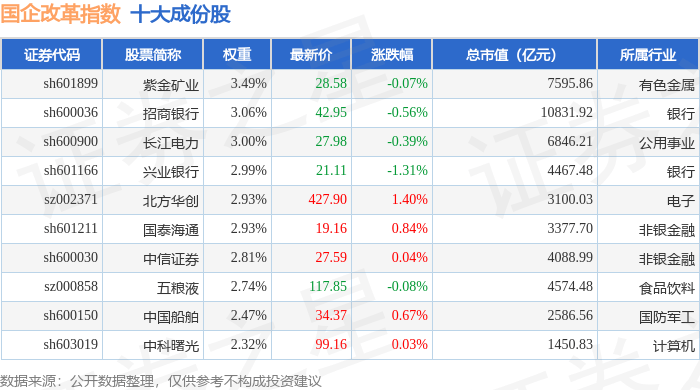
11月28日国企改革(399974)指数涨0.22%,成份股东方电气(600875)领涨
Sou Hu Cai Jing· 2025-11-28 10:40
Core Points - The State-Owned Enterprise Reform Index (399974) closed at 1841.64 points, up 0.22%, with a trading volume of 863.26 billion and a turnover rate of 0.48% [1] - Among the index constituents, 63 stocks rose, led by Dongfang Electric with a 5.56% increase, while 33 stocks fell, with China Merchants Shekou leading the decline at 2.63% [1] Index Constituents Summary - The top ten constituents of the State-Owned Enterprise Reform Index include: - Zijin Mining: Weight 3.49%, Latest Price 28.58, Market Cap 759.86 billion [1] - China Merchants Bank: Weight 3.06%, Latest Price 42.95, Market Cap 1083.19 billion [1] - Yangtze Power: Weight 3.00%, Latest Price 27.98, Market Cap 684.62 billion [1] - Industrial Bank: Weight 2.99%, Latest Price 21.11, Market Cap 446.75 billion [1] - North Huachuang: Weight 2.93%, Latest Price 427.90, Market Cap 310.00 billion [1] - Wenzhou Haidao: Weight 2.93%, Latest Price 19.16, Market Cap 337.77 billion [1] - CITIC Securities: Weight 2.81%, Latest Price 27.59, Market Cap 408.90 billion [1] - Wugong Liquid: Weight 2.74%, Latest Price 117.85, Market Cap 457.45 billion [1] - China Shipbuilding: Weight 2.47%, Latest Price 34.37, Market Cap 258.66 billion [1] - Zhongke Shuguang: Weight 2.32%, Latest Price 99.16, Market Cap 145.08 billion [1] Capital Flow Analysis - The net outflow of main funds from the index constituents totaled 788 million, while retail investors saw a net inflow of 768 million [3] - Notable capital flows include: - China Merchants Bank: Main net inflow 325 million, retail net inflow 35.88 million [3] - Zijin Mining: Main net inflow 151 million, retail net inflow 213 million [3] - Yangtze Power: Main net inflow 143 million, retail net outflow 11.30 million [3] - China Shipbuilding: Main net inflow 129 million, retail net outflow 52.74 million [3]