
FOTON(600166)

Search documents
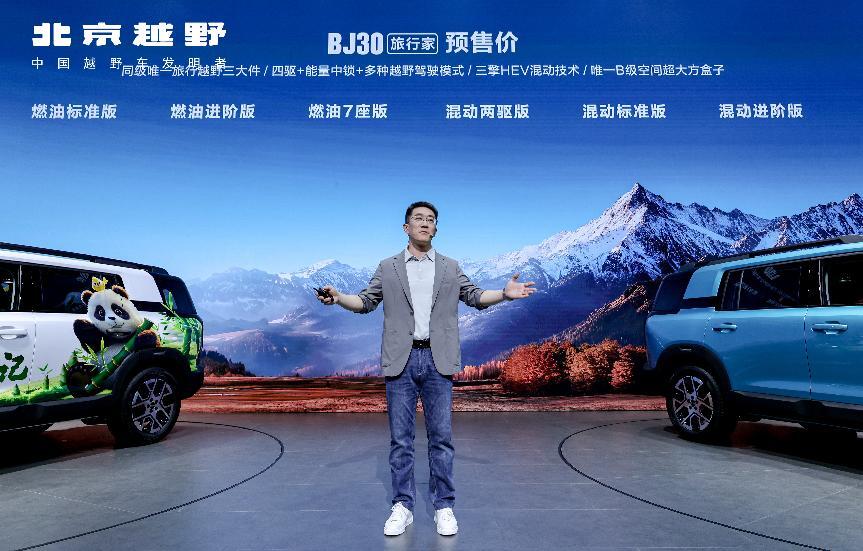
从连续月销破万到BJ30新车预售 北京越野缘何打开转型新局面
Bei Jing Ri Bao Ke Hu Duan· 2025-09-04 11:45
Core Insights - Beijing Off-road's BJ30 Travel Edition has officially started pre-sales at a price range of 102,900 to 139,900 yuan, aiming to redefine the perception of off-road vehicles as high fuel consumption products, thus embodying the company's strategic transformation [1] - The company reported a 103% year-on-year sales growth in the first half of the year, with sales exceeding 10,000 units for five consecutive months from April to August, indicating successful product renewal and technological upgrades [1][3] - The shift from a traditional "selling cars" approach to a user-centric model marks a significant transformation for Beijing Off-road, positioning it as a leader in user-oriented off-road vehicles [1][3] Strategic Focus - Beijing Off-road's commitment to the "off-road" and "light off-road" segments serves as a strategic foundation for its corporate renewal, allowing for precise allocation of R&D resources and team efforts towards technological breakthroughs and user needs [3] - The successful launch of models like BJ40 Extended Range and BJ40 Fuel is a result of coordinated changes in strategic positioning, management structure, user operations, and technological development [3] User-Centric Approach - The company's transformation emphasizes a user-centric perspective, as demonstrated by Chairman Wang Hao's role as "Product Experience Officer," which includes extensive real-world testing and user experience validation [4] - This shift from a technology-focused narrative to one centered on user value has fostered a company-wide culture that prioritizes user experience [4] "Off-road Equality" Initiative - Beijing Off-road has introduced the concept of "off-road equality," aiming to make off-road experiences accessible to a broader audience through a well-structured product matrix [6] - The launch of BJ40 Extended Range, which addresses high fuel consumption issues, and the subsequent introduction of BJ40 Fuel have lowered the barriers to entry for potential off-road users [6] - The BJ30 Travel Edition targets urban youth who are deterred by traditional off-road vehicle costs and fuel consumption, thus expanding the market reach [6] Brand Evolution - As a company with a rich history in China's off-road development, Beijing Off-road is redefining its brand identity from catering to hardcore enthusiasts to making off-road experiences available to the general public [7] - This shift not only broadens the user base but also translates brand influence into tangible sales growth, reinforcing the company's market position [7] User Ecosystem Development - The launch of the "Yueye·China" user ecosystem brand in May represents a key step in Beijing Off-road's transformation, creating a multi-dimensional system that connects products, services, communities, and culture [9] - Management's direct engagement with users through various platforms has accelerated product iterations and improvements based on user feedback [9] Quality Commitment - Beijing Off-road prioritizes quality, defining a problematic vehicle as a complete loss for users, and has implemented strategies to enhance delivery efficiency while maintaining quality standards [10] - The company's unique approach combines strategic focus on the off-road segment, breaking market boundaries through off-road equality, and a user-centric brand value reconstruction, setting a benchmark for the industry [10]


2025百度云智大会聚焦“AI+汽车” 产学研共探产业智能化跃迁路径
Zhong Guo Jing Ji Wang· 2025-09-04 09:28
Core Insights - The forum highlighted the integration of AI and the automotive industry as a key driver for enhancing global competitiveness in China's automotive sector [2][7] - Three main pathways for development were proposed: focusing on vehicle-cloud collaboration, enhancing understanding and application of AI technologies, and transforming automotive companies into AI-driven tech firms [2][7] Industry Trends - The competition in the "AI + automotive" sector is shifting from isolated technology comparisons to a comprehensive evaluation of system efficiency and ecosystem collaboration [3] - There is an anticipated high growth in demand for data and computing power over the next two years, emphasizing the need for robust technological foundations to support data security and compliance during automotive companies' international expansion [3] Technological Applications - AI is being applied across the entire automotive value chain, with significant advancements in areas such as multi-modal intelligent driving, high-precision mapping, and data synthesis, which have notably reduced data labeling costs [4] - Companies like Geely are leveraging AI to enhance product intelligence, operational efficiency, and industry-wide smart upgrades through their industrial internet platforms [4] Challenges and Solutions - Automotive companies face challenges such as "tool silos," "data breakpoints," and "disconnected processes" in AI application, prompting a shift from "technology-driven" to "business value-driven" approaches [5] - The need for enhanced cybersecurity measures is critical as vehicles become increasingly digital, with companies like Beiqi Foton implementing AI-enabled security operations to improve response times to threats [6] User Experience Enhancements - Advances in end-to-end voice technology are set to improve user interaction within vehicles, allowing for more natural and seamless communication [6][7] - The integration of conventional dialogue processing with intelligent agent collaboration is expected to elevate the smart cabin experience [7] Conclusion - The forum underscored the multi-dimensional value of AI in the automotive industry, with a consensus on the importance of vehicle-cloud collaboration, deep AI application, and the transformation of automotive companies into technology-centric entities as key drivers for high-quality development in the sector [2][7]


商用车板块9月4日跌0.19%,东风股份领跌,主力资金净流入2.02亿元
Zheng Xing Xing Ye Ri Bao· 2025-09-04 08:50
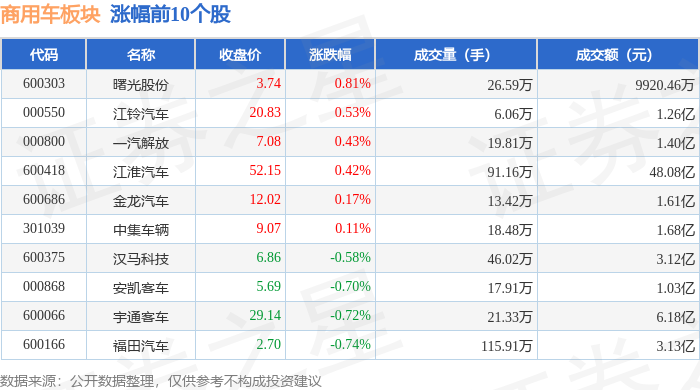
Market Overview - The commercial vehicle sector experienced a decline of 0.19% on September 4, with Dongfeng Motor leading the drop [1] - The Shanghai Composite Index closed at 3765.88, down 1.25%, while the Shenzhen Component Index closed at 12118.7, down 2.83% [1] Individual Stock Performance - Notable stock performances include: - Shuguang Co. (600303) closed at 3.74, up 0.81% with a trading volume of 265,900 shares [1] - Jiangling Motors (000550) closed at 20.83, up 0.53% with a trading volume of 60,600 shares [1] - Dongfeng Motor (600006) closed at 7.42, down 2.62% with a trading volume of 514,400 shares and a transaction amount of 383 million yuan [2] - Anhui Ankai Automobile (000868) closed at 5.69, down 0.70% with a trading volume of 179,100 shares [2] Capital Flow Analysis - The commercial vehicle sector saw a net inflow of 202 million yuan from institutional investors, while retail investors experienced a net inflow of 32.54 million yuan [2][3] - Key capital flows for individual stocks include: - Jianghuai Automobile (600418) had a net inflow of 335 million yuan from institutional investors [3] - Foton Motor (600166) experienced a net outflow of 12.92 million yuan from institutional investors [3] - Ankai Bus (000868) had a net outflow of 251,240 yuan from institutional investors [3]



8月多家车企销量创新高 新能源汽车和海外市场表现成亮点
Zhong Guo Zhi Liang Xin Wen Wang· 2025-09-04 05:00
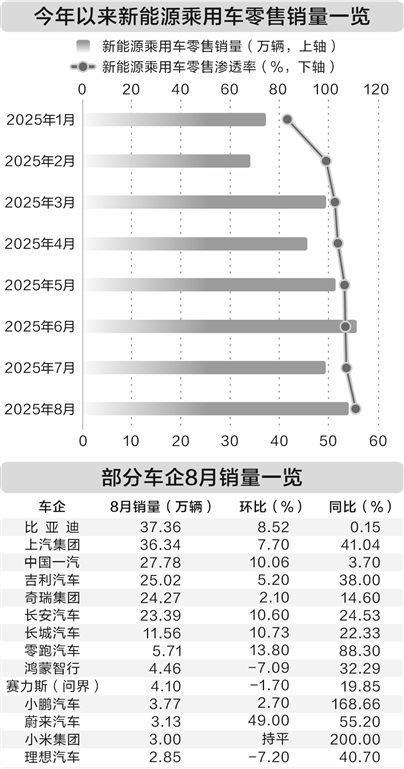
Group 1: Overall Market Performance - The automotive market in August showed strong performance, with many traditional and new energy vehicle companies achieving record sales [1][2] - The growth in sales was significantly supported by the performance of new energy vehicles and overseas markets [1] Group 2: Major Traditional Automakers - BYD's August sales reached 373,600 units, nearly flat compared to the same month last year, with cumulative sales of 2.864 million units from January to August, a 23% year-on-year increase [1] - SAIC Motor's total vehicle sales in August were 363,400 units, up 41.04% year-on-year, with new energy vehicle sales of 129,800 units, a 49.89% increase [1] - Geely's August sales were 250,200 units, a 38% increase, with new energy vehicle sales reaching 147,300 units, up 95% and accounting for 59% of total sales [1] Group 3: Emerging Automakers - Chery Group's August sales were 242,700 units, a 14.6% increase, with new energy vehicle sales of 71,200 units, up 53.1% [2] - Changan Automobile's August sales reached 233,000 units, with new energy vehicle sales of 88,000 units, an 80% increase [2] - Great Wall Motors achieved its best August sales with 115,600 units, a 22.33% increase, and new energy vehicle sales of 37,500 units, up 50.92% [2] Group 4: New Energy Vehicle Segment - New energy vehicle sales are a key driver for many automakers, with significant growth observed across various companies [1][2] - New entrants like Leap Motor achieved record deliveries of 57,100 units in August, an 88% year-on-year increase, while XPeng Motors delivered 37,700 units, a 169% increase [3] - NIO delivered 31,300 units in August, a 55.2% increase, marking a historical high for the company [3]



8月新能源汽车渗透率创新高!连续6个月超过五成
Zheng Quan Shi Bao· 2025-09-04 04:30
Sales Performance - In August, the total retail sales of passenger cars in China reached 1.952 million units, a year-on-year increase of 3% and a month-on-month increase of 7% [3] - The retail sales of new energy vehicles (NEVs) in August amounted to 1.079 million units, showing a year-on-year growth of 5% and a month-on-month increase of 9% [3] - The penetration rate of NEVs in the retail market reached 55.3% in August, marking a new monthly high and surpassing 50% for six consecutive months [3] Company Sales Data - BYD sold 373,600 vehicles in August, a slight increase of 543 units year-on-year [5] - SAIC Group's sales reached 363,400 units, with a significant year-on-year growth of 41.04% [2] - Changan Automobile reported sales of 233,900 units, reflecting a year-on-year increase of nearly 25% [5] - Geely Automobile sold 250,200 units, with a year-on-year increase of 38% [2] - Chery Group's sales were 242,700 units, up 14.6% year-on-year [5] - NIO delivered 31,300 vehicles, a year-on-year increase of 55.2%, surpassing Li Auto [5] - Leap Motor achieved a delivery volume of 57,100 units, marking an impressive year-on-year growth of over 88% [5] Market Outlook - The automotive market is expected to perform better in September due to the traditional peak season and the implementation of national and local purchase subsidies [5] - The cumulative retail sales of passenger cars for the year reached 14.698 million units, with a year-on-year increase of 9% [3] Stock Performance - The average stock price of automotive companies has increased by 7.02% year-to-date, with Qianli Technology showing the highest increase of 51.76% [6] - BYD reported a total revenue of 371.3 billion yuan for the first half of the year, a year-on-year increase of 23.3% [6] - Ankai Bus experienced the highest growth in net profit, with a year-on-year increase of 153.5% [6]



8月重卡狂飙8.7万辆!重汽2.2万封王 解放/东风超1.5万 福田/徐工暴涨 | 光耀评车
第一商用车网· 2025-09-04 03:48
Core Viewpoint - In August, China's heavy truck market achieved sales of 87,000 units, marking a nearly 40% year-on-year growth, indicating a strong recovery and potential to exceed 1 million units for the year [1][3][24]. Group 1: Market Performance - The heavy truck market in August saw a slight month-on-month increase of 2% compared to July, and a significant year-on-year increase of approximately 39% from 62,500 units [3][5]. - Cumulatively, from January to August, the heavy truck market reached 711,000 units sold, reflecting a year-on-year growth of about 14% [3][24]. - The August sales figure of 87,000 units is the second highest in the past eight years, only behind August 2020's 130,000 units [3]. Group 2: Factors Driving Growth - The growth in August is attributed to two main factors: a low base from the previous year and the implementation of a vehicle replacement policy for older trucks, which has stabilized the new truck market [5][10]. - Domestic terminal sales of heavy trucks are expected to have increased by nearly 50% year-on-year in August, further expanding from a 39% increase in July [5][8]. Group 3: Segment Performance - Both gas-powered and electric heavy trucks experienced significant year-on-year growth in August, with gas trucks rebounding after five months of decline [8][10]. - Electric heavy trucks saw a remarkable increase in terminal sales, exceeding 16,000 units in August, representing a year-on-year growth of over 160% [10][12]. - Diesel heavy trucks also showed a year-on-year increase of over 25% in August, although they faced a month-on-month decline of approximately 20% [10]. Group 4: Company Performance - China National Heavy Duty Truck Group (CNHTC) sold approximately 22,000 heavy trucks in August, maintaining its position as the market leader with a year-on-year growth of about 29% [12][14]. - FAW Jiefang sold around 16,500 heavy trucks in August, achieving a year-on-year growth of approximately 36% [16]. - Dongfeng Motor Corporation sold about 15,000 heavy trucks, with a notable year-on-year increase of 52% [18]. - Beiqi Foton and XCMG reported the highest growth rates among major companies, with Foton's sales increasing by 175% year-on-year [20][22]. Group 5: Future Outlook - The heavy truck market is on track to exceed 1 million units sold for the year, with an average monthly sales target of 73,000 units needed in the remaining months [24].

九三阅兵这些中国车震撼亮相!
Zhong Guo Qi Che Bao Wang· 2025-09-04 03:30
Group 1 - The event on September 3rd commemorated the 80th anniversary of the victory in the Chinese People's Anti-Japanese War and the World Anti-Fascist War, showcasing military and domestic automobile brands [1][25] - The Red Flag CA7601J, manufactured by FAW, served as the inspection vehicle, continuing a tradition of using Red Flag vehicles in major parades since 1958 [4][3] - Dongfeng participated with 115 vehicles, including 89 official review vehicles, marking its seventh participation in national parades since 1984 [6] Group 2 - Beijing Off-road showcased 61 BJ80 vehicles as artillery towing and news support vehicles, highlighting the brand's technological advancements and national confidence [10] - BYD contributed 23 pure electric sanitation vehicles, fulfilling sanitation support duties for the event, marking its third time in such a role [13] - North Benz Heavy Trucks deployed 28 vehicles equipped with radar and satellite jamming for electronic warfare, participating in the parade for the fifth consecutive time since 2009 [16] Group 3 - Yutong provided over 1,000 support vehicles, the largest fleet from a single brand, with nearly 200 high-end T7 models for core transportation tasks [23] - FAW Liberation, China National Heavy Duty Truck Group, and Shaanxi Automobile Heavy Truck also showcased various models, demonstrating China's industrial strength [23]


2025年中国警用车行业市场政策、产业链图谱、市场规模、竞争格局及发展趋势研判:国产品牌市场占有率超60%[图]
Chan Ye Xin Xi Wang· 2025-09-04 01:37
Overview - The police vehicle market in China is expected to reach a scale of 10.494 billion yuan in 2024, with a year-on-year growth of 3.23%, where police cars account for over 70% of the market [1][8][10] - The increasing complexity of crime and public expectations for safety are driving the demand for more advanced and specialized police vehicles [1][8] Market Policies - The Chinese government has implemented various policies to support the development of the automotive industry, including police vehicles, creating a favorable environment for growth [5][6] Industry Chain - The upstream of the police vehicle industry includes suppliers of power systems, chassis systems, braking systems, and other components, while the midstream consists of vehicle manufacturers, and the downstream includes users such as public security agencies and courts [6][8] Current Development - The demand for police vehicles is rising due to increased public safety investments and the need for vehicle upgrades, with a significant portion of the market focused on enhancing law enforcement capabilities [1][8] Competitive Landscape - Domestic brands like BYD, Hongqi, and Changan have become the main players in the police vehicle market, capturing over 60% market share in 2024, while foreign brands still dominate in specialized vehicles like armored cars [11][12] - BYD's Han DM-i model, featuring advanced technology and a long range, is highlighted as a key police vehicle [12] - New Handa (Chongqing) Intelligent Automotive Co., Ltd. specializes in smart special vehicles and emergency equipment, contributing to the police vehicle market [13]

阅兵中的中国车,争夺长安街一号位
汽车商业评论· 2025-09-03 23:15
Core Viewpoint - The article highlights the significant evolution of Chinese automotive brands, particularly in the context of national pride and military representation during the grand military parade celebrating the 70th anniversary of the victory in the Anti-Japanese War and World Anti-Fascist War, showcasing the transition from reliance on foreign vehicles to the prominence of domestic brands like Hongqi, Dongfeng, and Beijing [6][12][32]. Summary by Sections Historical Context - The first domestic vehicle, the "Dongfeng" car, was developed in 1958, marking the beginning of China's automotive journey. The first appearance of a domestic vehicle in a military parade was in 1959 with the Hongqi CA72 [9]. - Over the decades, Hongqi has become synonymous with state ceremonies, with various models being used in significant parades, including the CA7601J in 2019 and the latest iteration in 2025 [10][12]. Current Developments - The 2025 military parade featured a range of domestic vehicles, including 115 Dongfeng "Mans" military vehicles, emphasizing the brand's dominance in military logistics and support [19][22]. - Beijing Automotive Group's BJ80 also played a significant role in the parade, showcasing its long-standing relationship with national events since the 1960s [26][27]. Market Position and Strategy - Chinese automotive brands have shifted from being followers to leaders in the market, with significant advancements in technology and design, as evidenced by the high-profile presence of vehicles during national celebrations [7][32]. - The article notes that Chinese automotive parts hold a 60% market share in Russia, indicating the growing influence of Chinese manufacturers in international markets [7]. Product Offerings - The Hongqi brand has expanded its luxury offerings, with models like the Hongqi L5 and L3 being used for state visits, reflecting the brand's positioning in the high-end market [15][12]. - Dongfeng's military vehicles have been recognized for their quality and performance, contributing to the brand's reputation as a key player in China's defense sector [20][24]. Future Outlook - The article suggests that the ongoing development and participation of Chinese automotive brands in national events will continue to enhance their global standing and showcase China's industrial capabilities [32].

福田汽车20250903
2025-09-03 14:46
Summary of Foton Motor Conference Call Company Overview - **Company**: Foton Motor - **Industry**: Commercial Vehicles Key Points and Arguments 1. **Financial Performance**: - Foton Motor achieved an annualized ROE of 10.8% in the first half of 2025, the highest since 2013 [2][3] - Net operating cash flow increased fourfold to 1.89 billion yuan, with accounts receivable financing showing a positive change of 1.34 billion yuan [2][3] - The company reported a net profit attributable to shareholders of 550 million yuan, an 81% year-on-year increase, with Q2 revenue up 40% and net profit up 116% [3] 2. **Market Position**: - Heavy truck wholesale market share reached 12.3%, a nearly 5 percentage point increase, marking a ten-year high [3][4] - Domestic insurance market share rose to 11.7%, the highest in six years [3] 3. **Strategic Focus**: - The company is shifting its strategy to focus on commercial vehicles, developing proprietary technology platforms such as the new energy Aikang and Kavin [2][6] - Foton Motor's product range includes all types of commercial vehicles, with light trucks accounting for 50%-60% of revenue [2][11] 4. **Operational Flexibility**: - The company has a more flexible mechanism compared to traditional state-owned enterprises, with internal promotions for leadership roles [4][14] - Foton Motor has established sub-brands like "Kewen New Energy" to enhance flexibility and innovation [2][4] 5. **Technological Collaboration**: - The company relies on external partnerships for technology acquisition, collaborating with firms like Mercedes-Benz and Cummins [2][16] - This reliance has led to issues with autonomy and dependency on partners, particularly affecting operations in markets like Russia due to U.S. sanctions [2][16] 6. **Future Outlook**: - Foton Motor anticipates continued growth in the commercial vehicle sector, with projected net profits of 1.47 billion, 1.72 billion, and 2.15 billion yuan for 2025, 2026, and 2027 respectively [6][26] - The company expects to benefit from reduced impact from Foton Daimler, increased heavy truck exports, and stable growth in the powertrain business [6] 7. **Export Performance**: - Heavy and light vehicle exports are growing, with a 24% year-on-year increase in heavy truck exports in the first half of 2025 [4][21] - The company has established a strong presence in overseas markets, particularly in Latin America, with significant market shares in countries like Peru [9][22] 8. **Challenges and Risks**: - Historical losses from ventures like Baowo and Foton Daimler have impacted profitability, but core business segments remain robust [2][11] - The company faces challenges in maintaining technological independence while relying on joint ventures for innovation [16] 9. **Market Trends**: - The light truck market remains a key growth area, with Foton maintaining a leading market share of over 20% domestically [19] - The penetration rate of new energy vehicles has rapidly increased, reaching 15% in the first half of 2025, up 9 percentage points year-on-year [19] 10. **Investment Rating**: - The company maintains a "buy" rating based on competitive valuation and expected profit contributions from various segments, including light trucks and heavy truck exports [26] Additional Important Content - Foton Motor's historical strategy has included both expansion and trial strategies, leading to significant growth but also challenges due to lack of focus [17] - The company has a unique position in the market, balancing flexibility and operational efficiency while facing systemic constraints [14]