
YTO(600233)

Search documents
战略调整仍在进行 阿里巴巴拟再度减持圆通速递
Mei Ri Jing Ji Xin Wen· 2025-10-17 11:07
Group 1 - YTO Express (圆通速递) announced that its shareholder, Hangzhou Haoyue Enterprise Management Co., Ltd., plans to transfer up to 68 million shares, representing no more than 2% of the company's total share capital, through a block trade [1] - In the first half of 2023, YTO Express reported a revenue of 35.883 billion yuan, a year-on-year increase of 10.19%, and a net profit attributable to shareholders of 1.831 billion yuan, with express delivery business contributing 1.985 billion yuan to the net profit [1] - The company achieved a delivery volume of 14.863 billion parcels in the first half of 2023, reflecting a year-on-year growth of 21.79% [1] Group 2 - Shentong Express (申通快递) disclosed plans to acquire 100% of Zhejiang Daniao Logistics Technology Co., Ltd. for a transaction price of 362 million yuan, with Daniao Logistics being the operational entity of Cainiao Express [2] - Alibaba's strategy in the express delivery sector has shifted, as it has been reducing its stakes in logistics companies due to competitive pressures from platforms like Douyin, Kuaishou, and Pinduoduo, which do not hold significant stakes in logistics firms but still provide competitive logistics experiences [2] - In September 2023, Alibaba established a focus on "user-first" and "AI-driven" strategies, leading to a systematic exit from non-core assets, including the sale of its stakes in Intime Retail and Sun Art Retail [2]


阿里系再减持圆通速递,或套现11亿
Huan Qiu Lao Hu Cai Jing· 2025-10-17 08:37
Core Viewpoint - YTO Express's shareholder, Hangzhou Haoyue, plans to transfer up to 68.45 million shares through block trading, representing no more than 2% of the company's total share capital [1] Group 1: Shareholder Actions - Hangzhou Haoyue previously reduced its stake in YTO Express by selling 68.935 million shares between April and June this year, at an average price of 12.03-12.69 yuan per share, raising approximately 847 million yuan [1][2] - The current share sale could yield around 1.17 billion yuan, bringing the total cash raised from both sales to nearly 2 billion yuan [2] Group 2: Shareholding Structure - Before the current reduction, Hangzhou Haoyue held 310 million shares, accounting for 9.06% of YTO Express, making it the third-largest shareholder [2] - Together with Alibaba's investment entities, they collectively hold 18.75% of YTO Express [2] Group 3: Business Performance - In the first half of the year, YTO Express reported revenue of 35.883 billion yuan, a year-on-year increase of 10.19%, but net profit fell by 7.9% to 1.831 billion yuan, marking the first decline in semi-annual net profit in four years [2] - Despite the profit decline, YTO Express's market share increased, with a total parcel volume of 8.084 billion pieces in the second quarter, up 21.84% year-on-year, and market share rising to 16.0% [2] Group 4: Strategic Implications - Analysts suggest that the share reduction may be part of Alibaba's strategic adjustment in its logistics sector, focusing resources on international logistics and high-end delivery services [3] - The "Alibaba system" has also reduced stakes in other companies, aligning with its strategic focus on "AI + Cloud" and major consumer sectors [3]
物流板块10月17日跌1.6%,华光源海领跌,主力资金净流出6.58亿元
Zheng Xing Xing Ye Ri Bao· 2025-10-17 08:31
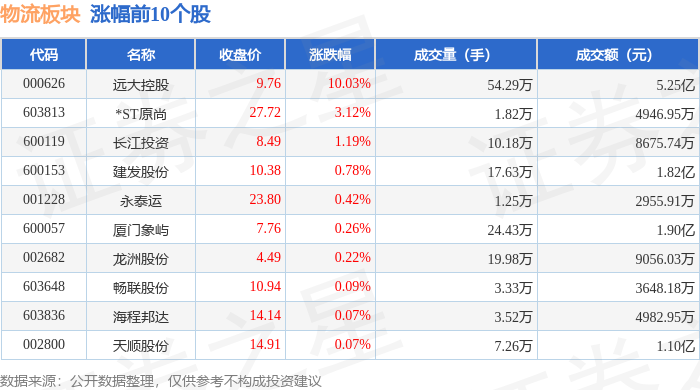
Core Viewpoint - The logistics sector experienced a decline of 1.6% on October 17, with major stocks like Huaguang Yuanhai leading the drop, while the Shanghai Composite Index fell by 1.95% and the Shenzhen Component Index decreased by 3.04% [1][2]. Group 1: Market Performance - The logistics sector's stocks showed mixed performance, with YD Holdings rising by 10.03% to close at 9.76, while Huami Yuanhai fell by 5.74% to 26.58 [1][2]. - The trading volume for YD Holdings was 542,900 shares, with a transaction value of 525 million yuan, indicating strong investor interest [1]. - The overall market saw significant declines, with the Shanghai Composite Index closing at 3839.76 and the Shenzhen Component Index at 12688.94 [1]. Group 2: Capital Flow - The logistics sector experienced a net outflow of 658 million yuan from institutional investors, while retail investors saw a net inflow of 471 million yuan [2][3]. - Notable stocks like Xiamen Guomao and Jianda Co. had varying net inflows and outflows, with Xiamen Guomao seeing a net inflow of 15.31 million yuan from institutional investors [3]. - The overall capital flow indicates a shift in investor sentiment, with retail investors showing more confidence compared to institutional investors [2][3].


开盘:三大指数小幅低开 兵装重组概念跌幅居前
Xin Lang Cai Jing· 2025-10-17 02:10
Market Overview - The three major indices opened slightly lower, with the Shanghai Composite Index at 3912.04 points, down 0.11%, the Shenzhen Component at 13060.24 points, down 0.20%, and the ChiNext Index at 3026.40 points, down 0.36% [1] Economic and Trade Developments - The Chinese Ministry of Commerce expressed an open attitude towards equal consultations based on mutual respect regarding potential new trade talks with the U.S. [2] - The Ministry of Industry and Information Technology is promoting a nationwide "millisecond computing" network construction initiative, aiming for comprehensive coverage and efficiency by 2027 [2] - The U.S. is considering extending the suspension of tariffs on China in exchange for delaying rare earth export controls, with China reiterating its stance on these issues [2] - Chinese Commerce Minister Wang Wentao met with Apple CEO Tim Cook, discussing U.S.-China trade relations and encouraging Apple to deepen cooperation and investment in China [2] - TSMC noted strong demand for AI applications, exceeding previous expectations, and is working to enhance Cowos capacity by 2026 [2] Company Announcements - Oriental Cable announced winning contracts totaling 2.374 billion yuan for ±500kV DC sea-land cable products and construction projects [3] - Zhaofeng Co. signed a strategic cooperation framework agreement with Nuoan Robotics [3] - TBEA announced a subsidiary's plan to acquire a 74.19% stake in Shuguang Cable for 946 million yuan [3] - Zhongtian Technology reported winning multiple marine project contracts totaling approximately 1.788 billion yuan [3] - Huatian Technology plans to acquire 100% of Huayi Microelectronics [3] - ZhiGuang Electric intends to purchase all or part of ZhiGuang Energy's minority equity [3] - ChipLink Integration plans to increase capital by 1.8 billion yuan to its controlling subsidiary [3] - Shijia Photon reported a 728% year-on-year increase in net profit for the first three quarters [3] - Rongzhi Rixin expects a net profit increase of 871%-908% year-on-year for the first three quarters [3] - Guangsheng Nonferrous anticipates a net profit of 100 million to 130 million yuan for the first three quarters [3] Corporate Changes - Fuyao Glass announced that its actual controller, Cao Dewang, resigned as chairman, with his son, Cao Hui, elected as the new chairman [4] - YTO Express reported that its third-largest shareholder, Hangzhou Haoyue, plans to transfer up to 2% of the company's shares through block trading [4] - Tongfu Microelectronics' largest shareholder, Huada Group, plans to reduce its stake by no more than 1% [4] - Debang Technology's largest shareholder, the National Big Fund, reduced its holdings by 1.5173 million shares from September 29 to October 15 [4] Regulatory Issues - Hainan Huatie announced that it is under investigation by the China Securities Regulatory Commission for suspected violations of information disclosure [5] U.S. Market Performance - The U.S. Senate failed to advance a temporary funding bill, increasing recession expectations [6] - U.S. stock indices closed lower, with the Dow down 0.65%, Nasdaq down 0.47%, and S&P 500 down 0.63% [7] Technology Developments - Apple is preparing to launch a new Mac computer featuring a touch screen, with the new MacBook Pro expected to include a touch display, a lighter body, and M6 series chips [8] - Oracle disclosed that its RPO has exceeded $500 billion, projecting $225 billion in revenue by fiscal year 2030, with adjusted earnings per share expected to reach $21 [9] Commodity Market - COMEX gold futures rose by 3.4% to $4344.3 per ounce, while COMEX silver futures increased by 3.99% to $53.43 per ounce, both reaching new closing highs [9] Market Sentiment - Zhongyuan Securities noted that the A-share market experienced slight fluctuations, with banking, automotive, communication equipment, and coal sectors performing well, while precious metals and wind power sectors lagged [10] - Dongguan Securities highlighted that the A-share market faced a pullback, with concerns over U.S. government "shutdown" increasing recession expectations [11]


10月16日增减持汇总:暂无增持 德邦科技等19股减持(表)




Xin Lang Zheng Quan· 2025-10-16 13:52
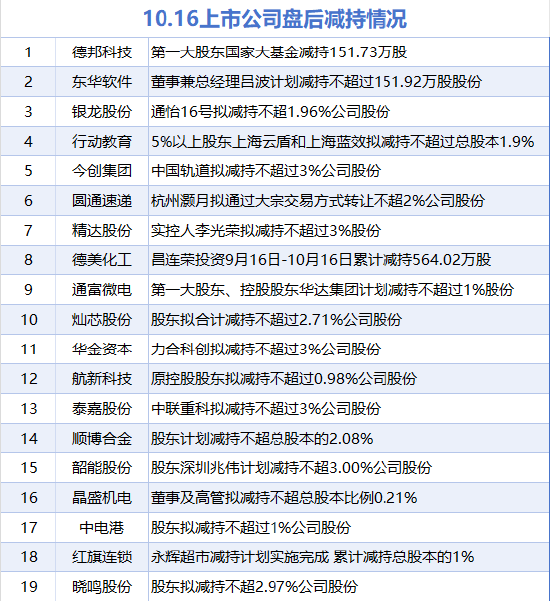
Core Insights - On October 16, no A-share listed companies disclosed any increase in shareholding, while 19 companies announced share reductions [1] Summary by Category Share Reduction Details - Debon Technology: The largest shareholder, the National Big Fund, reduced holdings by 1.5173 million shares [2] - Donghua Software: The director and general manager, Mu Bo, plans to reduce holdings by no more than 1.5192 million shares [2] - Yinlong Co., Ltd.: Proposed to reduce no more than 1.96% of the company's shares [2] - Action Education: Shareholders Shanghai Yundun and Shanghai Lanxiao plan to reduce no more than 1.9% of total share capital [2] - Jinchuan Group: China Railway plans to reduce no more than 3% of the company's shares [2] - YTO Express: Hangzhou Haoyue intends to transfer no more than 2% of the company's shares through block trading [2] - Jingda Co., Ltd.: The actual controller, Li Guangrong, plans to reduce no more than 3% of shares [2] - Demai Chemical: Chang Lianrong Investment reduced holdings by 5.6402 million shares from September 16 to October 16 [2] - Tongfu Microelectronics: The largest shareholder, Huada Group, plans to reduce no more than 1% of shares [2] - Canxin Co., Ltd.: Shareholders plan to reduce no more than 2.71% of the company's shares [2] - Legend Capital: Lihua Science and Technology plans to reduce no more than 3% of the company's shares [2] - Hangxin Technology: The original controlling shareholder plans to reduce no more than 0.98% of shares [2] - Taijia Co., Ltd.: Zhonglian Heavy Industry plans to reduce no more than 3% of the company's shares [2] - Shunbo Alloy: Shareholders plan to reduce no more than 2.08% of total share capital [2] - Shaolong Co., Ltd.: Shareholder Shenzhen Zhaowei plans to reduce no more than 3% of the company's shares [2] - Jingcheng Machinery: Directors and executives plan to reduce no more than 0.21% of total share capital [2] - Zhongdian Port: Shareholders plan to reduce no more than 1% of the company's shares [2] - Hongqi Chain: Yonghui Supermarket completed its reduction plan, cumulatively reducing 1% of total share capital [2] - Xiaoming Co., Ltd.: Shareholders plan to reduce no more than 2.97% of the company's shares [2]
圆通速递(600233.SH):阿里巴巴集团下属杭州灏月拟大宗交易转让不超2%公司股份
智通财经网· 2025-10-16 13:48
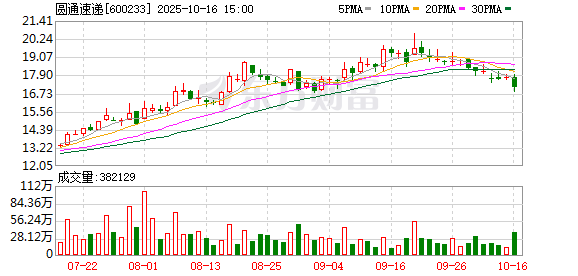
Core Viewpoint - YTO Express (600233.SH) announced that its shareholder Hangzhou Haoyue Enterprise Management Co., Ltd. plans to transfer up to 68.451 million shares through block trading within three months after the announcement, representing no more than 2% of the company's total share capital [1] Group 1 - The transfer of shares is set to occur within three months following the announcement date [1] - Hangzhou Haoyue is an enterprise controlled by Alibaba Group Holding Limited [1]
圆通速递:阿里巴巴集团下属杭州灏月拟大宗交易转让不超2%公司股份
Zhi Tong Cai Jing· 2025-10-16 13:45
Core Viewpoint - YTO Express (600233.SH) announced that its shareholder, Hangzhou Haoyue Enterprise Management Co., Ltd., plans to transfer up to 68.451 million shares through block trading within three months after the announcement, representing no more than 2% of the company's total share capital [1] Group 1 - The planned share transfer is set to occur 15 trading days after the announcement [1] - Hangzhou Haoyue is an enterprise controlled by Alibaba Group Holding Limited [1]
【财闻联播】雷军最新发声!时隔七个月,阿里系再度出手
券商中国· 2025-10-16 12:55
Macro Dynamics - The Chinese Ministry of Commerce will continue litigation against the U.S. for its clean energy subsidies that discriminate against Chinese products, despite the U.S. terminating certain provisions of the Inflation Reduction Act [2] - The People's Bank of China and the Central Bank of Iceland have renewed a bilateral currency swap agreement worth 35 billion RMB (700 million Icelandic króna) to enhance financial cooperation [3] - China expresses strong dissatisfaction with the UK's unilateral sanctions against Chinese companies, emphasizing the need to protect legitimate rights and interests [4] Market Data - A-shares experienced a collective pullback with total market turnover falling below 2 trillion RMB, marking a decrease of 141.7 billion RMB from the previous trading day [7][8] - The financing balance in the two markets increased by 2.3 billion RMB, with the Shanghai Stock Exchange reporting a balance of 1.236 trillion RMB and the Shenzhen Stock Exchange at 1.189 trillion RMB [9] Company Dynamics - Xiaomi's founder, Lei Jun, stated that AI models are the future of smart connected vehicles, with the company having delivered approximately 400,000 vehicles in a year and a half [11] - YTO Express announced that its third-largest shareholder, Hangzhou Haoyue, plans to transfer up to 2% of its shares through block trading, continuing a trend of share reduction [12] - Changan Automobile's Zhu Huarong revealed plans to mass-produce humanoid automotive robots by 2028 and flying cars by 2030 [13][14] - Guangsheng Nonferrous Metals expects a net profit of 100 to 130 million RMB for the first three quarters of 2025, marking a turnaround from losses due to improved market conditions in rare earths [16]


圆通速递:关于持股5%以上股东大宗交易减持股份计划的公告
Zheng Quan Ri Bao· 2025-10-16 12:10
(文章来源:证券日报) 证券日报网讯 10月16日晚间,圆通速递发布公告称,截至本公告披露日,公司股东杭州灏月企业管理 有限公司(简称"杭州灏月")持有公司310,244,613股无限售条件流通股,占公司总股本的9.06%。公 司于2025年10月16日收到杭州灏月通知,出于股东自身发展战略和资金筹划考虑,杭州灏月拟通过大宗 交易方式转让公司股份不超过68,450,994股,拟转让比例不超过公司总股本的2%。 ...
10月16日晚间公告 | 兆丰股份与纽鼐机器人签订战略合作框架协议;智光电气拟购买控股子公司智光储能股权
Xuan Gu Bao· 2025-10-16 12:07
Resumption of Trading - Zhiguang Electric plans to issue new shares to purchase all or part of the minority equity of Guangzhou Zhiguang Energy Technology, leading to the resumption of its stock trading [1] Mergers and Acquisitions - Guotou Fengle's acquirer, Guotou Seed Industry, intends to subscribe for no more than 184 million shares at a price of 5.91 yuan per share [2] Share Buybacks and Equity Transfers - Zhijiang Biology plans to repurchase shares worth between 60 million to 120 million yuan [3] - YTO Express, for strategic and financial planning reasons, intends to transfer no more than 2% of its shares through block trading by Hangzhou Haoyue [4] Daily Operations and External Investments - Zhaofeng Co. signed a strategic cooperation framework agreement with NiuNai Robotics, focusing on cognitive and humanoid robot development [5] - Huayu Automotive completed the acquisition of a 49% stake in Shanghai SAIC Qingtao Energy Technology Co., Ltd. [6] - Dingjide's high-end new material project for petrochemical technology, POE industrialization device, has been put into production [7] - Chiplink Integration plans to increase capital by 1.8 billion yuan to ensure the ongoing implementation of its 12-inch integrated circuit analog mixed-signal chip manufacturing project [7] - Shanghai Xiba has obtained the IATF16949 automotive quality management system certification for the design and production of silicon-carbon anode materials for new energy batteries [7] - Zhongtian Technology won multiple marine series projects in deep-sea technology, totaling approximately 1.788 billion yuan [8] - TBEA's subsidiary plans to acquire 74.19% of Shuguang Cable for 946 million yuan, specializing in 1E-level K1 and K3 cables for nuclear power plants [8] - Junshi Biosciences received FDA approval for the clinical trial application of JS207 for neoadjuvant therapy in non-small cell lung cancer patients [9] - Longbai Group's subsidiary intends to acquire assets related to Venator UK's titanium dioxide business [10] - Yunnan Energy Investment is investing 1.872 billion yuan to construct a 350MW compressed air energy storage demonstration project in Kunming Anning [11] Performance Changes - Shijia Photon reported a net profit of 299 million yuan for the first three quarters, a year-on-year increase of 728%, with orders for optical chips and devices increasing [12] - Guangku Technology expects a net profit of 110 million yuan for the first three quarters, a year-on-year increase of 97.00%-117.00%, driven by technological innovation and new product launches [12] - Rongzhi Rixin anticipates a net profit of 26.4 million to 27.4 million yuan for the first three quarters, a year-on-year increase of 871.30%-908.09% [13] - Guangsheng Nonferrous expects a net profit of 100 million to 130 million yuan for the first three quarters, a year-on-year increase of 136.29% to 147.18%, due to rising rare earth market prices [14] - Aobi Zhongguang expects to achieve a net profit of approximately 108 million yuan for the first three quarters, returning to profitability with rapid growth in various business areas [15] - Cangge Mining reported a net profit of 951 million yuan in the third quarter, a year-on-year increase of 66.49% [15]


