
YTO(600233)

Search documents
物流板块8月15日涨1.1%,圆通速递领涨,主力资金净流入2.66亿元
Zheng Xing Xing Ye Ri Bao· 2025-08-15 08:37
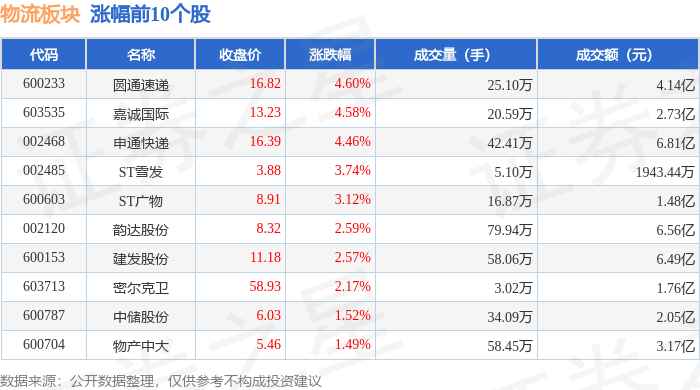
证券之星消息,8月15日物流板块较上一交易日上涨1.1%,圆通速递领涨。当日上证指数报收于 3696.77,上涨0.83%。深证成指报收于11634.67,上涨1.6%。物流板块个股涨跌见下表: 从资金流向上来看,当日物流板块主力资金净流入2.66亿元,游资资金净流出1.27亿元,散户资金净流出 1.38亿元。物流板块个股资金流向见下表: | 代码 | 名称 | 主力净流入(元) | 主力净占比 游资净流入(元) | | 游资净占比 散户净流入 (元) | | 散户净占比 | | --- | --- | --- | --- | --- | --- | --- | --- | | 002468 申通快递 | | - 8951.40万 | 13.14% | -159.63万 | -0.23% | -8791.76万 | -12.91% | | 002120 韵达股份 | | 8538.34万 | 13.02% | 1355.74万 | 2.07% | -9894.08万 | -15.08% | | 603056 德邦股份 | | 3030.64万 | 5.98% | -969.09万 | -1.91% | -20 ...


快递行业深度报告:快递价格洼地修复决心再现,反内卷新阶段展望
Shenwan Hongyuan Securities· 2025-08-15 08:15
Investment Rating - The report indicates a positive outlook for the express delivery industry, suggesting a potential recovery in pricing and profitability, with specific recommendations for companies like Shentong Express, YTO Express, and Jitu Express [3][66]. Core Insights - The current market dynamics are characterized by a recovery in express delivery prices, driven by both top-down and bottom-up pressures for price increases, indicating a shift away from intense price competition [3][66]. - The report outlines three scenarios for the future of the industry: 1) elimination of price disparities leading to sustained profit recovery and significant dividends; 2) continuation of competitive dynamics with increased industry fragmentation; 3) potential for higher-level mergers and acquisitions to optimize supply-side dynamics [39][66]. Summary by Sections Market Dynamics - The express delivery sector is experiencing a recovery phase, with significant price increases observed in regions like Guangdong and Yiwu, reflecting a commitment to eliminate price disparities [3][66]. - The report highlights that the express delivery price is a crucial driver of stock performance, with public fund holdings previously at low levels [6][66]. Company Recommendations - Recommended companies include Shentong Express for its high volume growth and profit improvement potential, YTO Express for its clear strategy and digital transformation, and Jitu Express for benefiting from high growth in Southeast Asian e-commerce [66]. - Zhongtong Express is noted for its market share recovery and profit rebound potential, while Yunda Express is recognized for its stable operations and improving network health [66]. Pricing Strategies - The report discusses the complexity of pricing policies in the express delivery sector, emphasizing the need for effective management of pricing strategies to maintain network stability and profitability [17][24]. - It also mentions that the stability of delivery fees is critical for the development of the industry, as it directly impacts the income of delivery personnel and overall service quality [30][32]. Future Outlook - The express delivery industry is expected to evolve towards a model resembling public utilities, with stable profits and cash flows leading to increased dividend payouts [43][66]. - The report suggests that the industry may see a shift from a consumer-driven PE valuation to a dividend yield-based valuation as profitability stabilizes [43][66].


交通运输行业8月投资策略:快递“反内卷”举措持续兑现,业绩期关注优质个股
Guoxin Securities· 2025-08-15 02:11
Group 1: Shipping Industry - The oil shipping market is expected to see a recovery in rates due to OPEC+'s decision to increase production, with VLCC freight rates experiencing significant increases [1][21] - The current supply situation is relatively tight, and any marginal changes in demand could have a multiplier effect on freight rates, leading to recommendations for COSCO Shipping Energy and China Merchants Energy [1][21] - The container shipping sector is facing pressure on profitability due to weakening cargo volumes and ongoing trade risks, with a recommendation to monitor COSCO Shipping Holdings for potential alpha opportunities [1][25] Group 2: Aviation Industry - The domestic passenger flight volume has shown a slight increase, with overall and domestic flight volumes up by 0.6% and 0.5% respectively compared to the previous week, indicating a recovery trend [2][36] - The average ticket price for domestic routes has decreased by 8.7% year-on-year, while the passenger load factor has improved slightly, suggesting a mixed performance in the aviation sector [2][36] - Investment recommendations include China Southern Airlines, China Eastern Airlines, and Spring Airlines, as the aviation sector is expected to benefit from economic recovery [2][45] Group 3: Express Delivery Industry - The "anti-involution" policy initiated on July 1 aims to reduce competition in the express delivery sector, with price increases already observed in regions like Zhejiang and Guangdong [3][53] - The policy is expected to lead to improved profitability and service quality in the express delivery industry, with a focus on monitoring the execution and sustainability of price increases [3][54] - Recommendations include SF Express, ZTO Express, YTO Express, and Shentong Express, as these companies are likely to benefit from the policy changes and market dynamics [3][66] Group 4: Logistics Sector - The logistics sector is facing challenges due to external economic pressures and internal strategy adjustments, with companies like DeBang Logistics experiencing significant profit declines [79] - Eastern Airlines Logistics is highlighted as a leader in the air cargo market, benefiting from a strong market share and operational efficiencies [79][80] - Investment focus should be on companies that can adapt to the changing market conditions and maintain competitive advantages [79][80]


物流板块8月14日跌0.66%,万林物流领跌,主力资金净流出5.1亿元
Zheng Xing Xing Ye Ri Bao· 2025-08-14 08:33
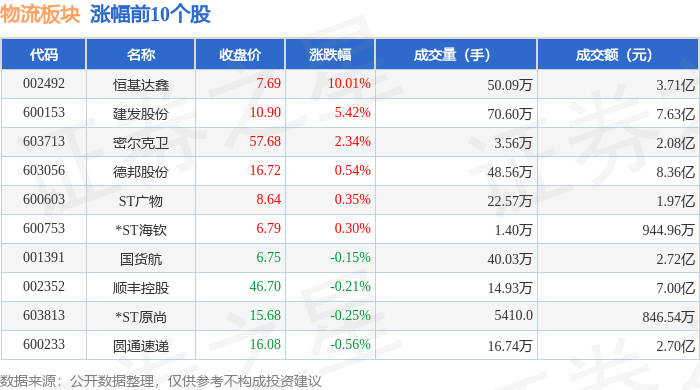
Market Overview - On August 14, the logistics sector declined by 0.66%, with Wanlin Logistics leading the drop [1] - The Shanghai Composite Index closed at 3666.44, down 0.46%, while the Shenzhen Component Index closed at 11451.43, down 0.87% [1] Individual Stock Performance - Hengji Dazheng (002492) saw a significant increase of 10.01%, closing at 7.69 with a trading volume of 500,900 shares and a turnover of 371 million yuan [1] - Jianfa Co. (600153) increased by 5.42%, closing at 10.90 with a trading volume of 706,000 shares and a turnover of 763 million yuan [1] - Wanlin Logistics (603117) experienced a decline of 5.34%, closing at 5.50 with a trading volume of 248,700 shares and a turnover of 138 million yuan [2] Capital Flow Analysis - The logistics sector experienced a net outflow of 510 million yuan from institutional investors, while retail investors saw a net inflow of 426 million yuan [2] - The table of capital flow indicates that Hengji Dazheng had a net inflow of 74.71 million yuan from institutional investors, while retail investors had a net outflow of 37.49 million yuan [3] Summary of Key Stocks - The top performers in terms of net inflow from institutional investors included Hengji Dazheng and Shunfeng Holdings (002352), which had a net inflow of 55.99 million yuan [3] - Other notable stocks with significant trading activity included Mierkewei (603713) and ST Guangwu (600603), with net inflows of 14.32 million yuan and 12.32 million yuan from institutional investors, respectively [3]




快递涨价了,但快递公司都在准备价格战
远川研究所· 2025-08-13 13:11
Core Viewpoint - The article discusses the recent price increase in the express delivery industry in Guangdong, which is seen as a response to the ongoing price war and declining average prices in the sector. The price adjustment is expected to have significant implications for the market dynamics and competition among delivery companies [4][6]. Group 1: Price Increase and Market Dynamics - Guangdong's express delivery base price was raised to 1.4 yuan per ticket, marking a 40% increase, aimed at curbing low-price competition and ensuring market stability [4][6]. - The express delivery sector in Guangdong is crucial, accounting for approximately 25% of the national total, with 234.3 billion packages sent in the first half of the year [4][6]. - Despite the price increase, the underlying issues of fierce competition and price wars in the express delivery industry remain unresolved [4][6]. Group 2: Historical Price Trends - The average price per express delivery ticket in China dropped from 8.14 yuan to 7.52 yuan in the first half of the year, a year-on-year decline of 7.7% [6]. - Over the past five years, the express delivery industry has experienced a continuous decline in average ticket prices, with a total decrease of 32% [11][22]. - The express delivery market has seen a tenfold increase in volume over the past decade, with a projected 1.758 billion packages to be delivered in 2024, reflecting a year-on-year growth of 21.5% [22][29]. Group 3: Competitive Landscape - The express delivery industry is characterized by intense competition, with major players struggling to establish a stable market structure. The top eight companies hold 85.2% of the market share, a modest increase of 2.7% over five years [19][22]. - The market remains fragmented, with new entrants and investments continuing to flood in, exacerbating the price competition [26][29]. - The industry's growth is heavily tied to the e-commerce sector, which drives demand for delivery services, further intensifying competition among providers [26][29]. Group 4: Investment and Operational Challenges - Companies in the express delivery sector are investing heavily in fixed assets, such as sorting facilities and transportation vehicles, often outpacing revenue growth [27][29]. - The fixed asset growth for companies like YTO Express has been significantly higher than revenue growth, indicating a focus on capacity expansion despite ongoing price wars [27][29]. - The article suggests that as long as the express delivery volume continues to grow rapidly, the price wars are unlikely to cease, creating a challenging environment for profitability [29].


物流板块8月13日跌0.32%,恒基达鑫领跌,主力资金净流出4.21亿元
Zheng Xing Xing Ye Ri Bao· 2025-08-13 08:41
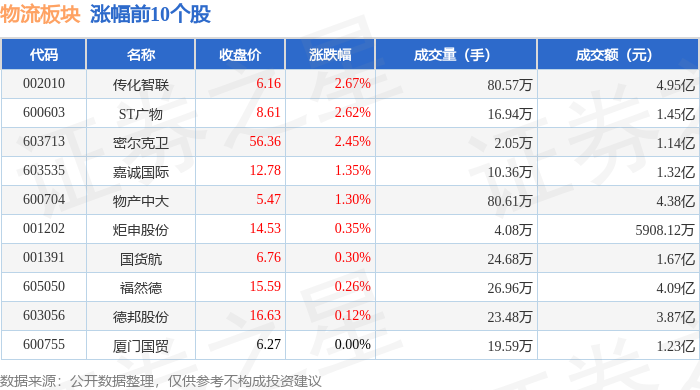
Market Overview - On August 13, the logistics sector declined by 0.32% compared to the previous trading day, with Hengji Daxin leading the decline [1] - The Shanghai Composite Index closed at 3683.46, up 0.48%, while the Shenzhen Component Index closed at 11551.36, up 1.76% [1] Stock Performance - Notable gainers in the logistics sector included: - Chuanhua Zhili (002010) with a closing price of 6.16, up 2.67% and a trading volume of 805,700 shares [1] - ST Guangwu (600603) closed at 8.61, up 2.62% with a trading volume of 169,400 shares [1] - Milkway (603713) closed at 56.36, up 2.45% with a trading volume of 20,500 shares [1] - Major decliners included: - Hengji Daxin (002492) closed at 6.99, down 5.41% with a trading volume of 388,400 shares [2] - Tiensheng Co. (002800) closed at 15.83, down 4.41% with a trading volume of 306,300 shares [2] - Haichen Co. (300873) closed at 26.01, down 3.60% with a trading volume of 163,100 shares [2] Capital Flow - The logistics sector experienced a net outflow of 421 million yuan from institutional investors, while retail investors saw a net inflow of 223 million yuan [2] - The main capital inflow and outflow for selected stocks included: - Chuanhua Zhili (002010) had a net inflow of 42.89 million yuan from institutional investors [3] - ST Guangwu (600603) saw a net inflow of 29.48 million yuan from institutional investors [3] - Yunda Co. (002120) had a net inflow of 16.05 million yuan from institutional investors [3]


快递费上调确认!继义乌后,广东也涨了:底价上调0.4元,各家不得低于1.4元揽收
Mei Ri Jing Ji Xin Wen· 2025-08-13 08:35
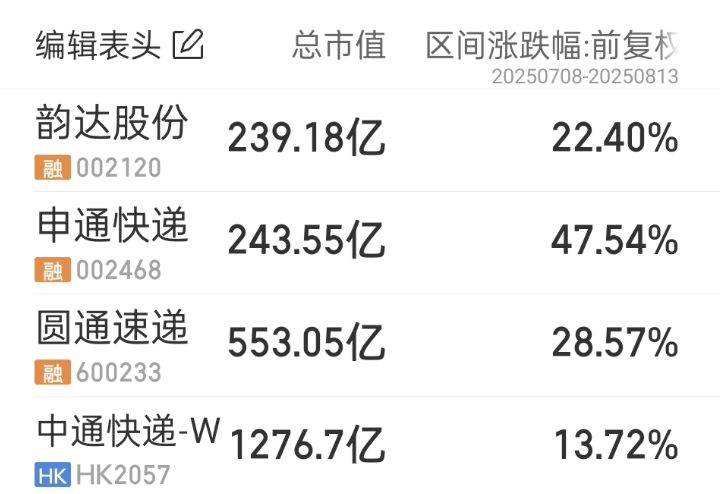
Core Viewpoint - The express delivery industry in Guangdong has implemented a price increase, raising the minimum cost per ticket to 1.4 yuan, which is expected to stabilize the financial situation of many delivery companies after a prolonged period of low pricing competition [1][2]. Group 1: Price Increase Details - Starting from August 5, the overall base price for express delivery in Guangdong has been raised by 0.4 yuan per ticket, with the average price exceeding 1.4 yuan [1]. - The increase in base price is aimed at ensuring that no express delivery company can collect below the cost price of 1.4 yuan, particularly affecting e-commerce clients who have high delivery demands [1]. - Prior to Guangdong, the city of Yiwu in Zhejiang province had already initiated a price increase mechanism, raising the base price from 1.1 yuan to 1.2 yuan [1]. Group 2: Industry Background - The express delivery industry has been suffering from a "low-price for volume" competition model, leading to reduced profit margins for grassroots outlets and poor service quality [2]. - The average price per ticket for express delivery in China has significantly decreased from 28.55 yuan in 2007 to 7.49 yuan as of June this year [2]. - Major express companies like SF Express, Shentong, Yunda, YTO, and Zhongtong have seen their average ticket revenues drop by approximately 40% since their listings in 2017, with only Zhongtong showing a slight increase [2]. Group 3: Regulatory Environment - The State Post Bureau has emphasized the need for stronger industry regulation and has opposed "involutionary" competition, aiming to improve service quality in the express delivery sector [3]. - Following these regulatory discussions, stocks of major express companies have surged, with Yunda's stock price increasing by 22.4%, Shentong by 47.54%, YTO by 28.57%, and Zhongtong by 13.72% [3][4].
广东快递底价上调0.4元:运费整体上涨,对低客单价商家影响大
Sou Hu Cai Jing· 2025-08-12 09:13
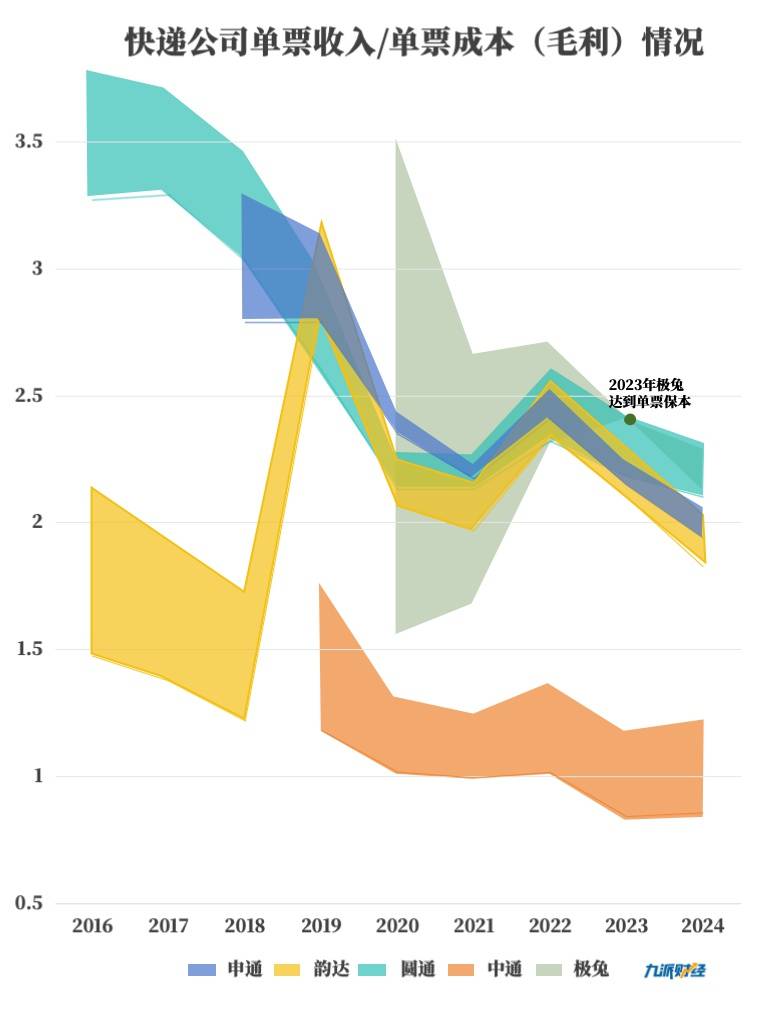
Core Viewpoint - The recent increase in express delivery base prices in Guangdong and Yiwu reflects concerns over the intense competition and low profitability in the express delivery industry, which has led to a downward trend in per-package revenue for major companies [1][2][3]. Group 1: Price Adjustments - Starting from August 4, the base price for express delivery in Guangdong has been raised by 0.4 yuan per package, bringing the average price to over 1.4 yuan [1]. - Yiwu also raised its express delivery base price by 0.1 yuan to 1.2 yuan starting July 18 [1]. - The overall express delivery costs have increased by approximately 0.4 yuan, although delivery personnel have not yet received news of a corresponding increase in their compensation [1]. Group 2: Revenue Trends - Major express companies, including Shentong, Yunda, Zhongtong, and Yunda, have seen a significant decline in per-package revenue, with figures for 2024 projected at 2.05 yuan, 2.3 yuan, 1.21 yuan, and 2.01 yuan respectively, representing a decrease of about 30% to 40% compared to 2019 [3]. - In June, Shentong and Yunda reported further declines in per-package revenue, dropping below the 2 yuan mark to 1.99 yuan and 1.91 yuan respectively, while Zhongtong decreased to 2.1 yuan [5]. - SF Express maintains a relatively stable per-package revenue of around 15 to 16 yuan, but has also experienced a decline of 11% to 14% compared to the previous year due to industry price wars [5][12]. Group 3: Delivery Challenges - The continuous decline in per-package revenue has led express companies to implement cost control measures, including reducing delivery fees for last-mile services [7]. - The delivery personnel face pressure to choose between home delivery and depositing packages at collection points, with a significant increase in the use of collection points, reaching a 72% entry rate in 2022 [11]. - Complaints regarding non-delivery to specified addresses have surged, with over 19,000 complaints related to this issue, highlighting the challenges in balancing delivery efficiency and service quality [11]. Group 4: Impact on Low-Cost Merchants - The recent price adjustments in express delivery services are expected to significantly impact low-cost merchants, as the low logistics cost is crucial for their survival [15]. - Merchants have indicated that a delivery cost exceeding 3 yuan is no longer sustainable for their profit margins, as the historical rate has been around 1 yuan for small packages [15].
你的快递费 开始贵了
Xin Lang Cai Jing· 2025-08-12 06:58
Group 1 - The core point of the article is that starting from August 4, the minimum price for express delivery in Guangdong Province has been raised by 0.4 yuan per ticket, with the average price per ticket exceeding 1.4 yuan [1] - The price adjustment is mandated by relevant authorities, and companies are prohibited from collecting below the cost price of 1.4 yuan, or they will face severe penalties [1] - As of August 5, major express delivery companies in the Tongda system (Shentong, Yuantong, Zhongtong, Yunda) have begun implementing the price increase [1] Group 2 - The current price increase primarily affects low-priced items from e-commerce, particularly packages weighing 0.3 kilograms or less [1] - Industry observers and e-commerce practitioners have been consulted regarding the price adjustment, but as of the report's publication, no responses have been received from the contacted express companies [1]
四大快递龙头上半年经营数据出炉 价格战持续单票收入下降
Xin Hua Wang· 2025-08-12 05:49
Core Viewpoint - Despite ongoing price wars leading to a decline in service prices, major express delivery companies in China have maintained steady growth in revenue and net profit in the first half of the year, indicating overall market expansion [1][5]. Revenue Performance - In June, three companies reported year-on-year revenue growth: SF Express achieved 16.704 billion yuan, up 3.59%; Shentong Express reported 3.36 billion yuan, up 12.67%; and YTO Express reached 4.246 billion yuan, up 3.39% [2]. - Yunda Express lagged behind with a revenue of 3.665 billion yuan, down 11.47%, and a business volume of 1.581 billion parcels, down 2.04% [2]. - SF Express expects a net profit of 4.02 billion to 4.22 billion yuan for the first half of 2023, a year-on-year increase of 60%-68% [2]. Business Volume Trends - In June, SF Express experienced a slight decline in business volume, handling 1.017 billion parcels, down 0.29%; Shentong Express saw a significant increase of 28.26% to 1.523 billion parcels; YTO Express grew by 14.03% to 1.792 billion parcels [2]. - Yunda Express's business volume decreased, but it anticipates a net profit growth of 37.31%-75.12% for the first half of the year [2]. Single Ticket Revenue - SF Express reversed its declining trend with a single ticket revenue of 16.42 yuan, up 3.86%; however, Shentong, YTO, and Yunda reported declines in single ticket revenue [3]. - Shentong's single ticket revenue fell to 2.21 yuan, down 11.95%; YTO's to 2.37 yuan, down 9.33%; and Yunda's to 2.32 yuan, down 9.73% [3]. Industry Outlook - The overall performance of the express delivery sector shows signs of stabilization and recovery, with most companies adapting to market demand and improving operational efficiency [5]. - The second half of the year is expected to see continued growth in the express delivery industry, driven by economic recovery and e-commerce market expansion [6].
