ZZPZH(600436)

Search documents
香港中文大学于君团队发现肝病防治新突破
Zhong Guo Jin Rong Xin Xi Wang· 2025-07-15 02:56
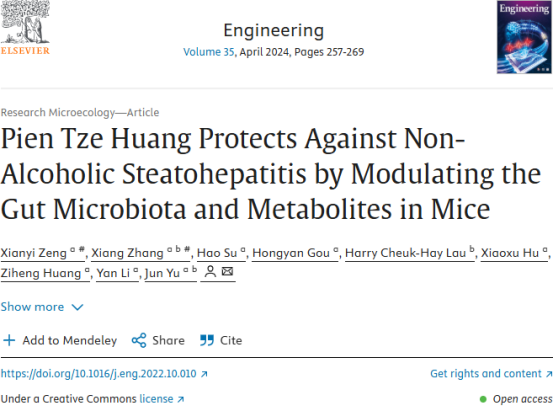
Core Insights - The research conducted by Professor Yu Jun's team at the Chinese University of Hong Kong focuses on the effects of Pien Tze Huang in preventing and treating non-alcoholic steatohepatitis (NASH) through modulation of gut microbiota and metabolites in mice [1][3] Group 1: Health Issue Overview - Non-alcoholic fatty liver disease (NAFLD) is a significant global health issue, affecting 25% of the world's population, with an even higher prevalence of 34% in Asian populations [3] - Approximately 20% of NAFLD patients may progress to more severe NASH, for which there are currently no effective treatments [3] Group 2: Traditional Medicine Focus - Traditional Chinese medicine, particularly Pien Tze Huang, is gaining attention due to its multi-target and multi-pathway mechanisms, with key ingredients including Panax notoginseng, musk, bezoar, and snake bile [3] Group 3: Research Findings - The study evaluates the role of Pien Tze Huang in the prevention and treatment of NASH, elucidating its effects on gut microbiota distribution and gut barrier function improvement in NASH models [3] - Metagenomic sequencing of mouse fecal samples revealed that Pien Tze Huang can restore gut microbiota imbalance and improve gut barrier function in mice with fatty liver disease [3] - The results indicate that Pien Tze Huang effectively prevents the progression of NASH induced by high-fat and high-cholesterol diets, significantly inhibiting liver damage, triglyceride accumulation, and lipid peroxidation [3] - Additionally, Pien Tze Huang significantly improves fatty degeneration and liver damage in mice [3]


医疗健康ETF泰康(159760)及联接基金最新净值连续五日上涨!医疗器械板块或迎业绩边际拐点
Xin Lang Cai Jing· 2025-07-15 02:04
Group 1 - The medical health ETF Taikang (159760) has seen a 0.17% increase, marking its fifth consecutive rise, while the index it tracks, the National Certificate Public Health and Medical Health Index (980016), rose by 0.13% [1] - As of July 14, the latest scale of the medical health ETF Taikang reached 82.4979 million yuan, a new high in nearly three months [2] - The medical device sector is expected to experience a performance turning point, driven by policies such as the old-for-new program and the gradual clearance of channel inventory [2] Group 2 - The top ten weighted stocks in the National Certificate Public Health and Medical Health Index account for 51.67% of the index, with leading companies including WuXi AppTec (603259) and Hengrui Medicine (600276) [3] - The CDMO sector has rebounded, with WuXi AppTec expected to see significant growth in revenue and profit by mid-2025, indicating strong global market demand [2] - The innovation drug industry chain is anticipated to enter a new upward cycle, supported by an improving domestic investment environment and active financing activities [2]



沪深300制药指数报11931.35点,前十大权重包含科伦药业等
Jin Rong Jie· 2025-07-14 08:28
Group 1 - The core viewpoint of the articles highlights the performance of the CSI 300 Pharmaceutical Index, which closed at 11,931.35 points, showing a decline of 1.18% over the past month, an increase of 7.25% over the past three months, and a year-to-date increase of 9.53% [1][2] - The CSI 300 Pharmaceutical Index is composed of listed companies in the pharmaceutical sector selected from the CSI 300 Index, reflecting the overall performance of these companies [1] - The top ten weighted companies in the CSI 300 Pharmaceutical Index include: Heng Rui Medicine (43.14%), Pian Zai Huang (10.14%), Yunnan Baiyao (8.49%), Kelun Pharmaceutical (6.31%), East China Pharmaceutical (5.98%), New Harmony (5.69%), Fosun Pharmaceutical (5.53%), Tong Ren Tang (4.16%), Bai Li Tian Heng (3.83%), and China Resources Sanjiu (3.54%) [1] Group 2 - The market share of the CSI 300 Pharmaceutical Index is dominated by the Shanghai Stock Exchange at 69.99%, while the Shenzhen Stock Exchange accounts for 30.01% [2] - In terms of industry composition, the index is primarily made up of drug formulations at 64.78%, traditional Chinese medicine at 29.52%, and raw materials at 5.69% [2] - The index samples are adjusted semi-annually, with adjustments occurring on the next trading day after the second Friday of June and December each year, and weights are fixed until the next scheduled adjustment [2]



中药行业周报:时临中报季,关注中药板块业绩表现-20250713
Xiangcai Securities· 2025-07-13 11:51
Investment Rating - The industry maintains an "Overweight" rating, suggesting a positive outlook for investment opportunities in the Chinese medicine sector [6]. Core Insights - The Chinese medicine sector saw a 1.08% increase last week, with the overall pharmaceutical sector experiencing a general upward trend [2]. - The price-to-earnings (PE) ratio for the Chinese medicine sector is 27.86X, reflecting a slight increase, while the price-to-book (PB) ratio stands at 2.31X, also showing a minor rise [3]. - The market for Chinese medicinal materials is currently in a low season, with a slight decline in price indices due to increased rainfall in southern regions [4]. - As of July 12, 2025, three out of five listed companies in the Chinese medicine industry reported positive net profit growth, with the lowest growth rate at 24.3% [5]. Summary by Sections Market Performance - The Chinese medicine sector index closed at 6451.72 points, up 1.08% last week, while the overall pharmaceutical index rose by 1.82% [2][17]. Valuation - The PE ratio (ttm) for the Chinese medicine sector is 27.86X, up 0.29X week-on-week, with a one-year maximum of 30.13X and a minimum of 22.58X. The PB ratio (lf) is 2.31X, up 0.03X, with a one-year maximum of 2.65X and a minimum of 1.99X [3][19]. Industry Trends - The Chinese medicine sector is entering the mid-year reporting season, with a focus on performance metrics such as inventory and accounts receivable [5]. - The report highlights three main investment themes: price governance, consumption recovery, and state-owned enterprise reform, indicating potential growth areas within the sector [6][9]. Investment Recommendations - Recommended companies include those with strong R&D capabilities and unique products, as well as those less affected by price collection policies. Specific companies highlighted are Zhaoli Pharmaceutical, Pizaihuang, and Shouxiangu [10].


沪深300制药指数报11609.22点,前十大权重包含百利天恒等
Jin Rong Jie· 2025-07-09 08:11
Group 1 - The core viewpoint of the articles highlights the performance of the CSI 300 Pharmaceutical Index, which closed at 11609.22 points, showing a decline of 2.48% over the past month, an increase of 5.29% over the past three months, and a year-to-date increase of 6.57% [1] - The CSI 300 Pharmaceutical Index is composed of listed companies in the pharmaceutical sector selected from the CSI 300 Index, reflecting the overall performance of these companies [1] - The index was established on December 31, 2004, with a base point of 1000.0 [1] Group 2 - The top ten weighted companies in the CSI 300 Pharmaceutical Index include: Heng Rui Medicine (41.61%), Pian Zai Huang (10.46%), Yunnan Baiyao (8.71%), Kelun Pharmaceutical (6.52%), East China Pharmaceutical (6.0%), New Harmony (5.88%), Fosun Pharmaceutical (5.59%), Tong Ren Tang (4.26%), Bai Li Tian Heng (4.09%), and China Resources Sanjiu (3.63%) [1] - The market segment distribution of the CSI 300 Pharmaceutical Index shows that the Shanghai Stock Exchange accounts for 69.26% and the Shenzhen Stock Exchange accounts for 30.74% [2] - In terms of industry composition, the index sample consists of 63.81% drug formulations, 30.31% traditional Chinese medicine, and 5.88% raw materials [2] Group 3 - The index sample is adjusted every six months, with adjustments implemented on the next trading day after the second Friday of June and December each year [2] - Weight factors are adjusted in accordance with the regular sample adjustments, which occur at the same time [2] - In special circumstances, the index may undergo temporary adjustments, such as when a sample company is delisted or undergoes mergers, acquisitions, or splits [2]
片仔癀连跌8天,易方达基金旗下1只基金位列前十大股东
Sou Hu Cai Jing· 2025-07-07 15:35
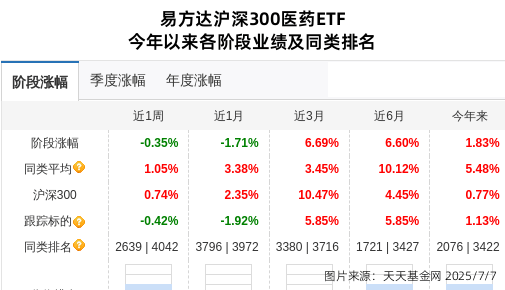
Core Viewpoint - Pianzaihuang has experienced a decline in stock price for eight consecutive trading days, with a cumulative drop of -2.33% [1] Company Overview - Zhangzhou Pianzaihuang Pharmaceutical Co., Ltd. is a time-honored Chinese enterprise primarily engaged in pharmaceutical manufacturing, established in 1956 and listed on the Shanghai Stock Exchange in 2003, with a current share capital of 603 million [1] Financial Performance - The financial report indicates that E Fund's E Fund CSI 300 Pharmaceutical ETF is among the top ten shareholders of Pianzaihuang, having reduced its holdings in the first quarter of this year [1] - Year-to-date return for Pianzaihuang is 1.83%, ranking 2076 out of 3422 in its category [2] Performance Metrics - Recent performance metrics show a weekly decline of -0.35%, a monthly decline of -1.71%, a quarterly increase of 6.69%, a six-month increase of 6.60%, and a year-to-date increase of 1.83% [2] - The average performance of similar funds shows a year-to-date return of 5.48% [2] Fund Management - The fund manager for E Fund CSI 300 Pharmaceutical ETF is Yu Haiyan, who has extensive experience in investment management and analysis [4][5]
医保商保“双目录”双轨并行,部分集采中选中成药再降价
Xiangcai Securities· 2025-07-06 11:53
Investment Rating - The industry rating is maintained at "Overweight" [6] Core Insights - The Chinese medicine sector saw a 1.27% increase last week, lagging behind other pharmaceutical segments, with the overall pharmaceutical sector rising by 3.64% [2] - The price-to-earnings (PE) ratio for the Chinese medicine sector is 27.57X, up 0.34X week-on-week, while the price-to-book (PB) ratio is 2.28X, also showing a slight increase [3] - The market for traditional Chinese medicine materials is experiencing increased supply but declining prices, with a 0.5% drop in the total price index last week [4] Summary by Sections Market Performance - The Chinese medicine sector's performance is weaker compared to other pharmaceutical segments, with notable companies like Jiuzi Tang and Zoli Pharmaceutical performing well, while others like Mayinglong and Dong'e Ejiao lag behind [2][15] Valuation - The current PE ratio of 27.57X places the sector at the 29.53% percentile since 2013, while the PB ratio of 2.28X is at the 5.37% percentile [3] Supply Chain Dynamics - The market for Chinese medicinal materials is characterized by increased production and declining prices, with a significant number of categories experiencing price drops [4] Policy Developments - The dual-track system for medical insurance and commercial insurance is being implemented, allowing for dynamic adjustments and submissions for inclusion in the basic medical insurance directory [5][6] Investment Recommendations - The report suggests focusing on three main investment themes: price governance, consumption recovery, and state-owned enterprise reform, highlighting companies with strong R&D capabilities and unique products [11][12][13]
漳州片仔癀药业股份有限公司关于国有股份无偿划转完成过户登记的公告
Zhong Guo Zheng Quan Bao - Zhong Zheng Wang· 2025-07-03 23:24
Group 1 - The equity change will not alter the controlling shareholder or actual controller of Zhangzhou Pianzaihuang Pharmaceutical Co., Ltd. [2][5] - After the equity change, Zhangzhou Jiulongjiang Group Co., Ltd. will still hold 307,522,643 shares, accounting for 50.97% of the total share capital of the company [2][4] - Fujian Zhanglong Group Co., Ltd. has committed not to reduce the shares obtained from the free transfer for 36 months after the completion of the share transfer registration [2][5] Group 2 - The basic situation of the state-owned share free transfer indicates that Jiulongjiang Group plans to transfer 2,000,000 shares (0.33% of the total share capital) to Zhanglong Group [2] - The free transfer of state-owned shares has been approved by the State-owned Assets Supervision and Administration Commission of Zhangzhou City [2] - The share transfer registration has been confirmed by China Securities Depository and Clearing Corporation Limited [3] Group 3 - After the completion of the free transfer, Jiulongjiang Group will directly hold 307,522,643 unrestricted shares, accounting for 50.97% of the total share capital, while Zhanglong Group will hold 7,056,700 unrestricted shares, accounting for 1.17% [4]
片仔癀(600436) - 漳州片仔癀药业股份有限公司关于国有股份无偿划转完成过户登记的公告
2025-07-03 08:46
证券代码:600436 证券简称:片仔癀 公告编号:2025-020 漳州片仔癀药业股份有限公司 关于国有股份无偿划转完成过户登记的公告 本公司董事会、全体董事及投资者漳州市九龙江集团有限公司保证本公告 内容不存在任何虚假记载、误导性陈述或者重大遗漏,并对其内容的真实性、 准确性和完整性承担法律责任。 重要内容提示: 一、本次国有股份无偿划转的基本情况 2025 年 6 月,九龙江集团与漳龙集团签订《关于公司的国有股 份无偿划转协议》(以下简称"《无偿划转协议》"),九龙江集团 拟将其持有的公司 2,000,000 股(占公司总股本 0.33%)无偿划转至 漳龙集团。本次国有股份无偿划转事宜已取得漳州市人民政府国有资 产监督管理委员会同意。 2025 年 6 月,公司已在上海证券交易所网站和指定媒体披露《公 司关于国有股份无偿划转暨持股 5%以上股东权益变动触及 1%刻度的 二、股份过户登记情况 近日,公司获悉九龙江集团收到中国证券登记结算有限责任公司 出具的《证券过户登记确认书》,确认上述无偿划转的股份过户登记 已办理完毕。 三、本次国有股份划转后股东的持股情况 本次无偿划转完成后,九龙江集团直接持有公司无 ...
粒度仪中标周盘点 | 高端设备需求激增,头部品牌领跑市场
仪器信息网· 2025-07-01 08:21
Anton Pear 其旗舰产品 Lites i zer DIF 500 激光粒度仪 在药企研发设备采购中脱颖而出, Lites i zer DIF 500 激 光 粒 度 仪 提 供 粒度 从 10 nm 到 3.5 mm 的先进测量方式。这款激光衍射粒度分析仪配备了强大的 10 mW 和 25 mW 激光器,以及市场上最宽的检测衍射角范 围,即 0.01°-170°。并且,Kal l iope 软件简化了粒度测量,只需三次点击即可开始测量。 导读: 粒度仪作为新能源电池材料研发和医药质量控制的核心设备,现将上周(6.23-6.29)粒度仪中标信息进行盘点。 特别提示 微信机制调整,点击顶部"仪器信息网" → 右上方"…" → 设为 ★ 星标,否则很可能无法看到我们的推送。 粒度仪是新能源电池材料研发和医药质量控制的核心设备,现将上周(6.23-6.29)采购中标信息进行盘点 。 经平台搜索,上周共收录三条 粒度仪设备中标信息,涉及医药研发、新能源材料等领域。 其 中 , 安 东 帕 Lites i zer DIF 激 光 粒 度 仪 以 55.9 万 元 高 价 中 标 某 知 名 药 企 研 发 中 心 ...