TONGWEI CO.,LTD(600438)

Search documents
最高亏损达百亿元,9家光伏龙头齐发预亏公告
DT新材料· 2026-01-18 16:05
Core Viewpoint - The photovoltaic industry is facing significant losses, with major companies like Longi Green Energy, Tongwei Co., and Aiko Solar all forecasting substantial net losses for 2025, indicating a challenging market environment driven by overcapacity and rising raw material costs [1][2]. Group 1: Company Performance - Longi Green Energy expects a net loss of approximately 60 billion to 65 billion yuan for 2025, citing increased costs of silver paste and silicon materials as key factors [1]. - Tongwei Co. is projected to incur a net loss of 82 billion to 96 billion yuan for 2025, with product prices remaining low and insufficient cost transmission impacting profitability [1]. - Aiko Solar anticipates a net loss of 45 billion to 48 billion yuan for 2025, while TCL Zhonghuan expects a loss of 12 billion to 19 billion yuan, both companies highlighting the impact of structural overcapacity on their operations [2]. Group 2: Industry Trends - The photovoltaic sector has experienced nine consecutive quarters of losses since Q4 2023, with ongoing supply-demand imbalances exacerbating the situation [2]. - Industry experts emphasize the need for capacity clearing and structural optimization, suggesting that companies must move beyond simple production cuts to enhance competitive advantages through technology and product differentiation [2]. - TCL Zhonghuan's acquisition of Yida Energy marks a significant step towards industry consolidation, aiming to optimize resources and foster collaboration, which could help the sector transition from low-level competition to value co-creation [2].






巨亏!光伏龙头,突发利空!
券商中国· 2026-01-18 15:50
Core Viewpoint - The photovoltaic industry is experiencing widespread losses, with major companies like Longi Green Energy and Tongwei Co. both forecasting significant net losses for 2025, indicating ongoing challenges in the sector [1][2][6]. Group 1: Company Performance - Longi Green Energy expects a net loss of 60 to 65 billion yuan for 2025, with a projected loss of 68 to 74 billion yuan after excluding non-recurring items [2][5]. - Tongwei Co. anticipates a net loss of approximately 90 to 100 billion yuan for 2025, compared to a loss of 70.39 billion yuan in 2024 [6]. - Aiko Solar predicts a net loss of 12 to 19 billion yuan for 2025, citing structural overcapacity and ongoing price pressures [7]. Group 2: Industry Challenges - The photovoltaic industry is facing a deep adjustment phase, with supply-demand mismatches and intense price competition leading to sustained low operating rates [5][8]. - Rising costs of raw materials, such as silver and silicon, have further pressured profit margins, contributing to the overall losses in the sector [5][6]. - The industry is expected to undergo a reshaping process in 2026 as "anti-involution" measures take effect, potentially restoring supply-demand balance and improving pricing [1][10]. Group 3: Price Trends - Recent data indicates an increase in photovoltaic component prices, with TOPCon and BC components seeing price adjustments due to changes in export tax policies and rising silver prices [1][10]. - The average transaction price for distributed photovoltaic components has reached between 0.67 yuan/watt and 0.8 yuan/watt, with an average of 0.72 yuan/watt [10]. Group 4: Future Outlook - Analysts suggest that policy adjustments may accelerate industry consolidation and capacity elimination, with leading Chinese battery companies likely to enhance their global competitiveness in the long term [11].
周末突发!巨亏100亿
Zhong Guo Ji Jin Bao· 2026-01-18 14:53
Group 1: Company Forecasts - Tongwei Co., Ltd. (通威股份) expects a net loss of approximately 90 billion to 100 billion yuan for the year 2025, citing industry challenges such as supply surplus and rising raw material prices [7] - Longi Green Energy Technology Co., Ltd. (隆基绿能) anticipates a net loss of 60 billion to 65 billion yuan for 2025, attributing this to ongoing low operating rates and intensified competition in the photovoltaic industry [6] Group 2: Regulatory and Market Environment - The State Council is focusing on measures to boost consumption and ensure the payment of wages to migrant workers, indicating a proactive approach to economic stability [2] - The China Securities Regulatory Commission (CSRC) emphasizes maintaining market stability and preventing excessive speculation, aiming to foster a healthy investment environment [2] - The People's Bank of China has adjusted the minimum down payment ratio for commercial property loans to no less than 30%, reflecting a tightening of credit conditions [4] Group 3: Market Trends and Analyst Insights - Analysts suggest that the A-share market is not seeking a "crazy bull" but rather a "slow bull" for sustainable growth, emphasizing the importance of companies improving operational quality and transparency [3] - The market is expected to experience a phase of adjustment following a period of high trading activity, with a focus on performance disclosures as earnings reports begin to be released [11][20] - Investment strategies are shifting towards sectors with solid fundamentals, such as technology and industrial metals, while also considering consumer services and non-bank financials as key areas of interest [15][18]

周末突发!巨亏100亿
中国基金报· 2026-01-18 14:48
Core Viewpoint - The article summarizes significant developments over the weekend, highlighting the expected net losses for Tongwei Co., Ltd. and Longi Green Energy in 2025, indicating a challenging environment for the photovoltaic industry [1][9][10]. Group 1: Government and Regulatory Actions - The State Council held a meeting to discuss measures to boost consumption and ensure the payment of wages to migrant workers, reflecting a focus on economic stability and growth [3]. - The China Securities Regulatory Commission (CSRC) emphasized maintaining market stability and preventing excessive speculation, indicating a commitment to regulatory oversight [4]. - The People's Bank of China and the National Financial Regulatory Administration announced adjustments to the minimum down payment ratio for commercial property loans, aiming to manage market dynamics [6][7]. Group 2: Company-Specific Forecasts - Longi Green Energy announced an expected net loss of approximately 60 billion to 65 billion yuan for 2025, citing ongoing challenges in the photovoltaic sector, including supply-demand mismatches and competitive pressures [9]. - Tongwei Co., Ltd. projected a net loss of about 90 billion to 100 billion yuan for 2025, attributing the difficulties to a slowdown in new installations and rising raw material costs [10]. Group 3: Market Analysis and Strategies - Citic Securities suggested a shift towards performance-driven investment strategies as the market enters the earnings forecast period, indicating a focus on quality and stability in portfolio construction [15]. - Shenwan Hongyuan noted that the market may enter a consolidation phase after a strong start to 2026, driven by increased risk appetite and capital inflows [16]. - Huashan Strategy expressed concerns about the potential end of the current market rally, while also indicating that there may still be opportunities for accelerated growth in certain sectors [17]. - Guojin Strategy highlighted the importance of fundamental trends in driving market performance, suggesting that recent regulatory actions do not necessarily indicate a market peak [18]. - China Galaxy emphasized the strengthening foundation for a long-term bull market, supported by recent policy measures aimed at stabilizing market sentiment [22].

A股公司,密集发布!
证券时报· 2026-01-18 14:38
Core Viewpoint - The article discusses the earnings forecasts for several listed companies, highlighting a mixed performance with some companies expecting profit increases while others anticipate continued losses in 2025 [1]. Group 1: Earnings Forecasts - ILe Home is expected to achieve a net profit of approximately 171 million to 190 million yuan, representing a growth of 40.78% to 56.42% [2]. - Guolian Minsheng anticipates a net profit of about 2.008 billion yuan, with a significant increase of 406% [2]. - Longi Green Energy forecasts a net loss of 6 billion to 6.5 billion yuan, with a decline of 24.58% to 30.38% [2]. - Gui Guang Network expects a net loss of approximately 1.35 billion to 1.07 billion yuan, with a change of -24.51% to 1.31% [2]. - Ruiming Technology predicts a slight profit increase with a net profit of around 37 million to 40 million yuan, reflecting a growth of 27.58% to 37.92% [2]. - Aiko Solar anticipates a net loss of 1.9 billion to 1.2 billion yuan, with an increase of 64.28% to 77.44% [2]. - Okoyi expects a net profit of approximately 96 million to 110 million yuan, with a growth of 67.53% to 91.96% [2]. - Tiandi Source forecasts a net loss of 900 million to 1.35 billion yuan, with a change of -32.36% to 11.76% [2]. - Tongwei Co. anticipates a net loss of 9 billion to 10 billion yuan, with a decline of 27.86% to 42.07% [2]. - Lida New Materials expects a net loss of 36 million to 26 million yuan, with a change of -5.18% to 24.04% [2]. Group 2: Industry Challenges - Longi Green Energy cites ongoing supply-demand mismatches in the photovoltaic industry, persistent low-price competition, and rising costs of silver paste and silicon materials as key challenges impacting its performance [2]. - Tongwei Co. indicates that its silicon business is affected by production ramp-up and low market prices, leading to increased losses [3]. - Tiandi Source mentions that the overall real estate market conditions are negatively impacting its project sales and revenue [4]. Group 3: Positive Performers - Guolian Minsheng's significant profit increase is attributed to the acquisition of Minsheng Securities and growth in its securities investment and wealth management businesses [4]. - Okoyi's profit growth is driven by rising prices of raw materials and successful product upgrades in its hard alloy tool segment [5]. - ILe Home's profit increase is linked to its differentiated brand strategy and improved operational efficiency [6].




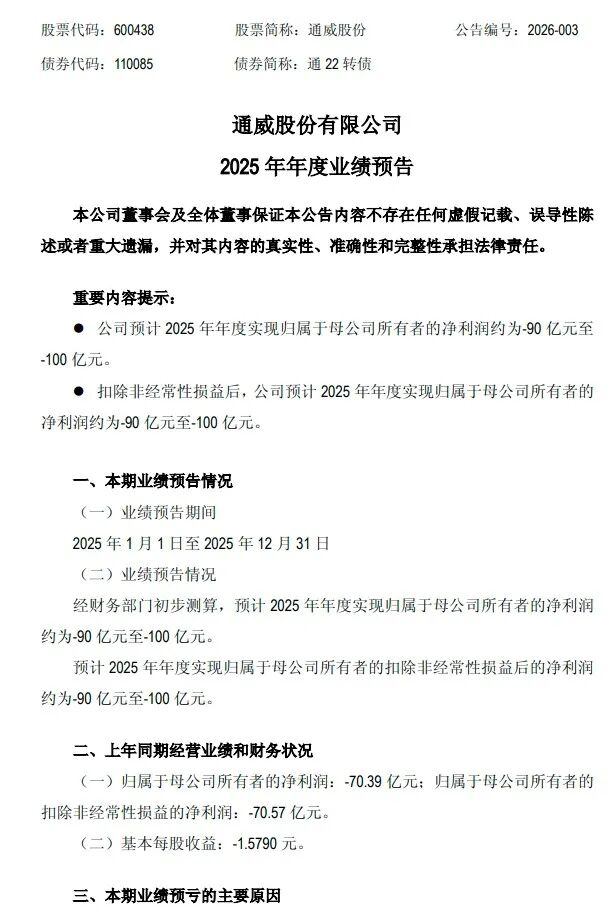
通威巨亏90-100亿!
Xin Lang Cai Jing· 2026-01-18 14:25
Core Viewpoint - Tongwei Co., Ltd. (600438.SH) expects a net profit attributable to shareholders of the parent company for 2025 to be approximately -9 billion to -10 billion yuan, indicating significant operational challenges in the photovoltaic industry [1][4][17]. Group 1: Performance Forecast - The performance forecast period is from January 1, 2025, to December 31, 2025 [5]. - The company anticipates a net profit attributable to shareholders of the parent company to be around -9 billion to -10 billion yuan, both including and excluding non-recurring gains and losses [4][18]. Group 2: Previous Year Performance - In the same period last year, the net profit attributable to shareholders was -7.039 billion yuan, with a basic earnings per share of -1.5790 yuan [6][19]. Group 3: Reasons for Expected Loss - The overall installed capacity in the photovoltaic sector is expected to maintain year-on-year growth, but there is a noticeable slowdown in the second half of the year, with ongoing supply surplus issues and declining operating rates across the industry [8][21]. - The company estimates an operational loss of approximately 7.5 billion to 8 billion yuan, which is an increase in operational losses of about 1.2 billion to 1.7 billion yuan compared to the previous year [8][21]. - The industrial silicon business is expected to face intensified losses due to production ramp-up and low market prices, contributing to a year-on-year increase in losses of about 900 million yuan [8][21]. - The polysilicon business, despite a decline in sales volume and average selling price, managed to achieve operational profitability in the second half of the year, reducing losses by approximately 600 million yuan [8][21]. - The battery and module business is expected to see further declines in average selling prices, exacerbating losses by about 1.2 billion yuan [8][21]. Group 4: Asset Impairment and Future Outlook - The company plans to recognize long-term asset impairments totaling approximately 1.5 billion to 2 billion yuan, an increase of about 700 million to 1.2 billion yuan year-on-year, primarily due to technological changes and market demand fluctuations [9][22]. - Despite being at the bottom of the industry cycle, the company remains optimistic about the photovoltaic sector's growth potential and is committed to technological research and cost reduction [9][22].
【公告精选】容百科技被证监会立案,天元智能董事长被留置,国联民生2025年净利润同比预增406%
Sou Hu Cai Jing· 2026-01-18 13:18
Group 1 - Fenglong Co., Ltd. has completed the suspension review and will resume trading on January 19 [1] - Rongbai Technology is under investigation by the China Securities Regulatory Commission for potentially misleading statements regarding a major contract [1] - Rongbai Technology estimates a total contract amount of 120 billion yuan with CATL [1] Group 2 - Minexplosion Optoelectronics is planning to acquire Xiazhi Precision and Jiangxi Maida, both of which focus on core consumables in PCB manufacturing [1] - Yanjing Co., Ltd. intends to purchase 98.54% equity of Yongqiang Technology, expanding its business into high-end electronic interconnection materials for integrated circuits [1] Group 3 - Tianyuan Intelligent's actual controller and chairman, Wu Yizhong, has been detained [1] - Tiantie Technology's actual controller, Xu Jiding, has had his compulsory measures changed to bail pending trial [1] Group 4 - Guolian Minsheng expects a net profit increase of approximately 406% year-on-year for 2025 [1] - Oke Yi anticipates a net profit increase of 67.53% to 91.96% year-on-year for 2025 [1] Group 5 - Tiandi Source forecasts a net loss of 900 million to 1.35 billion yuan for 2025 [1] - Gui Guang Network expects a net loss of 1.07 billion to 1.35 billion yuan for 2025 [1] - Aisheng Co., Ltd. projects a net loss of 1.2 billion to 1.9 billion yuan for 2025 [1] - Longi Green Energy anticipates a net loss of 6 billion to 6.5 billion yuan for 2025 [1] - Tongwei Co., Ltd. expects a net loss of 9 billion to 10 billion yuan for 2025 [1] Group 6 - Weisi Medical's actual controller's concerted action party plans to reduce its stake in the company by no more than 3% [1] - Chuhuan Technology's pre-IPO employee stock ownership platform intends to reduce its stake in the company by no more than 3% [1] - Sandam Membrane's Qingyuan China plans to reduce its stake in the company by no more than 3% [1]


税务部门提醒:自查近三年境外所得;容百科技被证监会立案调查丨周末要闻速递
21世纪经济报道· 2026-01-18 13:05
Key Points - The State Council is focusing on measures to boost consumption and cultivate new growth points in service consumption, while also addressing overdue payments to enterprises and ensuring wage payments to migrant workers [2] - The tax authority is reminding taxpayers to self-check their overseas income for the past three years, with potential penalties for non-compliance [3] - The minimum down payment ratio for commercial property loans has been adjusted to no less than 30% [4] - Public rental housing tax incentives have been extended, including exemptions from land use tax and stamp duty for public rental housing projects [5] - China's annual electricity consumption is projected to exceed 10 trillion kilowatt-hours for the first time, reaching 10.4 trillion kilowatt-hours, which is more than double that of the United States [6] - Public pension funds can now be redeemed early without holding period restrictions, which is a positive development for investors [7] - The China Securities Regulatory Commission (CSRC) is emphasizing market stability and fair trading, while also addressing excessive speculation and market manipulation [8][9] - The CSRC is seeking public opinions on the draft regulations for derivative trading supervision to promote a healthy development of the derivatives market [9] - Tongwei Co. expects a net loss of 9 to 10 billion yuan for 2025 due to industry challenges, including supply chain issues and rising raw material costs [11] - Longi Green Energy anticipates a net loss of 6 to 6.5 billion yuan for 2025, citing ongoing low prices and cost pressures in the photovoltaic industry [13] - The U.S. plans to impose tariffs on goods from eight European countries, which may impact international trade dynamics [14] - Iran has dismantled a spy organization linked to unrest, highlighting geopolitical tensions [15] Industry Insights - The A-share market is expected to maintain a long-term bullish trend, supported by policy signals aimed at stabilizing the market and encouraging rational investment [25] - The market is experiencing a structural shift, with a focus on performance-driven investments as the narrative-driven trends fade [24] - The technology sector is anticipated to undergo a two-phase upward trend, with the first phase focusing on structural opportunities and the second phase driven by cyclical improvements and increased asset allocation towards equities [26]


三家光伏龙头公司,2025年业绩预亏,合计超160亿元
Zheng Quan Shi Bao Wang· 2026-01-18 13:01
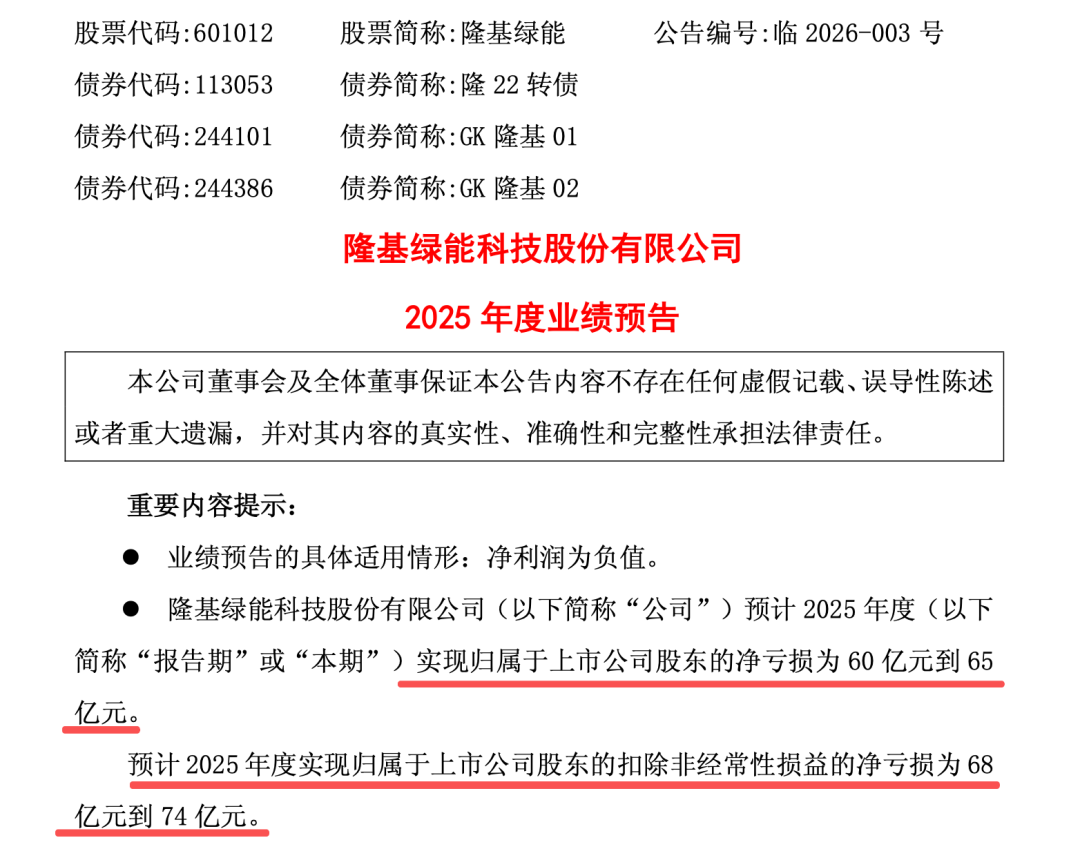
光伏龙头业绩预亏。 光伏产业周期调整持续,行业内多家上市公司预亏。1月18日晚间,光伏龙头隆基绿能(601012)、通威股份(600438),以及爱旭股份(600732)均披露了预计 2025年业绩亏损的公告。从公告来看,这三家龙头去年预计亏损合计超160亿元。 从行业龙头的业绩预告中看到,在价格竞争激烈、海外贸易环境复杂等多重压力下,行业仍处于周期下行的深度调整阶段。 业绩预亏 隆基绿能 隆基绿能业绩预告显示,预计2025年度实现归属于上市公司股东的净亏损为60亿元到65亿元。 | 股票代码:601012 | 股票简称:隆基绿能 | 公告编号:临 2026-003 号 | | --- | --- | --- | | 债券代码:113053 | 债券简称:隆 22 转债 | | | 债券代码:244101 | 债券简称:GK 隆基 01 | | | 债券代码:244386 | 债券简称:GK 隆基 02 | | 通威股份业绩预告显示,预计2025年度实现归属于母公司所有者的净利润亏损90亿元至100亿元。 | 股票代码:600438 | | --- | | 债券代码:110085 | 隆基绿能表示,2025年 ...
最高亏损达百亿元,9家光伏龙头齐发预亏公告
财联社· 2026-01-18 12:09
Core Viewpoint - The photovoltaic industry is undergoing a deep adjustment, with the overall sector still in a state of loss, as evidenced by the recent earnings forecasts from major companies indicating significant expected losses for 2025 [1][2]. Group 1: Company Performance - Longi Green Energy (隆基绿能) expects a net loss of approximately 60 billion to 65 billion yuan for 2025, primarily due to rising costs of silver paste and silicon materials [3]. - Tongwei Co., Ltd. (通威股份) anticipates the highest loss among the companies, with a projected net loss of 90 billion to 100 billion yuan for 2025, despite some performance improvement from rising polysilicon prices [2][3]. - TCL Zhonghuan (TCL中环) forecasts a net loss of 82 billion to 96 billion yuan for 2025, with product prices remaining low and insufficient cost transmission [2][3]. - JA Solar (晶澳科技) and Aiko Solar (爱旭股份) expect net losses of 45 billion to 48 billion yuan and 12 billion to 19 billion yuan, respectively, citing structural overcapacity as a significant challenge [3]. - Trina Solar (天合光能) and JinkoSolar (晶科能源) have not disclosed specific loss amounts but have indicated continued losses for 2025 [3]. Group 2: Industry Trends - The losses among these nine major companies are correlated with their production capacity, indicating that larger companies are experiencing greater losses [2]. - The industry is shifting from a focus on scale to a competition based on the ability to reduce losses, with Tongwei being the only company to see an increase in loss magnitude for 2025 compared to 2024 [4]. - The overall industry has faced nine consecutive quarters of losses since the fourth quarter of 2023, with ongoing supply-demand imbalances [4]. - Companies are urged to break away from homogeneous competition and build comprehensive advantages through technology, products, and ecosystems [4].