TONGWEI CO.,LTD(600438)

Search documents
国家电网“十五五”投资4万亿元,固态电池近期催化密集落地



GOLDEN SUN SECURITIES· 2026-01-18 06:32
Investment Rating - The report indicates a positive outlook for the power equipment industry, particularly in the renewable energy sector, with significant investments and technological advancements expected to drive growth [1][2][4]. Core Insights - The report highlights that the State Grid's investment during the "14th Five-Year Plan" period is projected to reach 4 trillion yuan, marking a 40% increase compared to the previous plan [2]. - The report emphasizes the stability in polysilicon prices and the continuous rise in battery component prices, with N-type battery prices increasing to 0.40 yuan per watt [15][16]. - The report identifies three key areas of focus: supply-side reform leading to price increases in the industry chain, long-term growth opportunities from new technologies, and industrialization opportunities from perovskite GW-level layouts [16]. Summary by Sections 1. New Energy Generation 1.1 Photovoltaics - Polysilicon prices remain stable, while battery component prices are on the rise, with N-type battery prices reaching an average of 0.40 yuan per watt [15]. - The report notes that leading component companies are responding to industry self-discipline by raising component prices, with distributed sales prices reaching 0.72 yuan per watt [15][16]. - Key companies to watch include Tongwei Co., GCL-Poly, LONGi Green Energy, JA Solar, and Trina Solar [16]. 1.2 Wind Power & Grid - The UK AR7 offshore wind auction results exceeded expectations, with a total scale of approximately 8.4GW, validating the upward trend in European offshore wind [17]. - The State Grid's investment is expected to enhance transmission capacity significantly, addressing bottlenecks in renewable energy delivery [18]. - Companies to focus on include Goldwind, Yunda Wind Power, Mingyang Smart Energy, and Sany Heavy Energy [18]. 1.3 Hydrogen & Energy Storage - By 2025, the production and sales of fuel cell vehicles in China are projected to reach 7,797 units, reflecting a 44% year-on-year increase [20]. - The report anticipates that new energy storage installations will reach 58.6GW/175.3GWh by 2025, with significant growth expected in the energy storage sector [21]. - Key players in the hydrogen sector include Shuangliang Energy, Huadian Heavy Industries, and Shenghui Technology [20]. 2. New Energy Vehicles - Solid-state batteries are gaining traction, with several automakers making progress towards mass production by 2026 [29]. - Companies such as BYD, Changan Automobile, and Chery are expected to achieve significant milestones in solid-state battery technology [29]. - The report suggests monitoring companies like Xiamen Tungsten, Hailiang Co., and Nanjing Advanced Lithium Battery [29]. 3. Industry Trends - The report notes a 0.4% increase in the new energy equipment sector from January 12 to January 16, 2026, with a cumulative increase of 5.3% since the beginning of the year [12]. - The photovoltaic equipment sector saw a 3.52% increase, while the wind power equipment sector experienced a decline of 1.28% during the same period [13].
被传有基地停产?通威股份:始终根据市场情况动态调整开工
Bei Ke Cai Jing· 2026-01-16 09:29
Core Viewpoint - The silicon material industry is experiencing significant production adjustments, with major companies like Tongwei Co., Ltd. reportedly halting production, leading to a potential supply-demand rebalancing in the market [1][2]. Group 1: Production Adjustments - Tongwei Co., Ltd. has been adjusting its production rates dynamically based on market conditions to optimize economic performance, although specific execution details remain unclear [2]. - The China Nonferrous Metals Industry Association's silicon division reported that some leading companies are gradually halting production, with plans to continue for up to six months, which may reduce monthly silicon production to between 70,000 and 90,000 tons by Q1 2026 [2]. - In the first half of 2025, there are nine operational multi-crystalline silicon producers in China with a total capacity of 3.35 million tons per year, but production is expected to drop by 44.1% year-on-year to 597,000 tons, resulting in an operating rate of 38.6% to 44.1% [2]. Group 2: Inventory and Market Conditions - Despite production cuts, the high inventory levels in the silicon material sector remain unchanged, with an estimated inventory of 290,000 tons by the end of 2025, close to three months of consumption [3]. - The market is currently in a critical phase of supply-demand rebalancing, with stable silicon wafer production and slight consumption of social inventory providing essential support for the market [2]. Group 3: Financial Performance - Daqo New Energy Co., Ltd. has forecasted a net loss of 1 to 1.3 billion yuan for 2025, a significant reduction from over 2.7 billion yuan in the previous year, attributed to changes in asset impairment factors [4]. - Although there is an anticipated recovery in multi-crystalline silicon prices starting in Q3 2025 due to ongoing policy guidance, the industry still faces challenges from high inventory levels and weak demand [5].

美银证券:“赤马年”首选铝股 看淡建筑及太阳能材料 个股首选中国宏桥等
Zhi Tong Cai Jing· 2026-01-16 06:20
Core Viewpoint - Bank of America Securities predicts that 2026 will be a "Red Horse Year" for the Chinese base metals market, driven by favorable conditions for electrification and AI power infrastructure in 2023 due to factors such as a weak dollar and the US interest rate cut cycle [1] Group 1: Market Drivers - The supply of copper and aluminum remains tight [1] - Demand drivers for this year include a 10% year-on-year increase in grid investment, a 27% growth in electric vehicle battery production, a 41% increase in energy storage systems, and rising AI power demand [1] - The anti-involution policy is becoming more balanced, although recent enforcement has been weak [1] Group 2: Stock Recommendations - Preferred stocks include aluminum companies as alternative investments for AI power supply, with a forecasted price-to-earnings ratio between 8 to 10 times [1] - Positive outlook on gold, copper, lithium (including battery materials), and cobalt stocks; neutral view on coal; bearish on solar energy and construction materials (like steel) due to weak demand and declining steel profit margins [1] Group 3: Specific Stock Picks - Key stock picks include China Aluminum (601600) (02600), Zijin Mining (601899) (02899), China Hongqiao (01378), Shandong Gold (600547) (01787), and Ganfeng Lithium (002460) (01772) [1] - Underperforming stocks identified include Tongwei Co. (600438) (600438.SH), Xinyi Solar (00968), Ansteel (000898) (00347), and China Resources Cement (01313) [1]



美银证券:“赤马年”首选铝股 看淡建筑及太阳能材料 个股首选中国宏桥(01378)等
智通财经网· 2026-01-16 06:20
Group 1 - The core viewpoint of the article is that 2026 is identified as the "Year of the Red Horse," which is favorable for the Chinese base metals market due to several key factors, including a weak US dollar and a US interest rate cut cycle benefiting metals [1] - Key demand drivers for this year include a 10% year-on-year increase in grid investment, a 27% growth in electric vehicle battery demand, a 41% increase in energy storage systems, and rising AI power demand [1] - Supply constraints for copper and aluminum are expected to continue, contributing to the overall market dynamics [1] Group 2 - The preferred investment stocks include aluminum companies, with a forecasted price-to-earnings ratio between 8 to 10 times, and a "buy" outlook on gold, copper, lithium (including battery materials), and cobalt stocks [1] - The company holds a neutral view on coal and a bearish outlook on solar energy and construction materials (such as steel) due to weak demand and declining steel profit margins [1] - Key stocks that are expected to underperform the market include Tongwei Co., Ltd. (600438.SH), Xinyi Solar (00968), Ansteel Group (00347), and China Resources Cement Technology (01313) [1]

光伏反内卷有望进一步加强与落实,光伏ETF嘉实(159123)一键布局光伏产业链投资机遇
Xin Lang Cai Jing· 2026-01-16 03:50
Group 1 - The photovoltaic sector experienced a strong upward trend, with the China Securities Photovoltaic Industry Index rising by 1.30% as of 11:01 AM on January 16, 2026, driven by significant gains in stocks such as Robotech (up 10.25%), Junda Co. (up 7.33%), and Maiwei Co. (up 7.21%) [1] - The space photovoltaic concept has gained significant attention at the beginning of 2026, with brokerages releasing multiple research reports predicting a "trillion-level market," as companies like JinkoSolar, Trina Solar, and Junda Co. actively disclose their strategic developments and future plans [1] - The market regulator emphasized the importance of addressing "involutionary" competition within the photovoltaic industry, with GF Securities reporting that the ongoing efforts to combat involution are expected to improve industry profitability, particularly in the downstream component segment in 2026 [1] Group 2 - As of December 31, 2025, the top ten weighted stocks in the China Securities Photovoltaic Industry Index included TBEA, LONGi Green Energy, Sungrow Power, TCL Technology, Tongwei Co., Maiwei Co., Deye Technology, Chint Electric, TCL Zhonghuan, and Jiejia Weichuang, collectively accounting for 55.11% of the index [2] - The Jiahua Photovoltaic ETF (159123) tracks the China Securities Photovoltaic Industry Index, providing a convenient tool for investing across the entire photovoltaic industry chain [3] - Investors can also access the photovoltaic ETF through the off-market connection (014605) to capitalize on investment opportunities within the photovoltaic industry chain [4]




通威牵手央企,成立新能源公司
Xin Lang Cai Jing· 2026-01-15 14:09
Core Viewpoint - Recently, China General Nuclear Power Group (CGN) established a new company named CGN New Energy (Changning) Co., Ltd. with a registered capital of 10 million yuan, focusing on various energy services including power generation and transmission [1][4]. Group 1 - The legal representative of CGN New Energy (Changning) Co., Ltd. is Pu Zhiyong [1][4]. - The company's business scope includes power generation, transmission, distribution, wind power technology services, solar power technology services, and energy storage technology services [1][4]. - The company is jointly owned by CGN Yunnan New Energy Co., Ltd. and Sichuan Yongxiang Co., Ltd., with respective ownership stakes of 99% and 1% [5]. Group 2 - The registered capital of CGN New Energy (Changning) Co., Ltd. is 10 million yuan [1][4]. - The ownership structure indicates that CGN Yunnan New Energy Co., Ltd. is the major shareholder, contributing 9.9 million yuan, while Sichuan Yongxiang Co., Ltd. contributes 0.1 million yuan [5].


2025中国企业ESG“金责奖”最佳环境E责任奖揭晓
Xin Lang Cai Jing· 2026-01-15 07:31
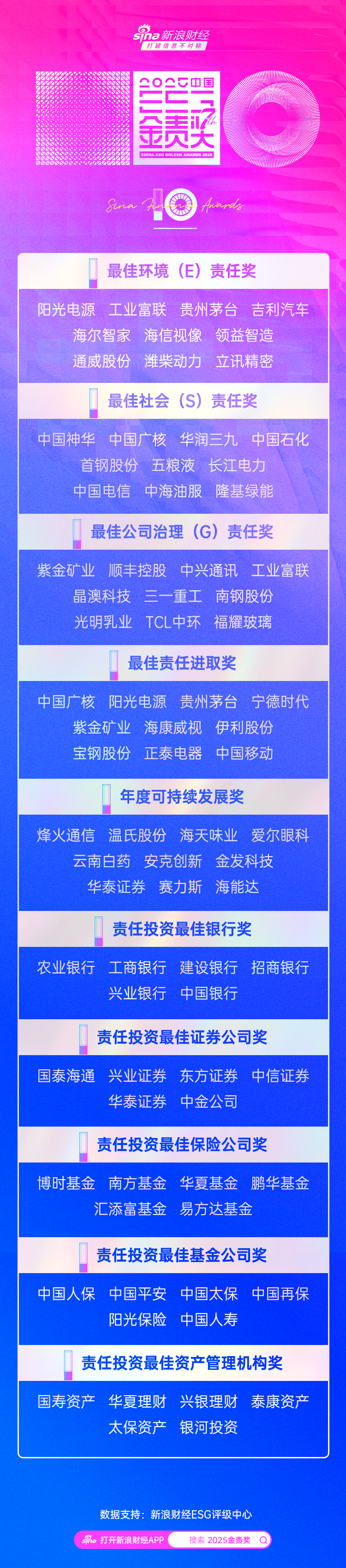
Core Viewpoint - The 2025 China Enterprise ESG "Golden Responsibility Award" aims to recognize companies that have made significant contributions to ESG (Environmental, Social, and Governance) practices, with over 5,000 enterprises participating in the evaluation process [1][4]. Group 1: ESG Award Overview - The award was launched in November 2025 by Sina Finance ESG Rating Center, focusing on promoting sustainable development and responsible investment [1][4]. - The evaluation process included comprehensive performance assessments, professional scoring, and online voting to determine the winners [1][4]. Group 2: Award Winners - The winners of the Best Environmental Responsibility Award include notable companies such as Sungrow Power Supply, Industrial Fulian, Kweichow Moutai, Geely Automobile, Haier Smart Home, Hisense Visual Technology, Linyang Electronics, Tongwei Co., Weichai Power, and Luxshare Precision [2][5]. - The award committee congratulated the winners and expressed hope that these companies will lead by example in enhancing their ESG capabilities and contribute to high-quality development in China [2][5]. Group 3: ESG Rating Center Introduction - The Sina Finance ESG Rating Center is the first Chinese platform dedicated to ESG information and ratings, promoting sustainable development and responsible investment [3][6]. - The center aims to establish ESG evaluation standards suitable for China's characteristics and enhance corporate ratings through collaboration with leading ESG enterprises and partners [3][6].





2025中国企业ESG“金责奖”优秀奖评选结果揭晓

Xin Lang Cai Jing· 2026-01-15 03:45
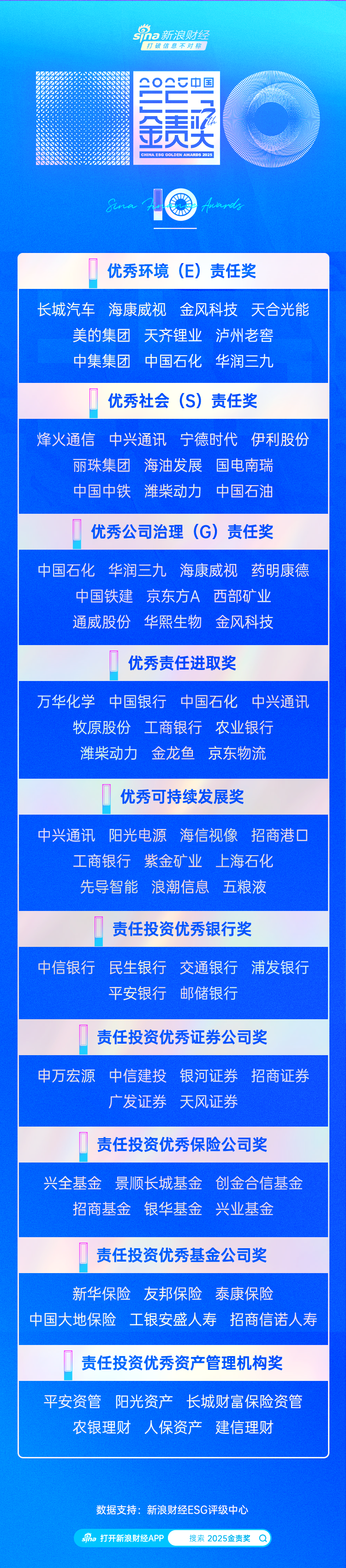
Core Viewpoint - The 2025 China Enterprise ESG "Golden Responsibility Award" aims to recognize companies and institutions that have made significant contributions to ESG initiatives in China, reflecting a shift from voluntary practices to compliance requirements in ESG performance [1][12]. Group 1: ESG Development and Awards Overview - By 2025, China's ESG development has transitioned from "setting standards" to "strengthening regulations," with a comprehensive disclosure standard system being established [1][12]. - The award selection attracted over 5,000 companies, with results based on ESG performance, online voting, and professional evaluations [2][12]. Group 2: Award Categories and Winners - The award categories include Excellent Environmental Responsibility Award, Excellent Social Responsibility Award, Excellent Corporate Governance Responsibility Award, Excellent Responsibility Initiative Award, Excellent Sustainable Development Award, and various responsibility investment awards [1][12]. - Notable winners of the Excellent Environmental Responsibility Award include Great Wall Motors, Hikvision, and China Petroleum [7][24]. - The Excellent Social Responsibility Award was awarded to companies such as YF Communication, ZTE, and Ningde Times [7][24]. - Winners of the Excellent Corporate Governance Responsibility Award include China Petroleum, Hikvision, and WuXi AppTec [7][24]. - The Excellent Responsibility Initiative Award was given to companies like ZTE, Sunlight Power, and Industrial and Commercial Bank of China [7][24]. - The Excellent Sustainable Development Award included companies such as WanHua Chemical, China Bank, and China Petroleum [7][24]. Group 3: Responsibility Investment Awards - The Responsibility Investment Excellent Bank Award was given to institutions like CITIC Bank and Minsheng Bank [5][21]. - The Responsibility Investment Excellent Securities Company Award included firms such as Shenwan Hongyuan and CITIC Securities [5][22]. - The Responsibility Investment Excellent Insurance Company Award recognized companies like New China Life and AIA [5][26]. - The Responsibility Investment Excellent Fund Company Award included firms such as Xinhua Fund and Harvest Fund [5][27]. - The Responsibility Investment Excellent Asset Management Institution Award recognized institutions like Ping An Asset Management and Sunshine Asset Management [5][28]. Group 4: Call to Action and Future Directions - The award committee encourages more Chinese enterprises to integrate ESG principles into their operations and strategic planning, emphasizing the importance of balancing commercial and social values [10][29].
通威股份跌2.04%,成交额8.44亿元,主力资金净流出9225.47万元
Xin Lang Zheng Quan· 2026-01-15 03:27
Core Viewpoint - Tongwei Co., Ltd. has experienced a decline in stock price and financial performance, with significant net outflows of capital and a decrease in revenue and profit year-on-year [1][2]. Group 1: Stock Performance - On January 15, Tongwei's stock price fell by 2.04%, reaching 20.15 CNY per share, with a trading volume of 844 million CNY and a turnover rate of 0.92%, resulting in a total market capitalization of 907.15 billion CNY [1]. - Year-to-date, Tongwei's stock has decreased by 1.80%, with a 6.97% drop over the last five trading days, a 3.13% decline over the last 20 days, and a 12.69% decrease over the last 60 days [1]. Group 2: Financial Performance - For the period from January to September 2025, Tongwei reported a revenue of 646.00 billion CNY, a year-on-year decrease of 5.38%, and a net profit attributable to shareholders of -52.70 billion CNY, down 32.64% year-on-year [2]. - Since its A-share listing, Tongwei has distributed a total of 251.92 billion CNY in dividends, with 169.23 billion CNY distributed over the last three years [3]. Group 3: Shareholder and Institutional Holdings - As of December 19, the number of shareholders in Tongwei increased to 293,500, a rise of 16.48%, while the average circulating shares per person decreased by 14.15% to 15,337 shares [2]. - As of September 30, 2025, major institutional shareholders have reduced their holdings, with Hong Kong Central Clearing Limited holding 136 million shares, down by 27.91 million shares from the previous period [3].
2025中国企业ESG“金责奖”评选结果揭晓 共筑可持续发展新生态
Xin Lang Cai Jing· 2026-01-15 02:38
Core Viewpoint - The 2025 China Enterprise ESG "Golden Responsibility Award" aims to recognize companies and institutions that have made significant contributions to ESG initiatives in China, reflecting a shift from voluntary practices to compliance requirements in ESG performance [1][18]. Group 1: Award Categories and Winners - The award includes ten categories: Best Environmental Responsibility Award, Best Social Responsibility Award, Best Corporate Governance Responsibility Award, Best Responsibility Initiative Award, Annual Sustainable Development Award, Best Responsible Investment Bank Award, Best Responsible Investment Securities Company Award, Best Responsible Investment Insurance Company Award, Best Responsible Investment Fund Company Award, and Best Responsible Investment Asset Management Institution Award [1][18]. - The Best Environmental Responsibility Award winners include: Sungrow Power Supply, Industrial Fulian, Kweichow Moutai, Geely Automobile, Haier Smart Home, Hisense Visual Technology, Linyang Electronics, Tongwei Co., Weichai Power, and Luxshare Precision [10][28]. - The Best Social Responsibility Award winners include: China Shenhua, China General Nuclear Power, China Resources Sanjiu, Sinopec, Shougang, Wuliangye, Yangtze Power, China Telecom, China Oilfield Services, and LONGi Green Energy [10][28]. - The Best Corporate Governance Responsibility Award winners include: Zijin Mining, SF Holding, ZTE Corporation, Industrial Fulian, JA Solar, Sany Heavy Industry, Nanjing Steel, Bright Dairy, TCL Zhonghuan, and Fuyao Glass [10][28]. - The Best Responsibility Initiative Award winners include: FiberHome Technologies, Wens Foodstuff Group, Haitian Flavoring and Food, Aier Eye Hospital, Yunnan Baiyao, Anker Innovations, Kingfa Sci. & Tech., Huatai Securities, Silex, and Hainengda [11][28]. - The Annual Sustainable Development Award winners include: China General Nuclear Power, Sungrow Power Supply, Kweichow Moutai, Contemporary Amperex Technology, Zijin Mining, Hikvision, Yili, Baosteel, Chint Electric, and China Mobile [11][28]. Group 2: Responsible Investment Awards - The Best Responsible Investment Bank Award winners include: Agricultural Bank of China, Industrial and Commercial Bank of China, China Construction Bank, China Merchants Bank, Industrial Bank, and Bank of China [11][28]. - The Best Responsible Investment Securities Company Award winners include: Guotai Junan, Everbright Securities, CITIC Securities, Huatai Securities, and CICC [12][28]. - The Best Responsible Investment Insurance Company Award winners include: China Life Insurance, China Ping An, China Pacific Insurance, China Re, Sunshine Insurance, and China Life [13][28]. - The Best Responsible Investment Fund Company Award winners include: Bosera Funds, Southern Fund, China Asset Management, Penghua Fund, Huitianfu Fund, and E Fund [14][28]. - The Best Responsible Investment Asset Management Institution Award winners include: China Life Asset Management, Huaxia Wealth Management, Xingyin Wealth Management, Taikang Asset, Taikang Asset, and Galaxy Investment [15][28]. Group 3: ESG Development Context - By 2025, China's ESG development has transitioned from "setting standards" to "strengthening regulations," with a comprehensive disclosure standard system being established [1][18]. - The ESG performance of enterprises is now a compliance requirement, linking commercial value with social value [1][18]. - The ESG rating center aims to promote sustainable development and responsible investment, enhancing the ESG performance of listed companies [17][34].