
GXED(600617)

Search documents
跃升:我国新能源汽车产业加速提质向新
Zhong Guo Jin Rong Xin Xi Wang· 2025-08-12 10:08
Core Viewpoint - The development of new energy vehicles (NEVs) is essential for China to transition from a major automotive country to a strong automotive nation, with significant advancements in technology and market presence since the 14th Five-Year Plan [1][2]. Industry Growth - By 2024, the number of NEVs in China is expected to reach 31.4 million, a more than fivefold increase from 4.92 million at the end of the 13th Five-Year Plan [2]. - NEVs have become the dominant force in China's automotive market, indicating a steady progression in the electrification transformation [2]. - In the first seven months of 2025, NEV production and sales exceeded 8.2 million units, with a market penetration rate rising to 45%, surpassing the target set in the New Energy Vehicle Industry Development Plan [2]. Systematic Breakthroughs - The NEV industry has achieved comprehensive breakthroughs across the entire value chain, focusing on pure electric vehicles, plug-in hybrid vehicles, and fuel cell vehicles [3]. - Key technological advancements include innovations in power batteries, management systems, and intelligent connectivity, enhancing the supply chain for critical components [3]. Innovation and Technology - Innovations such as lightweight composite materials and advanced battery technologies are improving energy density and safety in NEVs [4]. - The introduction of programmable cockpit technology allows users to customize their driving experience, reflecting a shift towards more intelligent vehicle systems [4]. - The 14th Five-Year Plan emphasizes the need for breakthroughs in high-safety power batteries and intelligent vehicle technologies [4]. Automation and Smart Manufacturing - The implementation of AI and automation in manufacturing processes has reached 100% in certain facilities, enhancing product quality and consistency [5]. - The integration of smart technologies across various stages of NEV production signifies a trend towards increased intelligence in the industry [5]. Strategic Industry Reforms - The establishment of new central enterprises in the automotive sector aims to optimize resource integration and enhance organizational efficiency [7]. - Recent government initiatives focus on fostering competitive and sustainable development within the NEV industry, including measures to regulate competition and support smaller enterprises [7]. Future Directions - The automotive industry is shifting from scale development to value creation, emphasizing the need for high-quality technological supply and original research [8]. - Strengthening innovation in areas such as chips and artificial intelligence is crucial for overcoming bottlenecks in high-quality development [8].

决胜“十四五” 打好收官战丨跃升:我国新能源汽车产业加速提质向新
Xin Hua Wang· 2025-08-12 09:42
Core Viewpoint - The development of the new energy vehicle (NEV) industry is essential for China to transition from a major automotive country to a strong automotive nation, with significant advancements in production scale, core technologies, and international competitiveness since the start of the 14th Five-Year Plan [1][2]. Industry Growth and Market Penetration - By 2024, the total number of NEVs in China is expected to reach 31.4 million, a more than fivefold increase from 4.92 million at the end of the 13th Five-Year Plan [2]. - NEVs have become the dominant force in China's automotive market, indicating a stable development phase in the electrification transition [2]. - In the first seven months of 2025, NEV production and sales exceeded 8.2 million units, with a market penetration rate rising to 45% [2]. Systematic Breakthroughs in the Industry - The NEV industry has achieved systematic breakthroughs across the entire value chain since the 14th Five-Year Plan, focusing on electric vehicles, plug-in hybrids, and fuel cell vehicles [3]. - Key components such as power batteries, drive motors, and intelligent technologies are being developed to enhance the supply chain [3]. Innovation and Technological Advancements - Innovations like lightweight composite covers and advanced battery technologies are addressing issues like range anxiety and safety [4]. - The introduction of programmable cockpit technology allows users to customize their driving experience, showcasing the shift towards intelligent and personalized vehicle features [4]. - The 14th Five-Year Plan emphasizes breakthroughs in high-safety batteries, efficient drive motors, and smart vehicle technologies [4]. Automation and Smart Manufacturing - The application of AI and automation in manufacturing processes, such as in the SaiLisi Super Factory, has achieved 100% automation in production stages [5]. - The integration of smart technologies in various stages of NEV development and production reflects the industry's shift towards intelligence and efficiency [5]. Brand Development and Industry Structure - The establishment of new central enterprises in the automotive sector aims to enhance resource integration and optimize organizational structures [6]. - Recent government initiatives focus on fostering competitive and sustainable development within the NEV industry, including measures to regulate competition and support smaller enterprises [6]. Future Directions and Challenges - The automotive industry is transitioning from scale development to value creation, emphasizing the need for high-quality technological supply and original research [7]. - Strengthening innovation in areas like chips and artificial intelligence is crucial for overcoming bottlenecks in high-quality development [7].
年中经济观察丨中国新能源汽车如何逐“新”提“智”——中国经济年中观察之二
Xin Hua Wang· 2025-08-12 06:37
Core Viewpoint - The Chinese new energy vehicle (NEV) industry has shown remarkable growth in the first half of the year, with production and sales both exceeding 6.9 million units, marking a year-on-year increase of over 40% [1] Group 1: Industry Performance - The NEV market penetration rate continues to rise, and exports have increased by 75.2% [1] - The automotive industry is characterized by efficient production rhythms and continuous technological renewal [1] Group 2: Innovation and Technology - AI technologies are enhancing production processes, with factories achieving 100% automation and utilizing over 40 advanced technologies for smarter, lower-carbon, and more efficient production [5] - New battery technologies, such as the dual-core battery developed by CATL, are being introduced to meet specific user needs, showcasing the industry's focus on performance and innovation [6] Group 3: Collaboration and Ecosystem - The automotive industry is witnessing new steps in open cooperation, with suppliers and manufacturers integrating more closely, such as CATL's production lines being located next to vehicle assembly lines [8] - Collaborative efforts are being made to develop new intelligent driving solutions tailored for the Chinese market, emphasizing the importance of partnerships in driving innovation [8] Group 4: Market Dynamics and Challenges - The automotive industry is facing challenges such as irrational competition and low profit margins, with the industry's profit rate at 4.3%, lower than the average of 5.7% for downstream industrial enterprises [10] - Regulatory measures are being implemented to address issues of competition and safety, including new standards for electric vehicle batteries and safety requirements for vehicle components [11] Group 5: Future Outlook - Industry leaders emphasize the need for a long-term strategy focused on value creation rather than price competition, with a consensus emerging on the importance of brand strength and innovation [13]





前5个月我国新能源汽车新车销量占汽车新车总销量44%
Xin Hua Wang· 2025-08-12 05:50
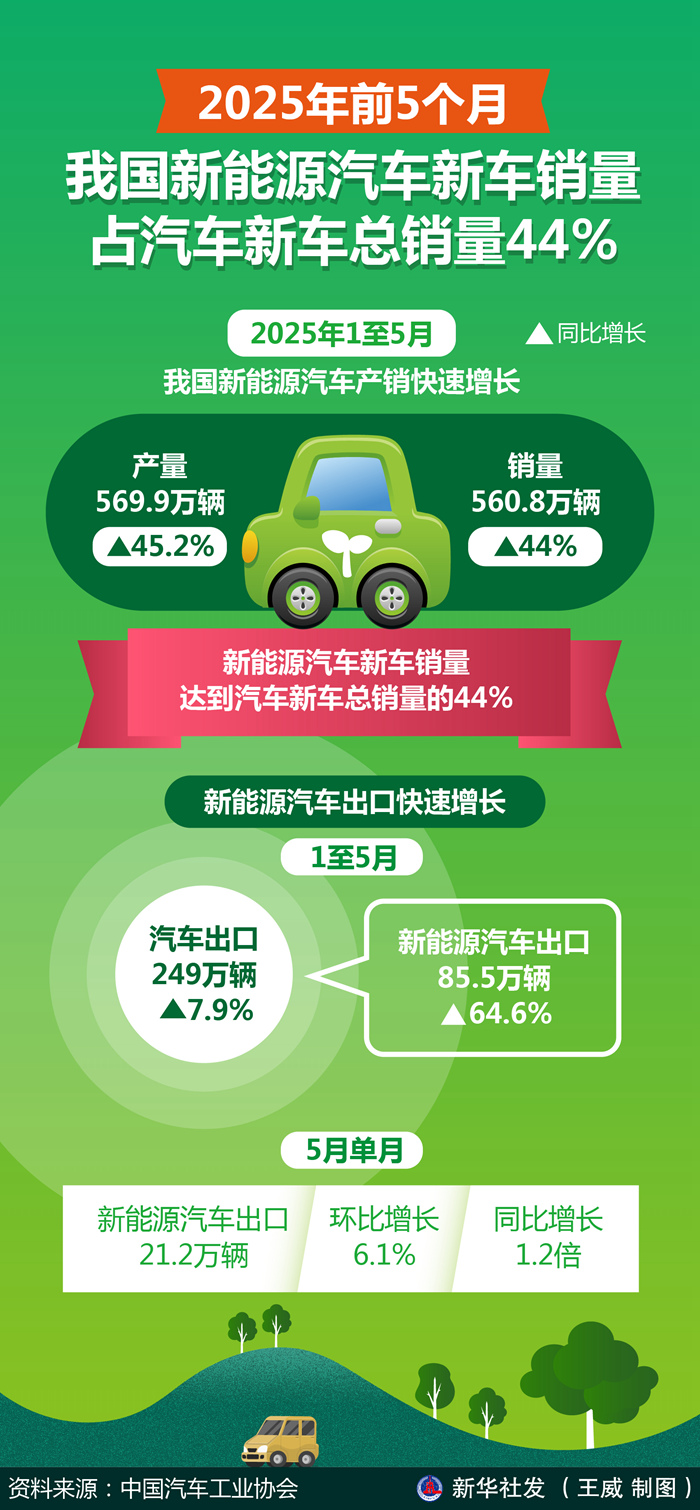
新华社北京6月11日电(记者唐诗凝)记者11日从中国汽车工业协会获悉,2025年1至5月,我国新能源 汽车产销快速增长,分别完成569.9万辆和560.8万辆,同比分别增长45.2%和44%,新能源汽车新车销量 达到汽车新车总销量的44%。 【纠错】 【责任编辑:施歌】 新能源汽车出口快速增长。1至5月,汽车出口249万辆,同比增长7.9%;其中,新能源汽车出口85.5万 辆,同比增长64.6%。5月单月,新能源汽车出口21.2万辆,环比增长6.1%,同比增长1.2倍。 乘用车市场延续良好表现。1至5月,乘用车产销分别完成1108万辆和1099.6万辆,同比分别增长14.1% 和12.6%。 数据显示,1至5月,我国汽车产销分别完成1282.6万辆和1274.8万辆,同比分别增长12.7%和10.9%,产 量增速较前4个月收窄0.2个百分点,销量增速扩大0.1个百分点。 "两新"政策加力扩围,持续显效,叠加汽车企业新品投放等利好因素,助力汽车市场消费活力加速释 放。1至5月,汽车国内销量1025.8万辆,同比增长11.7%。5月单月,汽车国内销量213.5万辆,环比增 长3%,同比增长10.3%。 ...

我国新能源汽车迈向技术输出新阶段
Xin Hua Wang· 2025-08-12 05:49
Group 1 - The core viewpoint of the articles highlights the increasing recognition and importance of domestic electric vehicle brands in the global automotive industry, particularly in the context of partnerships between traditional automakers and new energy vehicle companies [1][2] - The collaboration between Volkswagen and Xpeng Motors signifies a shift in the valuation of automotive companies in the new energy era, indicating that Xpeng's technological advantages are acknowledged by a major global player [1] - The strategic partnership is seen as a response to the competitive pressures faced by traditional automakers, as they seek new pathways to maintain relevance in a rapidly evolving market [1][2] Group 2 - The trend of brand strategic alliances in the new energy vehicle sector is emerging, as no single company can dominate in cost, technology, brand, and supply chain advantages alone [2] - The collaboration between traditional and new energy vehicle companies is accelerating the arrival of intelligent driving technologies, marking a significant milestone in the output of domestic technology [2] - The partnership is expected to enhance the development of a new localized platform for smart connected vehicles, benefiting the entire new energy vehicle supply chain and driving breakthroughs in key technologies [2]

多家公司大股东承诺未来一年内不减持
Xin Hua Wang· 2025-08-12 05:47
Core Viewpoint - Multiple listed companies' controlling shareholders have made commitments not to reduce their holdings, reflecting confidence in the companies' future development and contributing to market stability [1][3]. Group 1: Commitments from Controlling Shareholders - Companies such as Xiangyu Medical, Wanhua Chemical, Guo New Energy, and Jinjiang Hotels have announced commitments from their controlling shareholders to refrain from selling shares for a period of 12 months [1][2]. - Xiangyu Medical's controlling shareholder, Henan Xiangyu Health Industry Management Co., Ltd., and its actual controllers have committed not to reduce their holdings from March 12, 2024, to March 11, 2025 [2]. - Wanhua Chemical's controlling shareholders have also expressed confidence in the company's future and committed to not reducing their holdings for the next 12 months [2]. Group 2: Market Stability and Confidence - The trend of controlling shareholders making long-term commitments not to sell shares is seen as a way to bolster market confidence and protect the interests of all shareholders [3][6]. - The recent increase in commitments from controlling shareholders comes amid a turbulent secondary market, with many companies taking measures to stabilize their stock prices [3][6]. Group 3: Positive Business Performance - Xiangyu Medical reported a significant increase in revenue and net profit for 2023, with total revenue reaching 745 million yuan, a year-on-year increase of 52.46%, and net profit of 230 million yuan, up 82.96% [4]. - Wanhua Chemical achieved total revenue of 175.36 billion yuan in 2023, a 5.92% increase from the previous year, with net profit of 16.81 billion yuan, reflecting a 3.57% growth [5].




【图片新闻】 7月我国新能源汽车出口同比增长1.2倍
Zheng Quan Shi Bao· 2025-08-11 22:33
Group 1 - In July, China's automotive industry produced and sold 2.591 million and 2.593 million vehicles, representing year-on-year growth of 13.3% and 14.7% respectively [1] - The growth rate of new energy vehicles (NEVs) outpaced the overall automotive market, with production and sales increasing by 26.3% and 27.4% year-on-year [1] - NEV exports were particularly strong in July, with 225,000 units exported, marking a month-on-month increase of 10% and a year-on-year increase of 120% [1]
7月我国新能源汽车出口同比增长1.2倍
Zheng Quan Shi Bao· 2025-08-11 17:49
Group 1 - In July, China's automotive industry produced and sold 2.591 million and 2.593 million vehicles respectively, representing year-on-year growth of 13.3% and 14.7% [1] - The growth rate of new energy vehicles (NEVs) outpaced the overall automotive market, with production and sales increasing by 26.3% and 27.4% year-on-year [1] - NEV exports were particularly strong in July, with 225,000 units exported, marking a month-on-month increase of 10% and a year-on-year increase of 120% [1]
7月中国新能源汽车出口22.5万辆,同比增长1.2倍
Zhong Guo Xin Wen Wang· 2025-08-11 08:05
Group 1 - In July, China's automobile production and sales reached 2.591 million and 2.593 million units respectively, with month-on-month declines of 7.3% and 10.7%, but year-on-year increases of 13.3% and 14.7% [1] - Traditional fuel vehicle exports in July were 350,000 units, down 9.6% month-on-month and 4.3% year-on-year, while new energy vehicle exports were 225,000 units, up 10% month-on-month and 120% year-on-year [1] - From January to July, traditional fuel vehicle exports totaled 2.373 million units, a year-on-year decrease of 7%, while new energy vehicle exports reached 1.308 million units, a year-on-year increase of 84.6% [1] Group 2 - The China Automobile Industry Association noted that July marked a traditional off-season for the car market, with some manufacturers conducting annual equipment maintenance, leading to a seasonal decline in production and sales [1] - The effects of the vehicle trade-in policy continue to show, and the industry's comprehensive rectification of "involution" has made positive progress, with new models being continuously launched to support stable market operations [1] - In May, the China Automobile Industry Association issued an initiative to maintain fair competition and promote healthy industry development, which was supported by the Ministry of Industry and Information Technology [2]
乘联分会:中国新能源乘用车世界份额68.3%
Cai Jing Wang· 2025-08-11 02:36
Group 1 - The core viewpoint of the article highlights China's significant market share in the global new energy passenger vehicle sector, reaching 68.3% in the first half of 2025, with a notable 70.4% in June, reflecting a 3 percentage point increase year-on-year [1] - In the first half of 2025, China's share in the global pure electric vehicle market was 64.5%, which is an increase of 1.9 percentage points compared to the second quarter of 2024 [1] - China's market share in the global plug-in hybrid vehicle market reached an impressive 76% in the first half of 2025, indicating strong performance in this segment [1]