
BAIC BluePark(600733)

Search documents
我国自动驾驶迈入L3级时代
Shen Zhen Shang Bao· 2025-12-17 14:30
Core Viewpoint - The official approval of two L3 autonomous driving models marks a significant advancement in the transition from assisted driving to higher levels of automation in China [1][6]. Group 1: L3 Autonomous Driving Models - The Ministry of Industry and Information Technology has granted permission for two L3 autonomous driving models: Changan SC7000AAARBEV and Arcfox BJ7001A61NBEV [1][3]. - L3 level is a critical threshold in autonomous driving, allowing the system to perform all driving tasks under specific conditions, unlike L2 which requires driver supervision [2][3]. Group 2: Conditions and Limitations - The approved models are subject to strict conditions, including limitations on vehicle types, designated areas, and speed restrictions [3]. - Changan's model can operate at a maximum speed of 50 km/h in specific urban and highway conditions, while Arcfox's model can reach 80 km/h, both limited to single-lane operations in designated routes [3]. Group 3: Technological Background - Changan's SC7000AAARBEV features the self-developed "Tianshu Intelligent" driving system, while Arcfox's model is equipped with Huawei's ADS [4][5]. - Both companies have a strong technological foundation, with extensive testing and data accumulation to support their L3 capabilities [4][5]. Group 4: Strategic Importance - The selection of Changan and Arcfox for this pilot program reflects their early strategic positioning and technological readiness in the autonomous driving sector [4][5]. - The testing locations in Chongqing and Beijing are chosen for their complex terrains and traffic scenarios, allowing for comprehensive system adaptability testing [5]. Group 5: Future Implications - The approval of L3 models is seen as a pivotal step towards enhancing the reliability and commercial viability of autonomous driving in China [6][7]. - Industry experts believe this will accelerate the transition from technology validation to mass production applications in the autonomous vehicle sector [7].


L3上路,妥了
36氪· 2025-12-17 11:45
Core Viewpoint - The approval of L3-level conditional autonomous driving vehicles marks a significant step towards the commercialization of autonomous driving in China, transitioning from testing to official road use under specific conditions [8][9][10]. Group 1: Approval Details - The Ministry of Industry and Information Technology (MIIT) has approved two L3-level autonomous vehicles: Changan SC7000AAARBEV and BAIC Alpha S6, allowing them to operate under specific conditions in designated areas of Chongqing and Beijing [5][6][16]. - The Changan vehicle can achieve autonomous driving at speeds up to 50 km/h in congested traffic and on specific roads in Chongqing, while the BAIC vehicle can operate at speeds up to 80 km/h on certain highways in Beijing [17][19]. Group 2: Significance of Approval - This approval signifies the transition of autonomous vehicles into a "certified era," indicating that L3-level vehicles are now recognized for their operational capabilities under real-world conditions [8][12]. - The distinction between "product approval" and "testing licenses" is crucial, as the former indicates a higher level of regulatory recognition and the ability to operate on public roads [10][11][12]. Group 3: Future Implications - The approval is part of a gradual process that began with policy discussions in 2022, leading to the current stage where L3 and L4 vehicles can be tested under specific conditions [26][28]. - The industry anticipates a rapid increase in L3 vehicle approvals, with many companies setting 2026 as a target for widespread deployment of L3 autonomous driving technology [30][31][32].

汽车行业12月17日资金流向日报
Zheng Quan Shi Bao Wang· 2025-12-17 09:44
Market Overview - The Shanghai Composite Index rose by 1.19% on December 17, with 28 out of 33 sectors experiencing gains, led by the communication and non-ferrous metals sectors, which increased by 5.07% and 3.03% respectively [1] - The automotive sector saw a modest increase of 0.77% [1] - The sectors that declined included agriculture, forestry, animal husbandry, and fishery, defense and military industry, and coal, with declines of 0.54%, 0.20%, and 0.11% respectively [1] Capital Flow Analysis - The net inflow of capital in the two markets was 9.51 billion yuan, with 16 sectors experiencing net inflows [1] - The communication sector had the highest net inflow of 6.45 billion yuan, coinciding with its 5.07% increase [1] - The electronics sector followed with a net inflow of 6.34 billion yuan and a daily increase of 2.48% [1] - Conversely, 15 sectors experienced net outflows, with the defense and military industry leading with a net outflow of 4.87 billion yuan [1] - The retail sector also saw significant outflows, totaling 2.31 billion yuan, along with notable outflows in the automotive, agriculture, forestry, animal husbandry, and fishery, and computer sectors [1] Automotive Sector Performance - The automotive sector had a net outflow of 2.24 billion yuan, with 282 stocks in the sector, of which 178 rose and 97 fell [2] - Notably, 5 stocks had net inflows exceeding 50 million yuan, with Feilong Co. leading at 348 million yuan, followed by Junsheng Electronics and Zhejiang Shibao with inflows of 140 million yuan and 76 million yuan respectively [2] - The stocks with the highest net outflows included Beiqi Blue Valley, with an outflow of 619 million yuan, followed by Sailis and Haima Automobile with outflows of 256 million yuan and 228 million yuan respectively [3] Automotive Sector Inflow and Outflow Rankings - **Inflow Rankings**: - Feilong Co. (10.01% increase, 348 million yuan inflow) [2] - Junsheng Electronics (5.01% increase, 140 million yuan inflow) [2] - Zhejiang Shibao (10.04% increase, 76 million yuan inflow) [2] - **Outflow Rankings**: - Beiqi Blue Valley (-0.85% decrease, 619 million yuan outflow) [3] - Sailis (-1.43% decrease, 256 million yuan outflow) [3] - Haima Automobile (-6.76% decrease, 228 million yuan outflow) [3]




网约车概念下跌0.90%,主力资金净流出19股
Zheng Quan Shi Bao Wang· 2025-12-17 09:43
Group 1 - The ride-hailing concept sector declined by 0.90%, ranking among the top declines in concept sectors, with Longzhou Co. hitting the limit down, and Haima Automobile, Hainan Airlines, and Tianmai Technology experiencing significant declines [1] - Among the ride-hailing sector, 11 stocks saw price increases, with Changbai Mountain, Yunnan Tourism, and Dahua Co. leading the gains at 3.83%, 3.02%, and 1.98% respectively [1] - The ride-hailing sector experienced a net outflow of 1.236 billion yuan from main funds, with 19 stocks seeing net outflows, and 7 stocks having outflows exceeding 30 million yuan [2] Group 2 - The top net outflow stock was Beiqi Blue Valley, with a net outflow of 619 million yuan, followed by Haima Automobile and Changan Automobile with net outflows of 228 million yuan and 209 million yuan respectively [2] - The stocks with the highest net inflow included Changbai Mountain, Shenkangjia A, and Dahua Co., with net inflows of 56.36 million yuan, 15.70 million yuan, and 14.38 million yuan respectively [2] - The ride-hailing sector's outflow list included stocks like Beiqi Blue Valley, Haima Automobile, and Changan Automobile, with respective declines of 0.85%, 6.76%, and 2.24% [3]





四维图新(002405.SZ):和北汽蓝谷在智能座舱、智能驾驶方面有合作,且均斩获订单
Ge Long Hui· 2025-12-17 06:57
格隆汇12月17日丨四维图新(002405.SZ)在互动平台表示,公司和北汽蓝谷在智能座舱、智能驾驶方面 有合作,且均斩获订单。 ...

四维图新:和北汽蓝谷在智能座舱、智能驾驶方面有合作,且均斩获订单
Ge Long Hui· 2025-12-17 06:55
格隆汇12月17日丨四维图新(002405.SZ)在互动平台表示,公司和北汽蓝谷在智能座舱、智能驾驶方面 有合作,且均斩获订单。 ...
金禄电子(301282.SZ):公司尚未和北汽蓝谷建立直接合作关系
Ge Long Hui· 2025-12-17 06:38
Core Viewpoint - Jinlu Electronics (301282.SZ) has not established a direct cooperation relationship with BAIC Blue Valley, but its PCB products are ultimately applied in the new energy vehicles under BAIC [1] Company Summary - Jinlu Electronics has indicated that there is no direct partnership with BAIC Blue Valley [1] - The company's PCB products are utilized in the new energy vehicle segment of BAIC [1]
国联民生证券:L3级自动驾驶商业化加速 行业有望开启发展新阶段
Zhi Tong Cai Jing· 2025-12-17 06:24
Group 1 - The Ministry of Industry and Information Technology officially announced the first batch of L3 conditional autonomous driving vehicle permits in China, marking a significant step towards the commercialization of L3 autonomous driving [1] - Two models, one from Changan Automobile and another from BAIC BluePark, have received conditional approval for L3 autonomous driving capabilities, with specific operational areas designated in Chongqing and Beijing [1] - The Changan SC7000AAARBEV can operate in congested traffic at speeds up to 50 km/h, while the Arcfox BJ7001A61NBEV can operate at speeds up to 80 km/h on designated highways [1] Group 2 - Multiple domestic automakers, including Changan, BYD, GAC, Dongfeng, SAIC, Geely, Xpeng, and Li Auto, have made substantial progress in the L3 autonomous driving sector, with several models receiving road testing permits [2] - Huawei's QianKun Intelligent Driving ADS L3 solution is undergoing internal testing across multiple cities and models, while GAC's A800 has obtained a license for L3 testing at speeds of up to 120 km/h in Guangzhou [2] - The PhiGo Max, developed by 4D Mapping and its subsidiary, is set for mass production in 2026, targeting the high-end L3 intelligent driving market [2]



两融资金年末大调仓,谁在加仓谁在撤离?
Sou Hu Cai Jing· 2025-12-17 05:49
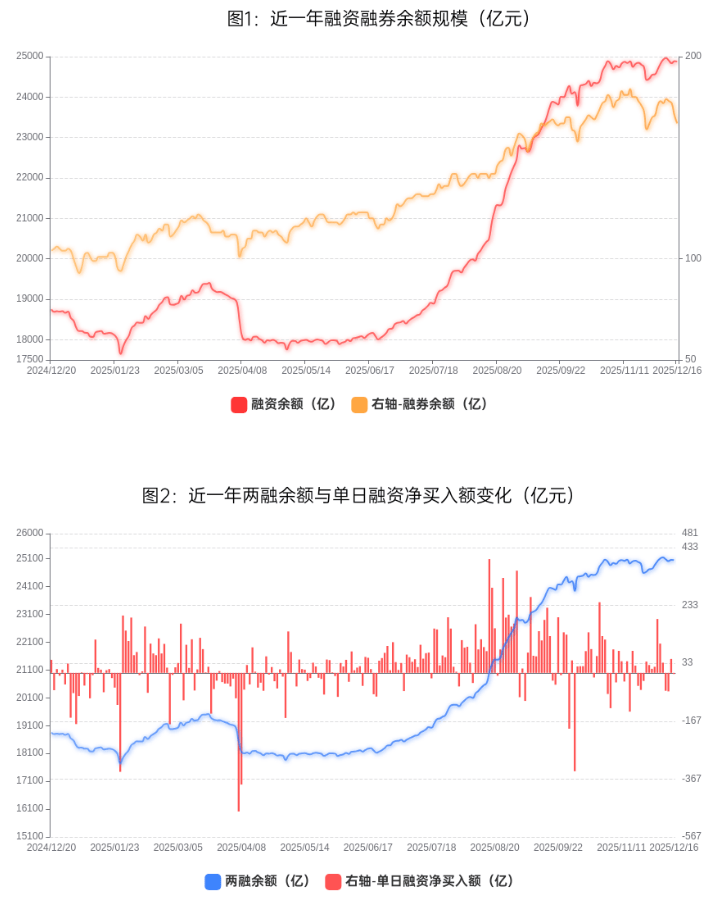
Core Viewpoint - As of December 16, the total margin financing and securities lending balance in the Shanghai, Shenzhen, and Beijing markets is 25,048.35 billion yuan, showing a decrease of 8.35 billion yuan from the previous trading day [1] Group 1: Margin Financing and Securities Lending Overview - The margin financing balance is 24,881.15 billion yuan, down by 4.59 billion yuan from the previous trading day [1] - The securities lending balance is 167.21 billion yuan, decreasing by 3.75 billion yuan from the previous trading day [1] Group 2: Capital Flow Analysis - On December 16, net inflows were observed in sectors such as insurance, commercial retail, and software development, with 11 industries seeing net inflows exceeding 1 million yuan [5] - Conversely, sectors like communication equipment, photovoltaic equipment, and electronic components experienced significant net outflows [5] - The financing balance decreased by 0.02% on the long side, while the securities lending balance saw a larger decline of 2.19% on the short side [5] Group 3: Stock Performance and Trading Volume - The top ten stocks by securities lending volume on December 16 include: - 600008 with a lending volume of 134.93 million shares, an increase of 6294.79% [6] - 600010 with a lending volume of 85.18 million shares, an increase of 1326.80% [6] - The top stocks by net financing amount include: - 601318 with a net financing amount of 75,424.32 million yuan, showing a slight decrease of 0.12% [7] - 601933 with a net financing amount of 42,634.83 million yuan, increasing by 10.10% [7] Group 4: Notable Trading Activity - Significant trading volume was noted for stocks such as: - 688536 with a volume ratio of 12.18 and a decrease of 1.70% [9] - 688105 with a volume ratio of 11.97 and a decrease of 0.55% [9]




长安、北汽L3级车型明年一季度试点上路,资本市场闻风动
Bei Ke Cai Jing· 2025-12-17 05:40
Core Viewpoint - The Ministry of Industry and Information Technology has announced the first batch of L3 conditional autonomous driving vehicle permits in China, with Changan Automobile and BAIC's Arcfox planning to pilot their models in designated areas of Beijing and Chongqing by the first quarter of 2026 [1][2]. Group 1: Company Plans - Changan Automobile's model, the Deep Blue SL03, and BAIC's Arcfox Alpha S (L3 version) will be operated by Chongqing Changan Car Networking Technology Co., Ltd. and Beijing Mobility Automotive Service Co., Ltd., respectively [2]. - Both companies aim to accumulate practical experience for a replicable and scalable autonomous driving operation system, with plans to initiate L3 operations in specific scenarios by the first quarter of 2026 [2]. Group 2: Market Impact - Following the announcement of the permit list, BAIC Blue Valley's stock hit the daily limit, while Changan Automobile's stock closed with a 4.42% increase; the intelligent driving sector saw a surge, with multiple stocks reaching their daily limits [2]. - However, by the afternoon of December 17, both Changan Automobile and BAIC Blue Valley experienced declines, although the intelligent driving index continued to rise [2].