
BAIC BluePark(600733)

Search documents
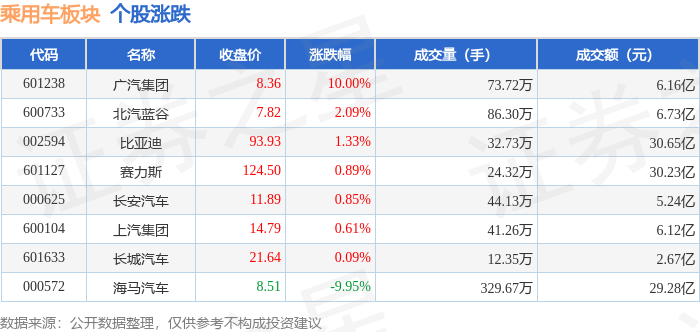
乘用车板块11月24日涨1.25%,广汽集团领涨,主力资金净流入4.03亿元
Zheng Xing Xing Ye Ri Bao· 2025-11-24 09:03
Core Viewpoint - The passenger car sector experienced a 1.25% increase on November 24, with GAC Group leading the gains, while the overall market indices showed modest increases [1] Group 1: Market Performance - The Shanghai Composite Index closed at 3836.77, up 0.05%, and the Shenzhen Component Index closed at 12585.08, up 0.37% [1] - GAC Group's stock price rose by 10.00% to 8.36, with a trading volume of 737,200 shares and a transaction value of 616 million [1] - Other notable performers included BAIC Blue Valley, which increased by 2.09%, and BYD, which rose by 1.33% [1] Group 2: Fund Flow Analysis - The passenger car sector saw a net inflow of 403 million from main funds, while retail investors experienced a net outflow of 44.18 million [1] - GAC Group attracted a net inflow of 259 million from main funds, accounting for 42.00% of its trading volume, while retail investors had a net outflow of 105 million [2] - BYD also saw a significant net inflow of 189 million from main funds, but retail investors withdrew 133 million [2]





新能源汽车指数下跌7.25% 磷酸铁锂平均报价上涨2850元/吨丨行业周报
2 1 Shi Ji Jing Ji Bao Dao· 2025-11-24 04:59
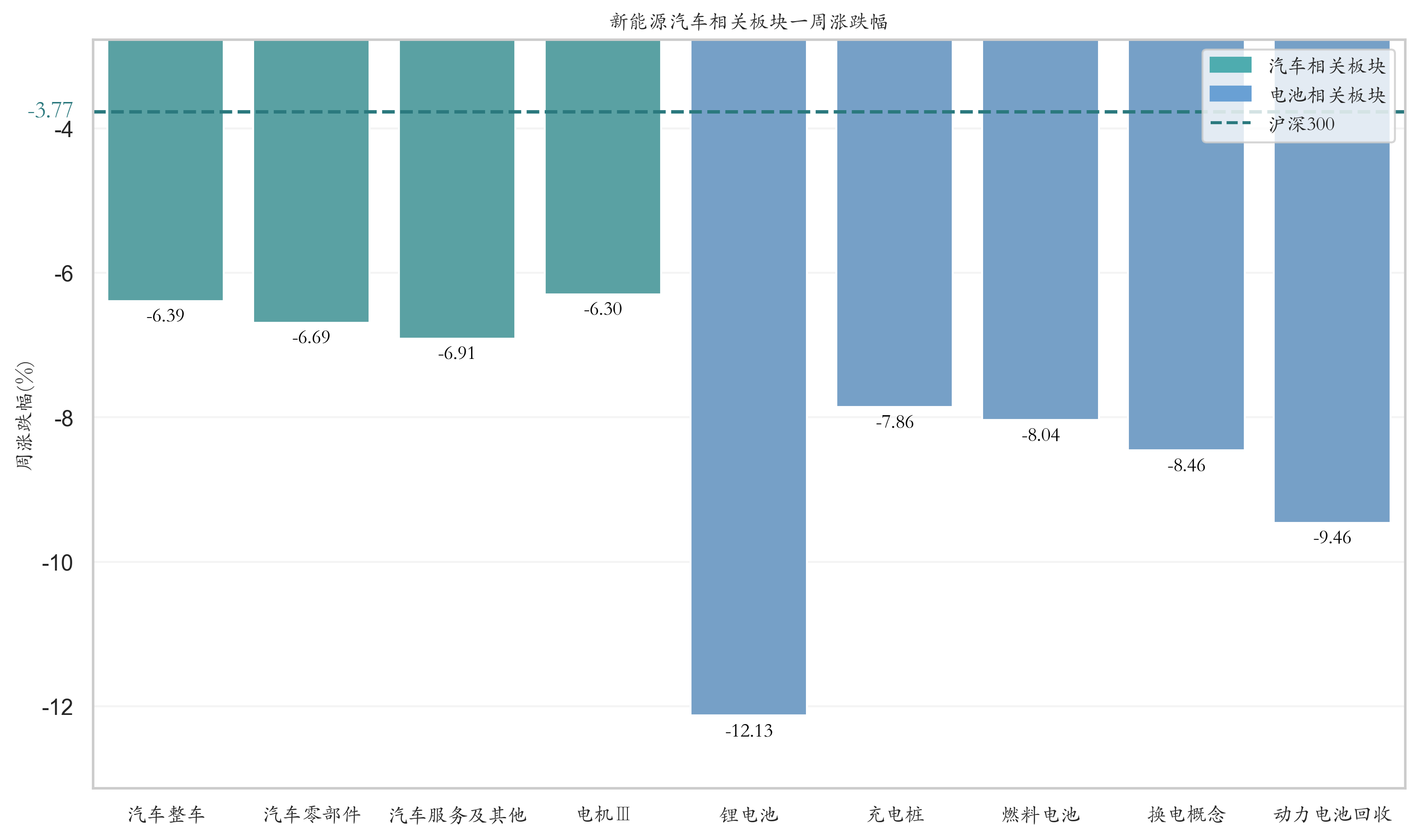
行情回顾 同花顺数据显示,上周(11月17日-11月21日,下同),新能源汽车指数(885431.TI)周内下跌7.25%,跑输沪深300指数3.48%。其中,汽车相关板块中表 现最好的是电机Ⅲ指数(884085.TI),周跌幅为6.30%。新能源车电池相关板块中表现最好的是充电桩指数(885461.TI),周跌幅为7.86%。 1.新能源汽车相关板块一周行情梳理 2.上市公司一周(11月17日-11月21日)行情梳理 新能源整车 | 代码 | 证券名称 | 收盘价(元) | | --- | --- | --- | | 600418.SH | 江淮汽车 | 48.26 | | 601238.SH | 广汽集团 | 7.6 | | 600733.SH | 北汽蓝谷 | 7.66 | | 000625.SZ | 长安汽车 | 11.79 | | 601633.SH | 长城汽车 | 21.62 | | 002594.SZ | 比亚迪 | 92.7 | | 601127.SH | 赛力斯 | 123.4 | | 000572.SZ | 海马汽车 | 9.45 | 电机电控 | 代码 | 证券名称 | 收盘价(元) ...



汽车行业周报(20251117-20251123):负beta消化过程中,看好汽车板块1Q26筑底/上行-20251123
Huachuang Securities· 2025-11-23 11:02
Investment Rating - The report maintains a "Buy" rating for the automotive sector, anticipating a bottoming and upward trend in Q1 2026 [1]. Core Insights - The automotive sector is currently experiencing a cooling sentiment due to the impact of trade-in quotas, with October retail sales falling below expectations and November expected to perform moderately. The fourth quarter is also anticipated to underperform previous market expectations. However, the sector is expected to find a bottom and begin to rise in Q1 2026, presenting potential investment opportunities for the upcoming year [1][2]. Data Tracking - In early November, the discount rate for vehicles increased to 10.0%, up by 0.4 percentage points month-on-month and 1.5 percentage points year-on-year. The average discount amount rose by 23,103 yuan, with significant fluctuations among major brands [3]. - In October, new energy vehicle deliveries from leading companies showed a notable increase for BYD, which delivered 442,000 units, a month-on-month increase of 11.5% but a year-on-year decrease of 12.1%. Other companies like Leap Motor and Xpeng also reported significant year-on-year growth [3][20]. - Traditional automakers also saw growth in October, with Geely's sales reaching 307,000 units, a year-on-year increase of 35.0% and a month-on-month increase of 12.5% [3][23]. Industry News - The report highlights several key developments in the automotive industry, including the launch of new models and significant sales figures for new energy vehicles. For instance, from November 1 to 16, the retail sales of new energy vehicles reached 554,000 units, a year-on-year increase of 2% [30][31]. - The report also notes the introduction of advanced technologies in new models, such as the Deep Blue L06 and the Xiaopeng X9, which feature cutting-edge battery systems and autonomous driving capabilities [30][31].


30.98万元起 顶配降8万元 新享界S9上市!鸿蒙智行旗舰MPV将亮相 余承东:将超越市面所有对手
Mei Ri Jing Ji Xin Wen· 2025-11-20 13:48
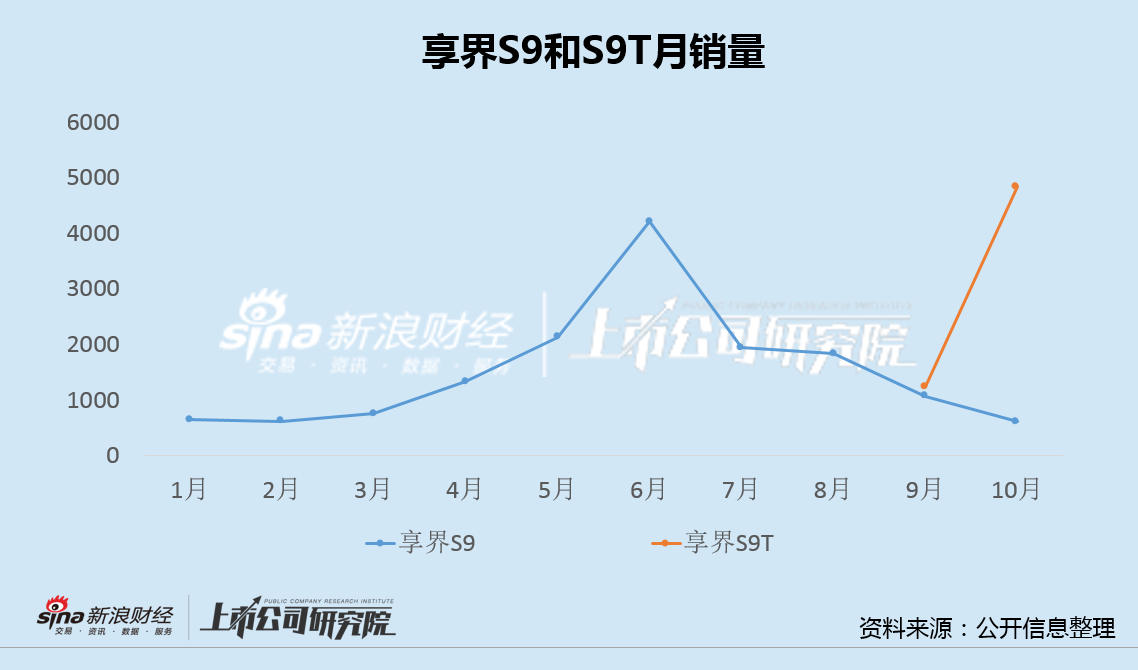
Core Insights - The launch of the new Xiangjie S9 marks the last new vehicle from Hongmeng Zhixing for the year, featuring four models with a price range of 309,800 to 369,800 yuan, maintaining the starting price of the previous model while reducing the top model's price by 80,000 yuan [1] - Huawei's executive Yu Chengdong announced the upcoming flagship MPV of the "9 series," claiming it will surpass all existing flagship MPVs in the market [1] Pricing and Market Position - The Xiangjie S9 was initially priced between 399,800 and 449,800 yuan, which was higher than competitors like the Mercedes-Benz E-Class, BMW 5 Series, and Audi A6, leading to a lack of market competitiveness [2] - The S9's sales performance was disappointing, with monthly sales averaging below 1,000 units due to factors such as brand recognition issues and limited practical applications of its smart driving features [2] Sales Performance and Strategy - In April 2025, the S9 introduced an extended-range version with a significant price reduction to 309,800 yuan, which improved its sales performance temporarily [2] - However, sales declined again in the latter half of 2025, with monthly sales dropping to 618 units by October [2] Strategic Partnerships and Future Plans - The second model, Xiangjie S9T, launched in September 2025, achieved over 30,000 pre-orders within 66 days, indicating a positive market response [3] - A strategic partnership between BAIC New Energy and Huawei aims to invest 20 billion yuan over three years to enhance the Xiangjie brand through technology upgrades and resource sharing [3] Product Development and Features - The new Xiangjie S9 shares design and configuration elements with the S9T, including advanced sensor technology and a unified control architecture for improved system integration [4] - The vehicle adopts Huawei's new Tuling platform, enhancing its technological capabilities [4] Market Challenges - The overall market for vehicles priced between 300,000 and 400,000 yuan has seen a decline of 3.9% year-on-year, with a notable drop in sedan sales [5] - Internal competition between the S9 and S9T may lead to market confusion and dilute brand performance, necessitating clear differentiation strategies [5]
乘用车板块11月20日跌1.48%,赛力斯领跌,主力资金净流出15.85亿元
Zheng Xing Xing Ye Ri Bao· 2025-11-20 09:09
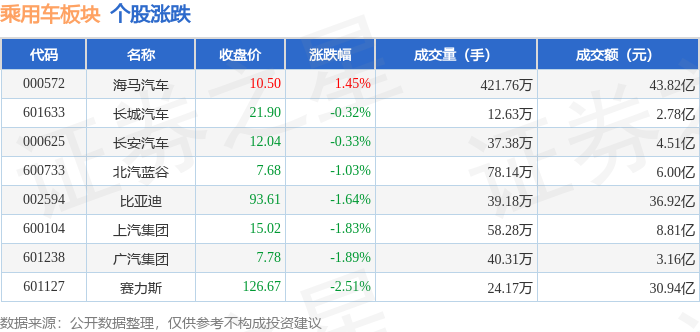
Core Points - The passenger car sector experienced a decline of 1.48% on November 20, with Seres leading the drop [1] - The Shanghai Composite Index closed at 3931.05, down 0.4%, while the Shenzhen Component Index closed at 12980.82, down 0.76% [1] Passenger Car Sector Performance - The closing prices and changes for key companies in the passenger car sector include: - Haima Automobile: 10.50, +1.45% - Great Wall Motors: 21.90, -0.32% - Changan Automobile: 12.04, -0.33% - BAIC Blue Valley: 7.68, -1.03% - BYD: 93.61, -1.64% - SAIC Group: 15.02, -1.83% - GAC Group: 7.78, -1.89% - Seres: 126.67, -2.51% [1] Capital Flow Analysis - The passenger car sector saw a net outflow of 1.585 billion yuan from institutional investors, while retail investors contributed a net inflow of 1.453 billion yuan [1] - The capital flow for specific companies indicates: - Great Wall Motors: Institutional net inflow of 7.4341 million yuan, retail net inflow of 5.4436 million yuan - GAC Group: Institutional net outflow of 32.0352 million yuan, retail net inflow of 5.4416 million yuan - SAIC Group: Institutional net outflow of 41.5678 million yuan, retail net inflow of 96.6030 million yuan - Changan Automobile: Institutional net outflow of 43.4795 million yuan, retail net inflow of 59.3332 million yuan - BAIC Blue Valley: Institutional net outflow of 68.5522 million yuan, retail net inflow of 47.5268 million yuan - Seres: Institutional net outflow of 634 million yuan, retail net inflow of 523 million yuan - BYD: Institutional net outflow of 69.47 million yuan, retail net inflow of 644.1 million yuan [2]
北汽蓝谷跌2.06%,成交额3.10亿元,主力资金净流出5938.19万元
Xin Lang Cai Jing· 2025-11-20 02:57
Group 1 - The core viewpoint of the news is that Beiqi Blue Valley's stock has experienced a decline, with a current price of 7.60 yuan per share and a market capitalization of 42.36 billion yuan [1] - As of November 20, the stock has dropped 5.00% year-to-date, with a 3.80% decline over the last five trading days and an 18.72% drop over the last 60 days [1] - The company specializes in the research, production, sales, and service of pure electric new energy passenger vehicles and core components, with 90.72% of its revenue coming from vehicle sales [1] Group 2 - For the period from January to September 2025, Beiqi Blue Valley achieved operating revenue of 15.38 billion yuan, representing a year-on-year growth of 56.69%, while the net profit attributable to shareholders was -3.43 billion yuan, an increase of 23.73% year-on-year [2] - As of September 30, 2025, the number of shareholders decreased by 11.53% to 240,100, while the average circulating shares per person increased by 13.04% to 20,346 shares [2] - Among the top ten circulating shareholders, Hong Kong Central Clearing Limited is the fourth largest, holding 114 million shares, an increase of 46.59 million shares from the previous period [2]
新能源汽车指数下跌0.82%,磷酸铁锂平均报价上涨500元/吨丨行业周报
2 1 Shi Ji Jing Ji Bao Dao· 2025-11-18 07:27
Market Performance - The new energy vehicle index (885431.TI) decreased by 0.82% from November 10 to November 14, outperforming the CSI 300 index by 0.26% [1] - The best-performing sector within the automotive industry was the automotive complete vehicle index (881125.TI), which rose by 0.42% [1] - In the new energy vehicle battery sector, the power battery recycling index (885944.TI) had the highest weekly increase of 1.49% [1] Company Stock Prices - The closing prices for various new energy vehicle companies as of November 14 are as follows: - Haima Automobile: 10.94 CNY [4] - JAC Motors: 47.87 CNY [4] - BYD: 98.37 CNY [4] - Changan Automobile: 12.23 CNY [4] - Great Wall Motors: 22.7 CNY [4] - Seres: 135.2 CNY [4] - GAC Group: 7.75 CNY [4] - BAIC Blue Valley: 7.82 CNY [4] Industry Data - In October, the production of new energy vehicles reached 1,772,000 units, a year-on-year increase of 21.1%, with cumulative production of 13,015,000 units, up 33.1% [37] - The sales volume for new energy vehicles in October was 1,715,000 units, reflecting a year-on-year increase of 20%, with cumulative sales of 12,943,000 units, up 32.7% [37] - Exports of new energy vehicles totaled 250,000 units in October, a year-on-year increase of 99.9%, with cumulative exports reaching 2,010,000 units, up 90.4% [37] - The wholesale sales of new energy vehicles in October were 1,621,000 units, a year-on-year increase of 18.6% and a month-on-month increase of 8.5% [37] Battery Data - The installed capacity of power batteries in October was 84,100 MWh, a year-on-year increase of 42.1% and a month-on-month increase of 10.7% [37] - Cumulative installed capacity reached 578,000 MWh, with a year-on-year increase of 42.4% [37] - The installed capacity of ternary material power batteries was 16,500 MWh, up 35.8% year-on-year, while lithium iron phosphate power batteries reached 67,500 MWh, up 43.7% year-on-year [37] Company Sales Performance - BYD's new energy vehicle sales in October were 441,706 units, a month-on-month increase of 11.47% but a year-on-year decrease of 12.13% [37] - Leap Motor's new energy vehicle deliveries were 70,289 units, a month-on-month increase of 5.45% and a year-on-year increase of 84.11% [37] - Seres sold 51,456 new energy vehicles in October, reflecting a month-on-month increase of 15.17% and a year-on-year increase of 42.89% [37]


北汽蓝谷拟再募60亿背后:直接融资410亿负债率升至84%享界首秀失利押注小众市场
Xin Lang Cai Jing· 2025-11-17 12:03
Core Viewpoint - Beiqi Blue Valley has received approval from the Shanghai Stock Exchange for a new round of non-public stock issuance, aiming to raise up to 6 billion yuan for projects related to new energy vehicle development and AI intelligent platform development. However, the company continues to face deep losses despite revenue growth and stable gross margins, raising questions about its ability to reverse its performance through additional fundraising [1][10]. Financial Performance - In the first three quarters of this year, Beiqi Blue Valley sold 111,500 units, a year-on-year increase of 64.34%. Revenue reached 15.384 billion yuan, up 56.69%, but the net profit attributable to shareholders was -3.426 billion yuan, indicating a narrowing loss yet still deep in the red [3]. - The company's gross margin was -2.70%, an improvement from -6.68% in the same period last year [3]. Stock Issuance and Financing - Since its backdoor listing in 2018, Beiqi Blue Valley has raised a total of 41 billion yuan through multiple rounds of financing, which is close to its current total market value of 44 billion yuan. However, the company's debt ratio has risen to 84%, up approximately 22 percentage points from 62% at the end of its listing year [5][6]. - The 60 billion yuan fundraising planned for 2023 has seen multiple project changes and delays, with a significant portion of the raised funds still unutilized [8][9]. Product Performance and Market Position - The launch of the high-end brand "Xiangjie" in collaboration with Huawei has not met expectations, with the first model, S9, experiencing poor sales. The introduction of a range-extended version in April did not significantly improve sales figures [2][3]. - The average selling price of vehicles has decreased, with a projected drop of 18% to approximately 127,400 yuan in 2024, following a 5% decline to 138,000 yuan in the first three quarters of this year [4].
北汽蓝谷拟再募60亿背后:直接融资410亿负债率升至84% 享界首秀失利押注小众市场
Xin Lang Zheng Quan· 2025-11-17 11:30
Core Viewpoint - Beiqi Blue Valley has received approval for a new round of non-public stock issuance, aiming to raise up to 6 billion yuan for projects related to new energy vehicle development and AI intelligent platform development. However, the company continues to face deep losses despite revenue growth and stable gross margins, raising concerns about its ability to reverse its performance decline with additional fundraising [1][3][10]. Financial Performance - In the first three quarters of this year, Beiqi Blue Valley sold 111,500 units, a year-on-year increase of 64.34%. Revenue reached 15.384 billion yuan, up 56.69%, but the net profit attributable to shareholders was -3.426 billion yuan, indicating a narrowing loss yet still deep in the red [3]. - The company's gross margin was -2.70%, an improvement from -6.68% in the same period last year, but it has not yet turned positive [3]. Product Performance - The high-end brand Xiangjie, developed in collaboration with Huawei, faced significant challenges. The first model, S9, launched in August 2024, has seen disappointing sales, with the initial version priced at 399,800 yuan and the extended range version dropping to 309,800 yuan. Sales peaked at 4,215 units in June but plummeted to 618 units by October [4][6]. - The company has introduced the S9T model targeting the niche travel vehicle market, which has shown initial sales growth, but concerns remain about whether it will follow the declining sales trend of the S9 extended range version [6]. Financing and Debt - Since its backdoor listing in 2018, Beiqi Blue Valley has raised a total of 41 billion yuan through multiple rounds of financing, approaching its current market capitalization of 44 billion yuan. However, the company's debt ratio has risen to 84%, up from 62% at the end of its first year of listing, indicating increasing financial pressure [7][8]. - The 60 billion yuan fundraising planned for 2023 has faced changes and delays in several investment projects, with a significant portion of the raised funds still unutilized, raising doubts about the company's ability to achieve self-sustainability and reverse its long-term performance decline [10].
汽车行业周报(20251110-20251116):Q4翘尾预计低于预期,看好明年汽车板块预期修复-20251116
Huachuang Securities· 2025-11-16 10:42
Investment Rating - The report maintains a positive investment recommendation for the automotive sector, anticipating a recovery in the market next year [1]. Core Insights - The automotive market is currently experiencing a downturn, with Q4 expectations falling short due to the impact of trade-in quotas. However, there is optimism for an upward revision in Q1 2026, suggesting that the sector may hit bottom sooner than expected. Despite the current sluggish trading environment, selective investment opportunities for next year are encouraged [1]. Data Tracking - In early November, the discount rate for vehicles increased to 10.0%, up by 0.4 percentage points month-on-month and 1.5 percentage points year-on-year. The average discount amount rose by 23,103 yuan, with significant fluctuations noted among major brands [3]. - In October, new energy vehicle deliveries saw significant growth, with BYD delivering 442,000 units (down 12.1% year-on-year but up 11.5% month-on-month), while other brands like Leap Motor and Xpeng reported substantial year-on-year increases [3][21]. - Traditional automakers also showed strong sales, with Geely's sales increasing by 35.0% year-on-year to 307,000 units in October [3][24]. Recommendations - For complete vehicles, the report recommends investing in Geely and BYD, highlighting Geely's upcoming product cycle and potential for significant profit increases in the next 6-9 months. The report also suggests considering Jianghuai Automobile due to its strong product cycle and recent stock price corrections [5]. - In the automotive parts sector, the report identifies AI and intelligent driving as key areas for growth, recommending companies like Horizon Robotics and Sensetime Technology. It also highlights opportunities in liquid cooling and robotics, suggesting investments in companies like Minth Group and Top Group [5]. - The heavy truck segment is noted for its strong performance in recent months, with recommendations for companies like China National Heavy Duty Truck Group and Weichai Power [5]. Industry News - In October, new energy vehicles accounted for over 50% of total new car sales for the first time, with production and sales figures for the year showing over 10% growth [8][31]. - The report mentions the launch of new models, including the IM LS9, which features advanced technology and significant performance metrics [31]. - The Ministry of Industry and Information Technology has set new requirements for new energy vehicle credit ratios for 2026 and 2027, indicating a regulatory push towards electric vehicles [31].

