
WINGTECH(600745)

Search documents
纳指跌近500点,比特币跌破8.7万美元;商务部部长会见美驻华大使;闻泰科技最新声明;霸王茶姬迎来“老板娘”?天合光能回应丨每经早参
Mei Ri Jing Ji Xin Wen· 2025-11-20 22:03
每经编辑|陈鹏程 王晓波 √美国2025年FOMC票委、芝加哥联储主席古尔 斯比发表讲话 2 欧元区11月综合PMI初值公布 3 美国11月密歇根大学消费者预期指数终值公布 国际油价走低,美油主力合约跌0.88%,报58.73美元/桶;布伦特原油主力合约跌0.66%,报63.09美元/桶。 4 2025第二十三届广州国际汽车展览会将于11. 21日至30日举办 5 华为将发布AI领域突破性技术,有望解决算力 资源利用效率难题 1 何立峰在湖北、湖南调研时强调 持续推动外贸提质增效 打通全国统一大市场建设卡点堵点 中共中央政治局委员、国务院副总理何立峰11月18日至20日到湖北、湖南调研。何立峰指出,面对严峻复杂的外部环境,我国外贸顶住压力保持稳定增长, 为国内经济发展提供了有力支撑。要支持跨境电商等新业态新模式发展和海外仓建设,持续推动外贸市场多元化,继续保持外贸平稳增长。要持续优化商品 和服务供给,更好满足多样化消费需求。要积极探索"铁公水空"多式联运,加快构建现代物流体系,有效降低全社会物流成本,坚决打通阻碍全国统一大市 场建设的卡点堵点。(新华社) 2 隔夜市场 美股三大指数集体收跌,道指跌0.84%, ...



闻泰科技新发声明股价连续反弹荷兰安世改称10月对华未断供晶圆
Xin Lang Cai Jing· 2025-11-20 21:05
Core Viewpoint - The recent developments regarding Nexperia's control issues have seen a positive turn with the Dutch government announcing a suspension of the ministerial order, although the control remains limited for the time being [1] Group 1: Government Actions - The Dutch Minister of Economic Affairs and Climate Policy, Vincent Karremans, announced on November 19 that it is an appropriate time to take constructive measures due to recent developments [1] - The ministerial order issued on September 30, 2025, required Nexperia and its global subsidiaries to report on their assets and operations [1] - The Chinese Ministry of Commerce welcomed the Dutch government's decision to suspend the administrative order, viewing it as a step towards resolving the global semiconductor supply chain turmoil [1] Group 2: Company Status - Despite the suspension of the ministerial order, the court ruling from October 7, 2025, remains in effect, which continues to limit the control of WWT over Nexperia [1] - Nexperia announced that its CEO, Zhang Xuezheng, remains suspended and will not resume his duties, with the CFO Stefan Tilger continuing as the interim CEO [1] Group 3: Supply Chain and Operations - Nexperia stated that it has not completely halted wafer shipments and is committed to delivering wafers to the supply chain while providing alternative solutions [1] - The company indicated that Nexperia China has deviated from the established governance framework and has not followed the legitimate directives from the global management [1] - Nexperia assessed that it has sufficient wafer and finished product inventory to maintain operations for several months, attributing any failure to complete shipments to Nexperia China [1]
China's Wingtech says its control over Nexperia must be restored
Yahoo Finance· 2025-11-20 16:08
Group 1 - Wingtech asserts that its control over Nexperia must be restored following the Dutch government's suspension of its seizure of the chipmaker, which is crucial in the global supply chain crisis [1][2] - The Chinese commerce ministry welcomed the suspension and both Beijing and Wingtech are calling for a reversal of a Dutch court ruling that stripped Wingtech of its control over Nexperia [2] - Wingtech has stated it will not accept any attempts to legitimize what it considers illegal outcomes regarding Nexperia's governance and equity [3] Group 2 - Recent easing of export controls by Beijing on Nexperia chips packaged in China has provided temporary relief to global automakers and suppliers, but issues like the court ruling need resolution for supply chains to normalize [4] - The ongoing dispute began after the Dutch government intervened on September 30, leading to the removal of Nexperia's then-CEO Zhang Xuezheng due to alleged mismanagement, which Wingtech has rejected [5] - Nexperia was preparing to change its corporate structure to avoid being placed on the U.S. "entity list" of companies considered security threats, while Wingtech has been on this list since December 2024 [6] Group 3 - Wingtech has accused the Dutch government of instigating the court proceedings and has called for the government to withdraw its support [7] - The Dutch court is expected to decide on whether to conduct a full investigation into the alleged mismanagement within a reasonable timeframe, although no specific date has been set [7]
闻泰科技 最新声明!
Zheng Quan Shi Bao· 2025-11-20 15:12
Core Viewpoint - The company emphasizes the necessity of restoring its complete rights as a shareholder and legal control over Anshi Semiconductor, asserting that the Dutch Ministry of Economic Affairs' suspension of the administrative order is only a preliminary step towards resolving the issue, not a complete solution [2][9]. Group 1: Company Response to Dutch Government Actions - The company acknowledges the Dutch Minister's statement on November 19, which announced the suspension of the administrative order issued on September 30, 2025, under the Goods Availability Act, highlighting the importance of this development [7][8]. - The company expresses gratitude to the Chinese Ministry of Commerce for its efforts in addressing the Anshi Semiconductor issue and views the suspension as a recognition of the illegality and impropriety of the previous actions taken by the Dutch government [8]. - Despite the suspension, the company clarifies that the corporate court's emergency measures remain in effect, and the control over Anshi is still restricted, urging investors to be cautious [3][9]. Group 2: Demands for Resolution - The company insists that any genuine resolution must involve the permanent withdrawal of the administrative order and the restoration of the rights of Chinese shareholders and personnel, reverting Anshi to its status prior to September 29, 2025 [9]. - The company firmly rejects any attempts to "legalize" illegal outcomes or accept a new normal in Anshi's governance created through unlawful procedures, stating it will pursue all legal avenues to protect its and all shareholders' rights [9].
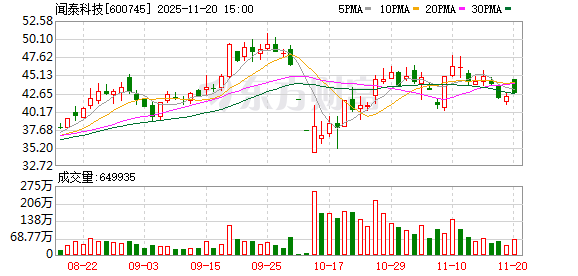
闻泰科技新发声明股价连续反弹? 荷兰安世改称10月对华未断供晶圆
Zheng Quan Shi Bao Wang· 2025-11-20 15:08
Core Viewpoint - The recent developments regarding Nexperia's control and supply chain issues indicate a potential stabilization, with the Dutch government suspending a ministerial order that restricted Nexperia's operations in China, although control remains limited for the company [1][2][3]. Group 1: Nexperia's Control and Legal Status - The Dutch Minister of Economic Affairs announced the suspension of a ministerial order that restricted Nexperia's global operations, which was initially set to last for one year [2]. - Despite the suspension, the court ruling from October 7, 2025, which limits Nexperia's control, remains in effect, and the company is exploring legal remedies to protect its rights [3]. - Nexperia has called for the Dutch government to permanently revoke the ministerial order and restore control to its Chinese shareholders [3]. Group 2: Supply Chain and Operational Updates - Nexperia has clarified that it has not completely halted the shipment of wafers and continues to deliver to its supply chain while seeking alternative solutions [5]. - The company indicated that its Chinese entity has deviated from the established governance framework, yet it continues to supply wafers directly to its Chinese factory during the export restrictions [5]. - Nexperia believes that its Chinese operations have sufficient wafer and finished product inventory to maintain operations for several months, attributing any shipment failures to the Chinese entity [5]. Group 3: Employee and Management Status - Nexperia's CEO remains suspended, with the CFO acting as the interim CEO, while the management structure is under the oversight of a court-appointed independent manager [4]. - Despite external pressures, Nexperia China has assured that employee salaries and benefits are being maintained without disruption [6].
闻泰科技,最新声明!
Zheng Quan Shi Bao· 2025-11-20 15:06
Core Viewpoint - The company emphasizes the necessity to restore its complete rights as a shareholder and legal control over Anshi Semiconductor, asserting that the recent suspension of the administrative order by the Dutch Ministry of Economic Affairs is only a preliminary step towards resolving the issue, not a complete solution [1][5][7]. Group 1: Company Response to Dutch Ministry's Actions - The company acknowledges the Dutch Minister's statement as a recognition of the current issues, viewing it as a step towards a proper resolution, while also highlighting the illegality of previous actions taken by the Dutch government [5][6]. - Despite the suspension of the administrative order, the company notes that the corporate court's emergency measures remain in effect, continuing to limit the rights of Chinese shareholders and personnel [2][5]. Group 2: Demand for Comprehensive Resolution - The company insists that the Dutch Ministry must fully and thoroughly address the issues surrounding Anshi Semiconductor, including the permanent withdrawal of the administrative order and the cessation of its involvement in the corporate court proceedings [6][7]. - The company firmly states that any genuine resolution must be based on restoring its complete rights as a shareholder and legal control over Anshi, rejecting any attempts to legitimize the outcomes of illegal processes [7][8].
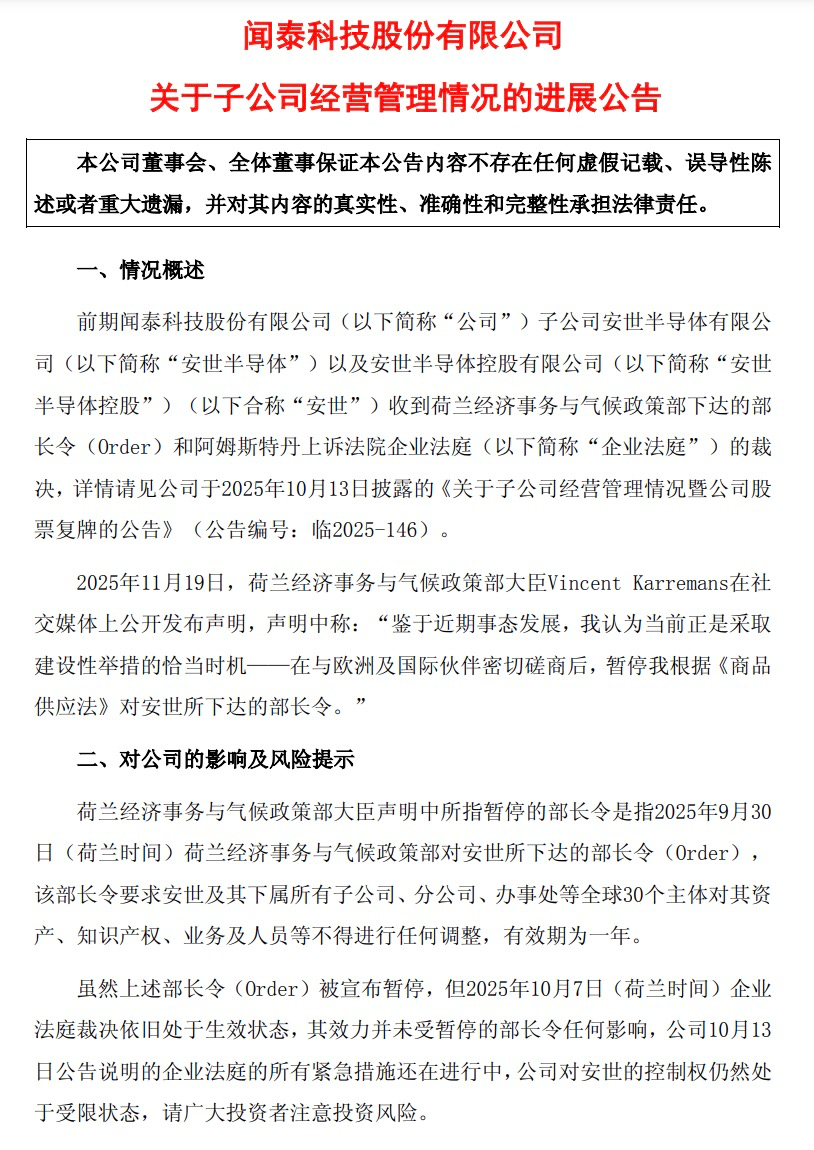
闻泰科技,最新声明!
证券时报· 2025-11-20 15:00
Core Viewpoint - The company emphasizes the necessity of restoring its complete rights as a shareholder and legal control over Nexperia, urging the Dutch Ministry of Economic Affairs to thoroughly correct its previous errors and permanently revoke the administrative order issued under the Goods Availability Act [1][9]. Summary by Sections Section 1: Overview of the Situation - The company’s subsidiary, Nexperia, received an administrative order from the Dutch Ministry of Economic Affairs, which restricts its operations and management for one year [4]. - The Dutch Minister of Economic Affairs announced the suspension of this order on November 19, 2025, indicating a potential shift towards resolving the issue [2][4]. Section 2: Impact on the Company - Despite the suspension of the administrative order, the court's ruling from October 7, 2025, remains in effect, continuing to limit the company's control over Nexperia [5]. - The company warns investors about the ongoing risks associated with the limited control over Nexperia [2][5]. Section 3: Company's Position on the Dutch Ministry's Decision - The company acknowledges the Dutch Minister's statement as a step towards addressing the issue but insists that the core problems remain unresolved [7][9]. - The company asserts that the administrative order's suspension does not address the underlying legal issues and continues to restrict the rights of Chinese shareholders [7][9]. Section 4: Call for Comprehensive Resolution - The company demands that the Dutch Ministry not only revoke the administrative order but also ensure the restoration of the legal rights of Chinese shareholders and the return of Nexperia to its status prior to September 29, 2025 [9]. - The company firmly rejects any attempts to legitimize the outcomes of illegal processes and will pursue all legal avenues to protect its and its shareholders' rights [9].

闻泰科技新发声明股价连续反弹 荷兰安世改称10月对华未断供晶圆
Zheng Quan Shi Bao Wang· 2025-11-20 14:38
Core Viewpoint - The recent developments regarding Nexperia's control issues have seen a positive turn with the Dutch government announcing a suspension of the ministerial order, although the control remains limited for the company [1][2][3]. Group 1: Company Control and Legal Status - The Dutch Minister of Economic Affairs announced the suspension of the ministerial order that restricted Nexperia's operations, which was initially set to last for one year [2]. - Despite the suspension, the court ruling from October 7, 2025, which limits Nexperia's control, remains in effect, and the company is actively seeking legal remedies to protect its rights [3]. - Nexperia has urged the Dutch government to permanently revoke the administrative order and restore control to its Chinese shareholders [3]. Group 2: Supply Chain and Operations - Nexperia has welcomed constructive dialogue between China and the Netherlands aimed at stabilizing the supply chain, but emphasizes that full recovery requires cooperation from its entities in China [4]. - The company has clarified that it has not completely halted wafer shipments and continues to deliver wafers to maintain supply chain continuity [6]. - Nexperia's Chinese entity has been accused of deviating from the company's governance framework, yet the company continues to supply wafers directly to its Chinese factory during the export restrictions [6][7]. Group 3: Management and Leadership - The CEO of Nexperia, Zhang Xuezheng, remains suspended, and the voting rights of shares held by Nexperia are managed by an independent administrator appointed by the court [4]. - The CFO, Stefan Tilger, is acting as the interim CEO, while other executives continue to fulfill their roles under the oversight of the court-appointed non-executive director [4].
闻泰科技最新声明:必须得到恢复!
Zhong Guo Ji Jin Bao· 2025-11-20 14:34
Core Viewpoint - Wentech Technology emphasizes the need for the Dutch Ministry of Economic Affairs to fully resolve the issues surrounding Nexperia Semiconductor and restore the company's complete rights and legal control over Nexperia [2][4]. Group 1: Company Position - Wentech Technology reported that Nexperia Semiconductor had a revenue of approximately 14.7 billion yuan last year [2]. - The company warned that if control over Nexperia is not restored by the end of 2025, it may face risks of revenue, profit, and cash flow adjustments [2]. - As of November 20, Wentech Technology's stock closed at 42.65 yuan per share, with a total market capitalization of 53.1 billion yuan [2]. Group 2: Legal and Regulatory Context - The Dutch Ministry of Economic Affairs announced the suspension of an administrative order issued on September 30, 2025, regarding Nexperia, but the emergency measures from the Amsterdam Enterprise Court remain in effect [4][5]. - Wentech Technology highlighted that the Ministry's suspension does not address the core issue of the Enterprise Court's decision to strip Wentech of its control over Nexperia [4][6]. - The Ministry has actively participated in the court proceedings, asserting itself as a stakeholder and influencing the outcome, which has led to the suspension of Chinese directors and the trusteeship of nearly all shares held by Chinese stakeholders [5][6]. Group 3: Demands and Future Actions - Wentech Technology insists that any genuine resolution must restore its complete rights as a shareholder and legal control over Nexperia [6]. - The company will not accept any attempts to legitimize the illegal outcomes or a new governance structure for Nexperia created through unlawful procedures [6]. - Wentech Technology plans to take all necessary legal actions to protect its and all shareholders' legitimate rights [6].
闻泰科技回应荷兰经济部暂停行政令
Bei Jing Wan Bao· 2025-11-20 14:14
Core Viewpoint - The company expresses its strong concern regarding the Dutch Ministry of Economic Affairs and Climate Policy's decision to suspend the administrative order issued on September 30, 2025, against Nexperia, emphasizing the need for a comprehensive resolution to the issues surrounding Nexperia's governance and control [1] Group 1: Response to the Dutch Ministry's Decision - The company acknowledges that the Dutch Minister's statement follows consultations between the Chinese Ministry of Commerce and the Dutch Ministry, appreciating the efforts made to resolve the Nexperia issue [1] - The suspension of the administrative order indicates the Dutch Ministry's recognition of the illegality and impropriety of its previous actions [1] - Despite the suspension, the emergency measures imposed by the Amsterdam Court of Appeal remain in effect, continuing to infringe upon the rights of Chinese shareholders and personnel [1] Group 2: Obligations of the Dutch Ministry - The administrative order issued on September 30, 2025, is viewed as the beginning of a series of actions by the Dutch government [1] - The Dutch Ministry actively participated in the court proceedings initiated by Nexperia's European management, asserting itself as a stakeholder and influencing the process [1] - The Ministry's involvement led to the court's emergency measures that deprived the company of its rights as a 100% shareholder, indicating a systematic illegal deprivation of ownership [1] Group 3: Restoration of Rights - The company insists that the suspension of the administrative order is only a preliminary step and not a comprehensive solution to the ongoing issues [1] - The company urges the Dutch Ministry to acknowledge the essence of the situation and to permanently withdraw the administrative order and its support for the court proceedings [1] - A genuine resolution must restore the company's complete rights as a shareholder and its legal control over Nexperia, rejecting any attempts to legitimize the illegal outcomes [1]