Bank Of Jiangsu(600919)

Search documents
城商行板块11月10日涨0.96%,厦门银行领涨,主力资金净流入7750.91万元
Zheng Xing Xing Ye Ri Bao· 2025-11-10 08:48
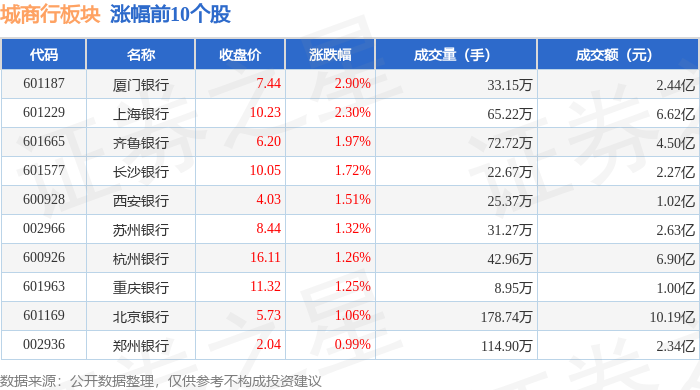
Market Performance - The city commercial bank sector increased by 0.96% on November 10, with Xiamen Bank leading the gains [1] - The Shanghai Composite Index closed at 4018.6, up 0.53%, while the Shenzhen Component Index closed at 13427.61, up 0.18% [1] Individual Bank Performance - Xiamen Bank's closing price was 7.44, with a rise of 2.90% and a trading volume of 331,500 shares, amounting to 2.44 billion yuan [1] - Shanghai Bank closed at 10.23, up 2.30%, with a trading volume of 652,200 shares and a transaction value of 660 million yuan [1] - Qilu Bank saw a closing price of 6.20, increasing by 1.97%, with a trading volume of 727,200 shares and a transaction value of 450 million yuan [1] - Other notable banks include Changsha Bank, Xi'an Bank, and Suzhou Bank, with respective increases of 1.72%, 1.51%, and 1.32% [1] Capital Flow Analysis - The city commercial bank sector experienced a net inflow of 77.51 million yuan from institutional investors, while retail investors saw a net outflow of 10.29 million yuan [1] - Beijing Bank had a significant net inflow of 1.35 billion yuan from institutional investors, but a net outflow of 582.22 million yuan from retail investors [2] - Jiangsu Bank also reported a net inflow of 103 million yuan from institutional investors, with retail investors experiencing a net outflow of 91.58 million yuan [2]




本周在售最低持有期产品哪家强?
2 1 Shi Ji Jing Ji Bao Dao· 2025-11-10 08:44
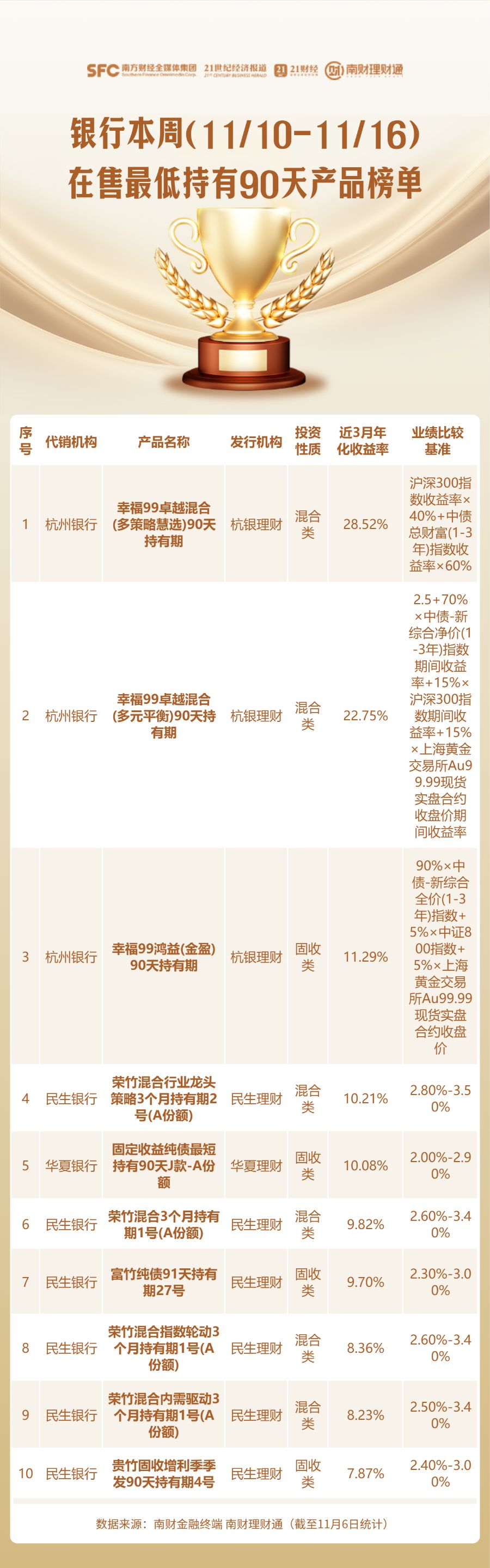
Core Insights - The article emphasizes the importance of distinguishing between various bank wealth management products, which often have similar names and vague characteristics, to help investors make informed choices [1] - The South Finance Wealth Management team compiles a weekly performance ranking of wealth management products available through different distribution channels, focusing on those with the best performance [1] Product Performance Summary - The report categorizes products based on minimum holding periods of 90 days, 180 days, and 365 days, calculating annualized returns for each category [1] - A total of 28 distribution institutions are involved in the ranking, including major banks such as Industrial and Commercial Bank of China, Bank of China, and Agricultural Bank of China [1] - The ranking is based on the assumption of the product's "on-sale" status, but actual availability may vary due to factors like sold-out quotas or differences in product listings for different customers [1] 90-Day Holding Period Products - The top-performing product for a 90-day holding period is from Hangzhou Bank, with an annualized return of 22.75% [4] - Other notable products include those from Minsheng Bank and Huaxia Bank, with returns of 10.21% and 10.08%, respectively [5] 180-Day Holding Period Products - For the 180-day holding period, Hangzhou Bank's product leads with a return of 14.04% [7] - Minsheng Bank also features prominently with products yielding 12.26% and 10.26% [7] 365-Day Holding Period Products - The report indicates that products with a 365-day holding period are also being evaluated, with specific performance data yet to be detailed in the provided excerpts [9]






研报掘金丨长江证券:江苏银行股价回调到位,配置价值突出,维持“买入”评级
Ge Long Hui A P P· 2025-11-10 08:41
Core Viewpoint - Jiangsu Bank's performance in the first three quarters of 2025 shows strong revenue growth and profitability, with a notable increase in net interest income and a stable non-performing loan ratio, indicating robust financial health and investment potential [1] Financial Performance - Revenue growth rate for the first three quarters of 2025 is 7.8%, consistent with the growth rate in the first half of the year [1] - Net interest income growth rate is 19.6%, highlighting strong interest income generation [1] - Net profit attributable to shareholders increased by 8.3%, with a quarterly growth rate of 8.8% in Q3 [1] Asset Quality - Non-performing loan ratio stands at 0.84%, remaining stable quarter-on-quarter and down by 5 basis points from the beginning of the period [1] - Provision coverage ratio is at 323%, showing a decrease of 8 percentage points quarter-on-quarter and down by 27 percentage points from the beginning of the period, but still indicating a strong buffer against potential loan losses [1] Market Position and Valuation - The bank's performance growth is significantly better than market expectations amid a bond market correction, suggesting strong underlying fundamentals [1] - The stock price has recently corrected due to market risk appetite, leading to a projected dividend yield of 5.0% for 2025, emphasizing its attractive dividend value [1] - Current valuations are at 0.81x price-to-book (PB) and 6.3x price-to-earnings (PE), indicating that the stock is undervalued and presents a compelling investment opportunity [1]

从增量扩面到提质控险 银行业普惠金融迈向差异化精准服务
2 1 Shi Ji Jing Ji Bao Dao· 2025-11-10 04:21
Core Insights - The report highlights the significant growth and development of inclusive finance in China, particularly focusing on small and micro enterprises and rural areas, with a notable annual growth rate of over 20% in inclusive micro loans during the 14th Five-Year Plan period [1][2] - As of June 2025, the balance of inclusive micro loans reached 36 trillion yuan, which is 2.3 times that of the end of the 13th Five-Year Plan, with a decrease in interest rates by 2 percentage points [1][2] - The average interest rate for newly issued inclusive micro loans was 3.48% as of June 2025, reflecting a decrease of 66 basis points year-on-year [1][2] Group 1: Digital Empowerment - Digital technology has been a key driver for the development of inclusive finance, with banks utilizing big data and AI to enhance loan approval efficiency and reduce financing costs [2][7] - The market structure among banks is changing, with large commercial banks holding a 45.11% share of inclusive micro loans, while rural financial institutions have seen a decline in their market share [2][3] - The average growth rate of inclusive micro loans has been slowing down, with a decrease from 30.9% in 2020 to 12.3% by mid-2025 [2][3] Group 2: Performance of Listed Banks - Among listed banks, Agricultural Bank of China, Industrial and Commercial Bank of China, and Beijing Bank reported the highest growth rates in inclusive micro loans at 18.50%, 17.30%, and 17.27% respectively [3][4] - In contrast, some banks, including Shanghai Bank and Zhengzhou Bank, experienced negative growth rates of -3.97% and -2.06% [3][4] - The performance of different banks varies significantly, with state-owned banks generally showing stronger growth in inclusive micro loans compared to smaller banks [3][4] Group 3: Interest Rates and Risk Management - The interest rates for newly issued inclusive micro loans have decreased across various banks, with the highest rate at 4.20% and the lowest at 2.94% [7][8] - The gap in interest rates between large and small banks is narrowing, with some large banks' rates aligning closely with those of smaller banks [8][9] - The report emphasizes the importance of risk management in the inclusive finance sector, with several banks focusing on improving asset quality and managing non-performing loans [9][10]


北京银行营收下降落后江苏银行156亿 金融投资增23%资本充足率降至8.44%
Chang Jiang Shang Bao· 2025-11-09 23:32
Core Viewpoint - Beijing Bank has lost its position as the leading city commercial bank, facing challenges in revenue and profit growth compared to its peers, particularly Jiangsu Bank and Ningbo Bank [1][4][5] Financial Performance - For the first three quarters of 2025, Beijing Bank reported operating income of 51.588 billion yuan, a year-on-year decrease of 1.08%, and a net profit attributable to shareholders of 21.064 billion yuan, a slight increase of 0.26% [1][3] - The bank's quarterly performance showed fluctuations, with operating income of 17.127 billion yuan, 19.091 billion yuan, and 15.370 billion yuan for the three quarters, reflecting year-on-year changes of -3.18%, +5.12%, and -5.71% respectively [3] Comparison with Peers - Jiangsu Bank surpassed Beijing Bank in both operating income and net profit by 15.595 billion yuan and 9.519 billion yuan respectively, achieving operating income of 67.183 billion yuan and net profit of 30.583 billion yuan, with year-on-year growth rates of 7.83% and 8.32% [4][5] - Ningbo Bank also outperformed Beijing Bank with operating income of 54.976 billion yuan and net profit of 22.445 billion yuan, both showing year-on-year growth of 8.32% and 8.39% [5] Asset Quality and Capital Adequacy - As of September 30, 2025, Beijing Bank's non-performing loan ratio was 1.29%, a slight decrease of 0.02 percentage points from the beginning of the year, while the provision coverage ratio was 195.79%, down 12.96 percentage points [10] - The capital adequacy ratios for Beijing Bank were reported at 12.82%, 11.87%, and 8.44% for total capital, tier 1 capital, and core tier 1 capital respectively, all showing declines from the previous year [2][10] Investment and Income Sources - The bank's investment income for the first three quarters was 9.903 billion yuan, a decrease of 3.6%, with fair value changes resulting in a loss of 1.189 billion yuan, a significant drop from a gain of 0.217 billion yuan in the previous year [6] - Interest income increased by 1.8% to 39.246 billion yuan, supported by a growth in interest-earning assets and a slight easing of margin pressure [7] Non-Interest Income - Non-interest income from fees and commissions reached 3.269 billion yuan, reflecting a year-on-year increase of 16.9%, with significant growth in personal wealth management product sales [9]
银行长期限存款“退场”背后
Bei Jing Shang Bao· 2025-11-09 13:49
Core Viewpoint - The long-term deposit products, once considered a "stabilizing force" for investors, are gradually disappearing from the shelves of some banks, indicating a profound restructuring of the banking industry's profit logic in response to deepening interest rate marketization and a low-interest environment [1][4][8]. Group 1: Disappearance of Long-term Deposits - As of November 9, major state-owned banks and some joint-stock banks have removed 5-year large certificates of deposit (CDs) from their offerings, with banks like ICBC, ABC, and BOC no longer listing these products [2][3]. - The interest rates for commonly available 3-year large CDs are now between 1.5% and 1.75%, with some banks facing a "one order hard to find" situation due to limited availability [2][3]. - Regional banks are also tightening their long-term CD offerings, with many now focusing on shorter terms such as 1 month, 3 months, and 1 year [3][5]. Group 2: Strategic Shift in Banking - The current low net interest margin has prompted banks to lower their liability costs to maintain stable profit levels, leading to the reduction or cancellation of high-interest long-term CDs [4][7]. - Smaller banks, particularly village banks, are also halting long-term deposit products, reflecting a broader industry trend towards optimizing balance sheets in response to regulatory pressures and changing market conditions [5][7]. - The traditional banking model of high-interest deposits and low-interest loans is facing unprecedented challenges, with net interest margins dropping to historical lows [8][9]. Group 3: Future Directions - The banking sector is expected to increasingly favor short-term adjustments and flexible combinations of various financial products to enhance customer loyalty and stabilize relationships [9]. - Banks are likely to optimize their liability structures by offering more medium- and short-term deposit products, reducing the proportion of high-cost deposits, and improving overall profitability through wealth management services [9].

江苏银行(600919):业绩增长确定性强,规模高增长
Changjiang Securities· 2025-11-09 13:15
Investment Rating - The investment rating for the company is "Buy" and is maintained [8] Core Views - The company shows strong certainty in performance growth, with a significant increase in scale [12] - Revenue growth for the first three quarters is 7.8%, with net interest income growth at 19.6% and net profit growth at 8.3% [5][12] - Total assets increased by 24.7% compared to the beginning of the year, with loans growing by 17.9% [5][12] - The non-performing loan (NPL) ratio remains stable at 0.84%, with a provision coverage ratio of 323% [5][12] Summary by Sections Performance - Net interest income continues to grow significantly, with a 19.6% increase in the first three quarters [12] - Non-interest income decreased by 16.0%, primarily due to adjustments in the bond market [12] - The effective tax rate has decreased, which has positively impacted profitability [12] Scale - Total assets grew by 24.7% compared to the beginning of the year, with a quarter-on-quarter increase of 2.9% [12] - Corporate loans saw a substantial increase of 26.3% compared to the beginning of the year [12] - Retail loans increased by 1.7%, although there was a quarter-on-quarter decrease of 1.3% [12] Interest Margin - The net interest margin for the first three quarters is estimated at 1.68%, with a narrowing decline compared to the previous period [12] - The cost of interest-bearing liabilities has decreased significantly, which is expected to continue improving [12] Asset Quality - The NPL ratio is stable at 0.84%, with a provision coverage ratio of 323% [12] - Retail asset quality shows signs of improvement, with a decrease in the NPL generation rate [12] Investment Recommendation - The company presents a strong certainty in performance growth, with significant expansion in credit scale and improvement in deposit costs [12] - The stock price has corrected, leading to a projected dividend yield of 5.0% for 2025, highlighting its investment value [12]
天弘基金管理有限公司关于以通讯方式召开天弘鑫利三年定期 开放债券型证券投资基金基金份额持有人大会的第二次提示性公告
Zhong Guo Zheng Quan Bao - Zhong Zheng Wang· 2025-11-08 00:23
Meeting Overview - Tianhong Fund Management Co., Ltd. has announced the convening of a communication-based meeting for the Tianhong Xinli Three-Year Regularly Open Bond Fund to discuss the proposal to delete certain investment restrictions and modify the fund's income distribution principles [1][4][22] - The meeting will be held via communication methods, with voting starting from November 11, 2025, to December 8, 2025, at 17:00 [2][9] Voting Process - Fund holders can submit their votes by sending the completed voting ballots to Tianhong Fund Management Co., Ltd. at the specified address [3][8] - Each fund share grants one voting right, and a quorum of more than half of the total fund shares is required for the meeting to proceed [9][11] Proposal Details - The proposal includes deleting certain investment restrictions and modifying the income distribution principles of the fund, which requires approval from more than half of the voting rights represented at the meeting [4][22] - The specific changes to the fund's investment restrictions and income distribution principles are detailed in the attached proposal document [15][24] Legal and Administrative Aspects - The decisions made at the meeting will be reported to the China Securities Regulatory Commission (CSRC) within five days and will take effect upon approval [9][23] - The fund management company is responsible for interpreting the meeting's content and ensuring compliance with relevant laws and regulations [14][15]
江苏前三季度2556户科技型企业首贷破冰
Zhong Guo Jing Ji Wang· 2025-11-07 14:53
Core Insights - Jiangsu Financial Regulatory Bureau, in collaboration with the provincial Science and Technology Department and Finance Department, has initiated a special action to expand the first loan support for technology-based enterprises, resulting in 2,556 companies receiving first loans totaling 14.14 billion yuan by the end of September [1][3] Group 1: Special Action Implementation - Jiangsu financial institutions have developed specific implementation plans to achieve the goals of the special action, with banks like Jiangsu Bank, Nanjing Bank, and Agricultural Bank of Jiangsu quickly establishing their action plans [2] - Nanjing Bank has set up reward policies focusing on customer visits, marketing implementation, and comprehensive services [2] - Bank of China Jiangsu Branch has created a "Digital Inclusive" service platform for automatic customer assignment to nearby branches [2] Group 2: Product and Service Optimization - Jiangsu financial institutions are continuously optimizing products and services to ensure that technology-based enterprises with reasonable financing needs can access loans [3] - Industrial and Commercial Bank of China Jiangsu Branch has introduced a "Value Evaluation System" for technology enterprises, facilitating the transition from "no loan" to "first loan" [3] - Nanjing Bank has launched a product for the transformation of scientific and technological achievements, and upgraded its online standardized product "Xin e Technology Enterprise" [3] Group 3: Loan Growth Metrics - By the end of September, the loan balance for technology-based enterprises in Jiangsu reached 27.7 trillion yuan, reflecting a growth of 16.17% since the beginning of the year, which is 7.33 percentage points higher than the overall loan growth rate [3]

城商行板块11月7日跌0.21%,齐鲁银行领跌,主力资金净流出1.48亿元
Zheng Xing Xing Ye Ri Bao· 2025-11-07 08:37
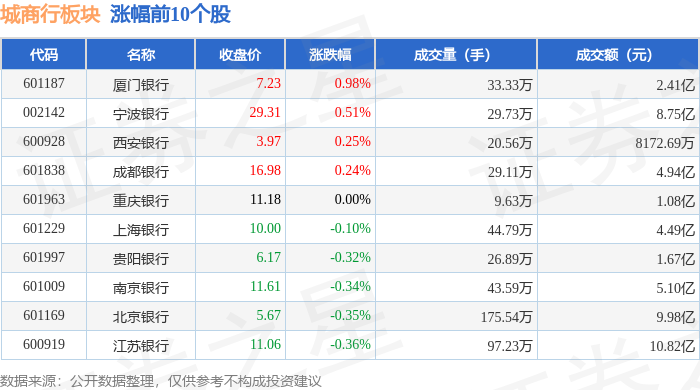
Market Overview - The city commercial bank sector experienced a decline of 0.21% on November 7, with Qilu Bank leading the drop [1] - The Shanghai Composite Index closed at 3997.56, down 0.25%, while the Shenzhen Component Index closed at 13404.06, down 0.36% [1] Individual Bank Performance - Xiamen Bank closed at 7.23, up 0.98% with a trading volume of 333,300 shares and a transaction value of 241 million [1] - Ningbo Bank closed at 29.31, up 0.51% with a trading volume of 297,300 shares and a transaction value of 875 million [1] - Qilu Bank closed at 6.08, down 1.46% with a trading volume of 648,100 shares and a transaction value of 39.86 million [2] - Suzhou Bank closed at 8.33, down 1.07% with a trading volume of 373,400 shares and a transaction value of 314 million [2] Capital Flow Analysis - The city commercial bank sector saw a net outflow of 148 million from institutional investors, while retail investors had a net inflow of 163 million [2] - Jiangsu Bank had a net inflow of 63.24 million from institutional investors, but a net outflow of 39.08 million from speculative funds [3] - Nanjing Bank experienced a net inflow of 24.45 million from institutional investors, with a net outflow of 30.58 million from speculative funds [3]