
Bank Of Jiangsu(600919)

Search documents
业绩增长稳健可期,引领价值回归:银行业2025年三季报业绩前瞻
Shenwan Hongyuan Securities· 2025-10-13 05:31
Investment Rating - The report maintains a positive outlook on the banking sector, indicating a stable performance with expected revenue growth and profit increase for listed banks in Q3 2025 [3][4]. Core Insights - The banking sector is projected to experience a slight slowdown in revenue growth, with a forecasted year-on-year increase of 0.6% for the first nine months of 2025, compared to a 1% growth in the first half of 2025. Net profit attributable to shareholders is expected to grow by 0.8% year-on-year [3][4]. - State-owned banks and joint-stock banks are expected to maintain stable growth, while regional banks are anticipated to lead in profit growth, particularly in high-quality regions such as Jiangsu and Sichuan [3][4]. - The report highlights three core supports for stable profitability: the stabilization of net interest income, recovery of non-interest income from low levels, and stable asset quality ensuring sustainable profits [3][4]. Revenue and Profit Forecast - For Q3 2025, state-owned banks are expected to see revenue growth of 1.3%, while joint-stock banks may experience a revenue decline of 2.4%. In contrast, city commercial banks are projected to achieve revenue and net profit growth of 5.8% and 8.2%, respectively [3][5]. - The report anticipates that the average loan interest rate for listed banks will stabilize around 3.7%, with a significant reduction in deposit costs contributing to this stability [4][5]. Non-Interest Income Analysis - The report notes that while non-interest income may decline by 10-20% in Q3 2025 due to rising bond market interest rates, the overall impact on cumulative revenue is expected to be limited due to favorable year-on-year comparisons [3][4]. - The recovery of fee income is highlighted as a potential driver for revenue improvement, with a projected year-on-year increase of 3% in non-interest income for the first half of 2025 [3][4]. Credit Growth and Asset Quality - Credit growth is expected to slow, with a year-on-year increase of approximately 6.6% in RMB loans as of August 2025. The report indicates a cautious approach to retail lending, with a focus on corporate lending [3][4]. - The non-performing loan (NPL) ratio is projected to remain stable at around 1.22%, with a slight decrease in the provision coverage ratio to 238% [4][5]. Investment Recommendations - The report suggests a focus on leading banks and high-quality regional banks as key investment opportunities, emphasizing the importance of stable earnings growth as a foundation for value recovery in the banking sector [4][5].






江苏银行涨2.08%,成交额13.03亿元,主力资金净流入1.05亿元
Xin Lang Zheng Quan· 2025-10-13 02:59
10月13日,江苏银行盘中上涨2.08%,截至10:49,报10.33元/股,成交13.03亿元,换手率0.70%,总市 值1895.69亿元。 分红方面,江苏银行A股上市后累计派现476.36亿元。近三年,累计派现257.94亿元。 机构持仓方面,截止2025年6月30日,江苏银行十大流通股东中,香港中央结算有限公司位居第三大流 通股东,持股9.79亿股,相比上期增加8714.94万股。 责任编辑:小浪快报 资金流向方面,主力资金净流入1.05亿元,特大单买入2.49亿元,占比19.14%,卖出1.68亿元,占比 12.93%;大单买入3.79亿元,占比29.07%,卖出3.55亿元,占比27.24%。 江苏银行今年以来股价涨11.09%,近5个交易日涨1.87%,近20日跌3.10%,近60日跌13.34%。 资料显示,江苏银行股份有限公司位于江苏省南京市中华路26号,成立日期2007年1月22日,上市日期 2016年8月2日,公司主营业务涉及吸收公众存款;发放短期、中期和长期贷款;办理国内外结算;办理票据 承兑和贴现;发行金融债券;代理发行、代理兑付、承销政府债券;买卖政府债券、金融债券;从事同业拆 借 ...

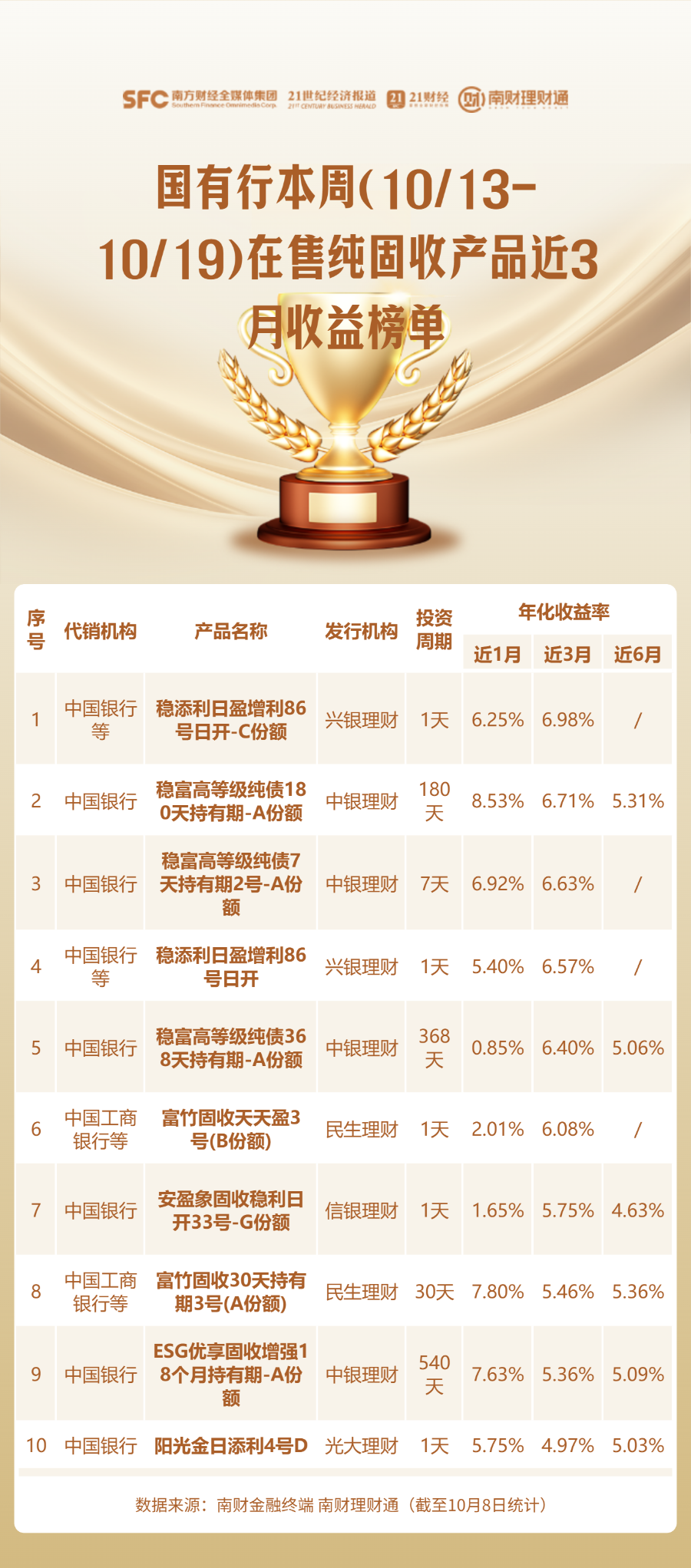
银行渠道本周在售纯固收理财产品榜单(10/13-10/19)
2 1 Shi Ji Jing Ji Bao Dao· 2025-10-13 01:16
Core Insights - The article discusses the diverse range of bank wealth management products available, emphasizing the need for investors to discern and select suitable options amidst similar-sounding and vaguely characterized products [1] - The South Finance Wealth Management team compiles a weekly performance ranking of wealth management products sold through various distribution channels, focusing on those with outstanding performance [1] - The ranking criteria include product type, specifically targeting pure fixed income, "fixed income plus," and mixed products, along with performance stability, requiring a minimum of three months of performance data [1] Product Performance Summary - The ranking showcases annualized performance over the past month, three months, and six months, sorted by the three-month annualized return to reflect multidimensional performance during recent market fluctuations [1] - The current focus is on pure fixed income products issued by wealth management companies, highlighting those available for investors through distribution channels [1] Distribution Institutions - A total of 28 distribution institutions are mentioned, including major banks such as Industrial and Commercial Bank of China, Bank of China, Agricultural Bank of China, and others [2] - The ranking's assessment of the "on-sale" status of wealth management products is based on their investment cycle, but actual availability may vary due to factors like sold-out quotas or differences in product listings for different customers [2] Performance Data - The article provides specific performance data for various wealth management products, including annualized returns and investment periods, with notable products listed from institutions like Bank of China and Minsheng Bank [5][7][10] - For instance, products from Bank of China show annualized returns ranging from 5.40% to 8.53% over different holding periods, indicating competitive performance in the current market [5][10]




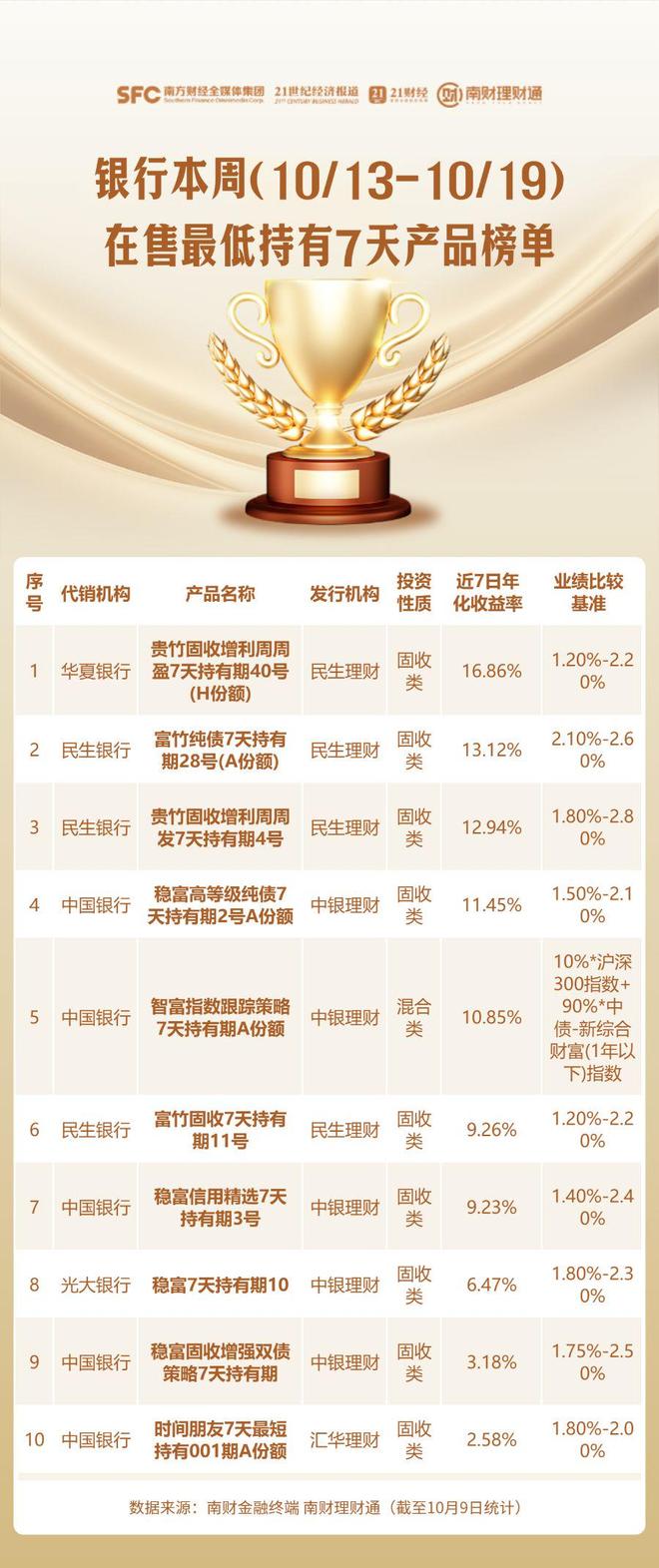
银行渠道本周在售最低持有期产品榜单(10/13-10/19)
2 1 Shi Ji Jing Ji Bao Dao· 2025-10-13 01:09
Core Insights - The article focuses on the performance of bank wealth management products with varying minimum holding periods, specifically highlighting the annualized returns of these products to assist investors in making informed choices [1][2]. Summary by Categories 7-Day Holding Period Products - The top-performing product is from Huaxia Bank, with an annualized return of 16.86% [4]. - Other notable products include: - Minsheng Bank's "Fuzhu Pure Bond" at 13.12% [4]. - Minsheng Bank's "Guizhu Fixed Income" at 12.94% [4]. - Bank of China’s "Stable Wealth High-Grade Pure Bond" at 11.45% [4]. 14-Day Holding Period Products - Minsheng Bank's "Guizhu Fixed Income" leads with a return of 13.71% [7]. - Other significant products include: - Minsheng Bank's "Fuzhu Pure Bond" at 10.97% [7]. - Bank of China's "Stable Wealth Fixed Income" at 9.67% [7]. 30-Day Holding Period Products - Minsheng Bank's "Fuzhu Pure Bond" has an annualized return of 9.51% [9]. - Other key products include: - Minsheng Bank's "Guizhu Fixed Income" at 8.99% [10]. - Bank of China's "Stable Wealth Preferred" at 7.13% [10]. 60-Day Holding Period Products - Bank of China's "Smart Wealth Index Tracking Strategy" tops the list with a return of 23.99% [12]. - Other notable products include: - Minsheng Bank's "Fuzhu Pure Bond" at 7.48% [12]. - Bank of China's "Stable Wealth Credit Selection" at 6.31% [12].
鹏扬基金管理有限公司关于旗下部分基金参与 江苏银行股份有限公司费率优惠活动的公告
Zhong Guo Zheng Quan Bao - Zhong Zheng Wang· 2025-10-12 23:16
Core Points - Pengyang Fund Management Co., Ltd. has announced a fee discount activity for certain funds sold through Jiangsu Bank, effective from October 13, 2025 [1] Group 1: Applicable Fund Range - The fee discount applies to certain open-end fund products managed by Pengyang Fund and sold by Jiangsu Bank, including both existing and future products [2] Group 2: Activity Duration - The activity starts on October 13, 2025, with the end date to be determined by Jiangsu Bank's official announcements [3] Group 3: Activity Details - Investors purchasing the applicable funds through Jiangsu Bank will enjoy a discount on subscription fees, with specific rates to be announced by Jiangsu Bank [4] - The interpretation rights of the discount activity belong to Jiangsu Bank, and investors are advised to refer to the relevant legal documents for detailed information about the funds [4] Group 4: Important Notes - The fee calculation and processing rules for fund transactions at Jiangsu Bank will be based on the bank's arrangements and regulations [5] - The discount activity is limited to subscription fees for the funds and does not cover redemption or conversion fees [5] Group 5: Inquiry Channels - Investors can inquire about details through Jiangsu Bank's customer service or website, as well as through Pengyang Fund Management's customer service [6]
银行股的保险资金配置:有望持续提升
ZHONGTAI SECURITIES· 2025-10-12 12:46
Investment Rating - The report maintains an "Overweight" rating for the banking sector [1]. Core Insights - The scale of insurance capital investment is steadily increasing, with a significant rise in stock investment proportion, which has outpaced bond growth [3][4]. - Bank stocks have consistently held the largest share in insurance capital's heavy stock holdings, with a notable recovery in their proportion post-2023, reaching 41.9% of total stock purchases in 2025 [3][4]. - Current policies are promoting long-term capital market entry, with adjustments in insurance company assessment mechanisms to enhance equity investment ratios, a strategy validated by experiences in the US and Japan [3][4]. Summary by Sections Insurance Capital Investment: Steady Growth and Increased Stock Proportion - As of 1H25, the total insurance capital investment balance in China reached 36.2 trillion yuan, marking a year-on-year growth of 17.4%, with life insurance companies accounting for 90% of this balance [6][8]. - Stock investment growth has outpaced bond investment, with stock investment proportion rising to 8.8% in 1H25, reflecting a significant increase compared to previous years [10][12]. - The decline in long-term interest rates has been a crucial factor driving insurance companies to increase stock investments, as they seek to mitigate risks associated with interest rate spreads [24][26]. Increased Proportion of Bank Stocks in Insurance Capital Holdings - Bank stocks have maintained the highest proportion in the heavy stock holdings of insurance capital, accounting for 47.2% in 1H25, significantly higher than other sectors [29][30]. - The number of stock purchases (or "takeovers") in the banking sector surged in 2025, with bank stocks representing 41.9% of total purchases, a marked increase from previous years [29][30]. Policy Support for Increased Equity Investment by Insurance Capital - Recent policies have been implemented to facilitate the entry of long-term capital into the market, with a focus on enhancing the willingness of insurance companies to invest in equities [31][32]. - The experiences of the US and Japan demonstrate that increasing equity investment during periods of declining long-term interest rates is a viable strategy for maintaining the health of insurance companies [33][37]. Projected New Insurance Investment Funds - It is anticipated that new insurance investment funds will exceed 4 trillion yuan in both 2025 and 2026, with stock investment proportions expected to rise to 9.3% and 10.9%, respectively [41][42]. Investment Recommendations - In the current policy and macroeconomic environment, it is recommended to focus on bank stocks, particularly those with regional advantages and high dividend yields, as insurance capital is likely to increase its holdings in this sector [48].

本周聚焦:银行股中期分红阵营扩大,国有大行分红超2000亿元
GOLDEN SUN SECURITIES· 2025-10-12 09:43
Investment Rating - The report indicates a positive outlook for the banking sector, particularly highlighting the increased mid-term dividend distributions from listed banks, with state-owned banks leading the way with over 200 billion yuan in dividends [2][3]. Core Insights - The report emphasizes that the mid-term dividend plans from listed banks reflect their stable profitability and capital adequacy, which is crucial in the current low-interest-rate environment. High dividend policies are expected to boost market confidence and enhance the defensive value of bank stocks for long-term investment [3][4]. - The report suggests that while short-term export impacts may arise from tariff policies, long-term domestic policies aimed at stabilizing the real estate market, promoting consumption, and enhancing social welfare are likely to support economic growth. The banking sector is expected to benefit from these policy catalysts [4]. Summary by Sections Dividend Distribution - Several banks have completed their mid-term dividend plans, with notable distributions including: - Industrial and Commercial Bank of China: 0.1414 yuan per share, totaling 50.396 billion yuan - China Construction Bank: 0.1858 yuan per share, totaling 48.605 billion yuan - Agricultural Bank of China: 0.1195 yuan per share, totaling 41.823 billion yuan - Bank of China: 0.1094 yuan per share, totaling 35.250 billion yuan - Bank of Communications: 0.1563 yuan per share, totaling 13.811 billion yuan - Postal Savings Bank: 0.1230 yuan per share, totaling 14.772 billion yuan [2][3][14]. Sector Performance - The report notes that the banking sector is expected to see a positive performance due to policy support and economic recovery, with specific banks like Ningbo Bank, Jiangsu Bank, Chengdu Bank, Shanghai Bank, and Hu'nong Commercial Bank recommended for investment based on their improving fundamentals [4][8]. Key Data Tracking - The average daily trading volume for stocks reached 26,032.76 billion yuan, an increase of 4,154.20 billion yuan from the previous week [8]. - The balance of margin financing increased by 0.70% to 2.44 trillion yuan [8]. - The issuance of non-monetary funds decreased significantly, with a total of 11.30 billion yuan issued this week, down 56.07 billion yuan from the previous week [8].
2025年H1中国手机银行APP流量监测报告
艾瑞咨询· 2025-10-12 00:06
Core Insights - The mobile banking app has become a core platform for commercial banks to serve users, optimize experiences, and enhance competitiveness in the context of national digital transformation and financial technology innovation [1] - The integration of AI technology, refined operational strategies, and diversified user demands are reshaping the market landscape and value of mobile banking apps [1] User Flow and Behavior - The user flow of mobile banking apps in China is stabilizing between 650 million to 700 million from 2023 to 2025, indicating a saturated market [2] - The decline in user engagement is evident, with average daily usage time dropping from 4.93 minutes to 2.70 minutes and daily usage frequency decreasing from 4.54 times to 2.86 times [4] Operational Strategies - Refined operations are crucial for banks to break through in a saturated market, focusing on precise user insights and intelligent technology applications [6][7] - AI technology is enhancing refined operations by upgrading interaction experiences, strengthening risk control, and improving data operations efficiency [9] Rankings and Performance - The top three banks by average monthly active users (MAU) are Agricultural Bank of China (24 million), Industrial and Commercial Bank of China (18.9 million), and China Construction Bank (10.6 million) [11][15] - Among joint-stock commercial banks, China Merchants Bank leads with over 7 million MAU, while other banks like Ping An Bank and CITIC Bank follow closely [16][17] - City commercial banks show strong performance, with Jiangsu Bank leading at 349.6 thousand MAU, and several banks achieving significant growth rates [19][20] Case Studies of Successful Apps - Agricultural Bank of China is integrating financial services with daily life scenarios, achieving a 4.8% growth in MAU [28][29] - China Merchants Bank continues to innovate its app to meet changing customer needs and leverage AI advancements [31] - Jiangsu Bank focuses on merging digital capabilities with wealth management, enhancing its app to address customer challenges [33] - Beijing Bank is implementing a digital transformation strategy that combines technology, scenarios, and services to create value [35]



江苏银行冠名2025环太湖国际公路自行车赛盛大开幕 以体育金融双轮驱动,倡导健康体重管理新理念
Zhong Jin Zai Xian· 2025-10-11 10:35
Group 1 - The event "2025 13th International Taihu Lake Road Cycling Race" was officially opened in Nanjing, attracting global participation from 22 professional teams and various stakeholders [1] - Jiangsu Bank has been actively involved in the "Sports + Finance" integration, sponsoring major sports events and promoting public fitness activities, which enhances its brand influence and corporate social responsibility [2] - The bank's sponsorship includes significant events like the Taihu Lake International Road Cycling Race and the Yangzhou Marathon, contributing to the high-quality development of the sports industry [2] Group 2 - Cycling is highlighted as an effective aerobic exercise that supports cardiovascular health and weight management, aligning with national health strategies [3] - Jiangsu Bank collaborates with health, medical, and sports technology sectors to launch financial health products and public service projects focused on "sports health" and "weight management" [3] - The bank aims to leverage sports as a connection to foster a healthier public ecosystem, promoting the theme "Finance empowers sports, and sports lead to health" [3]
北京金融监管局核准黄霞江苏银行北京分行副行长任职资格
Jin Tou Wang· 2025-10-11 03:57
Core Viewpoint - The Beijing Financial Regulatory Bureau has approved the appointment of Huang Xia as the Vice President of the Beijing Branch of Jiangsu Bank, emphasizing the importance of compliance with financial regulations and ongoing professional development [1] Group 1 - The approval of Huang Xia's appointment is officially documented in the notice from the Beijing Financial Regulatory Bureau [1] - Jiangsu Bank is required to ensure that the approved personnel adhere to relevant regulatory requirements and report their appointment status within three months [1] - The bank must encourage continuous learning and compliance awareness among the appointed personnel, ensuring they are familiar with their responsibilities [1]