
CHINA MOBILE(600941)

Search documents
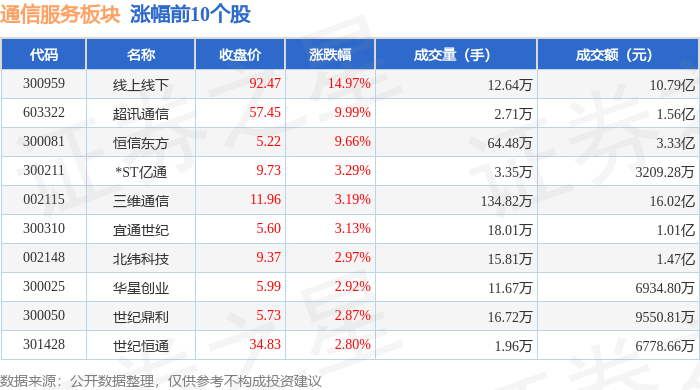
通信服务板块10月20日涨0.13%,线上线下领涨,主力资金净流入9545.79万元
Zheng Xing Xing Ye Ri Bao· 2025-10-20 08:37
Market Overview - On October 20, the communication services sector rose by 0.13% compared to the previous trading day, with online and offline leading the gains [1] - The Shanghai Composite Index closed at 3863.89, up 0.63%, while the Shenzhen Component Index closed at 12813.21, up 0.98% [1] Stock Performance - The top-performing stocks in the communication services sector included: - Online and Offline (300959) with a closing price of 92.47, up 14.97%, and a trading volume of 126,400 shares, totaling 1.08 billion yuan [1] - ChaoXun Communication (603322) closed at 57.45, up 9.99%, with a trading volume of 27,100 shares [1] - Hengxin Dongfang (300081) closed at 5.22, up 9.66%, with a trading volume of 644,800 shares [1] Fund Flow Analysis - The communication services sector saw a net inflow of 95.46 million yuan from institutional investors, while retail investors contributed a net inflow of 68.04 million yuan [2] - Notably, the sector experienced a net outflow of 163 million yuan from speculative funds [2] Individual Stock Fund Flow - Online and Offline (300959) had a net inflow of 155 million yuan from institutional investors, but a net outflow of 52.80 million yuan from speculative funds [3] - ChaoXun Communication (603322) recorded a net inflow of 61.15 million yuan from institutional investors, with a net outflow of 36.76 million yuan from speculative funds [3] - Hengxin Dongfang (300081) had a net inflow of 16.09 million yuan from institutional investors and a net inflow of 16.34 million yuan from speculative funds [3]



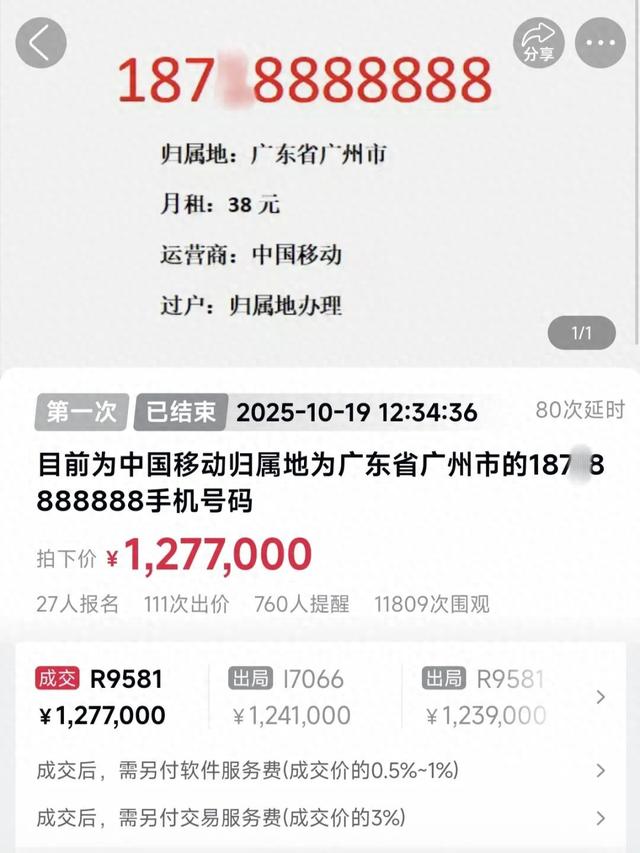
同一天拍出两个“尾号8888888”手机号,成交价分别为127.7万元和95.3万元
Huan Qiu Wang· 2025-10-20 05:35
Core Points - Two mobile phone numbers with the ending "8888888" were successfully auctioned on October 19, with one from China Mobile in Guangzhou sold for 1.277 million yuan and the other from China Telecom in Lijiang sold for 953,000 yuan [1][7] - The auction attracted significant interest, with 27 bidders for the China Mobile number and 33 bidders for the China Telecom number, resulting in a competitive bidding process [6][7] Auction Details - The starting bid for both numbers was set at 1,000 yuan, leading to substantial price increases during the auction [6] - The monthly rental for the China Mobile number is 38 yuan, while the China Telecom number has a monthly rental of 58 yuan, both with no minimum consumption period after transfer [3][4] Additional Costs - Buyers are required to pay additional fees, including a software service fee (0.5%-1% of the transaction price) and a transaction service fee (3% of the transaction price) [7]


计算机行业“一周解码”:政策东风助推智驾崛起
Bank of China Securities· 2025-10-20 05:11
Investment Rating - The industry investment rating is "Outperform the Market" [39] Core Views - The report highlights the acceleration of smart driving and the emergence of eSIM technology as key trends in the computer industry, indicating a shift towards a "cardless era" and the integration of smart terminals with communication ecosystems [4][11][14] - The report emphasizes the continuous order growth for humanoid robots from UBTECH, marking a significant advancement in the humanoid robotics industry [17][19] - Google's launch of the Veo 3.1 AI video generation model signifies a move towards "audio-visual integration," enhancing the capabilities of video content creation [21][23] - The policy push for vehicle-road collaboration is expected to facilitate the systematic development of smart driving infrastructure [14][16] Summary by Sections eSIM Technology - The three major telecom operators in China have received approval to conduct eSIM mobile service trials, which will enhance the convenience of mobile communication and drive upgrades across the entire industry chain [11][12] - eSIM technology allows for the integration of SIM card functions into the device, leading to lighter and more robust designs, and simplifying user operations such as activation and number changes [11][13] Humanoid Robotics - UBTECH has secured a procurement contract worth over 32 million yuan for its Walker S2 humanoid robots, following a record-breaking order in September [17][19] - The total contracts for the Walker series have approached 500 million yuan, indicating a strong demand and the company's commitment to increasing production capacity [17][19] AI Video Generation - Google's Veo 3.1 model introduces enhanced audio and narrative control, allowing for more realistic video generation and editing capabilities [21][22] - The model supports native audio generation, enabling users to control the emotional and narrative aspects of their videos during the creation process [21][23] Smart Driving Infrastructure - The Ministry of Housing and Urban-Rural Development has initiated a plan to promote the integration of smart city infrastructure with intelligent connected vehicles, focusing on enhancing urban logistics and emergency response capabilities [14][15] - The policy aims to improve the safety and reliability of smart driving through better infrastructure and technology integration [14][16]



视源股份亮相2025中国移动全球合作伙伴大会,携手共绘AI+新图景
Jin Tou Wang· 2025-10-20 03:42
Group 1: Event Overview - The 2025 China Mobile Global Partner Conference was held in Guangzhou, focusing on "Carbon-Silicon Symbiosis and Co-creation in the AI Era" [1] - Key products showcased included AI smart teaching solutions, AI learning cloud computers, and industrial-grade quadruped robots [1] Group 2: Xiwo's Product Highlights - Xiwo, an education technology brand under Vision Source, presented new products such as the Xiwo Parent-Child Screen and AI Learning Machine, attracting significant attention from parents [2] - The AI Learning Cloud Computer, a combination of a learning machine, computer, and tablet, features extensive learning resources and AI homework assistance [2] - Xiwo received multiple awards at the conference, including the "Best Product Cooperation Partner Award" and "Top Ten Excellent Partners in Smart Home" [2] Group 3: MAXHUB's Innovations - MAXHUB created an immersive exhibition area showcasing AI technology in smart office scenarios, including the MAXHUB X7 industrial-grade quadruped robot [3] - The cloud video conferencing solutions developed in collaboration with China Mobile were highlighted, integrating core functions like writing, displaying, remote communication, and AI meeting minutes [3] Group 4: Future Collaborations - Vision Source and China Mobile launched the "Smart Engine, Enjoy Action" initiative for AI-customized mobile phones and AI terminal ecosystem cooperation [4] - The company aims to integrate advanced AI education technology with robust cloud network capabilities to support the vision of "Carbon-Silicon Symbiosis" [4]

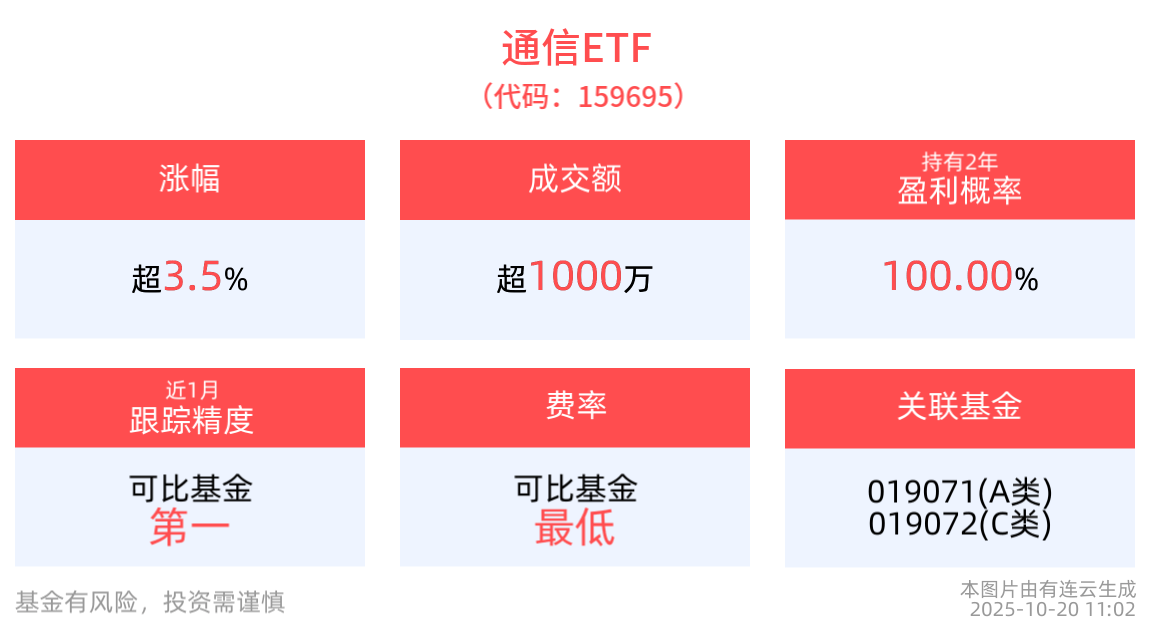
通信ETF(159695)盘中上涨3.52%,成分股剑桥科技10cm涨停,机构:持续看好25Q4通信板块机会
Sou Hu Cai Jing· 2025-10-20 03:36
Group 1 - The communication ETF has seen a turnover of 6.83% with a transaction volume of 17.29 million yuan, and its net value has increased by 76.97% over the past two years, ranking 80 out of 2353 index equity funds, placing it in the top 3.40% [3] - The highest monthly return since the establishment of the communication ETF is 33.97%, with the longest consecutive monthly gains being 5 months and a maximum increase of 76.35%, while the average return during rising months is 7.57% [3] - Galaxy Securities indicates strong demand and sustained prosperity in the AI-driven computing power industry, despite potential short-term market fluctuations and adjustments, maintaining a positive outlook for the AI computing sector from a medium to long-term perspective [3] Group 2 - According to Zheshang Securities, the communication industry is expected to see a 2.8% year-on-year revenue growth and a 7.8% increase in net profit attributable to the parent company in the first half of 2025, with steady performance improvements anticipated [3] - The report predicts continued high growth in sectors such as optical modules and liquid cooling in Q3 2025, with an ongoing improvement in the main business of operators and an increase in the proportion of innovative businesses [3] - The satellite internet industry is gradually establishing trends and is expected to see significant growth, with a positive outlook for opportunities in the communication sector in Q4 2025 [3] Group 3 - As of September 30, 2025, the top ten weighted stocks in the Guozheng Communication Index include Zhongji Xuchuang, Xinyi Sheng, ZTE Corporation, China Telecom, China Mobile, China Unicom, Tianfu Communication, Zhongtian Technology, Transsion Holdings, and Hengtong Optic-Electric, collectively accounting for 66.02% of the index [4] - The performance of individual stocks shows varied changes, with Zhongji Xuchuang increasing by 8.68% and Tianfu Communication rising by 9.80%, while China Telecom and China Mobile experienced slight declines [6] - Investors can access AI-driven optical communication investment opportunities through the communication ETF linked fund (019072) [6]


国内eSIM手机商用破冰 运营商加速迈向“无卡”时代
Zheng Quan Shi Bao· 2025-10-19 22:24
Core Insights - The introduction of eSIM technology marks a significant shift towards a "cardless" era in mobile communication, with eSIMs expected to gradually replace physical SIM cards in the long term [1][4][7] Industry Overview - eSIM technology allows for flexible network switching, space-saving in devices, and seamless connectivity across multiple devices and scenarios, indicating a trend towards "cardless" solutions [1][2] - The global market for eSIM-enabled smartphones is projected to reach approximately 1 billion connections by the end of 2025, with an expected growth to 7 billion by 2030, representing three-quarters of total smartphone connections [4] Market Dynamics - Major Chinese telecom operators have recently received approval to launch eSIM services for mobile phones, marking a significant milestone in the domestic market after a two-year pause [3][4] - The shift to eSIM is expected to enhance device waterproofing, internal space utilization, and battery optimization, thus driving innovation in high-end smartphone models [6][10] Competitive Landscape - The entry of eSIM technology into the Chinese smartphone market is seen as a catalyst for global eSIM development, with Apple leading the charge by launching eSIM-only devices [4][5] - Other smartphone manufacturers, including OPPO and vivo, are also preparing to release eSIM-compatible devices, indicating a rapid market response [4][5] Challenges and Considerations - The transition to eSIM technology faces challenges such as security concerns, consumer awareness, and the need for standardized interoperability among different operators [9][10] - The shift from physical SIM cards to eSIMs is expected to increase competition among telecom operators, as users will have greater flexibility to switch providers, potentially impacting traditional revenue models [10][11]
突破物联边界 eSIM技术迈入商用新阶段
Zhong Guo Zheng Quan Bao· 2025-10-19 22:21
Core Insights - Apple CEO Tim Cook announced the official launch of the iPhone Air in China on October 22, following the approval of eSIM services by major telecom operators in China [1][2] - The introduction of eSIM technology marks a significant shift in the mobile communication landscape, enabling a new phase of commercial use for smartphones in China [1][3] eSIM Technology and Market Trends - eSIM is predicted to be a major trend, with GSMA forecasting that global eSIM smartphone connections will reach 1 billion by 2025 and 6.9 billion by 2030, accounting for 76% of total smartphone connections [2][3] - The iPhone Air, being eSIM-only, is Apple's thinnest model at 5.6 mm and 165 grams, allowing for enhanced design possibilities and improved battery life [2][3] User Experience and Convenience - eSIM technology simplifies the process of changing phone numbers, particularly benefiting travelers who can easily switch to local numbers without needing physical SIM cards [3][4] - Over 400 global operators are expected to provide eSIM services by July 2025, with a 29% adoption rate among 5G users [3][4] Industry Implications and Innovations - The shift to eSIM is anticipated to drive significant investment across the entire supply chain, including wearables, IoT devices, tablets, and laptops, as the Chinese market sees annual smartphone sales of 300 million units [4][5] - eSIM's remote number-switching capability poses challenges for telecom operators, necessitating enhancements in marketing strategies and customer service to retain user loyalty [6][7] Future Applications and Developments - eSIM technology is expected to expand into various applications, including pet devices and robotics, further enhancing connectivity in the IoT landscape [5][6] - Telecom operators are actively participating in the development of eSIM standards and technology, ensuring compatibility and security for users [7]

突破物联边界eSIM技术迈入商用新阶段
Zhong Guo Zheng Quan Bao· 2025-10-19 20:13
Core Insights - Apple CEO Tim Cook announced the official launch of the iPhone Air in China on October 22, following the approval of eSIM services by major telecom operators in China [1][2] - eSIM technology is seen as a key infrastructure for transforming the communication industry, enhancing user experience, and driving digital economic growth in China [1][3] eSIM Technology Adoption - eSIM is predicted to be a significant trend, with GSMA forecasting that global eSIM smartphone connections will reach 1 billion by 2025 and 6.9 billion by 2030, accounting for 76% of total smartphone connections [2] - The iPhone Air, being the thinnest iPhone at 5.6 mm and weighing 165 grams, benefits from the removal of the physical SIM card, allowing for a larger battery and increased battery life by approximately 2 hours [2] User Experience and Convenience - eSIM simplifies the process of writing user identities, making it easier for travelers to manage communication needs abroad without needing physical SIM cards [3] - Over 400 global operators are expected to provide eSIM services by July 2025, with a 29% adoption rate among 5G users [3] Industry Impact and Future Applications - The introduction of eSIM is anticipated to drive significant investment across the entire industry chain, including wearables, IoT devices, tablets, and laptops, as the Chinese market sees annual mobile phone sales of 300 million units [4] - eSIM is expected to play a crucial role in the IoT sector, with GSMA predicting that over 50% of IoT applications will utilize eSIM by 2030 [4] Challenges for Telecom Operators - The remote number-switching capability of eSIM may increase user autonomy in changing service providers, posing challenges for telecom operators in terms of revenue stability and necessitating enhancements in marketing strategies and service offerings [4][6] - Telecom companies are focusing on optimizing eSIM services to meet diverse user needs and improve overall user experience [5][6]
股市必读:中国移动(600941)10月17日主力资金净流入6531.77万元,占总成交额4.93%
Sou Hu Cai Jing· 2025-10-19 17:07
Summary of Key Points Core Viewpoint - On October 17, 2025, China Mobile (600941) reported a closing price of 107.93 yuan, reflecting a slight increase of 0.11% with a trading volume of 12.27 million hands and a total transaction amount of 1.326 billion yuan [1]. Trading Information - On October 17, the net inflow of main funds was 65.32 million yuan, accounting for 4.93% of the total transaction amount - Retail investors experienced a net outflow of 14.60 million yuan, representing 1.1% of the total transaction amount [1][3]. Company Announcement - China Mobile's board announced that on October 17, 2025, Guangdong Mobile exercised its conversion rights, converting a total of 1.874 billion yuan (approximately 2.054 billion HKD) of Shanghai Pudong Development Bank's A-share convertible bonds into approximately 149.81 million A-shares at a conversion price of 12.51 yuan per share (approximately 13.71 HKD) - Following this conversion, the group's holdings in Shanghai Pudong Development Bank's A-shares increased to approximately 5.935 billion shares, representing about 18.15% of the expanded share capital - The newly issued shares are subject to a five-year transfer restriction, and the conversion is deemed fair and reasonable, aligning with the overall interests of the company and its shareholders [1][3].

中国电信行业:是时候重新审视优质落后标的。重申对中国电信运营商的积极看法-China Telecom Sector_ Time to revisit quality laggard names. Reiterate positive view on China telco operators
2025-10-19 15:58
Summary of China Telecom Sector Conference Call Industry Overview - **Industry**: China Telecom Sector - **Recent Performance**: China telco operators' H shares have underperformed the Hang Seng Index (HSI) over the last three months, with declines of 1-5% compared to HSI's increase of 5% [1][5][6]. Core Insights - **Investment Recommendation**: Investors are encouraged to accumulate shares of China telco operators, viewed as quality laggards with attractive dividend yields [1][5]. - **Dividend Yields**: Projected 2025 dividend yields for major telcos are 6.3% for China Mobile-H (CM-H), 5.4% for China Telecom-H (CT-H), and 5.6% for China Unicom-H (CU-H), which are favorable compared to HSI's 3.0% yield and the China 10Y bond yield of 1.8% [1][6]. - **Revenue Growth Trends**: Traditional telecom revenue growth has slowed, with MIIT data indicating a deceleration in year-over-year growth from 1.3% in Q2 2025 to 0.2% in Q3 2025 [5][6]. This slowdown is attributed to a decline in average revenue per user (ARPU) and stable mobile subscriber numbers [5]. Key Arguments - **Market Dynamics**: The underperformance of telco operators is linked to a market preference for growth stocks over value stocks, as evidenced by HSTECH's 12% rise compared to HSI's 5% [5]. - **Cloud Revenue Concerns**: Cloud revenue growth for telco operators has slowed to 5-10% in the first half of 2025, compared to 22% for internet companies like Alibaba, raising concerns about market share loss [5][6]. - **AI Investment Commitment**: The big three telcos are committed to increasing AI investments, with China Mobile planning to double its AI investment by 2028 and China Unicom focusing on domestic suppliers for its server tenders [6]. Additional Insights - **Shareholder Returns**: All three major telcos are expected to enhance shareholder returns by increasing cash dividend payout ratios over the next 2-3 years, projecting a 9% average dividend per share (DPS) compound annual growth rate (CAGR) from 2025 to 2027 [6]. - **Long-term Growth Outlook**: The long-term growth outlook for AI and cloud services is positive, with expectations that increased state-owned enterprise (SOE) investment in AI/cloud will benefit the telcos' cloud and data center businesses in the coming years [6]. Conclusion - **Top Pick**: China Telecom-H (CT-H) is highlighted as the top pick due to its significant exposure to cloud services and resilient traditional mobile/broadband offerings [1].