
CHINA MOBILE(600941)

Search documents
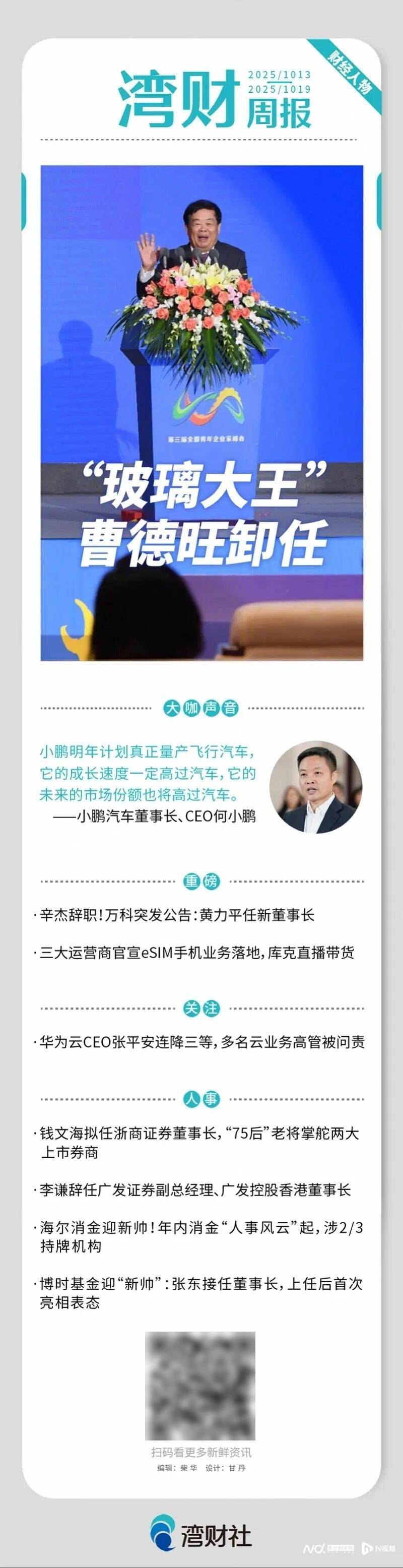
湾财周报 | 人物 79岁曹德旺卸任,长子接管福耀玻璃;辛杰辞任万科董事长;库克直播带货苹果新机
Sou Hu Cai Jing· 2025-10-19 14:22
Group 1 - Cao Dewang, known as the "Glass King," has announced his early resignation as chairman of Fuyao Glass, with his son, Cao Hui, set to take over the role, marking a new era for the company that holds a one-third share of the global automotive glass market [5] - He Xiaopeng, CEO of Xpeng Motors, stated at the 2025 Sustainable Global Leaders Conference that the market share of flying cars is expected to surpass that of traditional cars, with plans for mass production of flying cars next year [5] Group 2 - Vanke announced the resignation of Xin Jie as non-executive director and chairman, with Huang Liping elected as the new chairman, ensuring the board's normal operation will not be affected [6] - The three major telecom operators in China have officially launched eSIM mobile services, with over 70,000 online reservations reported for China Unicom's eSIM service [7] Group 3 - Qian Wenhai is proposed to be appointed as the chairman of Zheshang Securities, with the company set to follow legal procedures for the election [8] - Li Qian has resigned from his position as deputy general manager of GF Securities due to personal work changes, and will no longer hold any positions within the company [9] Group 4 - Haier Consumer Finance has appointed Zhou Wenlong as the new general manager, following a year-long vacancy, amidst a wave of personnel changes in the consumer finance industry [10] - Bosera Funds announced the appointment of Zhang Dong as chairman, who will also serve as the acting general manager, focusing on high-quality development and investor services [11]






十五五信息通信规划展望
HUAXI Securities· 2025-10-19 13:37
Investment Rating - Industry Rating: Recommended [4] Core Insights - The report emphasizes the importance of information communication as a critical infrastructure for the new round of technological upgrades, focusing on three major infrastructure networks: AI computing power infrastructure, integrated space-ground communication networks, and high-speed data circulation infrastructure [1][34] - The report highlights the rapid development of satellite internet and low-altitude economy, with a focus on the integration of satellite communication networks and the establishment of low-altitude economic networks [3][19] - The data element construction is crucial for building high-speed interconnected data circulation infrastructure, with significant growth expected in the data industry [24][27] - AI empowerment is seen as a key driver for industrial upgrades, with applications in various sectors including advanced manufacturing and smart manufacturing [29][30] Summary by Sections 1. Investment in Computing Power Infrastructure - Significant capital expenditure growth in computing power infrastructure, with major telecom operators increasing their investments [12][14] - Key beneficiaries include companies involved in AI chips, optical communication, and data center services [2][14][15] 2. Satellite and Low-Altitude Communication Infrastructure - The rapid deployment of satellite internet and the establishment of low-altitude economic networks are highlighted, with various companies benefiting from this trend [16][19][21] - Key beneficiaries include companies involved in satellite communication and low-altitude network equipment [6][23] 3. Data Element Construction - The data industry is projected to grow significantly, with a focus on building a robust data infrastructure to support data circulation [24][25][26] - Key beneficiaries include telecom operators and companies providing data platforms and security solutions [27][28] 4. AI Empowerment for Industrial Upgrades - AI is driving the transformation of traditional manufacturing into smart manufacturing, with a focus on enhancing productivity and efficiency [29][30][31] - Key beneficiaries include companies involved in AI applications across various sectors [35][36]



“智学伴”“心晴伴”全新发布!拉萨路小学携手南京移动鼓楼分公司构建校园AI新生态
Yang Zi Wan Bao Wang· 2025-10-19 11:49
Core Insights - The article discusses the launch of two AI-powered educational products, "Zhixueban" and "Xinqingban," by Nanjing Lasa Road Primary School in collaboration with Nanjing Mobile Gulou Branch, aimed at enhancing students' learning experiences and mental health support [1][6]. Group 1: Product Overview - "Zhixueban" is designed for research learning scenarios, integrating features such as AI Q&A, object recognition through photography, research task management, safety positioning, and SOS assistance [5]. - "Xinqingban" serves as an AI companion for mental health, utilizing voice interaction and emotional recognition technology to provide emotional support and academic assistance to students [5][6]. Group 2: Educational Philosophy - The initiative reflects a shift towards personalized education, addressing the unique needs of students during their research learning experiences, which traditional methods have struggled to meet [3][7]. - The school emphasizes the importance of technology in enhancing educational engagement and emotional support, aiming to bridge the gap between students and their emotional needs [7]. Group 3: Collaboration and Future Plans - The partnership between the school and Nanjing Mobile is part of a broader strategy to leverage AI and digital technologies in education, aligning with China's "AI+" and "Science and Technology Innovation+" initiatives [6]. - Future plans include further collaboration to explore innovative applications of AI in education, focusing on the comprehensive development of students [7].

湾财周报 | 人物 79岁曹德旺卸任,长子接管福耀玻璃;辛杰辞任万科董事长;库克直播带货苹果新机;华为云CEO张平安连降三等
Sou Hu Cai Jing· 2025-10-19 11:22
Group 1 - Fuyao Glass's founder, Cao Dewang, has announced his early retirement, with his son, Cao Hui, taking over as the new chairman, marking a new era for the company, which holds a one-third share of the global automotive glass market [6] - He Xiaopeng, CEO of Xiaopeng Motors, stated that the company plans to mass-produce flying cars next year, predicting that the growth rate and future market share of flying cars will surpass that of traditional automobiles [7] Group 2 - Vanke announced the resignation of its chairman, Xin Jie, due to personal reasons, with Huang Liping elected as the new chairman, ensuring that the board's operations remain unaffected [8] - Major Chinese telecom operators, including China Mobile, China Unicom, and China Telecom, have received approval to launch eSIM mobile services, with over 70,000 online reservations reported for China Unicom's eSIM service [9] - Huawei Cloud CEO Zhang Pingan has been demoted due to internal disciplinary actions related to issues of fraud and economic misconduct within the cloud business unit [10] Group 3 - Qian Wenhai is proposed to be appointed as the chairman of Zheshang Securities, with the company set to follow legal procedures for the election [11] - Li Qian has resigned from his position as deputy general manager of GF Securities and chairman of GF Holdings Hong Kong due to personal work changes [12] - Haier Consumer Finance has appointed new leadership, with Zhou Wenlong as the new general manager, amidst a wave of personnel changes in the consumer finance industry [13] - Bosera Funds has announced the appointment of Zhang Dong as the new chairman, who will also serve as the acting general manager [14][15]
C厂新闻|视源股份亮相2025中国移动全球合作伙伴大会,携手共绘AI+新图景
Sou Hu Wang· 2025-10-19 09:23
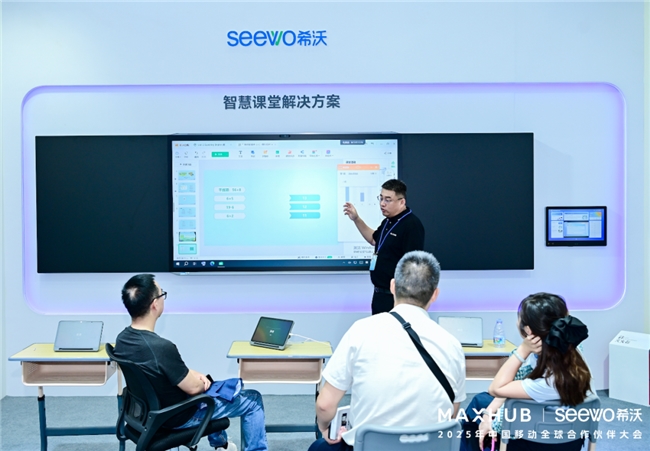
Core Insights - The 2025 China Mobile Global Partner Conference was held in Guangzhou, focusing on "Carbon-Silicon Symbiosis and Co-creation in the AI Era" [1] - Visionox's education technology brand, Seewo, showcased various AI-driven educational products, attracting significant attention from parents and industry professionals [2][4] - MAXHUB, another brand under Visionox, presented advanced office solutions, including an industrial-grade quadruped robot, which engaged attendees and highlighted the integration of AI in smart office environments [7] Seewo's Product Highlights - Seewo introduced several new products, including the Seewo Parent-Child Screen and AI Learning Machine, which aim to enhance family education [2] - The AI Learning Cloud Computer, a combination of a learning machine, computer, and tablet, was particularly popular among parents, featuring extensive learning resources and AI homework assistance [4] - Seewo received multiple awards at the conference, including the "Best Product Partner Award" and "Top Ten Excellent Partner Award" from China Mobile [6] MAXHUB's Innovations - MAXHUB created an immersive exhibition area that allowed attendees to experience various smart office functionalities powered by AI [7] - The MAXHUB X7 quadruped robot attracted considerable interest, demonstrating its capabilities as a companion and assistant in daily life [7] - MAXHUB also showcased a comprehensive cloud video conferencing solution developed in collaboration with China Mobile, integrating core functions like writing, displaying, remote communication, and AI meeting minutes [9] Strategic Collaborations - Visionox and China Mobile launched the "Smart Engine, Enjoy Action" initiative, focusing on AI-customized mobile phones and a broader AI terminal ecosystem [11] - The partnership aims to leverage AI technology and cloud network capabilities to create social value and address user needs across various industries [11][13] - Visionox plans to deepen its collaboration with China Mobile to integrate leading AI educational technologies and enterprise services, contributing to the vision of "Carbon-Silicon Symbiosis" [13]

2025年中国数据中心行业分类、相关政策、市场规模及竞争格局分析
Sou Hu Cai Jing· 2025-10-19 07:24
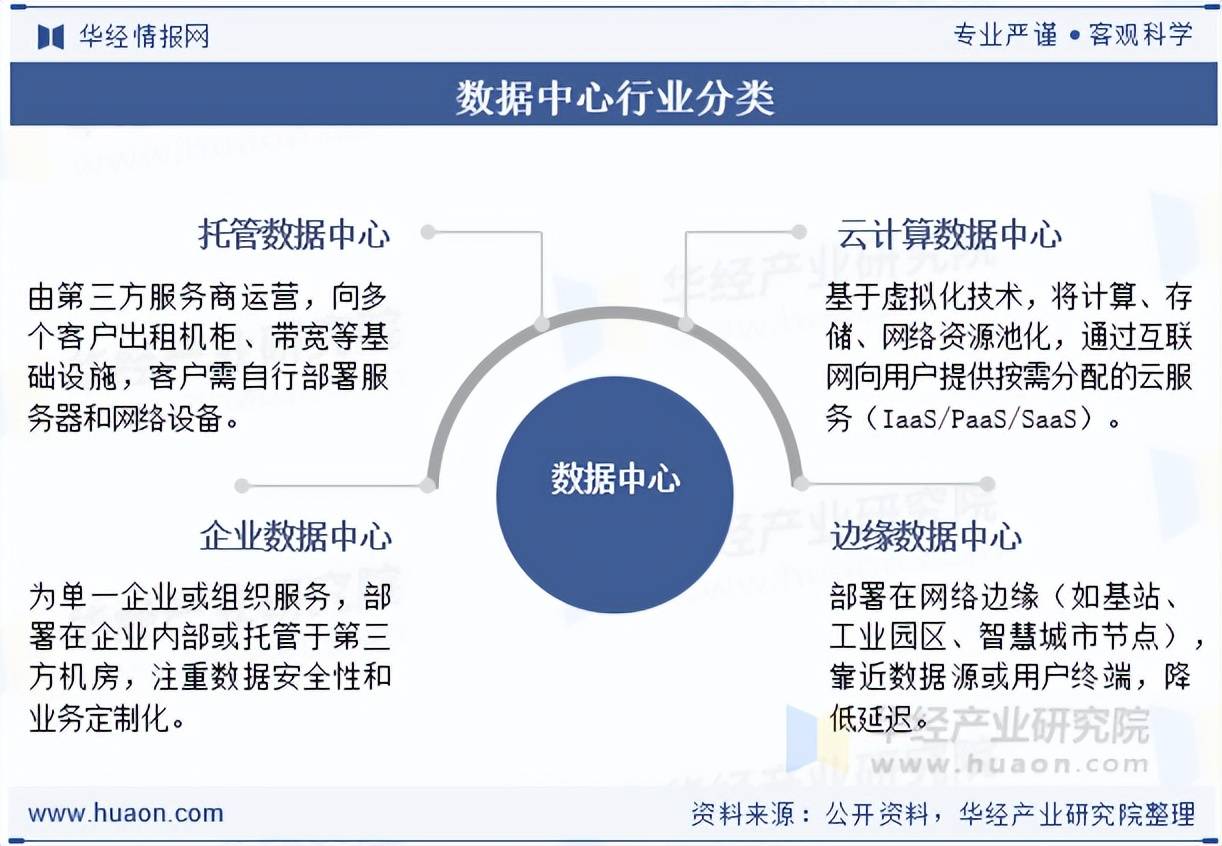
Core Insights - The data center industry is experiencing robust growth driven by emerging technologies such as 5G, cloud computing, and artificial intelligence, with the market size reaching 507.83 billion yuan in 2023 [6]. Policy Support - The development of the data center industry is supported by various policies at both national and local levels, focusing on layout optimization, green development, technology upgrades, and financing channels [4]. - Key policies include the "2030 Carbon Peak Action Plan" aimed at promoting energy-saving and carbon reduction in data centers [5], and the "New Type Data Center Development Three-Year Action Plan (2021-2023)" which outlines six key tasks for quality upgrades [5]. Market Structure - The competitive landscape of the data center industry is diverse, with major players including Alibaba Cloud, Tencent Cloud, and Huawei Cloud in the first tier, and third-party service providers like GDS Services, Century Internet, and DataPort in the second tier [8]. - The industry is characterized by a multi-tier structure, with significant contributions from both cloud service providers and telecommunications operators [8]. Industry Growth - The data center market is projected to continue its growth trajectory, supported by the increasing demand for digital services and the ongoing digital transformation across various sectors [6]. - The industry is moving towards a more integrated, large-scale, green, and intelligent development model [4]. Company Strategies - Major companies are expanding their data center footprints across key regions, with Century Internet and GDS Services actively developing data centers in first-tier cities and strategic locations [10]. - Companies like Alibaba Cloud and Tencent Cloud are establishing large-scale data centers in multiple regions, enhancing their service capabilities [10].



它们,同时押中宇树、摩尔
投中网· 2025-10-19 07:04
Core Viewpoint - The article discusses the rising interest in the IPOs of Moore Threads and Yushu Technology, highlighting the significant market movements and investment opportunities associated with these companies [3][4]. Group 1: Investment Opportunities - Moore Threads aims to break NVIDIA's monopoly with its domestic GPU, benefiting from the trend of domestic substitution [4]. - Yushu Technology has faced a challenging financing journey, with varying perceptions from venture capitalists over the years [4]. - Companies like Jinfa Technology are strategically positioned to benefit from both Moore Threads and Yushu Technology through direct collaborations and material supply agreements [6][7]. Group 2: Company Collaborations - Jinfa Technology has established a specialized team for humanoid robot material development and has signed strategic agreements with both Moore Threads and Yushu Technology [6]. - Other companies, such as Shuanghuan Transmission and Zhongdali De, have formed partnerships with Yushu Technology, providing essential components for their robotics projects [8]. - Companies like Jingxing Paper and Dazhong Public Utilities are more focused on financial investments, using indirect holdings to hedge against market fluctuations [9]. Group 3: Market Dynamics - The article notes that the excitement around IPOs leads to significant gains for related concept stocks, with direct shareholders benefiting the most [6]. - The investment landscape is characterized by a mix of strategic and financial investments, with some companies taking a more passive role in the emerging tech sectors [9][12]. - Major players like China Mobile and Tencent have entered the market later, focusing on financial investments rather than deep strategic partnerships [13][15].



下周重磅财经日程:重大会议、重磅数据,关键时刻开启了
Hua Er Jie Jian Wen· 2025-10-19 03:58
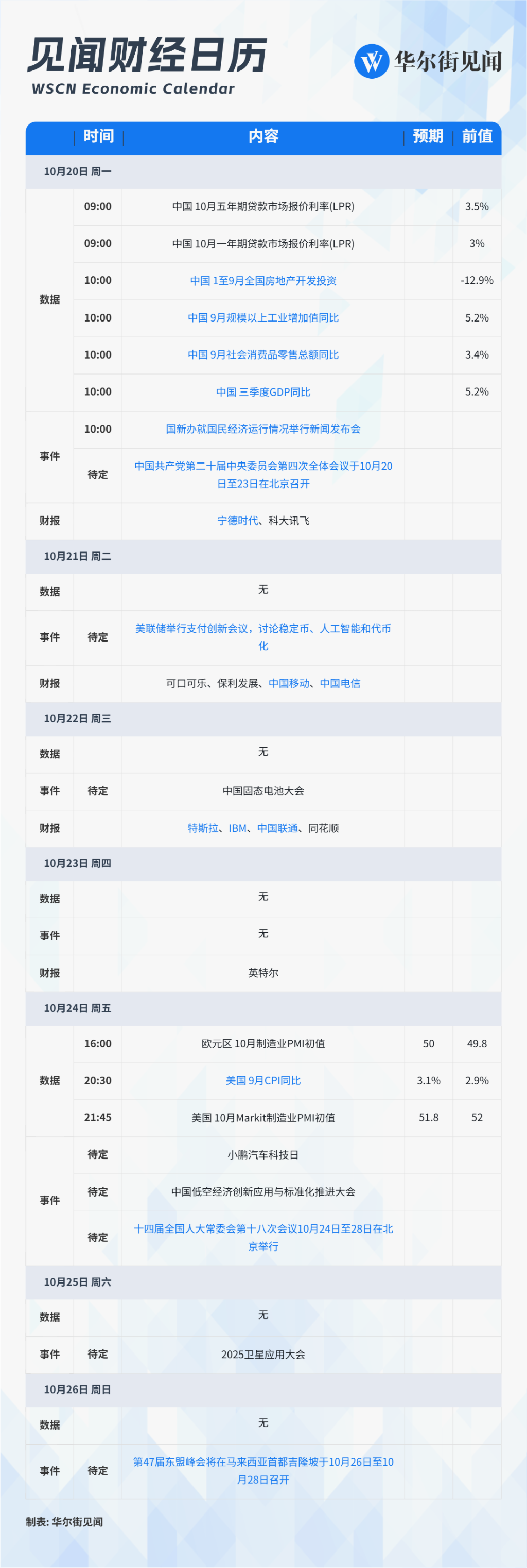
Economic Data - China will release key economic indicators including GDP, real estate investment, and retail sales on October 20, with expectations of a slight decline in GDP growth rate for Q3 [7][8] - The expected year-on-year decline in national real estate development investment is -12.9% [3] - The industrial added value for September is anticipated to show a year-on-year growth of 5.2% [3] Events - The 20th Central Committee of the Communist Party of China will hold its fourth plenary session from October 20 to 23 in Beijing [9] - The 14th National People's Congress Standing Committee's 18th meeting will take place from October 24 to 28 in Beijing [9] - The Federal Reserve will hold a payment innovation conference on October 21 to discuss stablecoins, AI, and tokenization [9] Industry Conferences - The China Solid-State Battery Conference will be held from October 22 to 24 in Hefei, with participation from companies like CATL and Guoxuan High-Tech [12] - The Low Altitude Economy Innovation Application and Standardization Promotion Conference is scheduled for October 24 in Beijing [12] - The 2025 Satellite Application Conference will take place from October 25 to 27 in Beijing [12] - Xiaopeng Motors is expected to hold a technology day on October 24, potentially unveiling a robot [13] Earnings Reports - Major companies set to report earnings include Tesla, IBM, Intel, Coca-Cola, and Procter & Gamble, with a focus on Tesla's Full Self-Driving progress and Intel's AI chip orders [14][15] - In China, companies like CATL, iFlytek, China Unicom, China Mobile, and China Telecom will also release their latest earnings reports [16] - CATL's solid-state battery technology roadmap may trigger a reevaluation of the value in the new energy industry if clear mass production signals are released [16]


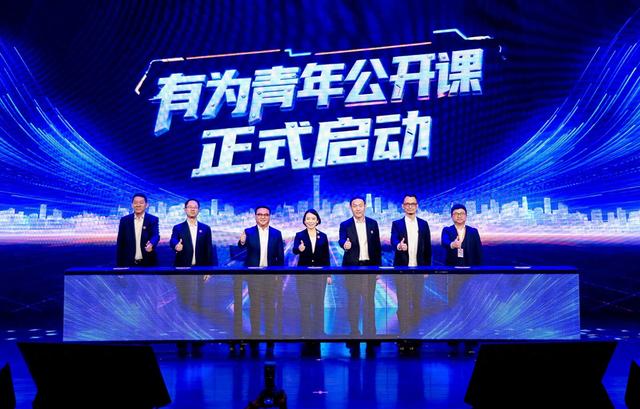
与院士、企业高管共话智能共生时代,“有为青年公开课”启幕
Bei Jing Ri Bao Ke Hu Duan· 2025-10-19 01:50
Core Insights - The event "Dynamic Zone for Youth Open Class" hosted by China Mobile focuses on the theme of "Intelligent Symbiosis Era," combining cutting-edge technology and humanistic thinking for contemporary youth [1][11] Group 1: Event Overview - The first session took place at Tsinghua University, featuring lectures from academicians, sharing from entrepreneurs, and discussions among students [1] - The event aims to provide a platform for youth to engage with the latest technological advancements and their implications for society [1][9] Group 2: Key Presentations - Academician Zhang Yaqin discussed the technological trends of the AI era, outlining five development directions for AI large models and predicting that the intelligent era will offer opportunities 100 times greater than the mobile internet era [3] - Chen Li, co-founder of Yushu Technology, highlighted the focus of intelligent robotics technology over the next 2-5 years, emphasizing that bipedal and quadrupedal robots will lead the next generation of hardware trends and integrate into daily life [5] Group 3: Student Engagement - A dialogue session allowed outstanding students to discuss the ultimate form of "coexistence" between artificial intelligence and humanity, exploring whether AI will replace or enhance human productivity [7] - The event included interactive experience zones showcasing the latest applications of intelligent technology, such as robot exhibitions and AI video ringtone experiences [9] Group 4: Future Plans - The open class will continue at other universities on October 25 and November 8, discussing themes like "New Blueprint for Low-altitude Economy" and "Intelligent Future" [11]
每周股票复盘:中国移动(600941)广东移动两度转换浦发银行可转债
Sou Hu Cai Jing· 2025-10-18 18:07
Core Points - China Mobile's stock price increased by 1.26% to 107.93 yuan as of October 17, 2025, with a market capitalization of 23,341.63 billion yuan, ranking 1st in the telecommunications services sector and 4th in the A-share market [1] Company Announcements - On October 13, 2025, Guangdong Mobile exercised its conversion rights, converting 5,631,454,000 yuan of SPDB A-share convertible bonds into 450,156,195 shares at a conversion price of 12.51 yuan per share, increasing its total holdings in SPDB A-shares to 5,785,049,019 shares, representing 18.18% of the enlarged share capital [1] - On October 17, 2025, Guangdong Mobile further converted 1,874,071,000 yuan of SPDB A-share convertible bonds into approximately 149,805,835 shares, raising its total holdings to about 5,934,854,847 shares, which is approximately 18.15% of the enlarged share capital [2] - The newly converted shares are subject to a five-year transfer restriction, and the conversions are in compliance with Hong Kong listing rules [2][3]
