
DTCIC(601001)

Search documents
行业周报:煤价再度反弹至700元之上,煤炭布局稳扎稳打-20250921
KAIYUAN SECURITIES· 2025-09-21 12:45
Investment Rating - The investment rating for the coal industry is "Positive" (maintained) [1] Core Viewpoints - Coal prices have rebounded above 700 RMB, with a current price of 704 RMB/ton, reflecting a week-on-week increase of 24 RMB/ton (3.53%) [3][4] - The demand for non-electric coal is expected to be a highlight in the upcoming months, particularly during the "golden September and silver October" period [4] - The report predicts that the current rebound in coal prices is at a turning point, with potential further increases expected as the market stabilizes [4][5] Summary by Sections Investment Logic - The prices of thermal coal and coking coal are at a turning point, with thermal coal prices expected to recover to long-term contract prices, currently above the second target price of around 700 RMB [4][13] - Future expectations indicate that thermal coal prices could reach a third target price of approximately 750 RMB, with a potential peak at around 860 RMB [4][13] Market Performance - The coal index increased by 3.51% this week, outperforming the CSI 300 index by 3.96 percentage points [8][25] - The average PE ratio for the coal sector is 13.59, and the PB ratio is 1.28, ranking low among all A-share industries [25][31] Coal Price Indicators - As of September 19, the Qinhuangdao Q5500 thermal coal price is 704 RMB/ton, with a week-on-week increase of 24 RMB [20] - The price of coking coal at the Jingtang port has risen to 1670 RMB/ton, reflecting a significant increase from earlier months [21][23] Investment Recommendations - The report suggests a dual logic for investment in coal stocks, focusing on both cyclical recovery and stable dividends, with specific stocks recommended for investment [5][14] - Key stocks identified for investment include: - Cyclical logic: Jinko Coal Industry, Yanzhou Coal Mining - Dividend logic: China Shenhua, Zhongmei Energy - Diversified aluminum elasticity: Shenhua Holdings, Electric Power Investment Energy - Growth logic: Xinjie Energy, Guanghui Energy [5][14][15]




再度提示煤炭供需改善与潜在政策催化下的配置机遇
Xinda Securities· 2025-09-21 02:05
Investment Rating - The investment rating for the coal mining industry is "Positive" [2] Core Viewpoints - The report indicates that the coal economy is at the beginning of a new upward cycle, with a resonance between fundamentals and policies, making it an opportune time to invest in the coal sector [3][13] - The report highlights that coal prices have shown signs of stabilization, and there is an expectation for price increases due to seasonal demand and supply constraints [5][13] - The report emphasizes the continued investment logic of coal capacity shortages, with a short-term balance and a long-term gap in supply [13][14] Summary by Sections Coal Price Tracking - As of September 19, the market price for Qinhuangdao port thermal coal (Q5500) is 699 CNY/ton, an increase of 21 CNY/ton week-on-week [4][31] - The price for coking coal at Jingtang port is 1610 CNY/ton, up 60 CNY/ton week-on-week [4][33] - International thermal coal prices have also seen fluctuations, with Newcastle thermal coal at 69.6 USD/ton, a week-on-week increase of 0.4 USD/ton [4][31] Supply and Demand Tracking - The capacity utilization rate for sample thermal coal mines is 91.7%, an increase of 2.4 percentage points week-on-week [4][48] - Daily coal consumption in inland provinces has increased by 4.10 thousand tons/day (+1.22%) [5][13] - The report notes that the supply side is still constrained by policies, and the demand is expected to rise as winter heating needs begin [5][13] Industry Performance - The coal sector has shown a weekly increase of 3.59%, outperforming the broader market [16] - The report identifies key companies to focus on, including China Shenhua, Shaanxi Coal, and others, highlighting their stable operations and strong performance [14][16]


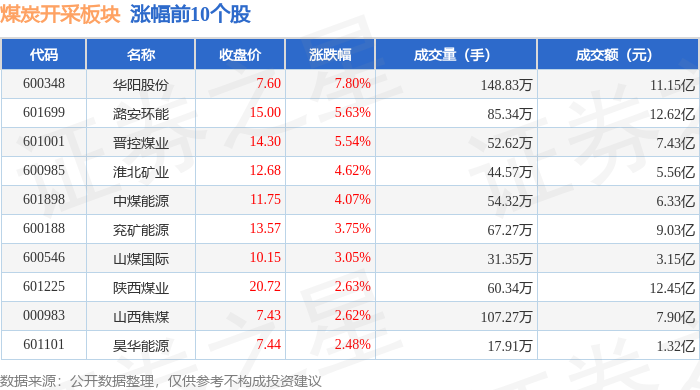
煤炭开采板块9月19日涨2.02%,华阳股份领涨,主力资金净流出3.55亿元
Zheng Xing Xing Ye Ri Bao· 2025-09-19 08:54
Group 1 - The coal mining sector increased by 2.02% on September 19, with Huayang Co. leading the gains [1] - The Shanghai Composite Index closed at 3820.09, down 0.3%, while the Shenzhen Component Index closed at 13070.86, down 0.04% [1] - Notable performers in the coal mining sector included: - Biaozhan Service (600348) with a closing price of 7.60, up 7.80% - Lu'an Huaneng (6691099) at 15.00, up 5.63% - Jinko Coal Industry (601001) at 14.30, up 5.54% [1] Group 2 - The coal mining sector experienced a net outflow of 355 million yuan from institutional investors, while retail investors saw a net inflow of 320 million yuan [2] - Key stocks with significant capital flows included: - Shanxi Coking Coal (000983) with a net inflow of 127 million yuan from institutional investors - Biaozhan Co. (600348) with a net inflow of 106 million yuan from institutional investors [3] - The overall trading volume for the coal mining sector was substantial, with various companies reporting significant transaction amounts [2][3]




今日看盘 | 9月19日:北方铜业继续领跌 煤炭板块表现优良
Xin Lang Cai Jing· 2025-09-19 08:07
Core Viewpoint - The overall market experienced a decline on September 19, with the Shenzhen Component Index down 0.04%, the Shanghai Composite Index down 0.30%, and the ChiNext Index down 0.16% [1] Group 1: Market Performance - The Shanxi sector showed a downward trend, with an overall decline of 0.34% [1] - More stocks in the Shanxi sector fell than rose, with three stocks increasing over 5%: Huayang Co. up 7.80%, Lu'an Environmental Energy up 5.63%, and Jinkong Coal Industry up 5.54% [1] - The leading decliner in the Shanxi sector was Northern Copper, which fell 5.12%, marking a cumulative decline of 10.37% over two days [1] Group 2: Energy Sector Insights - As a major energy province, Shanxi has several listed companies involved in coal and related fields, with the energy sector performing relatively well despite the overall market decline [1] - The coal mining and processing sectors saw gains of 1.82% and 2.30%, respectively, indicating resilience against the broader market downturn [1] Group 3: Stock Movements - Luohua Technology, after a cumulative increase of over 20% in previous days, has recently seen a decline, with a total drop of 18.52%, nearing a 20% decrease [1]

煤炭板块震荡走强
Di Yi Cai Jing· 2025-09-19 06:27
Group 1 - Huayang Co. reached the daily limit increase in stock price [1] - Lu'an Environmental Energy rose over 5% [1] - Jin控 Coal Industry, Huaibei Mining, Yanzhou Coal Mining, and China Coal Energy also experienced stock price increases [1]
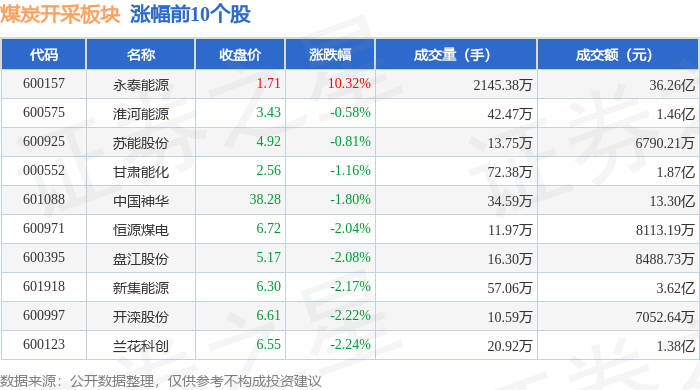
煤炭开采板块9月18日跌2.17%,晋控煤业领跌,主力资金净流入1.6亿元
Zheng Xing Xing Ye Ri Bao· 2025-09-18 08:59
Market Overview - The coal mining sector experienced a decline of 2.17% on September 18, with Jin控煤业 leading the drop [1] - The Shanghai Composite Index closed at 3831.66, down 1.15%, while the Shenzhen Component Index closed at 13075.66, down 1.06% [1] Individual Stock Performance - Yongtai Energy (600157) saw a significant increase of 10.32%, closing at 1.71 [1] - Other notable declines included Jin控煤业 (601001) down 3.97% to 13.55, and HuaiBei Mining (600985) down 3.96% to 12.12 [2] - The trading volume for Yongtai Energy was 21.45 million shares, while Jin控煤业 had a volume of 397,600 shares [1][2] Capital Flow Analysis - The coal mining sector had a net inflow of 160 million yuan from institutional investors, while retail investors contributed a net inflow of 126 million yuan [2] - Speculative funds saw a net outflow of 286 million yuan [2] - Yongtai Energy attracted the highest net inflow from institutional investors at 870 million yuan, representing 23.99% of its trading volume [3] Summary of Key Stocks - Jin控煤业 (601001) reported a trading volume of 397,600 shares with a transaction value of 548 million yuan [2] - Huai矿能源 (600188) had a trading volume of 643,900 shares and a transaction value of 851 million yuan [2] - The stock with the highest transaction value was China Shenhua (601088) at 1.33 billion yuan, closing at 38.28 with a decline of 1.80% [1][2]
晋控煤业跌2.06%,成交额1.64亿元,主力资金净流出1867.22万元
Xin Lang Cai Jing· 2025-09-18 02:22
Core Viewpoint - Jin控煤业's stock price has shown fluctuations with a recent decline of 2.06%, while the company has experienced a year-to-date increase of 7.01% in stock price [1] Financial Performance - For the first half of 2025, Jin控煤业 reported operating revenue of 5.965 billion yuan, a year-on-year decrease of 19.16%, and a net profit attributable to shareholders of 876 million yuan, down 39.01% year-on-year [2] - The company has distributed a total of 6.083 billion yuan in dividends since its A-share listing, with 3.640 billion yuan distributed in the last three years [3] Shareholder Structure - As of September 10, 2025, the number of shareholders for Jin控煤业 increased to 57,000, with an average of 29,363 circulating shares per shareholder, a decrease of 2.17% [2] - The top ten circulating shareholders include Hong Kong Central Clearing Limited, holding 22.0111 million shares, and Ruiyuan Growth Value Mixed A, holding 15.9652 million shares, with some fluctuations in their holdings [3] Market Activity - On September 18, 2025, Jin控煤业's stock traded at 13.82 yuan per share, with a total market capitalization of 23.131 billion yuan [1] - The stock has seen a trading volume of 164 million yuan with a turnover rate of 0.70% [1]
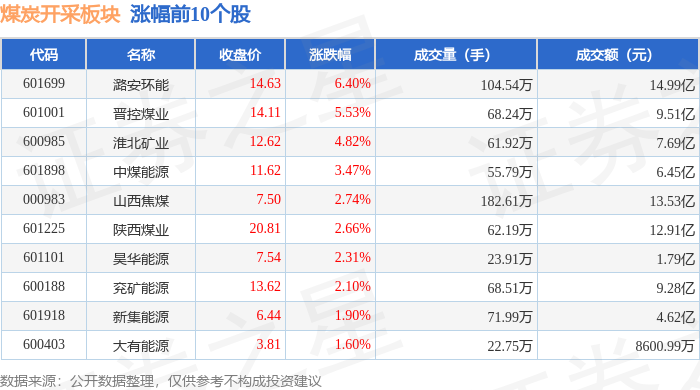
煤炭开采板块9月17日涨1.86%,潞安环能领涨,主力资金净流入2.96亿元
Zheng Xing Xing Ye Ri Bao· 2025-09-17 08:52
Group 1: Market Performance - The coal mining sector increased by 1.86% compared to the previous trading day, with Lu'an Huanneng leading the gains [1] - The Shanghai Composite Index closed at 3876.34, up 0.37%, while the Shenzhen Component Index closed at 13215.46, up 1.16% [1] Group 2: Individual Stock Performance - Lu'an Huanneng (code: 669109) closed at 14.63, up 6.40%, with a trading volume of 1.0454 million shares and a transaction value of 1.499 billion [1] - Jinko Coal Industry (code: 601001) closed at 14.11, up 5.53%, with a trading volume of 682,400 shares and a transaction value of 951 million [1] - Huai Bei Mining (code: 600985) closed at 12.62, up 4.82%, with a trading volume of 619,200 shares and a transaction value of 769 million [1] - Other notable performers include Zhongmei Energy (code: 601898) up 3.47%, Shanxi Coking Coal (code: 000983) up 2.74%, and Shaanxi Coal Industry (code: 601225) up 2.66% [1] Group 3: Capital Flow Analysis - The coal mining sector saw a net inflow of 296 million from main funds, while retail funds experienced a net outflow of 59.216 million [2] - Major stocks like Jinko Coal Industry had a net inflow of 120 million from main funds, but a net outflow of 68.97 million from retail investors [3] - Shanxi Coking Coal also reported a net inflow of 75.661 million from main funds, with retail investors withdrawing 37.116 million [3]
进口、产量维持同比下滑,再次重申“年底煤价或以最高点收官”
GOLDEN SUN SECURITIES· 2025-09-17 07:55
Investment Rating - The report maintains a "Buy" rating for several coal companies, including China Shenhua, China Coal Energy, and Qinfa, indicating a positive outlook for these stocks [9][42]. Core Viewpoints - The report emphasizes that coal prices are expected to peak by the end of the year, driven by supply constraints and resilient demand [4][44]. - It highlights a continuous decline in coal production and imports, with August coal production down 3.2% year-on-year and imports decreasing by 6.8% compared to the previous year [1][18]. - The report notes a slight increase in thermal power generation, which grew by 1.7% in August, while crude steel production saw a decline of 0.7% [21][31]. Summary by Sections Production - In August, the industrial raw coal output was 390 million tons, a year-on-year decrease of 3.2%, with a daily average of 12.6 million tons. For the first eight months, the output was 3.17 billion tons, a year-on-year increase of 2.8% [1][12]. - The forecast for 2025 suggests that coal production may reach approximately 3.88 billion tons, with a growth rate of about 1.4% [12]. Imports - In August, coal imports totaled 42.74 million tons, down from 45.84 million tons in the same month last year, marking a 6.8% decline. However, this was an increase of 20% compared to July [18][19]. - Cumulatively, coal imports for the first eight months of 2025 were 299.94 million tons, reflecting a 12.2% year-on-year decrease [18]. Demand - The report indicates that thermal power generation in August was 936.3 billion kWh, up 1.6% year-on-year, with a daily average of 30.2 billion kWh. The first eight months saw a total generation of 641.93 billion kWh, a 1.5% increase [21][22]. - The report also notes that crude steel production in August was 77.37 million tons, down 0.7% year-on-year, with a daily average iron output of 2.4055 million tons from 247 sample steel mills, reflecting a 7.69% increase [31][38]. Investment Recommendations - The report recommends companies with strong earnings elasticity such as Lu'an Environmental Energy, Yanzhou Coal Mining, and Jinneng Holding, while also highlighting the importance of companies focused on smart mining technologies [5][42]. - It suggests maintaining a focus on major coal enterprises like China Shenhua and China Coal Energy, and emphasizes the potential for recovery in companies like Qinfa [42].
煤炭行业事件点评:内蒙古超产核查落地,原煤产量理论同比减少6117万吨
Minsheng Securities· 2025-09-17 04:30
Investment Rating - The report maintains a "Buy" rating for several companies in the coal industry, including Lu'an Huanneng, Huayang Co., Shanmei International, China Shenhua, Zhongmei Energy, Shaanxi Coal, and Jinkong Coal [4]. Core Insights - The Inner Mongolia Energy Bureau has confirmed the overproduction of coal, with a theoretical reduction in raw coal output of 61.17 million tons year-on-year for 2024 [1]. - In 2024, Inner Mongolia's coal production exceeded the approved capacity by 61.17 million tons, representing an overproduction rate of 4.95% [1]. - The report anticipates a continued contraction in supply due to strict enforcement of overproduction regulations, which could theoretically impact supply by approximately 400 million tons [3]. - The demand for thermal coal is expected to gradually increase as the market transitions from the off-peak season, with a potential price rebound supported by declining port inventories and ongoing supply restrictions [3]. Summary by Sections Overproduction and Regulatory Actions - A total of 93 coal mines were found to be operating above their approved production capacities in Inner Mongolia, with 30% of the inspected mines exceeding their capacities by over 110% in 2024 [2]. - Approximately 32.2 million tons per year of production capacity is pending verification before resuming operations, affecting 15 mines in the Ordos region [2]. Supply and Demand Dynamics - The report suggests that the supply side is likely to continue contracting, which, combined with seasonal demand increases, may lead to a recovery in coal prices back to levels seen in Q3 2024 [3]. - The report highlights that traders are currently cautious, but the fundamentals are improving, which could support a price increase [3]. Investment Recommendations - The report recommends focusing on companies with high spot market exposure, stable performance, and growth potential, including Lu'an Huanneng, Jinkong Coal, and industry leaders like China Shenhua and Zhongmei Energy [3].
