NZP(601018)

Search documents
中证航运指数报1812.99点,前十大权重包含中国船舶等
Jin Rong Jie· 2025-06-13 16:26
Core Viewpoint - The China Securities Shipping Index (CS Shipping, 930718) is currently at 1812.99 points, reflecting a slight decline in the shipping sector over the past month, while showing a modest increase over the last three months [1][2]. Group 1: Index Performance - The CS Shipping Index has decreased by 0.41% over the past month, increased by 3.52% over the last three months, and has declined by 1.08% year-to-date [2]. - The index is designed to represent the overall performance of listed companies in the shipping industry, including sectors such as waterway transportation, port operations, shipbuilding, container manufacturing, and freight forwarding [2]. Group 2: Index Composition - The top ten weighted companies in the CS Shipping Index are: COSCO Shipping Holdings (11.55%), China Shipbuilding Industry (9.29%), China State Shipbuilding (8.73%), China Power (4.97%), China Merchants Energy Shipping (4.44%), Shanghai Port Group (3.35%), COSCO Shipping Energy (3.08%), China International Marine Containers (2.99%), Ningbo Port (2.93%), and HaiLanXin (2.58%) [2]. - The index is primarily composed of companies listed on the Shanghai Stock Exchange, which accounts for 82.62% of the index, while the Shenzhen Stock Exchange accounts for 17.38% [3]. Group 3: Index Adjustment Mechanism - The index samples are adjusted semi-annually, with adjustments occurring on the next trading day after the second Friday of June and December each year [4]. - Weight factors are generally fixed until the next scheduled adjustment, with special circumstances allowing for temporary adjustments [4].



港口板块短线拉升 南京港涨停
news flash· 2025-06-10 05:05
Group 1 - The port sector experienced a short-term surge, with Nanjing Port (002040) hitting the daily limit up, indicating strong investor interest [1] - Other ports such as Lianyungang (601008), Chongqing Port (600279), Xiamen Port (000905), Zhuhai Port (000507), and Ningbo Port (601018) also saw significant increases in their stock prices, reflecting a broader positive trend in the industry [1] - The movement of "smart money" towards these ports suggests a strategic shift in investment focus, potentially indicating future growth opportunities within the sector [1]


港口上市公司披露5月生产数据 集装箱吞吐量同比提升
Zheng Quan Shi Bao Wang· 2025-06-05 12:11
Group 1: Port Performance - Multiple A-share listed port companies reported an increase in container throughput in May, while Guangzhou Port experienced a slight decline in cargo throughput [1] - Ningbo Port projected a container throughput of 4.53 million TEUs in May, a year-on-year increase of 7.1%, and a cargo throughput of 107.6 million tons, up 7.7% [1] - Guangzhou Port's May container throughput is expected to reach 2.309 million TEUs, a 4.3% increase year-on-year, while cargo throughput is projected at 50.175 million tons, a slight decline of 0.3% [1] - Beibu Gulf Port reported a cargo throughput of 30.8633 million tons in May, a year-on-year increase of 6.43%, with container throughput reaching 881.3 thousand TEUs, up 10.79% [1] Group 2: Shipping Rates and Market Conditions - The China Export Container Freight Index rose by 0.9% year-on-year as of May 30, with the East America route increasing by 9.3% and the West America route by 4% [2] - Short-term demand for shipping on American routes remains strong due to tariff policy fluctuations and uncertain trade environments, but specific demand levels require further monitoring [2] - Nearly half of the port-listed companies reported a year-on-year increase in net profit for Q1, with Shanghai Port Group, Qingdao Port, and Ningbo Port showing growth rates of approximately 6%, 6.51%, and 4.54% respectively [2] Group 3: Operational Challenges - Beibu Gulf Port's management noted that the company faced challenges in revenue growth due to changes in cargo source structure and reduced high-value import/export trade [3] - Ningbo Port's management reported a 10.2% year-on-year increase in container throughput for the first quarter, ranking it among the top three global container ports [3] - The impact of the U.S. government's tariff policies on trade has led to a decrease in container throughput on American routes, while other routes continue to see growth [3]


宁波港(601018) - 宁波舟山港股份有限公司2025年5月份主要生产数据提示性公告
2025-06-05 09:15
2025年5月份,宁波舟山港股份有限公司预计完成集装箱吞吐量 453万标准箱,同比增长7.1%;预计完成货物吞吐量10760万吨,同 比增长7.7%。 证券代码:601018 证券简称:宁波港 编号:临 2025-026 债券代码:175812 债券简称:21 宁港 01 宁波舟山港股份有限公司 2025 年 5 月份主要生产数据提示性公告 本公司董事会及全体董事保证本公告内容不存在任何虚假记载、 误导性陈述或者重大遗漏,并对其内容的真实性、准确性和完整性承 担法律责任。 宁波舟山港股份有限公司董事会 2025 年 6 月 6 日 本公告所载2025年5月份的业务数据属于快速统计数据,与最终 实际数据可能存在差异,请投资者注意投资风险。 特此公告。 ...
业界专家:推进港口智慧绿色转型 政策层面将继续加码
Zhong Guo Xin Wen Wang· 2025-05-27 15:39
Core Insights - The National Port Technology Innovation Conference highlighted significant advancements in China's port industry, particularly in automation, intelligent scheduling systems, and green technologies, leading to improved operational efficiency and safety [1][2] Group 1: Technological Advancements - China's port industry has achieved remarkable results in technological innovation, with automated terminals leading globally and widespread application of intelligent scheduling systems [1] - The Ningbo-Zhoushan Port has entered the "world-leading" category in the global port rankings, alongside Singapore and Shanghai, as per the "World-Class Port Comprehensive Evaluation Report (2025)" [1] - Zhejiang Port Group has established a leading global remote-controlled automated equipment cluster, achieving full-process automation in port operations [1] Group 2: Industry Collaboration and Challenges - The port industry is increasingly focusing on the synergy between production and operational management, leveraging AI and digital infrastructure to connect logistics elements [2] - Despite advancements, challenges remain in the integration of industry, academia, and research, with some ports lacking strong technological innovation capabilities [2] - Recommendations include increasing R&D investment and forming collaborative innovation bodies to tackle key technological challenges [2] Group 3: Policy and Future Directions - The Ministry of Transport is accelerating the development of policies to support the integration of AI in transportation, with goals set for 2030 and beyond [2] - The port association is leading efforts to consolidate automation technologies for container terminals, promoting cooperation in technology, safety, and sustainability among ports [3]
法国第一大港口集团CEO:促进贸易便捷化是我们最重要的目标
Zhong Guo Xin Wen Wang· 2025-05-26 14:54
Core Viewpoint - HAROPA port group aims to enhance trade convenience through collaboration and infrastructure improvements, particularly with Ningbo-Zhoushan Port in China [1][2] Group 1: Company Overview - HAROPA is the largest port group in France, formed by the merger of Le Havre, Rouen, and Paris ports, and is the only river-sea intermodal port in France [1] - The port has an annual maritime and river throughput exceeding 100 million tons [1] Group 2: Strategic Initiatives - HAROPA operates 335 commercial shipping routes to China, connecting to 80 Chinese ports [1] - The port is focusing on emission reduction and digitalization, aiming to improve infrastructure for better connectivity with Zhoushan Port [1] - Collaboration will also focus on decarbonization efforts in the shipping trade sector [1] Group 3: Economic Impact - The partnership with Zhoushan Port is expected to inject more certainty into economic development [2] - HAROPA seeks to leverage global trade advantages to facilitate smoother cargo transport and communication [2] - The goal is to shift e-commerce freight from air to sea transport, thereby increasing throughput and reducing CO2 emissions [1]
自由贸易港概念下跌0.68%,5股主力资金净流出超3000万元
Zheng Quan Shi Bao Wang· 2025-05-20 08:35
Group 1 - The Free Trade Port concept declined by 0.68%, ranking among the top declines in concept sectors, with notable declines in stocks such as Xiamen Port, Ningbo Port, and Jinjiang Shipping [1] - Among the concept stocks, 14 experienced price increases, with Milkewei, Xinlong Holdings, and Shanghai Jianke leading with gains of 4.81%, 2.38%, and 1.64% respectively [1][2] - The top gaining concept sectors included Cultivated Diamonds (up 4.10%), Pet Economy (up 4.08%), and Animal Vaccines (up 4.00%), while the Shipping concept saw a decline of 1.44% [1] Group 2 - The Free Trade Port concept saw a net outflow of 417 million yuan, with 28 stocks experiencing net outflows, and five stocks seeing outflows exceeding 30 million yuan [1] - Xiamen Port had the highest net outflow of 127 million yuan, followed by Ningbo Port and Jinjiang Shipping with outflows of 67.43 million yuan and 40 million yuan respectively [1][2] - The stocks with the highest net inflows included Tianjin Port, Jiacheng International, and Xinlong Holdings, with inflows of 23.35 million yuan, 13.95 million yuan, and 7.49 million yuan respectively [1]


港口航运股开盘下挫 宁波远洋触及跌停
news flash· 2025-05-20 01:41
Group 1 - The port shipping stocks opened lower, with Ningbo Ocean reaching the daily limit down [1] - China National Aviation Ocean fell over 10%, while Phoenix Shipping and Jinjiang Shipping dropped over 5% [1] - Other companies such as COSCO Shipping Development, Ningbo Port, Rizhao Port, and Yantian Port also experienced declines [1]



冲刺90天:对美航运急速重启,大港航线全线提速
2 1 Shi Ji Jing Ji Bao Dao· 2025-05-19 13:35
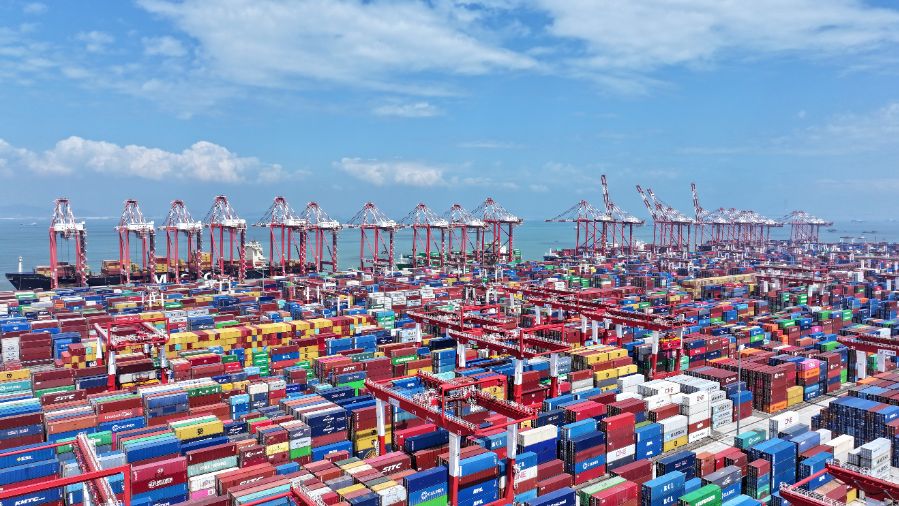
Core Viewpoint - The recent surge in shipping demand to the U.S. is driven by the expiration of tariffs and the urgency of foreign trade companies to fulfill orders within a 90-day window, leading to increased shipping costs and a booming port and shipping stock market [3][4][5]. Group 1: Shipping Demand and Pricing - The shipping costs for routes to the U.S. have increased significantly, with prices for a 40-foot container rising over $1,000, reaching approximately $4,000 for the West Coast and $5,000 for the East Coast [4][6]. - Prior to May 12, shipping prices were under downward pressure, with the China Export Container Freight Index showing declines of 13.0%, 13.2%, and 4.5% from February to April [4]. - Following the announcement of tariff cancellations on May 12, shipping prices began to rise sharply, with spot rates from Shanghai to Los Angeles increasing by 16% to $3,136 per 40-foot container by May 15 [4][5]. Group 2: Impact on Foreign Trade Companies - Foreign trade companies are rapidly fulfilling previously paused orders due to tariff policies, with one company reporting $150,000 in orders for the U.S. market, of which $50,000 has been shipped and $100,000 is pending [5]. - Companies are racing against time to ship goods within the 90-day tariff suspension window, with production cycles and shipping times being closely monitored to meet deadlines [5][6]. Group 3: Port and Shipping Industry Response - The surge in shipping demand is expected to impact port operations, with major ports like Guangzhou and Ningbo responding to increased activity and anticipating a rise in throughput by late May to early June [7]. - The shipping industry is experiencing a tightening of available space, with some shipping giants already raising rates for June shipments to the U.S. [6][7]. Group 4: Market Expansion Strategies - Companies are focusing on expanding into emerging markets such as Southeast Asia and Latin America to mitigate risks associated with traditional markets like North America [2][13]. - Ports are actively developing new shipping routes, particularly those aligned with the Belt and Road Initiative, to enhance their service offerings and capture a larger share of the growing trade with these regions [12][13].


抢运、爆舱,海运港口股再爆发!
第一财经· 2025-05-19 10:57
Core Viewpoint - The port and shipping stocks have shown strong performance, driven by the adjustment of US-China tariff policies and the approach of the traditional transportation peak season, leading to a surge in shipping demand [3][8]. Group 1: Market Performance - Several port stocks, including Ningbo Shipping, Nanjing Port, and Lianyungang, experienced a five-day consecutive limit-up, indicating strong market interest [3]. - The shipping futures market also saw a significant rise, with the container shipping index (European line) futures main contract closing at 2387 points, reflecting a weekly increase of approximately 54% [3]. Group 2: Factors Driving Growth - Analysts attribute the surge to the concentration of cargo owners initiating "rush shipping" operations due to tariff adjustments and the upcoming peak season [3]. - The traditional transportation peak season in Europe and the US is expected to lead to a pulse-like increase in cargo volume on Asia-Europe and trans-Pacific routes [3][8]. Group 3: Risk Warnings - Despite the strong market performance, several companies have issued risk warnings due to significant short-term price increases, including Nanjing Port and Lianyungang, which reported abnormal stock price fluctuations [4][5]. - Ningbo Shipping has also highlighted its poor financial performance, with a net profit of 22.12 million yuan in 2024, down 80.2% year-on-year, and a loss of 46.45 million yuan in the first quarter of 2025 [6]. Group 4: Price Trends and Expectations - The shipping industry anticipates that the "rush shipping" trend may push June freight rates to new highs, with expectations of price increases for at least eight shipping companies [9]. - However, immediate freight rates remain weak, and uncertainties regarding price increases persist, as indicated by the recent decline in Shanghai's export freight rates to Europe [9]. Group 5: Future Considerations - The industry faces uncertainties post-peak season, including ongoing tariff negotiations and potential impacts from global shipping capacity growth outpacing trade volume growth [9].