
SA(601021)

Search documents
“国内最赚钱航司”春秋航空招聘“空嫂” 年龄放宽至40周岁 已婚已育者优先
Zhong Guo Jing Ying Bao· 2025-10-27 11:52
Core Viewpoint - Spring Airlines has attracted attention with its recent recruitment of cabin crew (referred to as "空嫂"), which features relaxed entry requirements and aims to enhance service quality by targeting a broader demographic of candidates [2][3]. Recruitment Details - The recruitment for cabin crew positions does not limit applicants by major, focusing instead on cabin service and safety responsibilities, with job locations in Lanzhou and Shanghai [2]. - The basic requirements specify female candidates aged 25 to 40, with a preference for those who are married and have children [2]. - Physical requirements include a height range of 162 to 174 cm, adhering to the standards set by the Civil Aviation Administration of China [2]. Employment Conditions - Spring Airlines emphasizes a friendly entry condition for the "空嫂" position, with no prior work experience or specific major required, and an age limit extended to 40 years [2]. - Successful candidates will sign a formal labor contract, benefit from a comprehensive salary and welfare system, and receive one-on-one training from experienced instructors, with a 15% reduction in initial training costs [2]. Industry Context - Traditionally, many airlines have set age limits for cabin crew positions between 18 and 25 years, with some extending to 28-32 years [3]. - The recruitment head of Spring Airlines noted that the "空嫂" group possesses strong affinity and adaptability, which is advantageous in serving children and handling emergencies [3]. Financial Performance - According to Spring Airlines' 2025 semi-annual report, the company achieved a net profit of 1.169 billion yuan in the first half of the year, despite a year-on-year decline of 14.11%, maintaining its position as one of the most profitable airlines in China [3].


热搜第一!知名航司招已婚已育空嫂,40岁也可以;负责人:她们亲和力应变能力强,在职空嫂超七成已升至管理岗
Mei Ri Jing Ji Xin Wen· 2025-10-27 11:24
Group 1 - Spring Airlines has launched a special recruitment initiative for "air sisters," targeting married women for cabin crew positions, with age limits extended to 40 years and a minimum education requirement of a full-time bachelor's degree [1][3] - The recruitment aims to fill 30 to 60 positions in the northwest region, with training set to begin in early 2026, reflecting the growing demand for talent due to the expansion of western flight routes [3][4] - Currently, Spring Airlines employs approximately 3,400 flight attendants, with an average age of 28, and 70% of the workforce being under 30 years old [3][6] Group 2 - In the first half of 2025, Spring Airlines reported a revenue of 10.304 billion yuan, a year-on-year increase of 4.35%, while net profit decreased by 14.11% to 1.169 billion yuan [6] - The airline's passenger turnover for the first half of 2025 reached 2,521.9 million passenger-kilometers, marking a 9.4% increase year-on-year, with a seat occupancy rate of 90.5%, down 0.8 percentage points [6] - As of September 2025, Spring Airlines' passenger turnover increased by 22.87% year-on-year, with a fleet of 134 Airbus A320 aircraft and over 230 routes covering major business and tourist cities in China and Southeast Asia [7]

上海市工商联成立上市公司专委会
Zhong Guo Xin Wen Wang· 2025-10-27 11:05
Core Points - The Shanghai Municipal Federation of Industry and Commerce established a special committee for listed companies, consisting of 63 core executives from private listed companies, with Yang Guoping, Chairman and CEO of Dazhong Transportation Group, serving as the director [1] - The committee focuses on six key areas: strategic guidance, industrial collaboration, policy empowerment, financial support, standardized governance, and legal protection, aiming to enhance the quality of development of Shanghai's private economy [1] - As of now, there are 451 A-share listed companies in Shanghai, of which 254 are privately controlled, representing a crucial force in the private economy [1] - The first batch of committee members includes companies from integrated circuits, biomedicine, artificial intelligence, and green low-carbon sectors, with a total market capitalization exceeding half of the total market value of all private listed companies in Shanghai [1] - Shou Ziqi, Vice Chairman of the All-China Federation of Industry and Commerce and Chairman of the Shanghai Municipal Federation of Industry and Commerce, emphasized that private listed companies are the "leading geese" of Shanghai's private economy and the "vanguard" of technological innovation [1] Group 1 - The special committee aims to guide enterprises to align with national strategies, increase R&D investment, and promote digital and green transformation [1] - The committee will strengthen platform service functions, creating a "highway" for government-enterprise communication and a "hub" for resource matching and industrial coordination [1] - The committee intends to leverage leading enterprises to enhance and complement industrial chains, providing categorized services to optimize the capital market ecosystem [1] Group 2 - During a roundtable discussion, five committee member companies, including Dazhong Transportation, Spring Airlines, Geke Micro, Heyuan Bio, and Mercury Holdings, explored topics such as the transformation of technological innovation results, enhancing core competitiveness, and the integration of industrial chain formats [2]


春秋航空发布已婚已育“空嫂”专项招聘计划,年龄放宽至40岁
Bei Jing Shang Bao· 2025-10-27 11:03
Core Viewpoint - Spring Airlines has launched a recruitment plan for "Air Sisters" in Lanzhou, targeting married women to enhance its workforce and meet the growing demand for talent in the western flight routes [1] Group 1: Recruitment Details - The recruitment aims to hire 30 to 60 "Air Sisters," with training set to begin in early 2026 [1] - The current workforce of Spring Airlines includes approximately 3,400 flight attendants, with an average age of 28 years, and 70% of them are under 30 [1] - The recruitment is specifically for married women, with height requirements between 162 cm and 174 cm, and a minimum educational qualification of a full-time bachelor's degree [1] Group 2: Advantages of "Air Sisters" - "Air Sisters" are believed to possess life experiences that enable them to handle emergencies more calmly and anticipate passenger needs effectively [1] - They are particularly skilled in caring for child passengers and can enhance team cohesion within the cabin crew [1] - Among the current 88 "Air Sisters," 74% have been promoted to management positions, indicating a successful career progression within the company [1] Group 3: Market Context - The recruitment initiative is a response to the continuous growth of western flight routes, highlighting the increasing demand for qualified personnel in this region [1]
春秋航空启动已婚已育“空嫂”招聘,年龄放宽至40岁
第一财经· 2025-10-27 09:59
Core Viewpoint - Spring Airlines is launching a special recruitment plan for cabin crew (specifically targeting married women) in Lanzhou, aiming to break traditional age barriers in hiring and meet the growing talent demand due to the expansion of western routes [3][4]. Group 1: Recruitment Strategy - The recruitment is focused on women aged 40 and below, with a height requirement of 162cm to 174cm, and a minimum educational qualification of a full-time bachelor's degree [3]. - The company currently employs around 3,400 cabin crew members, with an average age of 28, and 70% of the workforce being under 30 years old [3]. Group 2: Market Context - Most airlines in China primarily recruit fresh graduates aged 18-25, with some extending the age limit to 28-32, while foreign airlines tend to have older average ages for cabin crew [4]. - This is the first time in 12 years that Spring Airlines is specifically recruiting "air sisters" (空嫂), with Lanzhou being the second largest base after Shanghai [4]. Group 3: Operational Goals - The recruitment aims to onboard 30 to 60 new crew members, with training set to begin in early 2026, thereby enhancing operational capacity for both the Lanzhou base and the Shanghai headquarters [3]. - The recruitment strategy is expected to improve the team's cohesion and enhance service quality, particularly in catering to families and children [3].
春秋航空对外投资22家企业
Xin Lang Cai Jing· 2025-10-27 09:37
Core Viewpoint - Spring Airlines has launched a special recruitment initiative for female cabin crew members, specifically targeting married women with children and raising the age limit to 40 years old [1] Company Overview - Spring Airlines was established in November 2004 and has a registered capital of approximately 980 million RMB [1] - The company is involved in public air transportation and road passenger transport operations [1] - The shareholders include Shanghai Spring International Travel Service (Group) Co., Ltd. and Hong Kong Central Clearing and Settlement System [1] Employment and Investment - The company reported an insured employee count of 5,130 for the year 2024 [1] - Spring Airlines has made external investments in 22 enterprises, including Shanghai Spring Real Estate Co., Ltd. and Spring Financing Leasing (Shanghai) Co., Ltd. [1]
年龄放宽至40岁,春秋航空首次招聘已婚已育空嫂
Ge Long Hui A P P· 2025-10-27 09:30
公开信息显示,此前的空姐招聘通常在18-25周岁,部分航空公司放宽至28-32周岁。10月中下旬,首都 航空发布的招聘信息显示,乘务长及以上人员可放宽至35周岁。 格隆汇10月27日|据界面,近日,春秋航空在公司官网推出空嫂专项招聘。据发现,在客舱乘务员(空 嫂)的任职要求中,首次明确提出,已婚已育女性优先;在具体年龄方面,放宽至40岁。学历要求为全 日制本科及以上,身高162cm至174cm,无工作经验限制。相关招聘信息显示,本次招聘的空嫂工作地 点为兰州、上海。 ...
春秋航空启动已婚已育“空嫂”招聘,年龄放宽至40岁
Di Yi Cai Jing· 2025-10-27 09:28
Group 1 - The core idea of the news is that Spring Airlines is launching a special recruitment plan for cabin crew (referred to as "air sisters") in Lanzhou, aiming to break the traditional age barrier in flight attendant hiring by targeting married women aged up to 40 with a bachelor's degree or higher [2][3] - Currently, Spring Airlines has approximately 3,400 flight attendants, with an average age of 28, and 70% of the staff being under 30 years old [2] - The recruitment initiative is driven by the growing demand for talent due to the continuous increase in western route operations, with plans to recruit 30 to 60 air sisters and start training in early 2026 [2] Group 2 - This recruitment marks the first time in 12 years that Spring Airlines is hiring "air sisters," with Lanzhou becoming the second largest base for the airline after Shanghai [3] - The recruitment manager highlighted that the life experience of air sisters allows them to handle emergencies more calmly and better anticipate passenger needs, particularly in caring for children, enhancing team cohesion [2] - Among the current 88 air sisters, 74% have been promoted to management positions, indicating a successful career progression within the company [2]
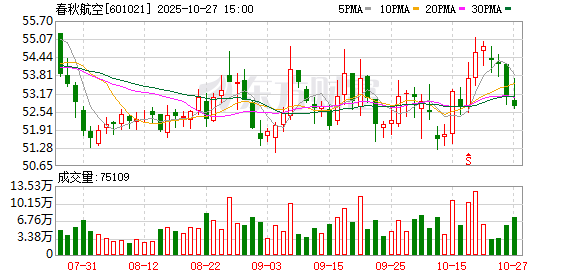
航空机场板块10月27日涨0.09%,厦门空港领涨,主力资金净流出1.53亿元
Zheng Xing Xing Ye Ri Bao· 2025-10-27 08:24
Core Viewpoint - The aviation and airport sector experienced a slight increase of 0.09% on October 27, with Xiamen Airport leading the gains. The Shanghai Composite Index closed at 3996.94, up 1.18%, while the Shenzhen Component Index closed at 13489.4, up 1.51% [1]. Summary by Category Stock Performance - Xiamen Airport (600897) closed at 16.00, up 1.91% with a trading volume of 127,600 shares and a turnover of 204 million yuan - China National Aviation (601111) closed at 8.46, up 1.08% with a trading volume of 532,900 shares - China Southern Airlines (600029) closed at 6.60, up 0.30% with a trading volume of 431,700 shares - Shanghai Airport (600009) remained unchanged at 31.37 with a trading volume of 71,700 shares - Hainan Airlines (600221) closed at 1.68, unchanged with a trading volume of 3,633,800 shares - China Eastern Airlines (600115) closed at 4.83, down 0.41% with a trading volume of 953,200 shares [1][2]. Capital Flow - The aviation and airport sector saw a net outflow of 153 million yuan from institutional investors, while retail investors contributed a net inflow of 107 million yuan [2][3]. - The detailed capital flow for key stocks indicates that: - China Southern Airlines had a net inflow of 29.35 million yuan from institutional investors - Hainan Airlines experienced a net outflow of 19.17 million yuan from institutional investors - Xiamen Airport had a net inflow of 6.56 million yuan from institutional investors [3].






春秋航空上海两机场地面值机服务再升级
Zhong Guo Min Hang Wang· 2025-10-27 05:07
Core Points - Spring Airlines is enhancing ground services at Shanghai Hongqiao and Pudong airports in preparation for the 2025 China International Import Expo, aiming to improve passenger convenience and uphold the service principle of "People's Aviation for People" [1] Group 1: Service Enhancements at Hongqiao Airport - Starting October 28, Spring Airlines has reduced the check-in cut-off time at Hongqiao Airport's T1 terminal from 30 minutes to 25 minutes before flight departure, optimizing multiple service aspects to reduce the risk of missed flights [2] - A dedicated check-in counter for late passengers has been established, staffed with experienced personnel to assist with check-in, baggage drop, and boarding processes [2] - The airport has also improved passenger flow to ensure efficient connections from check-in to boarding [2] Group 2: Night Check-in Service at Pudong Airport - Concurrently, Spring Airlines has launched a night check-in service at Pudong Airport's T2 terminal from 00:00 to 03:00 for domestic flights departing before 09:00, which has served over 2,700 passengers since its trial run began in August [3] - The increase in overnight flights from Southeast Asia and Japan/Korea has led to a significant rise in transfer demand for domestic flights, with one-third of domestic flights departing between 06:00 and 09:00 [3] - The night check-in service allows transfer passengers to check in immediately upon arrival, enhancing their travel experience and alleviating anxiety while waiting [3] - This initiative also helps the airline manage peak ground service pressures and improve on-time performance [3]