SA(601021)

Search documents
春秋航空:新增复飞多条国内国际地区航线
Zheng Quan Shi Bao Wang· 2025-10-27 03:45
Core Viewpoint - Spring Airlines has officially implemented its winter-spring flight schedule, focusing on both domestic and international markets with significant operational expansion [1] Group 1: Flight Operations - The airline plans to execute over 4,000 flights weekly in the new season [1] - Spring Airlines will operate more than 260 flight routes, including the addition of 8 new domestic and international routes [1] - The company is also resuming operations on over 10 popular routes [1]

民航冬春航季启动!广州新增多条国际航线
2 1 Shi Ji Jing Ji Bao Dao· 2025-10-26 14:19
Core Points - The 2025/26 winter-spring flight schedule will be implemented from October 26, 2025, to March 28, 2026, with multiple airlines announcing their flight adjustments [1] - A total of 210 domestic and international airlines plan to operate 119,500 passenger and cargo flights weekly, reflecting a 1.3% increase compared to the same period last year, indicating a stable and positive development trend [3] Group 1: China Southern Airlines (南航) - China Southern Airlines plans to execute approximately 470,000 passenger flights, with new and enhanced domestic and international routes [3] - The airline is focusing on strengthening its route network from hubs like Guangzhou, Beijing Daxing, and Urumqi, with new routes such as Beijing Daxing to Xishuangbanna and increased frequencies on several domestic routes [3] - Internationally, new routes from Guangzhou to Madrid and Darwin will commence, with a 30% year-on-year increase in flights to Australia [3] Group 2: China Eastern Airlines (东航) - From October 30, 2025, China Eastern Airlines will gradually transition its flights in Guangzhou to the T3 terminal, operating approximately 205 flights daily across 104 routes [6][7] - The airline has added 15 new routes and increased frequencies on 12 routes within Guangdong province compared to the previous winter-spring season [6] Group 3: Spring Airlines (春秋航空) - Spring Airlines will increase the frequency of flights from Guangzhou to Bangkok from 7 to 10 per week starting October 28, 2025, to meet rising travel demand [9] - The introduction of a permanent visa exemption policy between China and Thailand from March 1, 2024, is expected to boost tourism and facilitate travel planning for Chinese tourists [9]




春秋航空冬春航季新增复飞多条航线 周计划航班量超4000班
Zhong Guo Min Hang Wang· 2025-10-26 11:19
Core Points - Spring Airlines officially implements its winter-spring flight schedule starting October 26, with over 4,000 weekly flights and more than 260 routes, including 8 new domestic and international routes, and the resumption of over 10 popular routes to optimize its network and meet diverse travel demands [1] Domestic Routes - The airline will open 7 new domestic routes, enhancing accessibility to popular tourist destinations such as Altay in Xinjiang and Dali in Yunnan, while strengthening air connections between North China, Northeast China, the Yangtze River Delta, and Southwest regions [1] International and Regional Routes - New international routes include Shanghai Pudong to Kuala Lumpur, Malaysia (starting November 28, 2025), and the resumption of routes to Kaohsiung, Taiwan (February 1, 2026) and Sabah, Malaysia (January 28, 2026), providing travelers with more outbound options [1] Service Innovations - To enhance the ticket purchasing experience, Spring Airlines has launched a new member discount of 30 yuan for the first ticket purchase and continues its "Ticket Defense War" campaign until November 14, promoting official channel bookings for a more transparent consumer environment [2] Pet-Friendly Services - The airline has expanded its "pet-friendly" route network, offering "pets in cabin" services in 6 cities, covering 11 routes, with a focus on the "Travel with Pets" product that provides two seat spaces for each pet, allowing for a companionable travel experience [2] Operational Efficiency and Service Quality - Spring Airlines aims to maintain safety standards while expanding its route network, optimizing service processes, and enhancing passenger rights protection, contributing to high-quality development in civil aviation and improving the travel experience for passengers [2]
春秋航空冬航季新增复飞多条国内国际地区航线
Bei Jing Shang Bao· 2025-10-26 11:17
Core Points - Spring Airlines officially launched its winter flight schedule starting October 26, with over 4,000 weekly flights and more than 260 routes [1] - The airline has added 8 new domestic and international routes and restored over 10 popular routes [1] Domestic Routes - Spring Airlines will open 7 new domestic routes, enhancing connectivity to popular tourist destinations like Altay in Xinjiang [1] - The new routes include: Dalian-Yantai, Shanghai Hongqiao-Lanzhou-Altay, Chengdu Tianfu-Altay, Shanghai Pudong-Lanzhou-Hotan, Shanghai Hongqiao-Dali, Shanghai Pudong-Shijiazhuang-Zhangjiakou, and Shenyang-Dongying-Fuzhou [1] - The new routes optimize air connections between North China, Northeast China, the Yangtze River Delta, and Southwest regions [1] International Routes - The airline will introduce a new international route from Shanghai Pudong to Kuala Lumpur starting November 28, 2025, providing more options for travelers to Southeast Asia [1] - Spring Airlines will also resume several routes including Shanghai Hongqiao-Sanya, Tianjin-Sanya, Shenyang-Ningbo-Sanya, Lanzhou-Beihai, Shanghai Hongqiao-Taiyuan, Ningbo-Baishan, and Chengdu Tianfu-Urumqi [1] - The airline plans to increase the frequency of multiple routes in the new season [1] Pet-Friendly Services - Spring Airlines is expanding its "pet-friendly" route network, now offering "pets in the cabin" service in cities including Shanghai, Harbin, Lanzhou, Shijiazhuang, Nanchang, and Urumqi [2] - The service allows each pet to occupy two seats, promoting a companion-style travel experience [2]
广州白云机场加密东南亚航线!中泰、中印往来再提速
Nan Fang Du Shi Bao· 2025-10-24 11:59
Core Viewpoint - Guangzhou Baiyun International Airport is expanding its international flight network, enhancing connectivity between China and Thailand, as well as China and India, through new and increased flight routes [2] Group 1: Flight Network Expansion - Starting from October 28, Spring Airlines will increase the frequency of flights from Guangzhou to Bangkok from 7 to 10 flights per week, adding flights on Tuesdays, Thursdays, and Saturdays [2] - The new flight schedule includes Guangzhou to Bangkok Suvarnabhumi flight 9C8893 departing at 05:55 and arriving at 08:20, and the return flight 9C8894 departing at 10:20 and arriving at 14:00 [2] - The existing daily flight from Guangzhou to Bangkok Suvarnabhumi (9C7419) operates at 09:00, arriving at 11:00, with the return flight (9C7420) departing at 21:55 and arriving at 02:00 the next day [2] Group 2: New Routes and Market Impact - IndiGo Airlines will launch a daily direct flight from New Delhi to Guangzhou starting November 10, following the resumption of the Kolkata-Guangzhou route on October 26 [2] - This marks the official restart and intensification of direct flights between China and India after a five-year hiatus, utilizing Airbus A320 aircraft for the new route [2] - The new route is expected to connect India's extensive domestic network with the Chinese market, fostering cooperation in trade, investment, tourism, and education between the two countries [2]

春秋航空(601021) - 春秋航空关于控股股东部分股份质押展期及解除质押的公告
2025-10-24 10:01
股票代码:601021 股票简称:春秋航空 公告编号:2025-056 春秋航空股份有限公司 关于控股股东部分股份质押展期及解除质押的公告 本公司董事会及全体董事保证本公告内容不存在任何虚假记载、误导性陈 述或者重大遗漏,并对其内容的真实性、准确性和完整性承担法律责任。 重要内容提示: 春秋航空股份有限公司(以下简称"公司")控股股东上海春秋国际旅行社 (集团)有限公司(以下简称"春秋国旅")持有公司股份数量为 504,000,000 股, 占公司总股本的比例为 51.52%;本次办理质押展期和解除质押手续后,春秋国旅 累计质押公司股份数量为 35,910,000 股,占其所持公司股份数量的 7.13%,占公司 总股本的比例为 3.67%。 一、股东部分股份质押展期情况 春秋国旅本次解除质押的股份暂无后续质押计划,未来将基于相关融资需求而 定。 三、股东股份累计质押情况 公司于 2025 年 10 月 24 日接到控股股东春秋国旅关于部分股份质押展期的通 知,于 2025 年 10 月 23 日将其原质押给中信证券股份有限公司的合计 4,510,000 股 公司股票办理了相关质押展期手续。具体事项如下: | ...
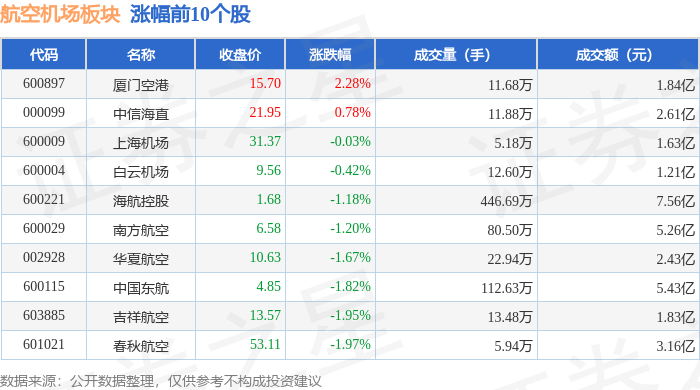
航空机场板块10月24日跌1.41%,中国国航领跌,主力资金净流出1.97亿元
Zheng Xing Xing Ye Ri Bao· 2025-10-24 08:27
Group 1 - The aviation and airport sector experienced a decline of 1.41% on October 24, with China National Aviation leading the drop [1] - The Shanghai Composite Index closed at 3950.31, up 0.71%, while the Shenzhen Component Index closed at 13289.18, up 2.02% [1] - Xiamen Airport saw a closing price of 15.70, with an increase of 2.28%, while China Eastern Airlines closed at 4.85, down 1.82% [1] Group 2 - The aviation and airport sector had a net outflow of 197 million yuan from institutional investors, while retail investors saw a net inflow of 100 million yuan [2] - Shenzhen Airport had a net inflow of 14.99 million yuan from institutional investors, while China National Aviation experienced a net outflow of 10.24 million yuan [2] - The overall capital flow showed that retail investors contributed positively to some stocks, despite the overall sector decline [2]



从每周7班升至每周10班!春秋航空加密广州至曼谷航线
Nan Fang Du Shi Bao· 2025-10-24 03:30
近日,春秋航空对外宣布:自 2025年10月28日起,对广州至曼谷航线进行加密,航班频次从每周7班提升至每周 10班,新增的直飞航班班次将于每周二、周四、周六出发。 每周新增二、四、六航班,提升至10班 跟团游产品将带领游客游览曼谷及周边的热门景点,如庄严宏伟的大皇宫、宁静神圣的玉佛寺、规模宏大的卧佛 寺等。同时,还为游客安排了丰富多样的特色美食体验和文化交流活动,让游客深度领略泰国的独特风土人情。 自由行产品则突出个性化和自由度,深受游客喜爱,游客可以根据自身的兴趣爱好和实际需求,自由规划行程, 尽情享受泰国轻松惬意的假期时光。 采写:南都N视频记者 肖阳 春秋航空相关负责人表示,为顺应游客不断攀升的出行热情,满足日益增长的出行需求,加开航班是公司东南亚 航线布局战略中的关键一步。未来,春秋航空还将持续发力,致力于为广大游客提供更加便捷、实惠的飞行服 务,为促进中外旅游交流与合作贡献力量。 春秋旅游打造"泰国5日游"旅游产品 随着新航线的开通,春秋旅游打造了为期5日的跟团游和自由行产品。 南都记者了解到,新增的航次为每周二、四、六航班:广州-曼谷素万那普 9C8893,05:55-08:20;曼谷素万那 普 ...
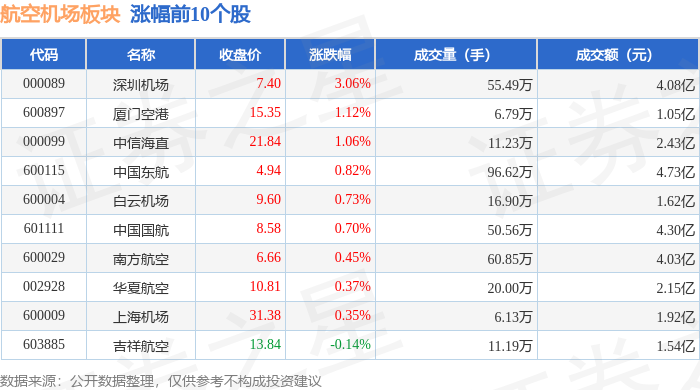
航空机场板块10月23日涨0.38%,深圳机场领涨,主力资金净流入3222.04万元
Zheng Xing Xing Ye Ri Bao· 2025-10-23 08:20
Market Overview - On October 23, the aviation and airport sector rose by 0.38% compared to the previous trading day, with Shenzhen Airport leading the gains [1] - The Shanghai Composite Index closed at 3922.41, up 0.22%, while the Shenzhen Component Index closed at 13025.45, also up 0.22% [1] Stock Performance - Shenzhen Airport (000089) closed at 7.40, up 3.06% with a trading volume of 554,900 shares and a turnover of 408 million yuan [1] - Xiamen Airport (600897) closed at 15.35, up 1.12% with a trading volume of 67,900 shares and a turnover of 105 million yuan [1] - China Eastern Airlines (600115) closed at 4.94, up 0.82% with a trading volume of 966,200 shares and a turnover of 473 million yuan [1] - China Southern Airlines (600029) closed at 6.66, up 0.45% with a trading volume of 608,500 shares and a turnover of 403 million yuan [1] Capital Flow - The aviation and airport sector saw a net inflow of 32.22 million yuan from institutional investors, while retail investors experienced a net inflow of 35.07 million yuan [2] - However, speculative funds recorded a net outflow of 67.29 million yuan [2] Individual Stock Capital Flow - China Southern Airlines (600029) had a net inflow of 69.47 million yuan from institutional investors, while it faced a net outflow of 34.49 million yuan from speculative funds [3] - China Eastern Airlines (600115) saw a net inflow of 39.42 million yuan from institutional investors, with a net outflow of 3.79 million yuan from speculative funds [3] - Shenzhen Airport (000089) experienced a net outflow of 11.13 million yuan from institutional investors, but had a net inflow of 5.62 million yuan from retail investors [3]
“超级周期长逻辑”获主流认可,航空板块迎来估值修复行情?
Zhi Tong Cai Jing· 2025-10-23 02:36
Core Viewpoint - The aviation sector is experiencing a significant recovery after being undervalued for the past two to three years due to the pandemic and international flight disruptions, with recent data indicating a strong upward trend in stock prices and operational metrics [1][6]. Group 1: Market Performance - Since October 9, 2025, the Hong Kong aviation sector has seen substantial gains, with increases of 3.47%, 5.68%, and 5.38% on October 9, 15, and 20 respectively, leading to a cumulative rise of 15.14% [1] - China Eastern Airlines (00670) has recorded a cumulative increase of 37.42%, while China Southern Airlines (01055) has seen a rise of 22.57% [1] Group 2: Passenger Demand and Flight Operations - The National Day and Mid-Autumn Festival holidays have driven a surge in travel, with an estimated 2.432 billion people traveling during the holiday period, marking a historical high and a 6.2% year-on-year increase [3] - Civil aviation passenger volume reached 19.138 million during the holiday, with a daily average of 2.392 million, reflecting increases of 4.1% and 26.9% compared to 2024 and 2019 respectively [3] - The number of flights executed daily has increased to 15,539, a 3.73% rise from the previous year, indicating stable growth in flight operations [3] Group 3: Pricing and Cost Dynamics - The average domestic economy class ticket price in September 2025 was 697 yuan, a 0.6% increase year-on-year, while prices during the holiday period averaged 849 yuan, up 0.3% year-on-year [5] - Oil prices are expected to decline, which could enhance the profitability of airlines as the cost of aviation fuel decreases [5] Group 4: Long-term Industry Outlook - The aviation industry is poised for a "super cycle" due to a favorable supply-demand dynamic, with demand expected to grow significantly as consumer behavior shifts towards leisure travel and business travel recovers [7][9] - The supply side faces constraints, with global aircraft manufacturing capacity recovering slowly, and domestic capacity growth projected at only 3.1% annually from 2025 to 2028 [10] - Market reforms and industry self-regulation have improved pricing power for airlines, leading to a potential increase in profitability as demand continues to rise [11] Group 5: Investment Opportunities - The aviation sector is entering a phase characterized by high demand, low supply, and supportive policies, creating conditions for a sustainable profit growth period from 2025 to 2028 [12] - Investors are encouraged to focus on full-service airlines with hub advantages and international route flexibility, as well as low-cost carriers with efficient operational models [12]