SGC(601139)

Search documents
申万公用环保周报:国网经营区电力现货市场全覆盖,欧美气价季节性上涨-20251110
Shenwan Hongyuan Securities· 2025-11-10 05:49
Investment Rating - The report maintains a "Positive" outlook on the power and gas sectors, highlighting the full coverage of the electricity spot market in the State Grid operating area and the seasonal rise in gas prices in Europe and the US [1]. Core Insights - The electricity spot market in the State Grid operating area has achieved near-complete coverage, with 18 provincial-level markets in continuous settlement trial operation as of November 1, 2025. This includes the formal operation of inter-provincial markets and five provincial-level markets [4][8]. - In the gas sector, US Henry Hub spot prices rose to $3.76/mmBtu, reflecting a weekly increase of 5.52%, while European gas prices also saw increases due to seasonal demand [13][19]. Summary by Sections 1. Electricity - The State Grid operating area has nearly achieved full coverage of the electricity spot market, with significant developments in various provinces. As of November 1, 2025, the market has transitioned to continuous settlement trials in Sichuan and Chongqing [4][8]. - In Shanxi, the first province to fully implement the electricity spot market, the average spot price for electricity was recorded at 0.283 yuan/kWh, with a total of 156.23 billion kWh cleared in the first half of 2025 [10]. - The growth of renewable energy capacity in Shanxi has been substantial, with an increase of 128.75% since the 14th Five-Year Plan, leading to a significant impact on electricity pricing and market dynamics [10]. 2. Gas - The report notes a divergence in global gas prices, with US prices rising while Asian LNG prices remain stable due to ample supply. As of November 7, 2025, the Northeast Asia LNG spot price was $11.10/mmBtu, unchanged from the previous week [13][27]. - The report highlights the increase in US natural gas production and demand, with the Henry Hub futures price reaching $4.32/mmBtu, marking a 4.63% increase [14][19]. - Recommendations for investment in gas-related companies include those with integrated natural gas trading capabilities, such as Kunlun Energy and New Hope Energy, as well as city gas companies benefiting from cost reductions [31]. 3. Weekly Market Review - The report indicates that the electricity equipment, public utilities, environmental protection, and gas sectors outperformed the Shanghai and Shenzhen 300 index during the week of November 2 to November 9, 2025 [35]. 4. Company and Industry Dynamics - As of September 2025, China's new energy storage capacity exceeded 100 million kW, representing over 40% of the global total, with significant contributions from various regions [41]. - The report also notes that the National Energy Administration is actively promoting the construction of a unified national electricity market, with trading volumes and participants steadily increasing [41].





申万公用环保周报(25/10/26~25/11/2):绿证价格大涨 9 月天然气消费增速回调-20251103
Shenwan Hongyuan Securities· 2025-11-03 11:15
Investment Rating - The report provides a positive investment outlook for the electricity and natural gas sectors, highlighting potential growth opportunities in renewable energy and natural gas consumption [4][8]. Core Insights - The green certificate market is experiencing a significant increase in both volume and price, with a 210% rise in average trading prices in Q3 compared to Q1. The total issuance of green power certificates reached 2.29 billion in September 2025, with 1.58 billion being tradable [7][8]. - Global natural gas prices are fluctuating, with the U.S. Henry Hub spot price reaching a six-month high of $3.57/mmBtu, while European prices are showing mixed trends [9][11]. - The report anticipates an increase in natural gas consumption in Q4 2025 due to low base effects and expected higher heating demand from a potential La Niña phenomenon [30][31]. Summary by Sections Electricity - The average trading price of green certificates increased by 210% in Q3 compared to Q1. The issuance of green certificates reached 2.29 billion in September 2025, with 1.58 billion being tradable, indicating a robust market growth [7][8]. - The report emphasizes the need for further development of the green certificate market and the introduction of regulations to enhance renewable energy consumption [4][7]. Natural Gas - As of October 31, 2025, the U.S. Henry Hub spot price was $3.57/mmBtu, marking an 11.16% increase week-on-week. In contrast, European gas prices showed a decline, with the TTF spot price at €30.35/MWh, down 5.42% [9][10]. - The report notes a decrease in China's apparent natural gas consumption in September 2025, but anticipates a rebound in Q4 2025 due to low base effects and increased heating demand [30][31]. - The LNG national ex-factory price in China rose to 4407 yuan/ton, reflecting a 3.11% increase week-on-week, driven by rising demand ahead of the heating season [28][30]. Investment Recommendations - The report recommends several companies based on their performance and market conditions: - Hydropower: Focus on Guotou Power, Chuan Investment Energy, and Yangtze Power due to favorable hydrological conditions [8]. - Green Power: Attention to New Energy, Funiu Co., Longyuan Power, and China Resources Power for their stable returns [8]. - Nuclear Power: Recommendations for China Nuclear Power and China General Nuclear Power due to ongoing approvals for new units [8]. - Thermal Power: Companies like Guodian Power and Huadian International are highlighted for improved profitability due to falling coal prices [8]. - Gas Power: Recommendations for Guangzhou Development and Shenzhen Energy based on expected stability in profitability [8].


申万公用环保周报:绿证价格大涨9月天然气消费增速回调-20251103
Shenwan Hongyuan Securities· 2025-11-03 07:46
Investment Rating - The report maintains a "Buy" rating for various sectors including hydropower, green electricity, nuclear power, thermal power, and gas power [4][9][44]. Core Insights - The green certificate market is experiencing a significant increase in both volume and price, with a 210% rise in average trading price in Q3 compared to Q1 [8]. - Global natural gas prices are fluctuating, with the US Henry Hub spot price reaching a near six-month high of $3.57/mmBtu, while European prices are showing mixed trends [11][12]. - The report anticipates a potential increase in gas consumption growth in Q4 2025 due to low base effects and high demand expectations, despite a 1.6% year-on-year decline in September gas consumption [32][33]. Summary by Sections 1. Electricity - In September 2025, 229 million green electricity certificates were issued, with 68.86% being tradable [4][8]. - The report highlights the improvement in market mechanisms and the growing demand for renewable energy consumption [8]. 2. Natural Gas - As of October 31, 2025, the US Henry Hub spot price increased by 11.16% week-on-week, while European prices showed a decline [11][12]. - The report notes a 1.6% year-on-year decrease in national gas consumption in September, with expectations for growth in Q4 2025 due to favorable weather conditions [32][33]. 3. Investment Recommendations - Recommendations include hydropower companies such as Guotou Power and Chuanwei Energy, green electricity firms like Xintian Green Energy and Longyuan Power, and gas companies including Kunlun Energy and New Hope Energy [9][44]. - The report emphasizes the potential for improved profitability in the gas sector due to declining costs and rising demand [33][44].


公用事业行业央企ESG评价体系:绿色安全+能源转型是核心社会责任担当是基石:公用事业行业央企ESG评价体系
Shenwan Hongyuan Securities· 2025-10-30 11:23
Investment Rating - The report assigns a "Buy" rating for several key companies in the public utility sector, including China Resources Power, Guodian Power, and Inner Mongolia Huadian [28]. Core Insights - The public utility sector is crucial for achieving national "dual carbon" goals, with a strong emphasis on environmental and social issues in the ESG evaluation framework [5][4]. - The ESG evaluation system for public utilities includes four categories of positive indicators and one category of negative indicators, focusing on objective assessment metrics [8][23]. - Recent policies from various government departments emphasize the need for green transformation, pollution prevention, and social welfare in the public utility sector [5][4]. Summary by Sections 1. ESG Policy in Public Utilities - The public utility sector is a major contributor to energy consumption and carbon emissions, making its green transformation essential for national goals [5]. - Key policies include the "14th Five-Year" energy conservation and emission reduction plan, which outlines specific requirements for green transformation and public service stability [5][4]. 2. ESG Evaluation System Construction - The ESG evaluation system consists of four positive categories: General Indicators, Environmental Indicators, Social Indicators, and Governance Indicators, with a total of 18 primary indicators and 35 secondary indicators [8][23]. - The negative category focuses on violations and penalties, with specific metrics for environmental, social, and governance aspects [23]. 3. General Indicators - General indicators assess the authenticity and standardization of ESG reports, including the basis for report preparation, third-party verification, and the publication of ESG-specific reports [10][9]. 4. Environmental Indicators - Environmental indicators are based on energy conservation, low carbon, and circular economy principles, with a total of four primary indicators focusing on emissions management, ecological compliance, resource utilization, and climate strategy [11][12]. 5. Social Indicators - Social indicators highlight the public utility sector's role in community development and social stability, with six primary indicators covering community contributions, employee development, innovation, supply chain responsibility, product safety, and core operational responsibilities [15][16][17]. 6. Governance Indicators - Governance indicators aim to enhance corporate governance and decision-making, with five primary indicators focusing on party leadership, industry reform, compliance risk management, governance structure, and information transparency [19][20][21]. 7. Negative Indicators - The negative indicators focus on compliance issues, with penalties for violations in environmental, social, and governance areas, deducting points for each violation [23][25].





公用事业行业央企ESG评价体系:绿色安全+能源转型是核心,社会责任担当是基石
Shenwan Hongyuan Securities· 2025-10-30 08:48
Investment Rating - The report maintains a positive outlook on the public utility sector's central enterprises with a focus on the ESG evaluation system [1]. Core Insights - The establishment of the ESG evaluation system for public utilities is based on a balanced emphasis on environmental and social issues, crucial for achieving national carbon neutrality goals [3][9]. - The evaluation system consists of four categories of positive indicators and one category of negative indicators, with a total of 18 primary indicators and 35 secondary indicators [12][28]. - Key policies guiding the sector include promoting renewable energy, enhancing energy efficiency, and ensuring equitable public services [9][11]. Summary by Sections 1. ESG Policy: Balancing Environmental and Social Issues - The public utility sector is a major contributor to energy consumption and carbon emissions, making its green transition vital for national carbon goals [3][9]. - Recent policies emphasize the development of clean energy and pollution control, with specific directives from various government bodies [9][11]. 2. Constructing the ESG Evaluation System: Multi-Dimensional Assessment - The ESG evaluation system is structured with four positive categories: General Indicators, Environmental Indicators, Social Indicators, and Governance Indicators, along with one negative category for violations [12][28]. - Each category has specific indicators designed to objectively assess the performance of enterprises in the public utility sector [12][28]. 3. General Indicators - General indicators assess the authenticity and standardization of ESG reports, including the basis for report preparation, third-party verification, and the publication of ESG-specific reports [12][14]. 4. Environmental Indicators - Environmental indicators focus on energy efficiency and circular economy principles, with metrics for emissions management, ecological compliance, resource utilization, and climate strategy [15][17]. 5. Social Indicators - Social indicators highlight the sector's role in public service, with metrics for community contributions, employee development, innovation, supply chain responsibility, and customer rights [19][21]. 6. Governance Indicators - Governance indicators aim to enhance corporate governance standards, focusing on party leadership, industry reform, compliance risk management, governance structure, and information transparency [23][26]. 7. Negative Indicators - The negative category includes penalties for violations, with specific metrics for environmental, social, and governance infractions, where each violation results in a deduction of points [28][31]. 8. Valuation of Key Companies - The report includes a valuation table for key companies in the public utility sector, indicating ratings and projected earnings per share (EPS) for the years 2025 to 2027 [34].
深圳燃气(601139):Q3电厂销气增速放缓智慧服务业务边际影响弱化
Shenwan Hongyuan Securities· 2025-10-29 13:14
Investment Rating - The report maintains a "Buy" rating for the company [6][8]. Core Views - The company reported a revenue of 22.528 billion yuan for the first nine months of 2025, reflecting an 8.63% year-on-year increase, while the net profit attributable to shareholders decreased by 13.08% to 918 million yuan, aligning with expectations [6][8]. - Natural gas sales volume reached 5.030 billion cubic meters, marking an 18.49% increase year-on-year, with city gas sales in the Greater Bay Area growing by 4.98% [6][8]. - The decline in gas sales to power plants is attributed to changes in pricing regulations and supply-demand dynamics in Guangdong province, although recent adjustments in capacity pricing are expected to provide compensation [6][8]. - The company has achieved a full industry chain integration in natural gas, with significant growth in wholesale gas volumes, which are projected to contribute positively to profits [6][8]. - The photovoltaic film business has seen a 48% increase in shipments year-on-year, while the impact of the smart service business on overall performance has diminished [6][8]. - Profit forecasts for 2025-2027 have been adjusted downwards to 1.419 billion, 1.771 billion, and 1.910 billion yuan respectively, with corresponding price-to-earnings ratios of 14, 11, and 10 times [6][8]. Financial Data and Profit Forecast - Total revenue projections for 2025 are set at 31.750 billion yuan, with a year-on-year growth rate of 12.0% [3][8]. - The net profit attributable to shareholders is forecasted to be 1.419 billion yuan for 2025, reflecting a decrease of 2.6% compared to the previous year [3][8]. - Earnings per share are expected to be 0.49 yuan in 2025, with a gross margin of 15.3% [3][8]. - The return on equity (ROE) is projected to be 8.7% in 2025 [3][8]. Market Data - The closing price of the stock is reported at 6.77 yuan, with a price-to-book ratio of 1.2 and a dividend yield of 2.36% [4][6]. - The company's net asset per share is 5.49 yuan, with a debt-to-asset ratio of 59.94% [4][6].
深圳燃气(601139):Q3电厂销气增速放缓,智慧服务业务边际影响弱化
Shenwan Hongyuan Securities· 2025-10-29 12:45
Investment Rating - The investment rating for the company is "Buy" (maintained) [2] Core Insights - The company reported a total revenue of 22.53 billion yuan for the first nine months of 2025, representing an 8.63% year-on-year increase, while the net profit attributable to the parent company was 918 million yuan, a decrease of 13.08% year-on-year, which is in line with expectations [7] - Natural gas sales volume for the first nine months reached 5.03 billion cubic meters, an increase of 18.49% year-on-year, with city gas sales in the Greater Bay Area growing by 4.98% [7] - The decline in gas sales to power plants is attributed to changes in cost compensation and electricity pricing regulations in Guangdong province, but recent adjustments in capacity pricing are expected to provide significant compensation to the company's gas power business [7] - The company's wholesale natural gas business has seen rapid growth, with sales volume increasing by 167% year-on-year, and is expected to contribute significantly to profits [7] - The photovoltaic film business has improved, with a 48% increase in shipments year-on-year, while the impact of the smart service business on overall profits has weakened [7] - Profit forecasts for 2025-2027 have been adjusted to 1.42 billion, 1.77 billion, and 1.91 billion yuan respectively, with corresponding price-to-earnings ratios of 14, 11, and 10 [7] Financial Data and Profit Forecast - Total revenue forecast for 2025 is 31.75 billion yuan, with a year-on-year growth rate of 12.0% [3] - Net profit attributable to the parent company for 2025 is forecasted at 1.42 billion yuan, with a year-on-year decrease of 2.6% [3] - Earnings per share for 2025 is projected to be 0.49 yuan [3] - The gross profit margin is expected to be 15.3% for 2025 [3] - Return on equity (ROE) is projected to be 8.7% for 2025 [3] Market Data - The closing price of the stock is 6.77 yuan, with a market capitalization of 19.48 billion yuan [4] - The stock has a price-to-book ratio of 1.2 and a dividend yield of 2.36% [4]
深圳燃气(601139):新业务与战略布局蓄力长期发展
HTSC· 2025-10-29 11:16
Investment Rating - The investment rating for the company is maintained as "Buy" with a target price of RMB 7.70 [2]. Core Insights - The company reported Q3 revenue of RMB 7.097 billion, a year-on-year increase of 2% but a quarter-on-quarter decrease of 10%. The net profit attributable to the parent company was RMB 280 million, down 12% year-on-year and 31% quarter-on-quarter. For the first three quarters of 2025, the company achieved revenue of RMB 22.528 billion, an 8.6% year-on-year increase, while net profit decreased by 13% year-on-year [5][6]. - Natural gas sales and wholesale volumes saw significant growth, with total natural gas sales reaching 5.030 billion cubic meters, an 18.5% year-on-year increase. The wholesale volume surged by 167% year-on-year, becoming a core growth driver. The company optimized gas source procurement to support stable business growth [6][7]. - The smart services segment negatively impacted overall performance, while the photovoltaic film and integrated energy businesses showed strong results. R&D investment increased by 26.6% year-on-year, focusing on technology upgrades and product innovation [7][8]. Financial Forecasts and Valuation - Revenue forecasts for the company are as follows: RMB 28.348 billion in 2024, RMB 30.152 billion in 2025, RMB 30.982 billion in 2026, and RMB 33.804 billion in 2027. The net profit attributable to the parent company is projected to be RMB 1.457 billion in 2024, RMB 1.579 billion in 2025, RMB 1.918 billion in 2027, reflecting a compound annual growth rate (CAGR) of 9.6% from 2025 to 2027 [4][9]. - The company’s price-to-earnings (PE) ratio is expected to decrease from 13.33 in 2024 to 10.13 in 2027, indicating a more attractive valuation over time [4][9]. Business Developments - The company completed the issuance of its third phase of technology innovation bonds, raising RMB 1.5 billion to support business development. Additionally, it plans to participate in the expansion of the Yuan Zhi Xing Chen Fund, which focuses on sectors like semiconductors and new materials, aligning with the company's strategic direction towards new productive forces [8][9]. - The company has adjusted its profit forecasts for 2025-2027, reducing net profit estimates by 5.3%, 8.0%, and 7.7% respectively, due to the impact of the completion of the "bottle-to-pipe" project and a downward revision of smart service revenues [9][22].
10月29日早间重要公告一览
Xi Niu Cai Jing· 2025-10-29 04:05
Group 1 - Chuanfa Longmang's wholly-owned subsidiary plans to invest 660 million yuan to establish a joint venture for a 175,000 tons/year high-pressure lithium iron phosphate project in Sichuan Mianzhu, with a total investment of 1.961 billion yuan [1] - The joint venture will be co-owned by Jiangxi Shenghua New Materials (51%) and Deyang Chuanfa Longmang (49%) [1] - Chuanfa Longmang specializes in the production and sales of various phosphate products, including lithium iron phosphate [1] Group 2 - Sino Medical's COMETIU self-expanding intracranial drug-coated stent system registration application was not approved by the National Medical Products Administration [2] - Sino Medical focuses on the research, development, production, and sales of high-end interventional medical devices [3] Group 3 - Jincheng Pharmaceutical's subsidiaries have been selected for the 11th batch of national drug centralized procurement [3] - Jincheng Pharmaceutical is engaged in the research, development, production, and sales of pharmaceutical intermediates and formulations [3] Group 4 - Zhongke Lanyun reported a 4.29% increase in revenue to 1.302 billion yuan and a 2.17% increase in net profit to 211 million yuan for the first three quarters [4] - The company specializes in wireless audio SoC chip research, design, and sales [5] Group 5 - Dabo Medical achieved a 22.69% increase in revenue to 1.876 billion yuan and a 77.03% increase in net profit to 425 million yuan for the first three quarters [6] - Dabo Medical focuses on the production, research, and sales of high-value medical consumables [7] Group 6 - Dayang Electric reported a 3.81% increase in revenue to 9.180 billion yuan and a 25.95% increase in net profit to 845 million yuan for the first three quarters [8][9] - The company operates in the electric motor sector, focusing on building and home appliance motors and automotive components [9] Group 7 - Fudan Microelectronics reported a 12.70% increase in revenue to 3.024 billion yuan but a 22.69% decrease in net profit to 330 million yuan for the first three quarters [10][11] - The company specializes in the design, development, and testing of large-scale integrated circuits [11] Group 8 - Shaanxi Energy reported a 2.83% decrease in revenue to 16.359 billion yuan and a 3.23% decrease in net profit to 2.417 billion yuan for the first three quarters [12][13] - The company is involved in thermal power generation and coal production and sales [13] Group 9 - Runhe Software reported a 12.86% increase in revenue to 2.719 billion yuan but a 29.01% decrease in net profit to 78.57 million yuan for the first three quarters [14][15] - The company focuses on financial technology, smart IoT, and smart energy [15] Group 10 - Shenzhen Gas reported an 8.63% increase in revenue to 22.528 billion yuan but a 13.08% decrease in net profit to 918 million yuan for the first three quarters [16][17] - The company specializes in urban gas supply and comprehensive energy services [17] Group 11 - Light Media reported a 150.81% increase in revenue to 3.616 billion yuan and a 406.78% increase in net profit to 2.336 billion yuan for the first three quarters [18][19] - The company is engaged in the investment, production, and distribution of film projects [19] Group 12 - Dazhong Mining's subsidiary obtained a mining license for the Hunan Jijiao Mountain lithium mine, with a resource amount of 490 million tons, equivalent to approximately 3.2443 million tons of lithium carbonate [19] - The company specializes in iron ore mining and production [19] Group 13 - Yirui Technology reported a 14.22% increase in revenue to 1.549 billion yuan and a 20.61% increase in net profit to 471 million yuan for the first three quarters [20] - The company focuses on the research, production, and sales of digital X-ray detectors and related solutions [20] Group 14 - TCL Zhonghuan reported a 4.48% decrease in revenue to 121.572 billion yuan and a net loss of 5.777 billion yuan for the first three quarters [21][22] - The company specializes in the research, production, and sales of photovoltaic silicon wafers, cells, and modules [22] Group 15 - Huangshan Tourism reported an 8.75% increase in revenue to 1.535 billion yuan but an 11.02% decrease in net profit to 253 million yuan for the first three quarters [23][24] - The company provides tourism and leisure services [24] Group 16 - Mountain Outside Mountain reported a 39.79% increase in revenue to 584 million yuan and a 68.68% increase in net profit to 105 million yuan for the first three quarters [25][26] - The company specializes in the research, production, and sales of blood purification equipment and services [26] Group 17 - Huajin Capital reported a 16.36% increase in revenue to 349 million yuan and a 185.62% increase in net profit to 104 million yuan for the first three quarters [27] - The company focuses on investment management and electronic device manufacturing [27] Group 18 - Datang Power reported a 1.82% decrease in revenue to 89.345 billion yuan but a 51.48% increase in net profit to 6.712 billion yuan for the first three quarters [28][29] - The company primarily engages in thermal power generation [29] Group 19 - Datang Power announced the acquisition of a 50% stake in Anhui Electric Power for 1 yuan, which will result in full ownership of Anhui Electric Power [30] - The company focuses on thermal power generation [30] Group 20 - Kairun Co. reported a 22.94% increase in revenue to 3.719 billion yuan but a 13.38% decrease in net profit to 278 million yuan for the first three quarters [31] - The company specializes in the research, design, production, and sales of leisure bags and related products [31] Group 21 - Dafu Technology reported a 1.95% increase in revenue to 1.764 billion yuan but a net loss of 170 million yuan for the first three quarters [32] - The company focuses on the research, production, and sales of RF products and automotive components [32] Group 22 - Dafu Technology plans to publicly transfer 49% of its stake in Dasheng Graphite [34] - The company specializes in the research, production, and sales of RF products and automotive components [34]


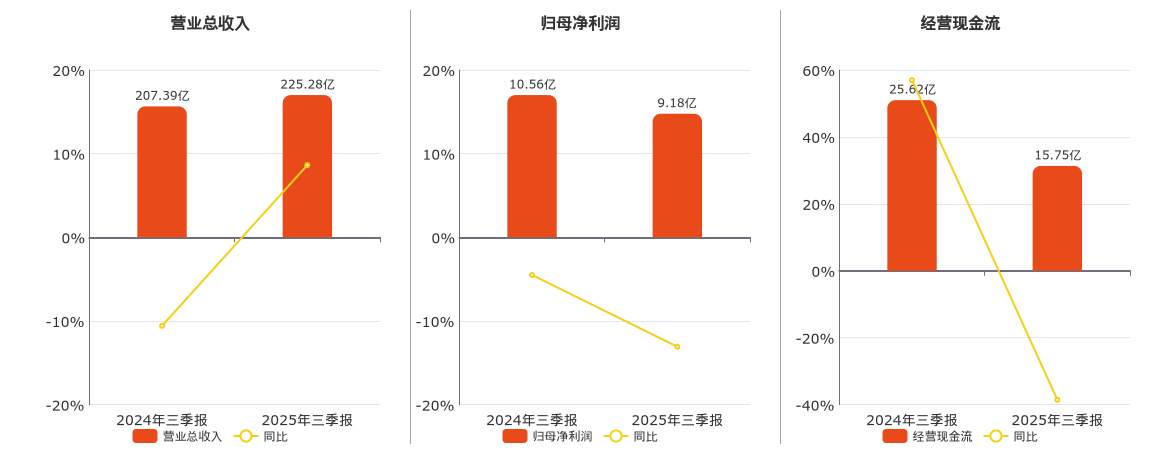
深圳燃气(601139.SH):2025年三季报净利润为9.18亿元、同比较去年同期下降13.08%
Xin Lang Cai Jing· 2025-10-29 01:28
Core Insights - Shenzhen Gas (601139.SH) reported a total operating revenue of 22.528 billion yuan for Q3 2025, an increase of 1.789 billion yuan compared to the same period last year, representing a year-on-year growth of 8.63% [1] - The company's net profit attributable to shareholders was 0.918 billion yuan, a decrease of 0.138 billion yuan from the same period last year, reflecting a year-on-year decline of 13.08% [1] - Operating cash flow showed a net inflow of 1.575 billion yuan, down by 0.988 billion yuan compared to the same period last year, marking a year-on-year decrease of 38.55% [1] Financial Ratios - The latest debt-to-asset ratio stands at 59.94%, a decrease of 0.34 percentage points from the previous quarter, but an increase of 0.27 percentage points compared to the same period last year [3] - The gross profit margin is reported at 15.40%, up by 1.55 percentage points from the previous quarter, but down by 0.92 percentage points year-on-year [3] - Return on equity (ROE) is at 5.73%, a decrease of 1.23 percentage points compared to the same period last year [3] Earnings Per Share and Turnover Ratios - The diluted earnings per share (EPS) is 0.32 yuan, down by 0.05 yuan from the same period last year, reflecting a year-on-year decline of 13.51% [3] - The total asset turnover ratio is 0.49 times, an increase of 0.02 times compared to the same period last year, representing a year-on-year growth of 4.59% [3] - The inventory turnover ratio is reported at 19.82 times, an increase of 8.75 times year-on-year, achieving two consecutive years of growth, with a year-on-year increase of 79.06% [3] Shareholder Structure - The number of shareholders is 48,600, with the top ten shareholders holding a total of 2.376 billion shares, accounting for 82.59% of the total share capital [3] - The largest shareholder is the State-owned Assets Supervision and Administration Commission of Shenzhen, holding 40.1% of shares [3]