Bank Of Shanghai(601229)

Search documents
银行股表现活跃 上海银行涨超2%
Shang Hai Zheng Quan Bao· 2025-11-04 02:46
Core Viewpoint - Bank stocks showed active performance on November 4, with several banks experiencing notable gains [1] Group 1: Stock Performance - Shanghai Bank rose over 2% by 9:53 AM [1] - Other banks such as CITIC Bank, Chongqing Bank, Agricultural Bank, China Merchants Bank, and Qilu Bank increased by more than 1% [1]



银行股持续走高 厦门银行涨超5%
Di Yi Cai Jing· 2025-11-04 02:42
Core Viewpoint - Xiamen Bank's stock price increased by over 5%, while other banks such as CITIC Bank, Shanghai Bank, Chongqing Bank, Industrial Bank, China Merchants Bank, Postal Savings Bank, Industrial and Commercial Bank of China, and Agricultural Bank of China saw their stock prices rise by over 2% [1] Group 1 - Xiamen Bank experienced a significant stock price increase of more than 5% [1] - Several major banks, including CITIC Bank and Shanghai Bank, reported stock price increases exceeding 2% [1] - The overall positive trend in stock prices indicates a favorable market sentiment towards these banks [1]

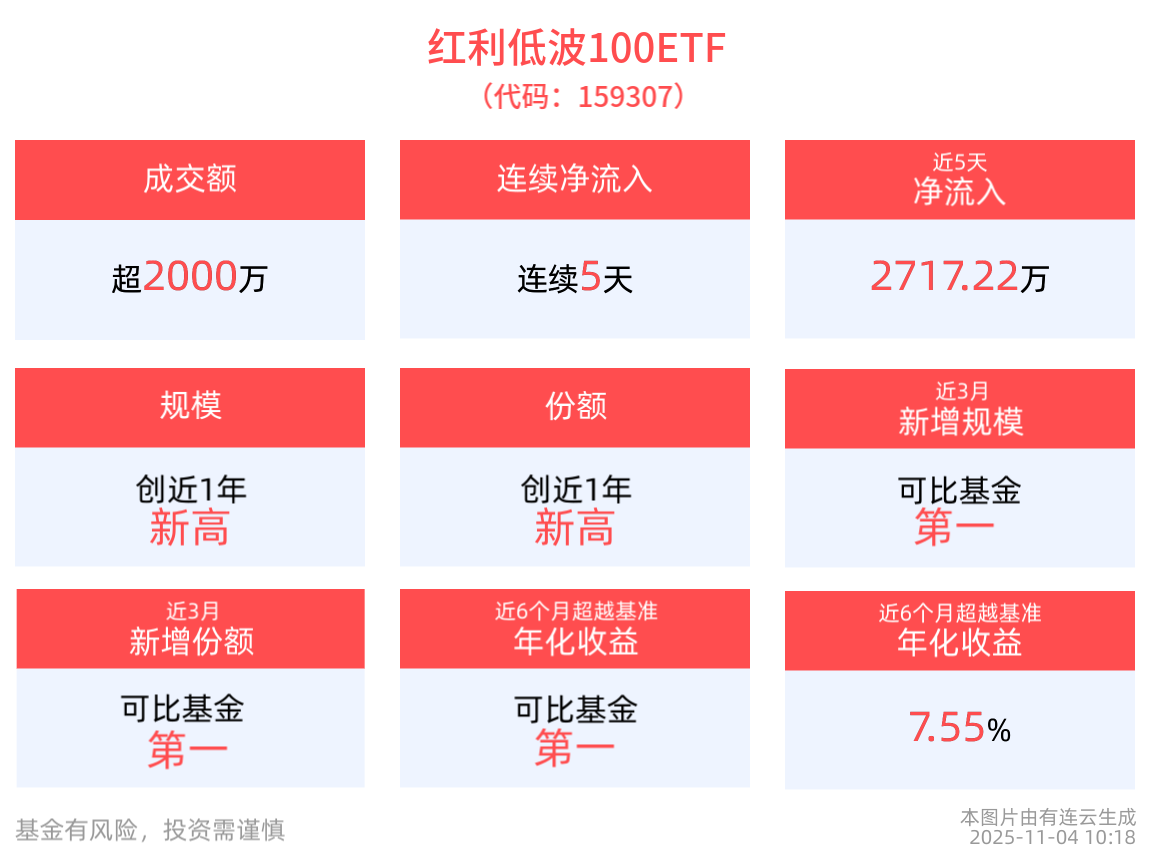
银行板块震荡走强,红利低波100ETF(159307)早盘稳步上行,机构:银行板块聚焦红利与复苏双主线
Xin Lang Cai Jing· 2025-11-04 02:36
Core Insights - The article discusses the performance and outlook of the Zhongzheng Dividend Low Volatility 100 Index and its associated ETF, highlighting recent gains and market dynamics [3][4][5]. Market Performance - As of November 4, 2025, the Zhongzheng Dividend Low Volatility 100 Index increased by 0.47%, with notable gains from stocks such as Fujian Expressway (+6.98%) and Xiamen International Trade (+3.73%) [3]. - The Dividend Low Volatility 100 ETF (159307) rose by 0.55%, reaching a latest price of 1.1 yuan, and has seen a cumulative increase of 0.27% over the past week [3]. Liquidity and Trading Activity - The ETF experienced a turnover rate of 1.61% during the trading session, with a total transaction volume of 24.14 million yuan [3]. - Over the past month, the ETF has maintained an average daily trading volume of 21.73 million yuan, ranking it among the top two comparable funds [3]. Banking Sector Outlook - The banking sector is showing strength, with several banks, including Shanghai Bank and China CITIC Bank, seeing gains of over 2% [3]. - A report from Huatai Securities anticipates a supportive policy environment for the banking sector in 2026, predicting a stabilization of interest margins and a recovery in intermediary business income [4]. Fund Performance and Inflows - The Dividend Low Volatility 100 ETF has reached a new high in scale at 1.496 billion yuan and a new high in shares at 1.368 billion [4]. - The ETF has seen continuous net inflows over the past five days, with a peak single-day inflow of 14.15 million yuan, totaling 27.17 million yuan in net inflows [4]. Index Composition - The Zhongzheng Dividend Low Volatility 100 Index comprises 100 stocks characterized by high liquidity, consistent dividends, high dividend yields, and low volatility [5]. - As of October 31, 2025, the top ten weighted stocks in the index accounted for 18.15% of the total index weight, including companies like Jizhong Energy and Xiamen International Trade [5].



银行板块持续走强 厦门银行涨超5%
Zheng Quan Shi Bao Wang· 2025-11-04 02:32
Core Viewpoint - The banking sector is experiencing a strong upward trend, with several banks showing significant stock price increases [1] Group 1: Stock Performance - Xiamen Bank has seen its stock price rise by over 5% [1] - Other banks including CITIC Bank, Chongqing Bank, Shanghai Bank, Industrial Bank, China Merchants Bank, Postal Savings Bank, Agricultural Bank, Industrial and Commercial Bank, and Jiangyin Bank have all increased by over 2% [1]
银行ETF指数(512730)涨超1%,上市银行营收开始企稳
Xin Lang Cai Jing· 2025-11-04 02:28
Core Insights - The banking sector in China shows signs of stabilization in operating income after two years of decline, with a slight increase of 0.9% year-on-year in the first three quarters of 2023, totaling 4.32 trillion yuan [1] - Net profit for the 42 listed banks in China reached 1.68 trillion yuan in the same period, reflecting a growth of 1.5% compared to the previous year, outpacing revenue growth by 0.6 percentage points [1] - The current low valuation of the banking sector, combined with attractive dividend yields compared to bonds and wealth management products, suggests potential for increased investment in the sector [1] Banking Index Performance - The China Securities Banking Index (399986) rose by 1.14%, with significant gains from constituent stocks such as Shanghai Bank (up 2.48%) and CITIC Bank (up 1.91%) [1] - The Banking ETF Index (512730) also increased by 1.01%, closing at 1.7 yuan [1] Dividend and Market Sentiment - The concentrated dividend distribution period for banks has largely concluded since July, leading to a shift in market sentiment and increased risk appetite among investors [1] - The ongoing dividend distribution from banks remains robust, enhancing the attractiveness of bank stocks as a viable investment option [1] Index Composition - As of October 31, 2025, the top ten weighted stocks in the China Securities Banking Index account for 64.87% of the index, with major players including China Merchants Bank and Industrial and Commercial Bank of China [2]

银行25Q3综述:韧性好于预期
HTSC· 2025-11-04 02:19
Investment Rating - The report maintains an "Overweight" rating for the banking sector [2] Core Viewpoints - The banking sector shows resilience better than expected, with a focus on strong fundamentals and quality dividends driving core profit improvement [6][15] - The annualized non-performing loan generation rate for listed banks is 0.55%, down 13 basis points from Q2 2025, indicating a marginal decline in non-performing loan generation across all types of banks [6] - The report suggests focusing on two main directions for investment: high-quality fundamentals that may recover valuation premiums as market risk appetite increases, and stable high-dividend stocks [6][15] Summary by Sections Operating Overview - In the first nine months of 2025, listed banks' revenue and net profit grew by 0.9% and 1.5% year-on-year, respectively, with revenue growth slightly declining due to bond market volatility affecting non-interest income [15][24] - The net interest margin for listed banks was 1.41%, remaining stable compared to the first half of 2025, driven by a continuous decline in funding costs [15][25] Profitability Breakdown - The net interest income of listed banks decreased by 0.6% year-on-year, but various types of banks showed improvement in net interest income, particularly city commercial banks [25] - Non-interest income from wealth management and commission fees increased by 4.6% year-on-year, reflecting a recovery in capital markets [16][25] Asset and Liability Insights - Total assets and liabilities of listed banks grew by 9.3% year-on-year, maintaining steady expansion [17] - Loan growth remained stable, with a year-on-year increase of 7.8%, while deposits grew by 7.8%, indicating a slight decline in deposit growth rate [10][17] Risk Perspective - The overall non-performing loan ratio for listed banks was stable at 1.23%, with a provision coverage ratio of 236%, indicating solid asset quality [11][15] Market Outlook - The report anticipates a gradual recovery in bank performance, with a focus on quality banks that exhibit strong resilience [6][15]



银行股全线上涨
第一财经· 2025-11-04 02:16
Core Viewpoint - The banking sector continues to show positive momentum, with several banks experiencing significant stock price increases on November 4th, indicating a bullish trend in the market [1]. Group 1: Stock Performance - Shanghai Bank, CITIC Bank, Industrial Bank, China Merchants Bank, Xiamen Bank, and Postal Savings Bank all saw stock price increases of over 2% [1]. - Specific stock performance data includes: - CITIC Bank: +2.29%, current price 8.04 [2] - Industrial Bank: +2.24%, current price 21.02 [2] - Shanghai Bank: +2.27%, current price 9.90 [2] - China Merchants Bank: +2.23%, current price 42.72 [2] - Xiamen Bank: +2.11%, current price 7.25 [2] - Postal Savings Bank: +2.08%, current price 5.90 [2] - Other banks also showed positive performance, with Agricultural Bank up by 1.87% and Industrial and Commercial Bank up by 1.65% [2].



银行板块震荡走强 上海银行等涨超2%
Zheng Quan Shi Bao Wang· 2025-11-04 02:07
Core Viewpoint - The banking sector has shown a strong upward trend, with several banks experiencing significant stock price increases [1] Group 1: Stock Performance - Shanghai Bank, China Merchants Bank, and CITIC Bank have all risen by over 2% [1] - Xiamen Bank, Postal Savings Bank, and Agricultural Bank have also seen increases of over 1% [1]
上海银行涨2.07%,成交额2.51亿元,主力资金净流入1780.52万元
Xin Lang Cai Jing· 2025-11-04 02:02
Core Viewpoint - Shanghai Bank's stock has shown a positive trend with a year-to-date increase of 14.48%, reflecting strong market interest and performance [1][2]. Group 1: Stock Performance - On November 4, Shanghai Bank's stock rose by 2.07%, reaching a price of 9.88 CNY per share, with a trading volume of 251 million CNY and a turnover rate of 0.18% [1]. - The stock's market capitalization stands at 140.385 billion CNY [1]. - The stock has increased by 2.92% over the last five trading days and 13.43% over the last 20 days, while it has decreased by 1.00% over the last 60 days [1]. Group 2: Financial Performance - As of September 30, 2025, Shanghai Bank reported a net profit attributable to shareholders of 18.075 billion CNY, marking a year-on-year growth of 2.77% [2]. - The bank has distributed a total of 52.454 billion CNY in dividends since its A-share listing, with 23.584 billion CNY distributed over the past three years [2]. Group 3: Shareholder Information - The number of shareholders for Shanghai Bank reached 114,900 as of September 30, 2025, an increase of 17.26% from the previous period [2]. - The average number of circulating shares per shareholder is 123,644, which represents a decrease of 14.72% from the previous period [2]. - Hong Kong Central Clearing Limited is the seventh largest circulating shareholder, holding 537 million shares, a decrease of 113 million shares from the previous period [2]. Group 4: Business Overview - Shanghai Bank, established on January 30, 1996, primarily engages in corporate finance, retail finance, and funding operations, with wholesale financial services accounting for 77.82% of its revenue [1]. - The bank is categorized under the city commercial bank sector and is part of various investment concepts, including undervalued stocks and low price-to-earnings ratios [1].
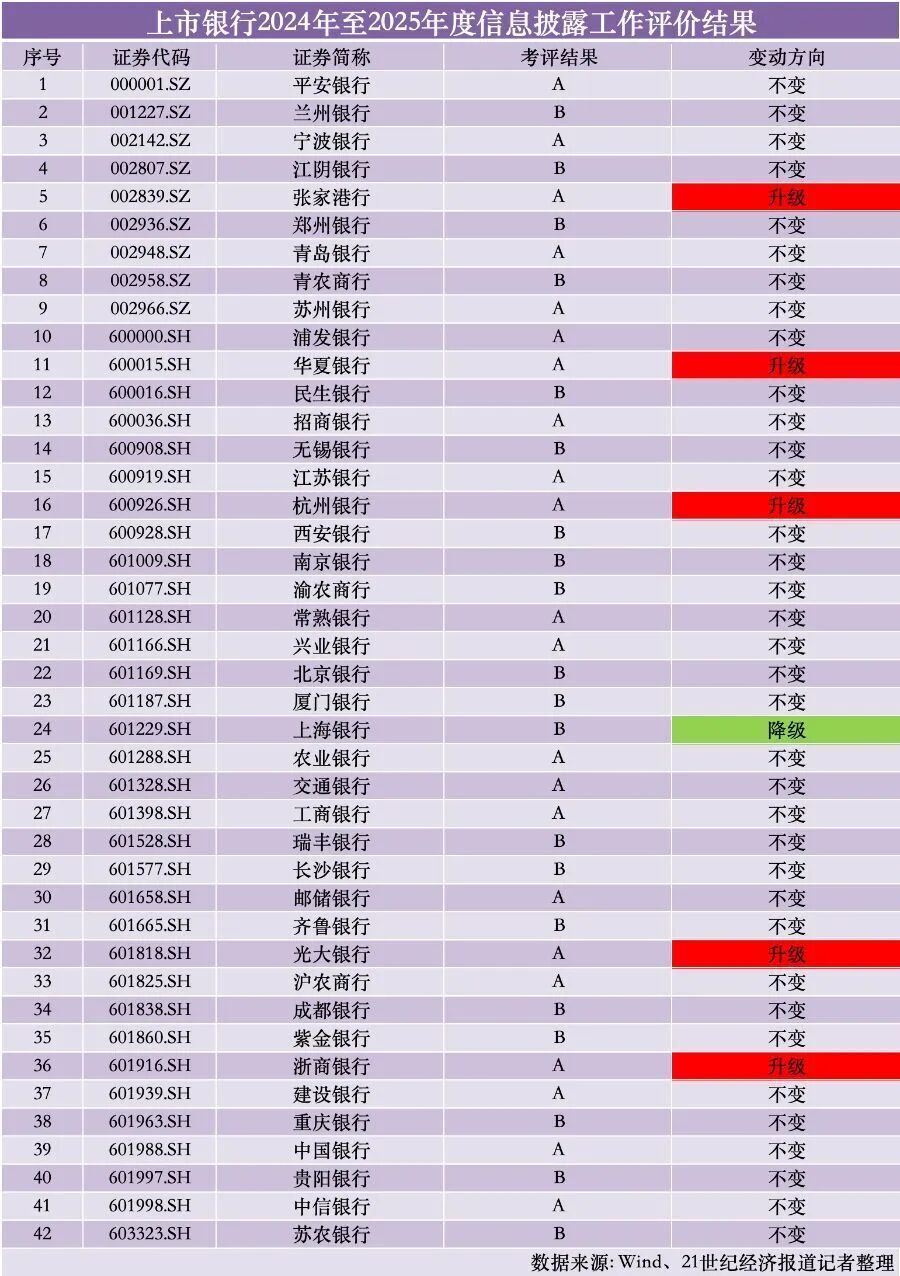
42上市银行信披考评出炉:5家升级1家降级
2 1 Shi Ji Jing Ji Bao Dao· 2025-11-03 12:08
Core Viewpoint - The quality of information disclosure is a crucial indicator of the quality of listed companies and serves as an important basis for investors' decision-making. The Shanghai and Shenzhen Stock Exchanges have emphasized the importance of this quality and have set higher requirements for listed companies in their recent evaluation guidelines [1][3]. Summary by Sections Information Disclosure Evaluation - In 2024-2025, 42 A-share listed banks received ratings of B or above for their information disclosure, with 22 banks rated A. The ratings remained consistent with the previous year for most banks, with only six experiencing changes [1][2][6]. Evaluation Criteria - The evaluation of information disclosure quality includes eight main aspects: compliance, effectiveness, investor relations management, return to investors, social responsibility disclosure, penalties and regulatory measures, support for exchange operations, and other factors recognized by the exchange [3][5]. Impact on Financing and Mergers - The evaluation results are considered in the review of refinancing and mergers and acquisitions. Companies rated A will receive various supports, such as exemptions from post-review for certain disclosures and prioritized training opportunities [6][7]. Bank Responses and Commitments - Several banks, including Hangzhou Bank and Citic Bank, have publicly committed to enhancing their information disclosure quality following their A ratings. They emphasize transparency, effective communication, and adherence to regulations as key components of their strategies [9][10][11].