Bank Of Shanghai(601229)

Search documents
冲刺!前三季长三角头部城商行营收、净利润双增,前三甲洗牌
Nan Fang Du Shi Bao· 2025-11-03 11:44
Core Viewpoint - The performance of the five major city commercial banks listed in the A-share market in the Yangtze River Delta region shows significant differentiation in growth rates, business structures, and asset quality as of the third quarter of 2025. Asset Scale - As of September 30, 2025, Jiangsu Bank leads with total assets of 4.93 trillion yuan, a year-on-year growth of 27.8% [2] - Ningbo Bank's total assets surpassed 3.5 trillion yuan for the first time, ranking second among city commercial banks [2] - Shanghai Bank continues to lag with a year-on-year asset growth of only 2% [2][13] Revenue and Profit - All five banks achieved year-on-year growth in both revenue and net profit in the first three quarters of 2025 [3] - Jiangsu Bank (67.18 billion yuan), Ningbo Bank (54.98 billion yuan), and Nanjing Bank (41.95 billion yuan) ranked in the top three for revenue [3][4] - Jiangsu Bank's net profit reached 31.9 billion yuan, leading the group with an 8.9% increase [4][5] Interest Income - Nanjing Bank reported a remarkable 28.5% year-on-year increase in net interest income, reaching 25.21 billion yuan [6][7] - Jiangsu Bank and Ningbo Bank also showed strong growth in net interest income, with increases of 19.6% and 11.8%, respectively [8] Non-Interest Income - In the first three quarters of 2025, Ningbo Bank's fee and commission income grew by 29.3% to 4.85 billion yuan, surpassing Jiangsu Bank [9] - Shanghai Bank experienced a decline in non-interest income, with a 6.9% drop [9] Financial Investment Performance - Shanghai Bank's investment income increased by 58.5% to 16.78 billion yuan, the highest among the five banks, with investment income accounting for 40.77% of its revenue [10][11] - All banks faced losses in fair value changes, with Shanghai Bank reporting the highest loss of 3.26 billion yuan [10] Asset Quality - As of September 30, 2025, the non-performing loan ratio for Jiangsu Bank, Ningbo Bank, and Nanjing Bank remained stable between 0.76% and 0.84% [14][15] - Jiangsu Bank's non-performing loan ratio decreased by 0.05 percentage points compared to the end of the previous year [14] Capital Adequacy - Jiangsu Bank's core Tier 1 capital adequacy ratio fell to 8.61%, the lowest among the five banks, and is less than one percentage point above the regulatory line [16] - Shanghai Bank maintained the highest core Tier 1 capital adequacy ratio at 10.52%, showing a slight increase [16]







上市银行信披考评出炉:光大、华夏、浙商提级,上海银行降级
2 1 Shi Ji Jing Ji Bao Dao· 2025-11-03 10:57
Core Viewpoint - The quality of information disclosure is a crucial indicator of the quality of listed companies and serves as an important basis for investors' decision-making. The Shanghai and Shenzhen Stock Exchanges have emphasized the importance of information disclosure quality and have implemented comprehensive evaluations of listed companies' disclosure practices [1][3]. Group 1: Regulatory Framework - In March, the Shanghai and Shenzhen Stock Exchanges released guidelines focusing on enhancing information disclosure regulation, punishing financial fraud, strengthening cash dividend supervision, and promoting the enhancement of investment value for listed companies [1][3]. - The evaluation criteria for information disclosure quality include eight aspects: normative disclosure, effective disclosure, investor relations management, return to investors, social responsibility disclosure, penalties and regulatory measures, support for exchange work, and other factors recognized by the exchange [3][5]. Group 2: Evaluation Results - Among the 42 A-share listed banks, all received ratings of B or above, with 22 banks rated A. Most banks maintained their ratings from the previous year, with only six experiencing changes [3][6]. - The banks rated A include major state-owned banks such as Industrial and Commercial Bank of China, Agricultural Bank of China, and China Bank, as well as several joint-stock and city commercial banks [6][7]. Group 3: Impact on Capital Activities - The evaluation results of information disclosure will influence the review of refinancing and mergers and acquisitions for listed banks, establishing a strong market incentive and constraint mechanism [5][8]. - Both the Shanghai and Shenzhen Stock Exchanges provide various supports and conveniences for companies rated A, such as exemptions from post-review for temporary reports and reduced inquiry rounds for restructuring audits [8][9]. Group 4: Commitment to Improvement - Several banks, including Hangzhou Bank and China CITIC Bank, have publicly committed to further enhancing their information disclosure quality following their A ratings, emphasizing transparency, effective communication, and governance [10][11]. - China CITIC Bank has highlighted its commitment to investor rights protection, having distributed over RMB 170 billion in cash dividends and planning to increase its mid-term dividend payout ratio [11].





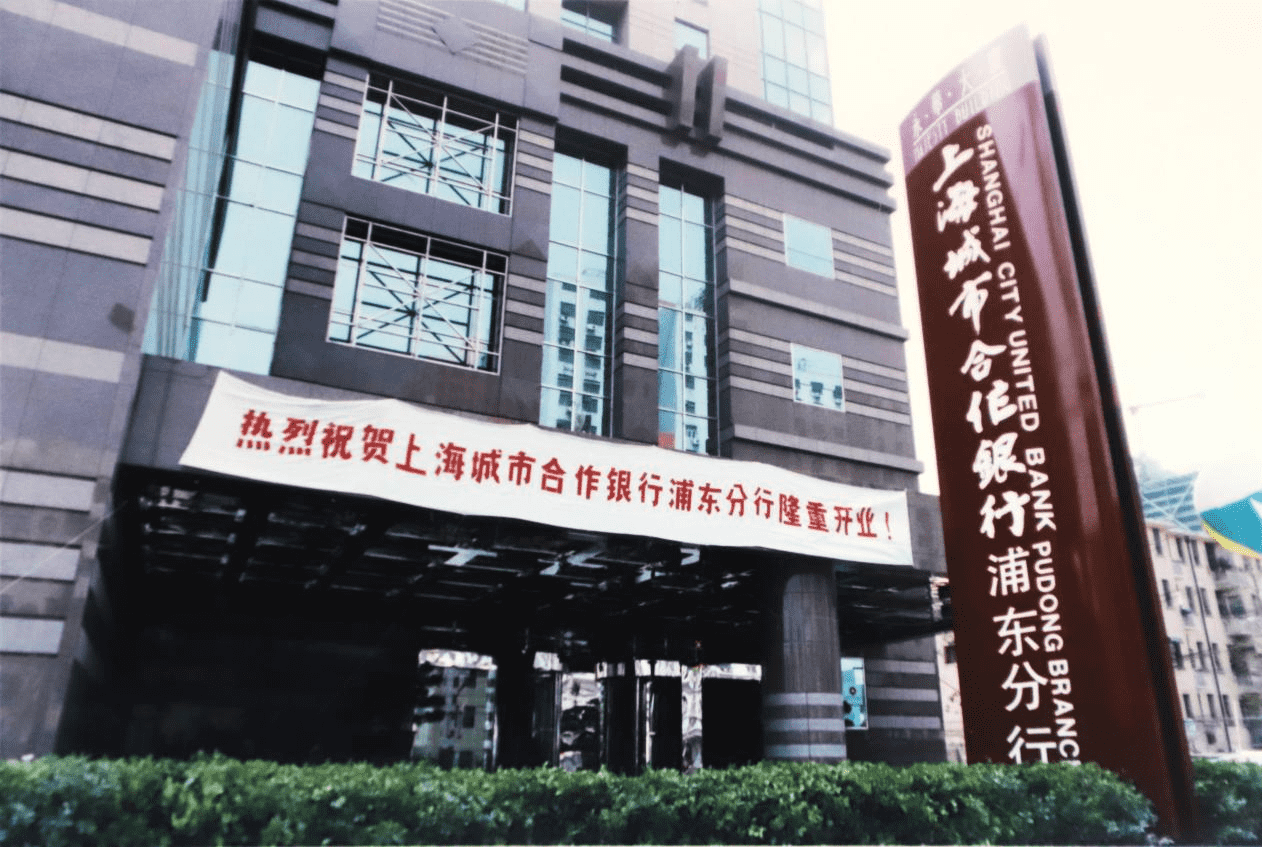
口述历史·上银30年 | 争当金融先行者 勇立浦东潮头尖 —— 记上海城市合作银行浦东分行的“创业印象”
Zhong Guo Jin Rong Xin Xi Wang· 2025-11-03 10:19
Core Insights - The establishment of the Pudong New Area in April 1990 marked a significant shift in Shanghai's urban development strategy, transitioning from a "follower" to a "leader" in China's reform and opening-up efforts [1] - The Shanghai Urban Cooperative Bank's Pudong branch was established in response to the call for financial leadership in the Pudong development initiative, showcasing a proactive approach to integrate into the rapid development of the area [1][3] Group 1: Development and Strategy - The Pudong branch was created with a tailored "New Area Policy" to adapt to the fast-paced reforms, providing flexibility in employee recruitment, financial accounting, and branch establishment [3] - The branch's rapid establishment, just over 100 days after the bank's founding, exemplified the "Pudong speed" in financial service development [4] Group 2: Talent and Innovation - The bank focused on recruiting energetic recent graduates from top universities, fostering a new generation of banking professionals through mentorship programs [3][7] - Training programs were implemented to enhance staff skills, including weekly sessions on business skills and basic competencies, which contributed to a professional and cohesive team [7] Group 3: Operational Achievements - Within 40 days of operation, the Pudong branch achieved a successful launch, and by its first anniversary, it had provided over 1.3 billion yuan in loans for key projects in the Pudong area [11] - The branch actively supported major projects such as the Lujiazui Financial Trade Development Company and the Pudong Airport, aligning its services with the local government's development initiatives [8][11] Group 4: Future Outlook - The Shanghai Urban Cooperative Bank aims to continue its role as a financial pioneer, aligning with national strategies and urban development to create innovative financial solutions [11]

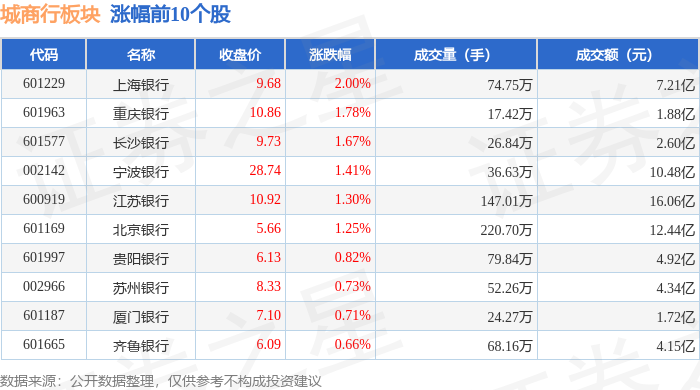
城商行板块11月3日涨1.08%,上海银行领涨,主力资金净流入2.8亿元
Zheng Xing Xing Ye Ri Bao· 2025-11-03 08:43
Market Performance - The city commercial bank sector increased by 1.08% on November 3, with Shanghai Bank leading the gains [1] - The Shanghai Composite Index closed at 3976.52, up 0.55%, while the Shenzhen Component Index closed at 13404.06, up 0.19% [1] Individual Stock Performance - Shanghai Bank (601229) closed at 9.68, up 2.00% with a trading volume of 747,500 shares and a transaction value of 721 million [1] - Chongqing Bank (601963) closed at 10.86, up 1.78% with a trading volume of 174,200 shares [1] - Other notable performers include: - Changsha Bank (601577) at 9.73, up 1.67% - Ningbo Bank (002142) at 28.74, up 1.41% - Jiangsu Bank (616009) at 10.92, up 1.30% [1] Capital Flow Analysis - The city commercial bank sector saw a net inflow of 280 million from institutional investors, while retail investors experienced a net outflow of 18.1 million [2] - The main capital flow for individual stocks includes: - Beijing Bank (601169) with a net inflow of 85.45 million from institutional investors [3] - Chengdu Bank (601838) with a net inflow of 78.77 million from institutional investors [3] - Jiangsu Bank (601009) with a net inflow of 28.60 million from institutional investors [3]

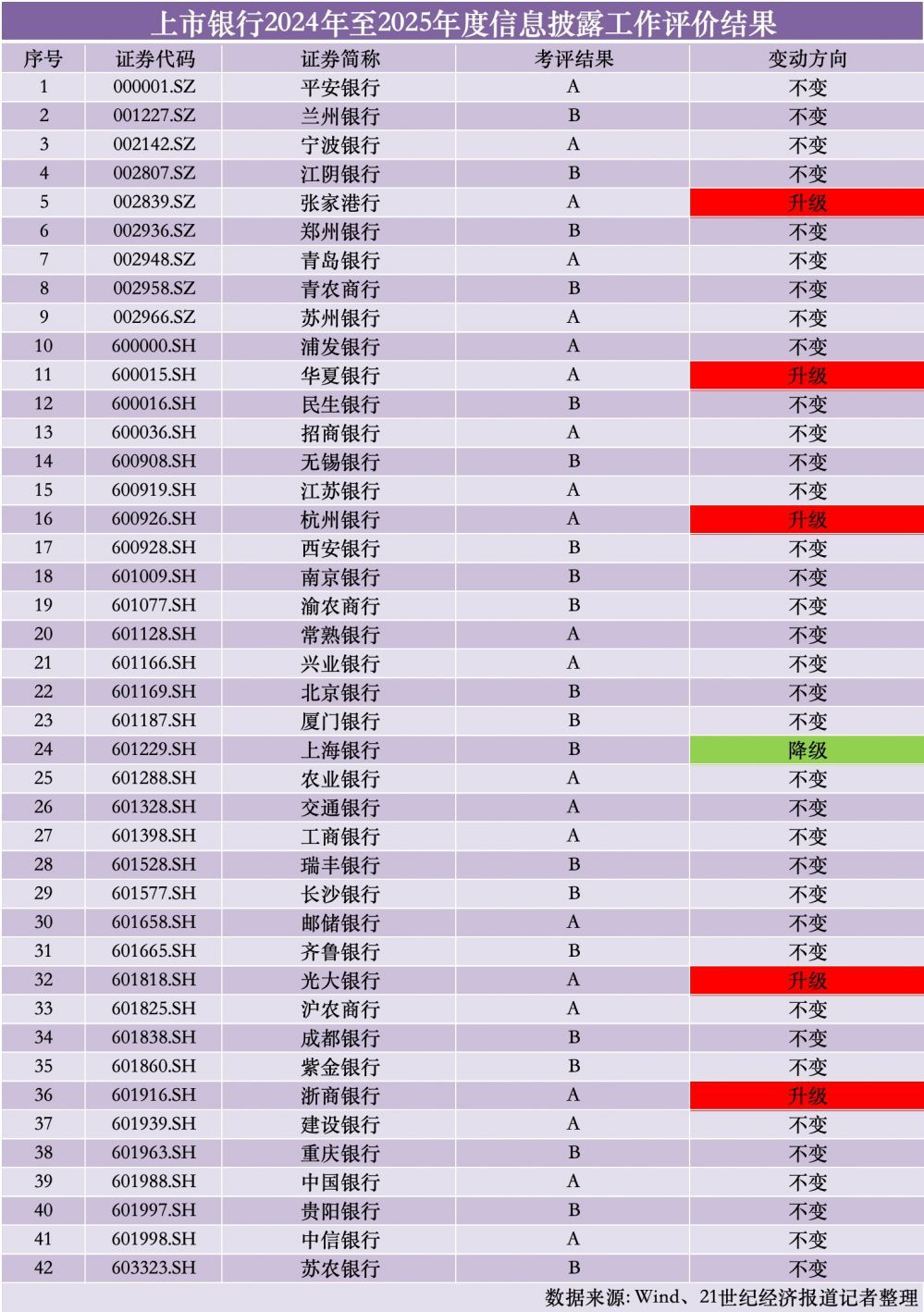
42家上市银行信披考评出炉:22家获A,光大、华夏和浙商银行提级
2 1 Shi Ji Jing Ji Bao Dao· 2025-11-03 08:21
Core Insights - The recent disclosure evaluation results for listed banks in China for the 2024-2025 period show that all listed banks received ratings of B or above, with 22 banks rated A, indicating a strong performance in information disclosure [1] Summary by Category Overall Ratings - All listed banks achieved a rating of B or higher, with 22 banks rated A, reflecting consistent performance compared to the previous year [1] - Only six banks experienced rating changes, with five banks improving their ratings and one bank, Shanghai Bank, experiencing a downgrade [1] Banks with Rating Changes - The following banks improved their ratings: - Zhangjiagang Bank - Hangzhou Bank - Huaxia Bank - Everbright Bank - Zhejiang Commercial Bank [1] - Shanghai Bank was the only bank to see a downgrade in its rating [1] Detailed Ratings - A selection of banks and their ratings includes: - Ping An Bank: A - Ningbo Bank: A - Agricultural Bank of China: A - Industrial and Commercial Bank of China: A - Shanghai Bank: B (downgraded) [2]



浙商证券:25Q3银行营收利润增速韧性强 Q4有望深蹲起跳
智通财经网· 2025-11-03 06:19
Core Viewpoint - The performance of listed banks in Q1-Q3 2025 slightly exceeded expectations, with revenue growth remaining stable and profit growth showing a slight increase [1][2] Performance Overview - Listed banks' revenue growth year-on-year is stable at 0.9%, while profit growth has increased to 1.6%. The weighted revenue and net profit attributable to shareholders increased by 0.9% and 1.6% respectively, with a slight slowdown in growth compared to H1 2025 [2][3] - Large banks showed a comprehensive performance turnaround, while the performance of small and medium-sized banks was mixed. Agricultural Bank, Bank of Communications, China Bank, and Industrial Bank performed better than expected, while China Construction Bank experienced a significant decline in quarterly interest margin [2][3] Driving Factors - Asset scale growth for listed banks in Q1-Q3 2025 was 9.3%, a slowdown of 0.3 percentage points compared to H1 2025. Loan growth decreased while financial investment growth increased [3] - The interest margin stabilized in Q3 2025, with a slight increase of 0.3 basis points to 1.37%. The asset yield decreased by 7 basis points to 2.81%, while the cost of liabilities decreased by 8 basis points to 1.56% [4] Non-Interest Income - Non-interest income for listed banks grew by 5.0% year-on-year, but the growth rate decreased by 2.0 percentage points compared to the previous quarter. Fee and commission income increased by 4.6% year-on-year, indicating some recovery in related business [5][6] - Bond trading income decreased by 0.6% year-on-year, with small and medium-sized banks experiencing a larger decline compared to state-owned banks [5][6] Asset Quality - The average non-performing loan (NPL) ratio remained stable at 1.23%, while the average attention rate increased by 2 basis points to 1.69%. The retail sector continues to face pressure, particularly in small and micro loans [7][8] - The number of banks announcing mid-term dividends has increased, with some banks raising their mid-term dividend rates compared to the previous year [9] Recommended Stocks - Recommended stocks include Shanghai Pudong Development Bank, Nanjing Bank, Shanghai Bank, Jiangsu Bank, Agricultural Bank, and Bank of Communications, with a focus on Qilu Bank and H-share large banks [9]

唯一城商行!上海银行获批“北向互换通”报价资质跨境做市实现全领域覆盖
Xin Lang Cai Jing· 2025-11-03 06:05
依托银行间市场核心交易商与做市商的深厚积淀,上海银行已完成跨境金融市场做市全布局。从2017年成为首批债券通"北向通"做市商,到2021年获批"南向通"交易资质,2024年拿下CNH外 恰逢即将迎来30周年行庆的重要节点,上海银行称此次实现跨境做市全领域覆盖,更具里程碑意义。展望未来,该行表示,将充分释放五大跨境业务资质协同优势,以总行核心FICC交易台、离 同时,上海银行将持续发挥扎根上海国际金融中心的地缘优势,助力提升"上海价格"国际影响力,为我国金融市场高水平对外开放与人民币国际化稳健推进注入"上银力量",为构建多层次金融 责任编辑:曹睿潼 记者自上海银行获悉,近日,在人民银行指导及外汇交易中心、上海清算所支持下,上海银行获批利率互换"北向互换通"报价商资质,成为国内唯一获此资质的城市商业银行。 ...
基金三季报:转债持仓占比进一步提升
Changjiang Securities· 2025-11-03 04:45
Report Overview - The report analyzes the convertible bond holdings of public funds in Q3 2025, including scale, industry and style preferences, and factor performance [1][9] 1. Report Industry Investment Rating - Not provided in the report 2. Report's Core View - As of Q3 2025, public funds held convertible bonds worth 303.8 billion yuan, with the market value ratio increasing to 38.94%. Funds prefer convertible bonds with low BS pricing premium, high conversion value, large balance, and low conversion premium ratio. Factors such as maturity, implied volatility, and pure bond value have performed well this year [1][9] 3. Summary by Relevant Catalog 3.1 Publicly - Held Convertible Bond Scale - As of Q3 2025, 1581 public funds held convertible bonds, with a total scale of 303.8 billion yuan, accounting for 38.94% of the total convertible bond market value [9][13] 3.2 Convertible Bond Funds and Heavy - Held Convertible Bonds - Funds with large convertible bond holdings in Q3 2025 include Boshi CSI Convertible and Exchangeable Bond ETF, Haifutong Shanghai Stock Exchange Investment - Grade Convertible and Exchangeable Bond ETF, etc., all with holdings over 7 billion yuan. Funds with a high proportion of convertible bonds include Huashang Convertible Bond Selection A, Rongtong Convertible Bond A, etc., all with a proportion over 105% [15] 3.3 Convertible Bond Holding Industry Distribution - In terms of market value, the banking, power equipment and new energy, basic chemicals, and electronics industries have the largest holdings, all over 20 billion yuan. The banking industry accounts for 19%. Power equipment and new energy, banking, and basic chemicals are over - allocated, while power and utilities, non - banking, and construction are under - allocated [9][20] 3.4 Convertible Bond Holding Style Distribution - 21 style factors are constructed from four aspects: convertible bond valuation, underlying stock, trading, and terms. The market's funds prefer convertible bonds with low BS pricing premium, high conversion value, large scale, and low conversion premium ratio [22][27] 3.5 Convertible Bond Holding Factor Performance - From December 31, 2024, to October 29, 2025, factors such as maturity, implied volatility, implied volatility premium for 1 year, pure bond value, and peak factor have performed relatively well, with information ratios above 1.7 [29][30]


89家公司年内分红金额超10亿元,300红利低波ETF(515300)红盘蓄势,机构:红利板块或仍有演绎配置机会
Xin Lang Cai Jing· 2025-11-03 02:56
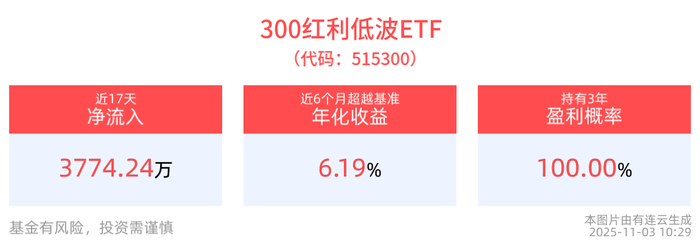
Core Insights - The CSI 300 Dividend Low Volatility Index has shown a positive performance with a 0.58% increase, driven by significant gains in stocks such as Baosteel and China Construction Bank [1][4] - The CSI 300 Dividend Low Volatility ETF (515300) has also increased by 0.45%, indicating strong investor interest and market activity [1][3] Market Performance - The CSI 300 Dividend Low Volatility ETF recorded a turnover rate of 0.92% with a transaction volume of 43.38 million yuan, reflecting active trading [3] - The ETF's latest scale reached 4.704 billion yuan, with a net inflow of 37.74 million yuan over the past 17 trading days, indicating a positive trend in investor sentiment [3] Dividend Distribution - As of October 31, 2025, a total of 1,033 listed companies have announced cash dividend plans, an increase of 141 companies compared to the previous year, with total cash dividends amounting to 734.9 billion yuan [3] - Notably, 89 companies have declared dividends exceeding 1 billion yuan within the year [3] Investor Sentiment - Market sentiment indicators have returned to a neutral zone, but there remains a willingness among investors to "buy the dip," suggesting that adjustments may present further investment opportunities [4] - The top ten weighted stocks in the CSI 300 Dividend Low Volatility Index account for 35.78% of the index, with companies like China Shenhua and Shuanghui Development leading the way [4][6] Stock Performance - The top performing stocks within the index include China Shenhua (up 1.93%), Shuanghui Development (up 1.59%), and China Petroleum (up 1.65%), while some stocks like Gree Electric and Huayu Automotive experienced declines [6] - Investors without stock accounts can access investment opportunities through the corresponding CSI 300 Dividend Low Volatility ETF linked fund (007606) [6]





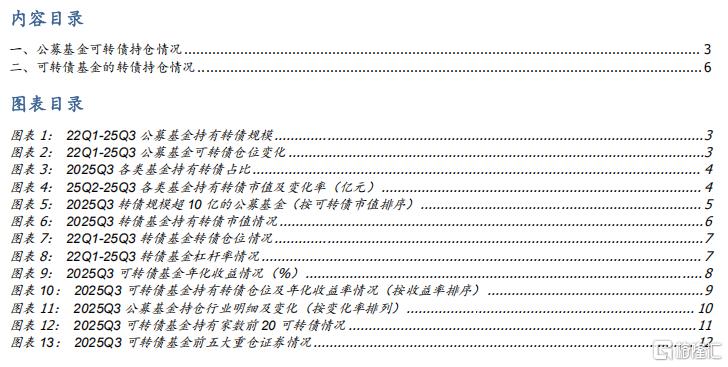
谁在增配转债,增配了哪些?
Ge Long Hui· 2025-11-03 00:15
Core Insights - The public funds held convertible bonds accounted for 55.34% of the total market value of convertible bonds as of Q3 2025, with a quarter-on-quarter increase of 12.93 percentage points, indicating a slight rise in positions by 0.09 percentage points [1][7] - Despite a decrease in the total balance of convertible bonds to 572.07 billion yuan, the proportion of convertible bonds held by institutions continues to increase [1][7] Group 1: Public Fund Holdings - As of Q3 2025, public funds held convertible bonds worth 316.57 billion yuan, representing 55.34% of the total market value, an increase of 12.93 percentage points from Q2 [1][14] - The number of public funds holding convertible bonds exceeded 2,009, with 61 funds holding over 1 billion yuan in convertible bonds, accounting for 69.46% of the total value of convertible bonds held by public funds [14][17] Group 2: Convertible Bond Fund Holdings - Convertible bond funds, totaling 40, held convertible bonds worth 121.21 billion yuan, a quarter-on-quarter increase of 42.2% [3][17] - The average position of convertible bond funds rose from 84.99% in Q2 to 87.17% in Q3, while the leverage ratio decreased from 142.08% to 135.17% [19][22] Group 3: Sector Performance - The fastest growth in public fund holdings of convertible bonds was observed in the oil and petrochemical sector, which increased by 59.14% quarter-on-quarter, followed by the electric power equipment sector with a 40.93% increase [4][26] - Significant increases were also noted in the beauty care, computer, steel, and communication sectors, while reductions were seen in the media, non-ferrous metals, social services, and household appliances sectors [4][26] Group 4: Fund Performance - The average annualized return of convertible bond funds in Q3 2025 was 67.31%, outperforming the average annualized return of the Zhongzheng Convertible Bond Index, which was 41.57% [22][24] - Notable performers included the Southern Changyuan Convertible Bond Fund with a return of 172.4% and the Huaxia Convertible Bond Enhanced Fund with a return of 160.4% [22][24]