
GAC GROUP(601238)

Search documents
京东:11月9日将发布一款新车
Zheng Quan Shi Bao Wang· 2025-10-14 08:26
Group 1 - JD.com announced a collaboration with GAC and CATL to launch a new car [1] - The official testing activities for the internal test version and public test version will begin at the end of October [1] - The official announcement of the new car is scheduled for November 9 [1]



京东宣布联合宁德时代、广汽推“国民好车”,双11开售
Xin Lang Ke Ji· 2025-10-14 07:13
Core Viewpoint - JD.com, in collaboration with CATL's Times Electric and GAC Group, is launching a new vehicle termed "National Good Car" during the JD 11.11 shopping festival, aiming to innovate in safety, battery technology, and consumer services [1] Group 1 - The vehicle will integrate JD.com's resources with GAC's manufacturing capabilities and CATL's battery technology and battery swap ecosystem [1] - The launch is set to occur during the JD 11.11 event, with exclusive sales through JD.com [1] - The initiative aims to create a new model for comprehensive automotive consumption, focusing on safety, battery and refueling, vehicle services, and pricing [1]
汽车股午后转跌 华晨中国跌超4% 瑞银称新能源免税门槛提高或不利市场情绪
Zhi Tong Cai Jing· 2025-10-14 05:55
Core Viewpoint - Automotive stocks experienced a significant rise in the morning but collectively turned negative in the afternoon, indicating volatility in market sentiment towards the sector [1] Group 1: Stock Performance - Brilliance China (01114) fell by 4.3%, trading at HKD 3.78 [1] - Great Wall Motors (601633) (02333) decreased by 2.75%, trading at HKD 15.54 [1] - GAC Group (601238) (02238) dropped by 1.86%, trading at HKD 3.17 [1] - Li Auto-W (02015) declined by 1.18%, trading at HKD 87.9 [1] Group 2: Policy and Market Sentiment - The Ministry of Industry and Information Technology and two other departments issued a notice regarding the exemption of vehicle purchase tax for new energy vehicles, with technical requirements set for 2026-2027 [1] - UBS reported that while most automakers should meet the new standards, the updated policies may appear stricter, negatively impacting market sentiment [1] - Despite potential policy headwinds in 2026, investors remain generally optimistic about new vehicle launches from individual companies [1] Group 3: Market Forecasts - The Secretary-General of the Passenger Car Association, Cui Dongshu, indicated that the association raised its annual market expectations in August and will further adjust forecasts after discussions in late October, with an upward revision expected for 2025 growth predictions [1] - Shenwan Hongyuan recently noted that as automotive subsidies are nearing their end and the exemption of purchase tax for new energy vehicles will conclude next year, vehicle purchase costs will significantly increase, potentially leading to a market rush in the fourth quarter [1]


俄罗斯又拖全球车市后腿了
Zhong Guo Qi Che Bao Wang· 2025-10-14 02:09
Group 1 - Global automotive markets, except for Russia, showed growth in September and the first three quarters of the year, driven by various factors such as electric vehicle (EV) subsidies in the US and tax reforms in India [2] - In the US, electric vehicle sales surged before the expiration of a $7,500 subsidy, with Q3 sales exceeding 438,000 units, marking a record quarter and a market share of 10.5% [3][4] - Major automakers in the US reported increased sales, with Ford's sales up 8.2%, General Motors up 8%, and Hyundai up 13%, largely driven by electric vehicle demand [4] Group 2 - In Europe, the automotive market saw a slight increase in passenger car sales, with a total of 8.69 million units sold from January to August, a 0.4% year-on-year growth [6] - Chinese automakers, particularly BYD and SAIC, have become significant players in the European market, with BYD's sales skyrocketing by 280% [7] - The UK experienced its highest new car sales in September since 2015, driven by strong electric vehicle performance and government subsidies [8] Group 3 - India's automotive market showed resilience with a total of 3.8 million new vehicles sold in the first three quarters, a 2.3% increase year-on-year, supported by tax reforms [9][10] - The new GST 2.0 tax structure in India has significantly improved the affordability of small cars, boosting consumer confidence and sales [10] - In Japan, new car sales reached 3.465 million units in the first nine months, a 5% increase, although the market faced challenges in the latter part of the year [11][12] Group 4 - Brazil's automotive market reported a 2.9% increase in September sales, with a total of 1.91 million vehicles sold in the first nine months, driven by strong export performance [13][14] - The Brazilian government plans to reintroduce tariffs on electric and hybrid vehicles starting in 2024, aiming to stimulate local production [15] - Russian automotive sales plummeted by 23% in the first nine months, with a significant decline in new car sales due to geopolitical factors and rising costs [16][17]


中国汽车-行业市场份额和利润分配的分散化可能持续至 2025 年第四季度-China Automobiles_ De-consolidation of industry market share and profit distribution likely to continue into 4Q25
2025-10-13 15:12
Summary of Conference Call Notes on the Automotive Industry Industry Overview - The automotive industry is experiencing a de-consolidation of market share and profit distribution, which is expected to continue into 4Q25 [1][2][18] - Domestic passenger vehicle (PV) demand is projected to slow down, with growth rates of +5% year-over-year (yoy) in 3Q25 and a decline of -9% yoy in 4Q25, compared to +11% yoy in 1H25 [1][2] Key Insights Market Dynamics - The capex expansion for auto original equipment manufacturers (OEMs) accelerated to +66% yoy in 2Q25, the highest growth rate since 3Q22, driven by a 13% growth in passenger vehicle production and a 14% increase in wholesale volume [2][9] - The Herfindahl-Hirschman Index (HHI) for domestic new energy vehicle (NEV) retail sales volume decreased to 1,218 in 8M25 from 1,479 in 8M24, indicating a more fragmented market [2] Financial Performance - The total OEM industry EBITDA declined by -1% yoy, with margins decreasing by -0.9 percentage points (pp) yoy. The top two profit-making OEMs saw a decline in EBITDA, while most others improved, suggesting a potential demand/supply imbalance [2][18] - Account payable days for the overall OEM industry shortened by 26 days quarter-over-quarter (qoq) and 5 days yoy, reflecting efforts to relieve suppliers' working capital pressure [2][16] Future Outlook - For 4Q25, expectations include: - Sequential growth in volume due to better seasonality and new model launches [4] - Potential widening of dealer discounts during the peak sales season [4] - Improvement in OEM margins sequentially, offsetting average selling price (ASP) pressure [4] - Gradual reduction in payable days and improved operating cash flow [4] Recent Trends - In 3Q25, market growth slowed due to a high base from the previous year and weaker-than-usual seasonality. NEV penetration increased to 56% from 50% in 1H25, while dealer discounts for NEVs widened [5][6] - The profit distribution among OEMs is becoming less concentrated, with industry leaders facing margin pressure while followers see margin improvements [6][18] Earnings Revisions - GAC's net profit estimates for 2H25/2026/2027 were lowered significantly due to continued market share loss, with a new target price of Rmb4.2, implying a downside of -45% [7] - SAIC's volume estimates were raised by up to 2% for 2H25-2027, but gross margins were lowered, maintaining a target price of Rmb8.8, implying a downside of -48% [7] - Huayu's EPS estimates were raised by 4%-6% due to better-than-expected customer diversification, with a target price increase to Rmb14.6, implying a downside of -29% [7] Additional Insights - The automotive industry is at a critical inflection point where many companies are nearing cash cost levels, indicating potential challenges in adding new capacity or maintaining profitability [19][20] - The overall industry is still above cash cost levels, but margin improvements are becoming increasingly difficult due to ongoing price competition and slowing volume growth [18][42] This summary encapsulates the key points from the conference call, highlighting the current state and future outlook of the automotive industry, along with specific financial performance metrics and earnings revisions for major players.




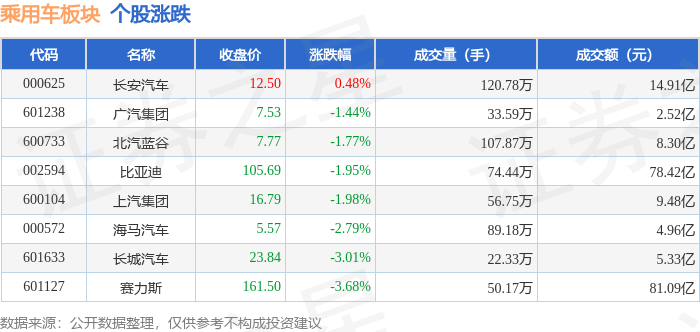
乘用车板块10月13日跌2.23%,赛力斯领跌,主力资金净流出25.79亿元
Zheng Xing Xing Ye Ri Bao· 2025-10-13 12:38
| 代码 | 名称 | 主力净流入(元) | 主力净占比 游资净流入 (元) | | 游资净占比 散户净流入 (元) | | 散户净占比 | | --- | --- | --- | --- | --- | --- | --- | --- | | 000625 长安汽车 | | 1.39亿 | 9.32% | -6276.59万 | -4.21% | -7623.45万 | -5.11% | | 601633 长城汽车 | | 869.50万 | 1.63% | -1432.68万 | -2.69% | 563.18万 | 1.06% | | 601238 广汽集团 | | -1711.84万 | -6.81% | 558.62万 | 2.22% | 1153.22万 | 4.59% | | 000572 海马汽车 | | -2191.08万 | -4.41% | 433.56万 | 0.87% | 1757.51万 | 3.54% | | 600733 北汽蓝谷 | | -6190.11万 | -7.46% | -1702.93万 | -2.05% | 7893.04万 | 9.51% | | 600104 ...




华为“车友圈”扩列,重塑中国汽车中场战事
2 1 Shi Ji Jing Ji Bao Dao· 2025-10-13 12:21
Core Insights - The collaboration between major Chinese automotive companies and Huawei marks a significant shift towards smart transformation in the automotive industry, with a focus on deep integration and co-creation of products [1][4][10] Group 1: Collaboration Models - Huawei's partnerships with automotive companies can be categorized into three main models: component supply, HI model (HUAWEI INSIDE), and the most integrated "Hongmeng Intelligent Travel" model, which involves deep collaboration across the product lifecycle [2][3] - The "HI Plus" model has emerged, allowing automotive companies to retain brand sovereignty while Huawei deeply integrates its technology throughout the product lifecycle [3] Group 2: Strategic Partnerships - Major state-owned automotive companies, including Dongfeng, GAC, and SAIC, are increasingly collaborating with Huawei, redefining the competitive landscape of the Chinese automotive industry [1][4] - Dongfeng's partnership with Huawei is central to its smart transformation strategy, contributing significantly to its electric vehicle sales [4][5] Group 3: Product Development and Innovation - Dongfeng's new project with Huawei, the DH project, emphasizes joint development and marketing, showcasing a collaborative approach to product innovation [3][6] - GAC's collaboration with Huawei has led to the launch of several smart vehicles, including the A800 sedan, which integrates Huawei's advanced driving and cockpit technologies [5][6] Group 4: Market Impact and Sales Performance - The collaboration has resulted in significant sales growth for companies like Lantu, which saw an 85% year-on-year increase in deliveries, highlighting the effectiveness of the partnerships [4][8] - The cumulative sales of vehicles developed in collaboration with Huawei have surpassed 3 million units, indicating a successful shift from isolated efforts to ecosystem collaboration [8] Group 5: Challenges and Cultural Integration - The partnerships face challenges related to resource allocation, cultural integration, and maintaining brand identity amidst deep collaboration [9][10] - Companies like Chery have experienced internal resource conflicts due to overlapping projects with Huawei, emphasizing the need for clear strategic alignment [9][10] Group 6: Future Outlook - The ongoing collaboration between state-owned automotive companies and Huawei is expected to evolve, focusing on balancing innovation with brand uniqueness and operational efficiency [10][11] - The competition in the automotive industry will increasingly hinge on finding optimal solutions between independent innovation and open collaboration [11]
时隔5个月,上汽重夺“销冠”
财联社· 2025-10-13 09:44
Core Viewpoint - The Chinese passenger car market experienced significant growth in September, with retail sales reaching 2.241 million units, a year-on-year increase of 6.3% and a month-on-month increase of 11.0%. Cumulatively, retail sales for the year reached 17.005 million units, marking a 9.2% year-on-year growth and setting a new historical peak [1]. Group 1: Market Performance - In September, 11 out of 14 listed car companies reported year-on-year sales growth, accounting for 78.6% of the sample. New energy vehicles (NEVs) were the primary driver of this growth, with total sales exceeding 1.32 million units among the 14 major companies [1]. - The penetration rate of NEVs in the overall passenger car retail market reached 57.8% in September, an increase of 5 percentage points compared to the same period last year. Among domestic brands, the penetration rate for NEVs reached 78.1% [1]. Group 2: Company-Specific Sales Data - SAIC Motor Corporation achieved sales of 439,777 units in September, a year-on-year increase of 40.39%, reclaiming the title of monthly sales champion among Chinese listed car companies after five months. Cumulative sales for the first nine months reached 3.193 million units, up 20.53% year-on-year [2]. - BYD's sales in September were 396,270 units, marking a year-on-year decline of 5.52%, ending an 18-month growth streak. The sales of pure electric models were 205,000 units, up 24.31%, while plug-in hybrid models saw a significant drop of 25.58% [3]. - Geely Automobile reported sales of 273,125 units in September, a year-on-year increase of 35.24%. NEV sales reached 165,201 units, up 81.27%, with a market penetration rate of 60.49% [3]. - Chery Automobile's sales reached 255,584 units in September, a year-on-year increase of 8.90%, with NEV sales at 83,498 units, up 17.24% [4]. - New force in the automotive sector, Leap Motor, achieved a record monthly delivery of 66,657 units in September, a year-on-year increase of 97.4% [4]. Group 3: Market Trends and Future Outlook - The automotive market in September saw the launch of over 70 new models, driven by government subsidies and local purchase incentives, which boosted consumer purchasing enthusiasm [5]. - The Secretary-General of the China Passenger Car Association, Cui Dongshu, indicated that the rapid release of new models, particularly from domestic brands, is enhancing competitiveness in the NEV market. The fourth quarter is expected to maintain stable growth due to policy guidance and a strong growth foundation [5].

9月乘用车零售再破历史峰值:上汽时隔五月重夺“销冠” 比亚迪同比首现负增长
Xin Lang Cai Jing· 2025-10-13 05:44
Core Insights - The overall retail sales of passenger cars in China reached 2.241 million units in September, marking a year-on-year increase of 6.3% and a month-on-month increase of 11.0% [1] - Cumulative retail sales for the year have reached 17.005 million units, representing a year-on-year growth of 9.2%, setting a new historical peak [1] - New energy vehicles (NEVs) have been the primary driver of sales growth, with 14 major car manufacturers collectively selling over 1.32 million NEVs in September [1] Industry Performance - The penetration rate of NEVs in the domestic passenger car market reached 57.8% in September, an increase of 5 percentage points compared to the same period last year [1] - Domestic brands achieved a NEV penetration rate of 78.1% [1] Company Performance - SAIC Motor Corporation achieved sales of 439,777 units in September, a year-on-year increase of 40.39%, reclaiming the title of monthly sales champion among Chinese listed car companies [2] - BYD's sales in September were 396,270 units, a decline of 5.52%, marking the first month of year-on-year decline since March 2024 [3] - Geely Automobile reported sales of 273,125 units in September, a year-on-year increase of 35.24%, with NEV sales reaching 165,201 units, up 81.27% [3] - Chery Automobile's sales reached 255,584 units in September, a year-on-year increase of 8.90%, with NEV sales of 83,498 units, up 17.24% [4] - Leap Motor achieved a remarkable sales increase of 97.4% in September, with 66,657 units delivered, setting a new record for new car manufacturers [5] Market Trends - The automotive market in September saw over 70 new car models launched, contributing to increased consumer purchasing enthusiasm [5] - The fourth quarter is expected to maintain stable growth, driven by policy guidance and high growth foundations, with an anticipated increase in consumer purchases before the adjustment of NEV tax policies in 2026 [6]

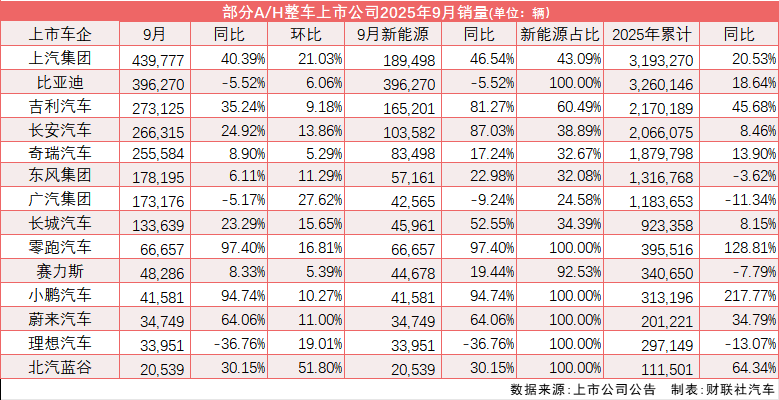
广汽集团9月汽车销量17.3万辆 环比增长27.6%
Zhong Zheng Wang· 2025-10-13 02:32
Core Viewpoint - GAC Group is experiencing significant sales growth and is actively expanding its global presence, particularly in the electric vehicle market and international markets, while enhancing its technological capabilities through partnerships. Group 1: Sales Performance - In September, GAC Group sold 173,000 vehicles, a month-on-month increase of 27.6%, with all brands showing positive growth [1] - From January to September, GAC Group exported 92,000 vehicles, with over 85,000 being self-owned brands, marking a year-on-year growth of 16.5% [2] - GAC Trumpchi sold 36,078 vehicles in September, a year-on-year increase of 3.8% and a month-on-month increase of 35.4% [1] - GAC Aion's September sales reached 29,113 vehicles, a month-on-month increase of 7.7%, with the AION V Home model contributing to a 256% increase in sales [1] - GAC Toyota's September sales were 71,220 vehicles, a month-on-month increase of 7.8%, while GAC Honda sold 32,808 vehicles, a month-on-month increase of 60.7% [1] Group 2: Global Expansion Strategy - GAC Group is focusing on "electrification leadership and localized deep cultivation" to drive global development [2] - The company plans to accelerate its entry into the European market, starting with Poland, Portugal, and Finland, aiming for full coverage by 2028 [2] - GAC is also expanding in Southeast Asia with a KD factory in Cambodia and a second locally assembled model in Malaysia, while entering three new countries in the Americas [2] Group 3: Technological Advancements - GAC is collaborating with Huawei to launch a high-end smart electric vehicle brand called "Qijing," integrating advanced smart technologies [3] - The company has expanded its self-operated charging network to cover 204 cities across 31 provinces, with over 20,000 charging piles and the largest number of 1000V fast charging piles among automakers [3] - GAC has established a comprehensive layout for vehicle-to-grid (V2G) services, creating the largest V2G demonstration project in the country [3]