
AGRICULTURAL BANK OF CHINA(601288)

Search documents
国开行、工行、农行、中行、建行、交行、邮储银行等迅速响应!
Jin Rong Shi Bao· 2025-12-26 04:46
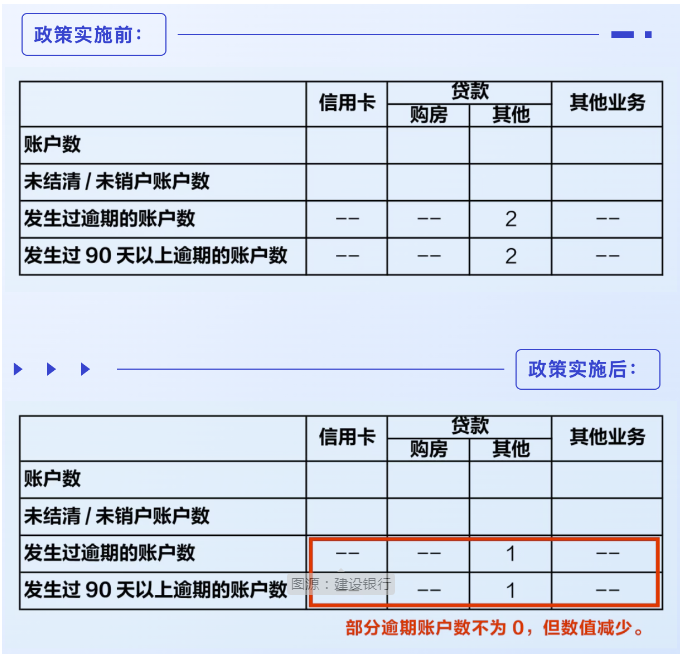
Core Viewpoint - The People's Bank of China has announced a one-time credit repair policy that allows individuals with overdue debts of up to 10,000 RMB to have their overdue information removed from the credit reporting system if they repay their debts in full by March 31, 2026 [1] Group 1: Policy Details - The policy applies to all types of personal credit, including credit cards, housing loans, and consumer loans, as long as they meet the specified conditions [1] - Individuals must fully repay overdue debts, including principal, interest, and penalties, and make timely payments for the current month to qualify for the credit repair [2] - The overdue information in credit reports will be adjusted, changing the repayment status from overdue to normal and the overdue amount from a non-zero value to zero [3][4] Group 2: Implementation and Support - Banks, including major institutions like Industrial and Commercial Bank of China and Agricultural Bank of China, are actively preparing to implement the policy and provide guidance to the public [6][7] - The central bank will offer an additional two free credit report inquiries in the first half of 2026 to accommodate increased demand for credit report checks following the policy implementation [5] - The policy is not to be viewed as a means of "credit washing," but rather as a special arrangement to address public concerns while maintaining the principle of punishing dishonesty [7]






全国省级首笔!农业银行银担“总对总”业务落地滨州
Qi Lu Wan Bao· 2025-12-26 02:38
Group 1 - Agricultural Bank of China (ABC) issued a working capital loan of 490,000 yuan to a local small micro enterprise, marking the first implementation of the "Government Guarantee e-Loan" business at the provincial level in China [1] - The "Government Guarantee e-Loan" is a collaborative product launched by the National Financing Guarantee Fund and ABC, utilizing a total-to-total cooperation model that enhances efficiency and reduces business risks through online operations [1] - The successful implementation in Shandong province is attributed to the collaboration between Shandong Investment and Financing Guarantee Group and ABC's Shandong branch, which established a direct connection system for seven municipal pilot institutions [1] Group 2 - Since 2025, Shandong Investment and Financing Guarantee Group and ABC's Shandong branch have deepened their cooperation, achieving a 127% year-on-year growth in cooperative business scale through various initiatives [1] - The next steps involve further enhancing multi-field cooperation, leveraging resources and professional advantages to provide more precise and efficient financial support for small micro enterprises and the agricultural sector in the province [2]
走在春天里的银行股
Shang Hai Zheng Quan Bao· 2025-12-25 18:50
Core Viewpoint - The banking sector is experiencing a valuation recovery, driven by increased dividends and stock price appreciation, despite still being in a state of deep undervaluation [1][2][4]. Group 1: Market Performance - Investors in bank stocks have seen significant gains this year, with some reporting stock values reaching 1.7 million yuan and benefiting from dividends [1]. - The banking sector index (Shenwan) has recorded a year-to-date increase of 6.35%, lagging behind the CSI 300 index by 11 percentage points, indicating a persistent undervaluation [1][2]. - Agricultural Bank of China has led the sector with a remarkable 50.7% increase in stock price this year, while Xiamen Bank also saw a substantial rise of 43.4% [2]. Group 2: Investment Trends - Long-term investors, including insurance funds and state-owned capital, are increasingly viewing bank stocks as a safe investment, contributing to a recovery in the banking sector [4]. - The trend of increasing dividends among banks is seen as a commitment to returning value to investors, with 37 A-share listed banks announcing mid-term dividends totaling 215.46 billion yuan [5][6]. - The implementation of mid-term dividends by banks, including a first for Industrial Bank, reflects a strategic move to attract stable long-term investments [6]. Group 3: Future Outlook - Analysts maintain an optimistic outlook for 2026, predicting a shift in the investment logic for bank stocks from merely defensive dividends to a combination of dividends and growth [7]. - The banking sector is expected to stabilize in terms of performance, with net interest margins projected to bottom out and begin to recover, contrasting with previous years of decline [7][8]. - The capital strength of major state-owned banks is being reinforced through new rounds of funding, enhancing their ability to support the real economy and manage risks effectively [8].

全国省级层面首笔农业银行“政担e贷”业务落地滨州
Xin Lang Cai Jing· 2025-12-25 17:23
Core Insights - The Agricultural Bank of China (ABC) in Binzhou successfully launched the first provincial-level "Government Guarantee e-Loan" business in collaboration with the Binzhou Financing Guarantee Group, marking a significant milestone in financial services for small and micro enterprises [1][3] - The total business cooperation scale between ABC Binzhou and the financing guarantee group has exceeded 1.4 billion yuan this year, leading the provincial Agricultural Bank system in business volume [1] Group 1 - The "Government Guarantee e-Loan" is a collaborative product launched by the National Financing Guarantee Fund and ABC, featuring a model of "active bank credit, multi-level government guarantee system for risk mitigation," and is processed entirely online, enhancing efficiency and risk control for small and micro enterprises [1] - The rapid implementation of this business is attributed to the prior system integration and collaborative efforts between the Shandong Investment and Financing Guarantee Group and ABC Shandong Branch [1] - A joint signing event for party building and promotion of the direct connection system was held on September 4, laying a solid foundation for the swift launch of the "Government Guarantee e-Loan" [1] Group 2 - The Binzhou Financing Guarantee Group was the first in the province to achieve a direct system connection with ABC, becoming a pilot unit for this initiative [2] - Future collaboration will focus on optimizing the guarantee service process and expanding the coverage of policy-based guarantee products, particularly in areas such as technological innovation and rural revitalization [2] - The aim is to provide more precise and efficient financial support for small and micro enterprises and the agricultural sector, contributing to the high-quality development of Binzhou's real economy [2]
农行广州分行:以数智化普惠金融“贷”动广州产业升级
Nan Fang Du Shi Bao· 2025-12-25 12:44
Core Insights - Guangzhou is focusing on building a "12218" modern industrial system to cultivate new productive forces and address the financing challenges faced by technology-oriented small and micro enterprises [2][5] Group 1: Mechanism Innovation - Agricultural Bank of China Guangzhou Branch recognizes the need for a systematic overhaul of traditional financial marketing and service models to meet the precise demands of industrial upgrades and changing customer bases [3] - The bank has elevated inclusive finance to a strategic level, aiming to provide targeted financial services to key sectors such as strategic emerging industries, technology enterprises, green economy, and private enterprises [5] Group 2: Data-Driven Solutions - The bank is leveraging technology and data to create a smart marketing service platform that addresses traditional bottlenecks in industry research and customer targeting [8] - By integrating various data sources, the bank constructs precise customer profiles to identify high-quality technology-oriented small and micro enterprises [10] Group 3: Service Extension - The bank's inclusive finance innovation extends beyond individual credit support to create a multi-win financial service ecosystem, focusing on supply chain finance to support small and micro enterprises [13] - A unique evaluation model has been developed to assess technology enterprises based on their growth potential rather than traditional financial metrics, facilitating smoother access to financing [15] Group 4: Performance and Future Outlook - As of October 2025, the bank's loans in key sectors exceeded 150.8 billion, 52.6 billion, 250.2 billion, and 257.7 billion respectively, demonstrating its commitment to supporting the real economy [5] - The bank's inclusive loan balance surpassed 90 billion, with a significant increase in the number of clients served, indicating a successful implementation of its inclusive finance strategies [16][17]
国有大型银行板块12月25日跌0.63%,农业银行领跌,主力资金净流出7.75亿元
Zheng Xing Xing Ye Ri Bao· 2025-12-25 09:03
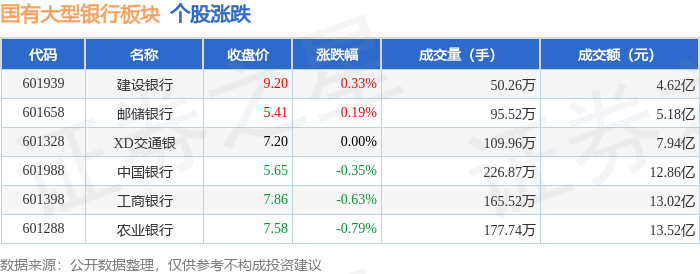
Group 1 - The core viewpoint of the news is that the state-owned large bank sector experienced a decline of 0.63% on December 25, with Agricultural Bank leading the drop [1] - The Shanghai Composite Index closed at 3959.62, up 0.47%, while the Shenzhen Component Index closed at 13531.41, up 0.33% [1] - The trading performance of individual stocks in the state-owned large bank sector showed mixed results, with Agricultural Bank down 0.79% and Industrial and Commercial Bank down 0.63% [1] Group 2 - The net outflow of main funds from the state-owned large bank sector was 775 million yuan, while retail investors saw a net inflow of 515 million yuan [1] - The detailed fund flow data indicates that Construction Bank had a net inflow of 49.54 million yuan from main funds, while Agricultural Bank had a net outflow of 289.7 million yuan [2] - The overall trend shows that retail investors are more active in the state-owned large bank sector, with significant net inflows compared to the outflows from main and speculative funds [2]
商业银行“出海”验成色:中行领跑,谁在悄然发力?
2 1 Shi Ji Jing Ji Bao Dao· 2025-12-25 08:34
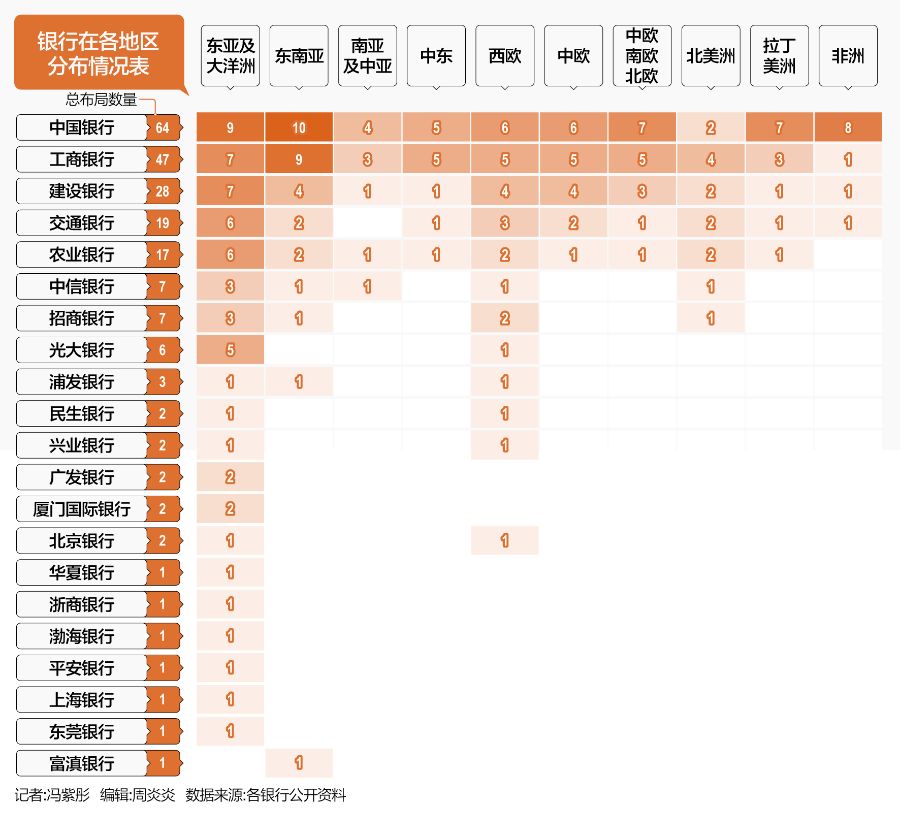
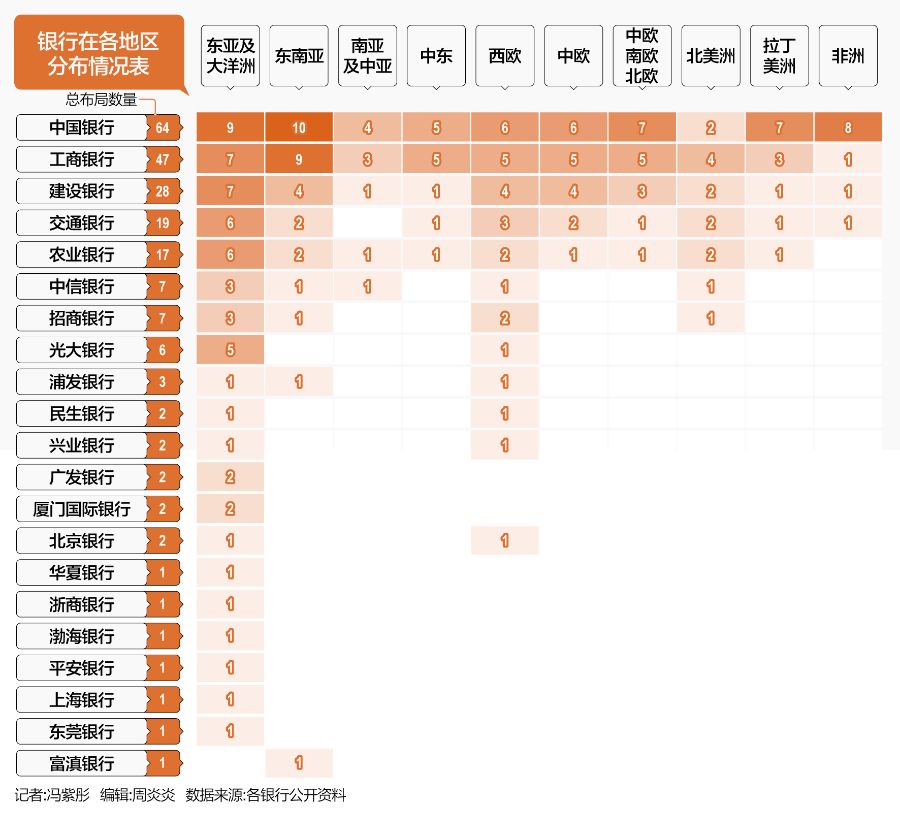
Core Insights - Chinese banks are expanding their overseas presence, establishing a comprehensive service network that covers major financial centers globally and key regions along the Belt and Road Initiative [1][4] - The internationalization strategy of Chinese banks has shifted from focusing primarily on traditional markets in Europe and the US to emerging markets in Southeast Asia, the Middle East, Latin America, and countries involved in the Belt and Road Initiative [1][9] Group 1: Overseas Expansion Strategies - Chinese banks utilize three main forms for overseas expansion: representative offices, branches, and subsidiaries, with larger banks often establishing branches or subsidiaries in mature markets and starting with representative offices in emerging markets [2][4] - The distribution of overseas institutions varies among banks, with a notable focus on new emerging markets and developing countries [2][4] Group 2: Performance of Major Banks - Bank of China leads in global presence with 539 overseas branches in 64 countries, including 45 countries involved in the Belt and Road Initiative, and has a strong focus on enhancing its competitive edge in Southeast Asia [4][12] - Industrial and Commercial Bank of China has 413 overseas institutions in 49 countries, with a significant presence in 30 Belt and Road countries, showcasing a flexible internationalization strategy [4][12] - Agricultural Bank of China has established 13 branches and 4 representative offices, focusing on supporting high-quality Belt and Road initiatives [4][12] Group 3: Revenue Growth and Performance Metrics - In the first half of 2025, Bank of China reported overseas revenue of 783.13 billion yuan, a 14.4% increase from the previous year, with overseas revenue accounting for 23.77% of total revenue [11][12] - Agricultural Bank of China achieved a 21.03% increase in overseas revenue, while Construction Bank's overseas revenue grew by 40.92%, indicating strong expansion momentum [12][14] - Shanghai Pudong Development Bank's overseas revenue surged by 119.37%, marking a significant growth and highlighting the effectiveness of its international strategy [14] Group 4: Challenges and Market Dynamics - Chinese banks face regulatory challenges in overseas markets, including compliance with both domestic and foreign regulations, which can lead to significant penalties [15][19] - The demand from Chinese enterprises for overseas financial services is evolving, with a shift towards more complex needs such as global treasury management and cross-border mergers and acquisitions [16][17] - Small and medium-sized enterprises are becoming a key growth driver for overseas financial services, emphasizing the need for lower financing thresholds and cost-effective payment solutions [16][17] Group 5: Future Directions and Strategic Focus - The future competitiveness of Chinese banks in international markets will depend on enhancing global collaboration, improving localization capabilities, and strengthening compliance risk management [18][19] - Emphasis on financial technology innovation and the development of cross-border digital infrastructure will be crucial for expanding their international footprint [19]


深度丨商业银行“出海”验成色:中行领跑,谁在悄然发力?
2 1 Shi Ji Jing Ji Bao Dao· 2025-12-25 08:32
Core Insights - Chinese banks are expanding their overseas presence, establishing a comprehensive service network that covers major financial centers globally and key regions along the Belt and Road Initiative [1][2] - The internationalization strategy of Chinese banks has shifted from traditional markets in Europe and the US to emerging markets in Southeast Asia, the Middle East, Latin America, and countries involved in the Belt and Road Initiative [1][2] Group 1: Global Expansion Strategy - Chinese banks are utilizing representative offices, branches, and subsidiaries for overseas expansion, with larger banks often establishing branches in mature markets and starting with representative offices in emerging markets [2] - The distribution of overseas institutions shows that major state-owned banks are leading the expansion, with a focus on both traditional and emerging markets [2][4] Group 2: Performance Metrics - As of June 2025, Bank of China leads with 539 overseas branches in 64 countries, including 45 Belt and Road countries, showcasing its extensive global network [4] - Industrial and Commercial Bank of China follows with 413 overseas institutions in 49 countries, including 250 in Belt and Road countries, demonstrating a flexible international strategy [4] - Agricultural Bank of China has established 13 branches and 4 representative offices, focusing on supporting high-quality Belt and Road initiatives [4] Group 3: Revenue Growth and Market Dynamics - In the first half of 2025, Bank of China reported overseas revenue of 783.13 billion yuan, a 14.4% increase from the previous year, with overseas revenue accounting for 23.77% of total revenue [12] - Industrial and Commercial Bank of China's overseas revenue was 562.52 billion yuan, showing a slight decline of 1.88%, while Agricultural Bank of China experienced a 21.03% increase [12][11] - The growth of overseas revenue among joint-stock banks, such as Shanghai Pudong Development Bank, which saw a 119.37% increase, highlights the varying performance across banks [14] Group 4: Challenges and Future Directions - Chinese banks face regulatory challenges in overseas markets, including compliance with both domestic and foreign regulations, which can lead to significant penalties [15] - The demand for diversified financial services is evolving, with a shift from traditional trade financing to more complex needs such as global treasury management and cross-border mergers [16] - Future competitiveness will depend on enhancing global collaboration, local operational capabilities, compliance risk management, and financial technology innovation [18][19]
国企红利ETF(159515)盘中涨0.26%,政策与资金聚焦高股息防御资产
Sou Hu Cai Jing· 2025-12-25 05:46
Core Insights - The China Securities State-Owned Enterprises Dividend Index has shown a slight increase of 0.08% as of December 25, 2025, with notable gains in constituent stocks such as Xiamen International Trade (up 4.44%) and Luxi Chemical (up 3.30%) [1] - The National State-Owned Enterprises Dividend ETF (159515) has also increased by 0.26%, reflecting a growing interest in dividend-paying assets amid a favorable monetary policy environment [1][2] Market Performance - The trading volume for the National State-Owned Enterprises Dividend ETF reached 2.91% turnover with a transaction value of 1.489 million yuan, and the average daily trading volume over the past week was 4.2193 million yuan [1] - The latest scale of the National State-Owned Enterprises Dividend ETF stands at 51.0433 million yuan, with a total of 44.7866 million shares [1] Policy and Economic Environment - The People's Bank of China has reiterated its commitment to maintaining a moderately loose monetary policy, which is expected to positively influence market sentiment [1] - The decline in the risk-free interest rate is expected to enhance the attractiveness of dividend assets, supported by ongoing policy improvements aimed at strengthening the quality and market capitalization management of listed companies [2] Investment Outlook - According to Kaiyuan Securities, the performance of dividend stocks is anticipated to outperform in 2026 compared to 2025, driven by improved relative valuations, easing pressure on cyclical earnings, and a shift in funding preferences towards high-dividend assets [2] - The National State-Owned Enterprises Dividend Index reflects the overall performance of high-dividend securities selected from state-owned enterprises, focusing on those with stable dividends and significant liquidity [2][3]


农业银行发布2025年底和2026年债市宝业务节假日休市安排通知
Jin Tou Wang· 2025-12-25 03:59
Summary of Key Points Core Viewpoint - The announcement by Agricultural Bank of China outlines the holiday market closure schedule for the bond market in 2026, as per the State Council's notification regarding holiday arrangements. Group 1: New Year Holiday - The bond market will be closed for four days from December 31, 2025, to January 3, 2026, and will resume normal operations on January 4, 2026 [1] Group 2: Spring Festival - The market will be closed for ten days from February 14 to February 23, 2026, with normal operations resuming on February 28, 2026 [2] Group 3: Qingming Festival - The bond market will be closed for four days from April 3 to April 6, 2026 [3] Group 4: Labor Day - The market will be closed for six days from April 30 to May 5, 2026, and will resume normal operations on May 9, 2026 [4] Group 5: Dragon Boat Festival - The bond market will be closed for four days from June 18 to June 21, 2026 [5] Group 6: Mid-Autumn Festival - The market will be closed for four days from September 24 to September 27, 2026 [6] Group 7: National Day - The bond market will be closed for eight days from September 30 to October 7, 2026, with normal operations on September 20 and October 10, 2026 [7]